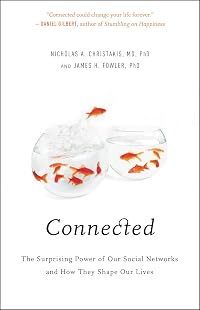
Connected: The Surprising Power of Our Social Networks and How They Shape Our Lives
by Nicholas A. Christakis, James H. Fowler
On This Page
Description
Renowned scientists Christakis and Fowler present compelling evidence for the profound influence people have on one another's tastes, health, wealth, happiness, beliefs, even weight, as they explain how social networks form and how they operate.Tags
Recommendations




Member Reviews
You might have seen reporting on the phenomenon that weight gain seems to be contagious: having friends gain weight makes it more likely that you will, too, and this is even true if friends of your friends gain weight. A lot of other things work like this, to the third degree but no further, and Christakis & Fowler have some interesting stories to tell about how this affects both individuals and societies—it has implications for the spread of STDs as well as for the rationality of voting (your vote may not make any difference, but if you vote your friends are more likely to vote, as are their friends, and if birds of an ideological feather flock together then your vote can be part of a cascade that does make a difference). It’s an show more interesting read. show less
Overall this is a book worth reading. It provides genuinely interesting insights with potentially far reaching implications for society and arguably for each of us as individuals. In my mind it's worth considering the world through this lens.
The book is made of many examples of studies which show how social networks work, how we influence each other, how ideas are spread, how that links to how diseases are spread and so on.
Some of the conclusions from these studies are in line with what one would expect, but most other small or greater insights into networks that I think most of us wouldn't have considered. One of the primary assertions of the book is that we influence and are influenced by people we don't know (friends of friends). show more There is a lot of exploration of the importance of networks to human beings, generally we sacrifice some independence to cooperate with others for our protection and well being. Also challenged is the traditional economist view of self-interest as opposed to altruism. The point being, again, that we value relationships with others beyond what is economically in our interests. The idea that we give to others purely in the anticipation of a favour returned is challenged as not representing the whole picture of what motivates us.
The weakness of the book is mainly its structure. The series of ideas and the studies that support them feel more like a collections of themed thoughts than a progressive series of arguments and evidence that lead to an undeniable conclusion. That said, still an interesting read. show less
The book is made of many examples of studies which show how social networks work, how we influence each other, how ideas are spread, how that links to how diseases are spread and so on.
Some of the conclusions from these studies are in line with what one would expect, but most other small or greater insights into networks that I think most of us wouldn't have considered. One of the primary assertions of the book is that we influence and are influenced by people we don't know (friends of friends). show more There is a lot of exploration of the importance of networks to human beings, generally we sacrifice some independence to cooperate with others for our protection and well being. Also challenged is the traditional economist view of self-interest as opposed to altruism. The point being, again, that we value relationships with others beyond what is economically in our interests. The idea that we give to others purely in the anticipation of a favour returned is challenged as not representing the whole picture of what motivates us.
The weakness of the book is mainly its structure. The series of ideas and the studies that support them feel more like a collections of themed thoughts than a progressive series of arguments and evidence that lead to an undeniable conclusion. That said, still an interesting read. show less
This book had some great information packed inside of a repetitive package that wasn't very sticky.
Once you picked up the key ideas, most of the conclusions followed in a fairly obvious manner. The key ideas or, at least, the ones that I remember, were:
- Network influence tends to travel three degrees before shrinking to statistical insignificance. You influence your friends, friends' friends, and friends' friends' friends, and they influence you back. The strength of influence decreases with each separation, but the number of people influenced increases.
- Network effects are real. They persist even once researchers account for other sources of similarity in the network such as homophily (the tendency for like to be connected to like) show more and common external factors (people near each other in the network may share experiences).
Everything travels across the network -- ideas, emotional state, behavior, disease, etc. -- and because of the three degrees of influence rule, you only have limited control over what you are exposed to and who you can influence.
- Not all network ties are equal (weak ties and strong ties). The most important information tends to come from ties that are distant or weak. This is because you have a pretty good idea of the information held by those connected with close, strong ties. For example, people tend to find jobs and relationship opportunities through distant or weak ties because they have generally already evaluated the opportunities presented by their strong, close ties. Distance brings information that you have not already incorporated.
Once you know these principles, much of the rest of the book becomes fairly straightforward.
The authors did present some compelling information in their discussion of the internet. Based on studies that they and others have done, they concluded that relationships on the internet tend to be largely the same as traditional relationships. The mix may have changed (more weak ties, perhaps) and the means of network maintenance have certainly changed, but, for better and worse, people are still largely the same creatures.
Overall, I am glad that I read this book. The information was interesting even if the presentation was less than gripping. The information in the book consisted almost exclusively of real studies, so the conclusions seem well founded, even if not surprising. show less
Once you picked up the key ideas, most of the conclusions followed in a fairly obvious manner. The key ideas or, at least, the ones that I remember, were:
- Network influence tends to travel three degrees before shrinking to statistical insignificance. You influence your friends, friends' friends, and friends' friends' friends, and they influence you back. The strength of influence decreases with each separation, but the number of people influenced increases.
- Network effects are real. They persist even once researchers account for other sources of similarity in the network such as homophily (the tendency for like to be connected to like) show more and common external factors (people near each other in the network may share experiences).
Everything travels across the network -- ideas, emotional state, behavior, disease, etc. -- and because of the three degrees of influence rule, you only have limited control over what you are exposed to and who you can influence.
- Not all network ties are equal (weak ties and strong ties). The most important information tends to come from ties that are distant or weak. This is because you have a pretty good idea of the information held by those connected with close, strong ties. For example, people tend to find jobs and relationship opportunities through distant or weak ties because they have generally already evaluated the opportunities presented by their strong, close ties. Distance brings information that you have not already incorporated.
Once you know these principles, much of the rest of the book becomes fairly straightforward.
The authors did present some compelling information in their discussion of the internet. Based on studies that they and others have done, they concluded that relationships on the internet tend to be largely the same as traditional relationships. The mix may have changed (more weak ties, perhaps) and the means of network maintenance have certainly changed, but, for better and worse, people are still largely the same creatures.
Overall, I am glad that I read this book. The information was interesting even if the presentation was less than gripping. The information in the book consisted almost exclusively of real studies, so the conclusions seem well founded, even if not surprising. show less
What happens to my friends, my friends' friends and my friends' friends' friends when I finish my review about this books which is about social networks? What happens when I say I recommend this book and state this on some social networking / social reading site? Can I affect 10 people? Can they affect 100 people in total? And can those 100 people affect about 1000 people? And what about simpler things such as my eating habits? Does my weight and lifestyle affect a much bigger circle of people than I thought? What about voting? Everybody knows that a single vote nearly never changes anything and rationally, economically I should not vote. But I do? Am I irrational or am I simply acting according to the hidden laws of social show more networks?
You'll find many answers in this thought-provoking book. You'll ask lots of questions, too. And you'll never view your circle of friends with the same perspective again.
The last 40-50 pages of the book seems a little bit out of focus, jumpîng from subject to subject without providing much context and connection but taking these imperfections into account I can still say this is one of the books that deserves to be categorized as "food for thought". I have marked lots of pages and references for further reading and pursuing a better understanding of why we do what we do. show less
You'll find many answers in this thought-provoking book. You'll ask lots of questions, too. And you'll never view your circle of friends with the same perspective again.
The last 40-50 pages of the book seems a little bit out of focus, jumpîng from subject to subject without providing much context and connection but taking these imperfections into account I can still say this is one of the books that deserves to be categorized as "food for thought". I have marked lots of pages and references for further reading and pursuing a better understanding of why we do what we do. show less
Social networking takes up a big portion of our time, as a way to remain connected to what’s happening in our social circles, keeping up with friends and sharing what we are doing and thinking with others. According to Nicholas A. Christakis and James H. Fowler, the authors of Connected, our social networking has a much deeper effect on our lives, which many of us may not be aware of.
Nicholas Christakis and James H. Fowler are both professors at Harvard University who have broken down the complexity of social networks and the virtual world that we are becoming more involved in as one of the most complicated and consequential networks in the universe.
Connected is more than another research study; the reader doesn’t get showered with show more numbers and statistics, and while those elements are important in the academic business, they often get ignored by the average reader. Charts and diagrams are still present in the book; but they act as convincing tools that aren’t at all boring.
The authors also use stories, some are real-life examples from the present and others from cultural backgrounds and folklore, proving that the idea of social networks isn’t at all a novelty of the new world; in their wider sense, social networks have existed since the beginning of time.
However, this reviewer felt Connected to be exaggerating in certain parts. Maybe it’s how the authors go to great lengths to explain how someone’s suicide can inspire the son of his friend’s friend to think of doing the same, or how your mom’s best friend’s husband's weight gain can result in your own weight gain. Although they have research study results to back up their claims, when applied to our actual personal lives, it’s easy to feel sceptical.
Connected dives into the nature of human beings and argues that our behaviour depends to a certain degree on that of others surrounding us, or even on the people around those surrounding us.
Connected is a good read that gives interesting insight without being too heavy. It may or may not have you look at your relationships in a new light and question if you’ve been unconsciously influenced by people in your social network. Nonetheless, it’s an informative and entertaining read.
By Salma Tantawi; Writer for http://www.Cairo360.com show less
Nicholas Christakis and James H. Fowler are both professors at Harvard University who have broken down the complexity of social networks and the virtual world that we are becoming more involved in as one of the most complicated and consequential networks in the universe.
Connected is more than another research study; the reader doesn’t get showered with show more numbers and statistics, and while those elements are important in the academic business, they often get ignored by the average reader. Charts and diagrams are still present in the book; but they act as convincing tools that aren’t at all boring.
The authors also use stories, some are real-life examples from the present and others from cultural backgrounds and folklore, proving that the idea of social networks isn’t at all a novelty of the new world; in their wider sense, social networks have existed since the beginning of time.
However, this reviewer felt Connected to be exaggerating in certain parts. Maybe it’s how the authors go to great lengths to explain how someone’s suicide can inspire the son of his friend’s friend to think of doing the same, or how your mom’s best friend’s husband's weight gain can result in your own weight gain. Although they have research study results to back up their claims, when applied to our actual personal lives, it’s easy to feel sceptical.
Connected dives into the nature of human beings and argues that our behaviour depends to a certain degree on that of others surrounding us, or even on the people around those surrounding us.
Connected is a good read that gives interesting insight without being too heavy. It may or may not have you look at your relationships in a new light and question if you’ve been unconsciously influenced by people in your social network. Nonetheless, it’s an informative and entertaining read.
By Salma Tantawi; Writer for http://www.Cairo360.com show less
I had a hard time grading this book, as I had a bit of a love-hate relationship with it. The subject matter fits in great with the other memetics and social networking books I've been reading, but at times I found myself very disengaged from the reading and my mind wandering. This made the read much harder ... until the last few chapters. I had initially selected this book as I expected a lot of discussion on social media and the impact of the internet on human networks, and the author really waited a little too long to get around to it. That being said, I really enjoyed the last few chapters and am glad I made it through. Worth the read if you're into this sort of thing.
A nice overview of research on social networks and how they affect the patterns and dynamics of the distribution of a huge variety of things, such as infectious disease, smoking and voting practices. It also looks at the effects of technology (particularly email and social-networking sites) on our networks. It's pretty light on the maths but explains core concepts clearly and with a lot of diagrams, and has a ton of citations to papers, books and newspaper articles should you wish to dig deeper into any of the topics covered.
Members
- Recently Added By
Lists

Books Cited in Blueprint by Nicholas Christakis
261 works; 1 member
Author Information
5+ Works 1,557 Members
Nicholas A. Christakis is a physician and sociologist who explores the ancient origins and modern implications of human nature. He directs the Human Nature Lab at Yale University, where he is the Sterling Professor of Social and Natural Science in the departments of Sociology, Medicine, Ecology and Evolutionary Biology, Statistics and Data show more Science, and Biomedical Engineering. He is the co-director of the Yale Institute for Network Science and the coauthor of Connected. show less
3 Works 811 Members
Awards and Honors
Awards
Notable Lists
Classifications
- Genres
- Sociology, Nonfiction, Technology, General Nonfiction, Science & Nature
- DDC/MDS
- 302.3 — Society, government, & culture Social sciences, sociology & anthropology Mass Communication & Media Social interaction within groups
- LCC
- HM741 .C46 — Social sciences Sociology (General) Sociology Groups and organizations
- BISAC
Statistics
- Members
- 804
- Popularity
- 34,536
- Reviews
- 20
- Rating
- (3.73)
- Languages
- 9 — Dutch, English, German, Hungarian, Polish, Portuguese, Romanian, Spanish, Swedish
- Media
- Paper, Audiobook, Ebook
- ISBNs
- 23
- ASINs
- 11