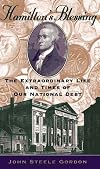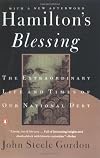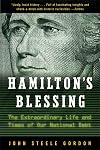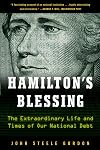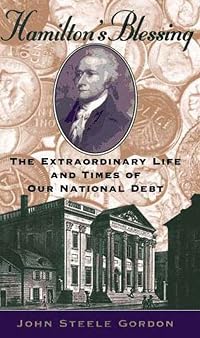
Hamilton's Blessing: The Extraordinary Life and Times of Our National Debt
by John Steele Gordon
On This Page
Description
From Alexander Hamilton's solution in the late eighteenth century through war bonds, the location of the nation's capital, why the Stock Exchange quotes fractional prices in eighths, and Keynesian economics to such people as Stephen Girard, Jay Cooke, and Benjamin Strong.Tags
Recommendations


















Member Reviews
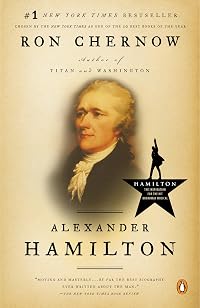
Most of us only know Alexander Hamilton as the man whose face graces our ten dollar bills. Or, perhaps we know him as the unfortunate answer to the Jeopardy question: “Who was on the wrong end of a duel with Aaron Burr?” That is too bad because, as this fascinating book makes clear, he really should be most famous for being the architect of the United States’ first set of economic policies in his role as the country’s Secretary of the Treasury. In particular, it was Hamilton who crafted a system of issuing debt at a federal level to replace the less efficient method of relying on the states to serve that role.
Hamilton’s Blessing is not really the story of any one man though; rather, it is the history of how America’s show more national debt developed and has changed over the past two centuries. If that sounds like a dull, painful reading experience, rest assured that it is not. In the hands of a talented historian like Gordon, this is a lively tale replete with myriad accounts of visionary economic insights as well as catastrophic political blunders. A key focus of the narrative is how the collective attitude in the United States regarding the act of borrowing money to pay our bills, which has been both the blessing that Hamilton promised and the curse that many others predicted, has evolved over time.
Today, things like income and inheritance taxes, the existence of a central bank, and a federal government that borrows more than it can ever hope (or intend) to repay are taken as given. However, these are relatively recent developments; a tax on personal income in the United States was introduced to help pay for the Civil War and only became a permanent fixture shortly before World War I. Also, for the country’s first 150 years, lawmakers followed Adam Smith’s prescription of paying back in good times what we needed to borrow strategically in the bad (e.g., wars, economic depressions). Starting in the 1940s, however, that attitude changed dramatically as John Maynard Keynes’ theory of managing the economy with active deficits began to take hold. That path, justified by the belief that the old pay-as-you-go mentality is irrelevant because “we are just borrowing from ourselves,” is the one we are still on today.
It has been said that there is no such thing as a pure economy—only political economies exist. The author emphasizes this point by noting that, removed from the discipline of having to balance the national budget, the last several generations of politicians have lacked the resolve to fix our convoluted tax system or cut federal spending at appropriate times. As a consequence, the national debt has now reached levels that would be incomprehensible to someone living just 50 years ago. While it is occasionally number-heavy and a little dated, this book provides the reader with both a superb historical context and sobering vision of our economic future. show less
Hamilton’s Blessing is not really the story of any one man though; rather, it is the history of how America’s show more national debt developed and has changed over the past two centuries. If that sounds like a dull, painful reading experience, rest assured that it is not. In the hands of a talented historian like Gordon, this is a lively tale replete with myriad accounts of visionary economic insights as well as catastrophic political blunders. A key focus of the narrative is how the collective attitude in the United States regarding the act of borrowing money to pay our bills, which has been both the blessing that Hamilton promised and the curse that many others predicted, has evolved over time.
Today, things like income and inheritance taxes, the existence of a central bank, and a federal government that borrows more than it can ever hope (or intend) to repay are taken as given. However, these are relatively recent developments; a tax on personal income in the United States was introduced to help pay for the Civil War and only became a permanent fixture shortly before World War I. Also, for the country’s first 150 years, lawmakers followed Adam Smith’s prescription of paying back in good times what we needed to borrow strategically in the bad (e.g., wars, economic depressions). Starting in the 1940s, however, that attitude changed dramatically as John Maynard Keynes’ theory of managing the economy with active deficits began to take hold. That path, justified by the belief that the old pay-as-you-go mentality is irrelevant because “we are just borrowing from ourselves,” is the one we are still on today.
It has been said that there is no such thing as a pure economy—only political economies exist. The author emphasizes this point by noting that, removed from the discipline of having to balance the national budget, the last several generations of politicians have lacked the resolve to fix our convoluted tax system or cut federal spending at appropriate times. As a consequence, the national debt has now reached levels that would be incomprehensible to someone living just 50 years ago. While it is occasionally number-heavy and a little dated, this book provides the reader with both a superb historical context and sobering vision of our economic future. show less
Hamilton, Alexander (Subject)
Ratings
Members
- Recently Added By
Published Reviews
ThingScore 100
I am partial to small books: despite size, most have a message. To those of the same mind, I recommend adding John Steele Gordon's book Hamilton's Blessing to their list. It is a serious effort to explain evolving views on the country's national debt that is worthy of the time devoted to its reading. Dealing with what some might say is a great idea gone awry, it is an excellent, readable, and show more eminently understandable chronology of what happened, what went wrong and, in the author's view, why with respect to our national debt... show less
added by amorabunda
History in the hands of a deft historian can be really delicious, even if it is about economics. "Hamilton's Blessing" is John Steele Gordon's history of our national debt, stretching from its inception during George Washington's presidency up to the modern day.
The national debt was the brainchild of Alexander Hamilton, the first secretary of the U.S. Treasury. Hamilton saw the national debt show more as a way to absorb the debts incurred by the individual states during the Revolutionary War, and also as a device for creating capital for the new nation's growing industries. show less
The national debt was the brainchild of Alexander Hamilton, the first secretary of the U.S. Treasury. Hamilton saw the national debt show more as a way to absorb the debts incurred by the individual states during the Revolutionary War, and also as a device for creating capital for the new nation's growing industries. show less
added by amorabunda
At the opening of his useful new book, ''Hamilton's Blessing: The Extraordinary Life and Times of Our National Debt,'' John Steele Gordon drops what at first seems an encouraging tidbit of news. The present national debt of more than $5 trillion is certainly ''incomprehensible to the average American,'' he admits. ''For the record,'' he writes, ''laid out in silver dollars, it would be about show more 120 million miles long, wrapping around the equator 5,000 times.''
However, ''considered as a percentage either of gross domestic product (usually called G.D.P., it is the sum of the goods and services produced within our borders) or of Federal revenues,'' our debt ''is nowhere near as high as was the British national debt in 1819, the year Queen Victoria was born and when Britain was, in the words of the late historian Cecil Woodham-Smith, 'within sight of the heights of power and of wealth from which it was, briefly, to dominate the world.' '' show less
However, ''considered as a percentage either of gross domestic product (usually called G.D.P., it is the sum of the goods and services produced within our borders) or of Federal revenues,'' our debt ''is nowhere near as high as was the British national debt in 1819, the year Queen Victoria was born and when Britain was, in the words of the late historian Cecil Woodham-Smith, 'within sight of the heights of power and of wealth from which it was, briefly, to dominate the world.' '' show less
added by amorabunda
Author Information

8+ Works 1,648 Members
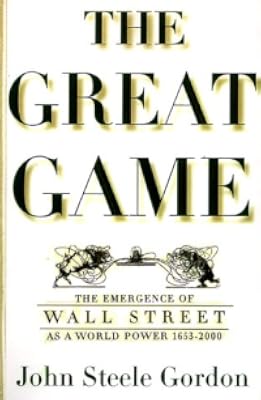
John Steele Gordon is the acclaimed author of An Empire of Wealth and The Great Game. He is a frequent contributor to the Wall Street Journal and can be heard often on American Public Media's Marketplace.
Common Knowledge
- Canonical title
- Hamilton's Blessing: The Extraordinary Life and Times of Our National Debt
- Original title
- Hamilton's Blessing: The Extraordinary Life and Times of Our National Debt
- Original publication date
- 1997
- People/Characters
- Alexander Hamilton
- Dedication
- To Eleanora Gordon Baird, to whom I am much indebted, with love
- First words
- In 1790, a British journalist, searching for a way to bring home to his readers the size of his country's national debt, seized upon an image that has a distinctly modern ring to it. The debt, he wrote, is of "a sum which the... (show all) human mind can hardly form an impression. Were it to be laid down in guineas in a line, it would extend upwards of four thousand three hundred miles in length."
- Last words
- (Click to show. Warning: May contain spoilers.)The fight for rules that will ensure that politicians spend money only in the people's interests, not in their own, will in all likelihood take quite as long to develop and enact. There will be a lot of political blood on the floor before the fight is over. But I have no doubt that in the long run the people's interests will prevail. For that is why democracy endures.
Classifications
- Genres
- Economics, Nonfiction, History, General Nonfiction, Business, Politics and Government
- DDC/MDS
- 336.3 — Society, government, & culture Economics Economic Development - Taxes Loans; Public securities
- LCC
- HJ8101 .G67 — Social sciences Public finance Public finance Public debts By region or country
- BISAC
Statistics
- Members
- 195
- Popularity
- 168,636
- Reviews
- 2
- Rating
- (3.84)
- Languages
- English
- Media
- Paper, Ebook
- ISBNs
- 5
- ASINs
- 3