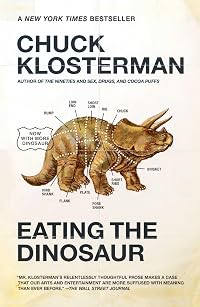
Eating the Dinosaur
by Chuck Klosterman
On This Page
Description
The best-selling author of Downtown Owl and Sex, Drugs, and Cocoa Puffs takes a humorous look at expectations versus reality in pop culture, sports, and media, in a book that explores such questions as: Why is pop culture obsessed with time travel?; What do Kurt Cobain and David Koresh have in common?; and much more.Tags
Recommendations




















Member Recommendations

Member Reviews
If you've ever wondered what makes Klosterman's books so compelling, the secret is out: he's honest. In a culture so obsessed with following trends and enjoying things because we're told to, Klosterman is honest with what he likes and dislikes. That is what makes this collection of essays so compelling.
He covers a lot of ground here: Garth Brooks, Time Travel, Abba, Football, Technology, and the list goes on. He has an ability to compare two seemingly unrelated things to unearth profound connections. I'll never think about David Koresh without the flannel-clad image of Kurt Cobain in the back of my head again!
The last essay clinched the collection for me. He confessed his belief that technology is degrading our relationships, along with show more his inability to resist its pull. I'm typing this review on a Dell laptop in a Wordpress interface that will automatically publish it in a month or so. Touché, Klosterman, touché. show less
He covers a lot of ground here: Garth Brooks, Time Travel, Abba, Football, Technology, and the list goes on. He has an ability to compare two seemingly unrelated things to unearth profound connections. I'll never think about David Koresh without the flannel-clad image of Kurt Cobain in the back of my head again!
The last essay clinched the collection for me. He confessed his belief that technology is degrading our relationships, along with show more his inability to resist its pull. I'm typing this review on a Dell laptop in a Wordpress interface that will automatically publish it in a month or so. Touché, Klosterman, touché. show less
This year I decided that I would make a resolution to read more essays because it is a genre in which I am completely lacking. It is for this reason that I picked up Eating the Dinosaur by Chuck Klosterman. I had read “Sex, Drugs, and Cocoa Puffs” when it was first published and found it rather lacking. While many reviewers found his essays to be insightful and hilarious, I found them to be littered with swears and tangential to his established thesis. Therefore, it was with great trepidation that I started this book but once I did I could not put it down! I suddenly discovered everything that reviewers had written years ago.
Basically, Klosterman has written Freakonomics for pop culture. He tackles football, basketball, Kurt Cobain, show more Weezer, Ralph Nader, and Don Draper all in hardcover. Perhaps the greatest testament to his book is that since reading his essays I have rethought my dislike for Kurt Cobain and all things Nirvana. On my top ten list of pop icons that I host a strong aversion to, Steven Speilberg tops off the list but Kurt Cobain comes in as a close second. However, Klosterman has made me feel compassion and understanding for Cobain. Though I still hate his music and find his fans to be some of the most obnoxious people since Jaws fans, I can now appreciate what he did for music and his role in the 1990s.
Only Klosterman can do this! He has the ability to take pop culture icons and intellectualize them which allows people who feel alienated from their generation (such as myself) to think twice about casting aside Brangelina and The Hills as insipid and unworthy of attention. It is with the perfect mixture of insight, cynicism, sarcasm, and humor that makes Klosterman one of the greatest essayists of our time.
www.iamliteraryaddicted.blogspot.com show less
Basically, Klosterman has written Freakonomics for pop culture. He tackles football, basketball, Kurt Cobain, show more Weezer, Ralph Nader, and Don Draper all in hardcover. Perhaps the greatest testament to his book is that since reading his essays I have rethought my dislike for Kurt Cobain and all things Nirvana. On my top ten list of pop icons that I host a strong aversion to, Steven Speilberg tops off the list but Kurt Cobain comes in as a close second. However, Klosterman has made me feel compassion and understanding for Cobain. Though I still hate his music and find his fans to be some of the most obnoxious people since Jaws fans, I can now appreciate what he did for music and his role in the 1990s.
Only Klosterman can do this! He has the ability to take pop culture icons and intellectualize them which allows people who feel alienated from their generation (such as myself) to think twice about casting aside Brangelina and The Hills as insipid and unworthy of attention. It is with the perfect mixture of insight, cynicism, sarcasm, and humor that makes Klosterman one of the greatest essayists of our time.
www.iamliteraryaddicted.blogspot.com show less
Reviewed by Mr. Overeem (Language Arts)
I have read many of Klosterman's books and liked them all. The five stars I've given this one were EARNED; 70-80 pages in I was hating it (he seemed too clever and wonky for his own good). Now, however, I think it's his best essay collection because it's his most unified: each piece grapples with the difficulty we have seeing reality in a media-drenched world. Along the way, Klosterman will force the reader to consider all the ethical dilemmas of time travel; the essentially liberal and progressive nature of football (I didn't stutter); what we are really looking for when we look in our neighbors' windows; why Garth Brooks' "Chris Gaines" experiment was the most fascinating thing he's ever done; show more why the Unabomber's manifesto might be essential reading; why ABBA is relevant (by being supremely irrelevant); what the popularity of MAD MEN reveals about our desire to be tricked; and (this isn't a comprehensive list of subjects, I just have other things to do) the kinship of Kurt Cobain and David Koresh. Needless to say, provocative stuff! show less
I have read many of Klosterman's books and liked them all. The five stars I've given this one were EARNED; 70-80 pages in I was hating it (he seemed too clever and wonky for his own good). Now, however, I think it's his best essay collection because it's his most unified: each piece grapples with the difficulty we have seeing reality in a media-drenched world. Along the way, Klosterman will force the reader to consider all the ethical dilemmas of time travel; the essentially liberal and progressive nature of football (I didn't stutter); what we are really looking for when we look in our neighbors' windows; why Garth Brooks' "Chris Gaines" experiment was the most fascinating thing he's ever done; show more why the Unabomber's manifesto might be essential reading; why ABBA is relevant (by being supremely irrelevant); what the popularity of MAD MEN reveals about our desire to be tricked; and (this isn't a comprehensive list of subjects, I just have other things to do) the kinship of Kurt Cobain and David Koresh. Needless to say, provocative stuff! show less
This is normally not the sort of thing I'd read, but this was a Little Free Library find, and the cover caught my eye. The book itself was sadly lacking in dinosaurs though. It's a collection of various essays by the author, covering different things like tv shows, music, sports, and a few other subjects. I found some of his observations to be thought-provoking, and as I don't care for sports, I skimmed over the sports essays, but there was enough interesting observations to keep me reading to the end of the book. 3.75/5 stars.
Could it be possible for a man to be more wrong on a regular basis?
If you're writing a time-travel essay, you had better get little things like the plot of Back to the Future 2 right, especially if an argument revolves around what you say happened! Again and again, he pulls out these kinds of factual confusions and mis-judgments until I finally had to stop reading to keep myself from throwing the book against the wall.
In retrospect, my warning sign should have been the book getting interesting when Errol Morris showed up for a few pages and talked about his interests and then immediately getting frustrating again once he had left the scene.
Still mad.
If you're writing a time-travel essay, you had better get little things like the plot of Back to the Future 2 right, especially if an argument revolves around what you say happened! Again and again, he pulls out these kinds of factual confusions and mis-judgments until I finally had to stop reading to keep myself from throwing the book against the wall.
In retrospect, my warning sign should have been the book getting interesting when Errol Morris showed up for a few pages and talked about his interests and then immediately getting frustrating again once he had left the scene.
Still mad.
I just finished reading Chuck Klosterman’s latest book, Eating the Dinosaur and i didn’t like it. Before i get into why i didn’t like it, i do want to say that i thought his essay about Kurt Cobain (Oh, the Guilt) and Garth Brooks (The Passion of Garth) to be really interesting. Also, the Time Machine and Abba essays were okay. I then had somewhat of a problem with the rest. I have 4 main reasons.
The first and main reason i didn’t like the book is this: Chuck writes about what he’s interested in. His past books were about Rock N Roll, Reality TV, Billy Joel, Dixie Chicks and other things. They had an interesting take on items i liked and were very familiar with. These essays expanded my thinking on these topics. For example, i show more had never realized that the Dixie Chicks were that similar to 80’s Van Halen, nor had i thought about how Billy Joels was a unique kind of cool different than almost all other rock stars (on a coolness range from white to black, he’s an orange). Also, past essays celebrated both the subjects and the concepts. The current essays are about philosophical views on the world. He asks questions and makes statements about society such as,
* Why we like or hate people who fail
* Why we interact with popular advertising in the manner we do
* Why Chuck hates laugh tracks in TV shows and america’s approach to humor
* Why NFL Football is great
* Why watching people (voyeurism) is exciting: (because there’s a possibility for anything to happen)
These are the topics of this book and they are just nowhere close to as interesting as his previous topics. His book of interviews, IV, had a great interview with Val Kilmer. Nothing here touches that.
Reason number 2 for not liking this book is that there are lots of quotes in the book. For some reason my Kindle never shows who says these quotes. That makes them WAY less interesting and just frustrating. Don’t read this book on a kindle.
My third reason is that I didn’t like the prose. I think i know why this is. I’ve tracked down Kloserman on podcasts and now seen him speak twice. I know what he sounds like in person. So much so that i now hear his voice talking when i read his text. Do you know when you notice someone is saying the word “like” too much and all of the sudden you find yourself pay attention to them actually say the work “like” over and over instead of whatever it is they are trying to say? Well, this happens with me and Chuck. He uses the words “idiom’ and italicizes his word “must” and i can hear his emphasis. It bothers me. Maybe i’ve just read too much of his stuff.
Finally, the last essay in the book is about his dislike of technology and I completely disagree with his opinion regarding the Internet. He has a part in the book where he criticizes anyone who publicly praises the internet because he argues they only like it because it now makes them relevant. He says,”the only people who insist the internet is wonderful are those who need it to give the life meaning.” I can’t begin to say how wrong that stance is.
At the end, Klosterman comes off as a guy who is just bitter that the world is changing. He reminds me of people who refuse to watch television, won’t own cell phones and only listen to music on vinyl. Grow up. show less
The first and main reason i didn’t like the book is this: Chuck writes about what he’s interested in. His past books were about Rock N Roll, Reality TV, Billy Joel, Dixie Chicks and other things. They had an interesting take on items i liked and were very familiar with. These essays expanded my thinking on these topics. For example, i show more had never realized that the Dixie Chicks were that similar to 80’s Van Halen, nor had i thought about how Billy Joels was a unique kind of cool different than almost all other rock stars (on a coolness range from white to black, he’s an orange). Also, past essays celebrated both the subjects and the concepts. The current essays are about philosophical views on the world. He asks questions and makes statements about society such as,
* Why we like or hate people who fail
* Why we interact with popular advertising in the manner we do
* Why Chuck hates laugh tracks in TV shows and america’s approach to humor
* Why NFL Football is great
* Why watching people (voyeurism) is exciting: (because there’s a possibility for anything to happen)
These are the topics of this book and they are just nowhere close to as interesting as his previous topics. His book of interviews, IV, had a great interview with Val Kilmer. Nothing here touches that.
Reason number 2 for not liking this book is that there are lots of quotes in the book. For some reason my Kindle never shows who says these quotes. That makes them WAY less interesting and just frustrating. Don’t read this book on a kindle.
My third reason is that I didn’t like the prose. I think i know why this is. I’ve tracked down Kloserman on podcasts and now seen him speak twice. I know what he sounds like in person. So much so that i now hear his voice talking when i read his text. Do you know when you notice someone is saying the word “like” too much and all of the sudden you find yourself pay attention to them actually say the work “like” over and over instead of whatever it is they are trying to say? Well, this happens with me and Chuck. He uses the words “idiom’ and italicizes his word “must” and i can hear his emphasis. It bothers me. Maybe i’ve just read too much of his stuff.
Finally, the last essay in the book is about his dislike of technology and I completely disagree with his opinion regarding the Internet. He has a part in the book where he criticizes anyone who publicly praises the internet because he argues they only like it because it now makes them relevant. He says,”the only people who insist the internet is wonderful are those who need it to give the life meaning.” I can’t begin to say how wrong that stance is.
At the end, Klosterman comes off as a guy who is just bitter that the world is changing. He reminds me of people who refuse to watch television, won’t own cell phones and only listen to music on vinyl. Grow up. show less
This one took me longer to read than Klosterman's previous work, and I don't think it was just because I was busy. Even though I still agree with or at least respect most of his opinions and find him to be an insightful, intelligent, interesting, and comedic writer, I just wasn't as captivated by what he had to say this time. In fact, a lot of it felt repeated - like he was taking the same ideas and just using another piece of pop culture to arrive at those ideas. Regardless, it was still an enjoyable read and, had I not read any of his previous work, perhaps I would have gobbled it up just as quickly as the others.
Members
- Recently Added By
Published Reviews
ThingScore 58
From the lyrics of ABBA and other groups to the best response to social and political allegations of misconduct, this is a hilarious--and pointed--set of cultural observations.
added by sduff222
Inevitably, Klosterman’s awkward confessionals creep into the foreground of these essays, nudging aside the heaps of celebrity tabloid fodder he molds like so much Play-Doh. He wonders if anything he does is “real.” He talks about his self-hatred, his insanity, his defeatism, his technophobia, his susceptibility to duplicitous advertising, and even his recreational voyeurism. We learn show more more about the inner Chuck than we do about greatness, authenticity, technological evils, or the rest of Dinosaur’s shopworn Intro to Culture Studies lecture material.
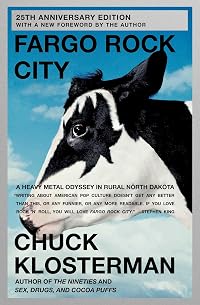
In other words, the once-galvanized heavy-metal monster behind Fargo Rock City now just sounds like a bad emo band. show less
In other words, the once-galvanized heavy-metal monster behind Fargo Rock City now just sounds like a bad emo band. show less
added by Shortride
The result is a collection as much about the author and his way of thinking as it is about his topics. In both cases, the author is unique.
Funny, irreverent and fascinating--Klosterman at his best.
Funny, irreverent and fascinating--Klosterman at his best.
added by sduff222
Author Information

42+ Works 17,618 Members
Chuck Klosterman, currently a music, film, & culture critic for Ohio's "Akron Beacon Journal", began his career with "The Forum" in Fargo, North Dakota. He lives in Akron, Ohio, where he once consumed nothing but McDonald's Chicken McNuggets for seven straight days. (Publisher Provided) Chuck Klosterman is the New York Times bestselling author of show more six books of nonfiction (including Sex, Drugs, and Cocoa Puffs, I Wear the Black Hat and But What If We're Wrong?) and two novels (Downtown Owl and The Visible Man). His debut book, Fargo Rock City, was a winner of the ASCAP-Deems Taylor Award. He currently covers sports and popular culture for ESPN and serves as "The Ethicist" for the New York Times Magazine. (Bowker Author Biography) show less
Awards and Honors
Distinctions
Work Relationships
Common Knowledge
- Original publication date
- 2009
- People/Characters
- Nirvana; Kurt Cobain; David Koresh; Ralph Sampson; Benny Anders; Garth Brooks (show all 14); ABBA; My Chemical Romance; Lady Gaga; Weezer; Rivers Cuomo; Werner Herzog; Ralph Nader; Ted Kaczynski
- Epigraph
- There is something insane and self-contradictory in supposing that things that have never yet been done can be done except by means never tried.
—Francis Bacon, The New Organon
That's not the way the world really works anymore. We're an empire now, and when we act, we create our own reality. And while you're studying that reality—judiciously, as you will—we'll act again, creating other new reali... (show all)ties, which you can study too, and that's how things will sort out.
—Unnamed George W. Bush senior adviser, speaking to New York Times reporter Ron Suskind in 2002
Don't Believe the Truth—I don't know what the title means. It's a pothead thing, innit?
—Liam Gallagher of Oasis, discussing his own album - First words
- For the first twelve years of my adult life, I sustained a professional existence by asking questions to strangers and writing about what they said.
- Quotations
- In the ten-thousand-year history of facial hair, no one has ever looked nonidiotic with a soul patch.
- Last words
- (Click to show. Warning: May contain spoilers.)You'll have to blow up my hands.
Classifications
Statistics
- Members
- 1,380
- Popularity
- 17,272
- Reviews
- 19
- Rating
- (3.70)
- Languages
- English
- Media
- Paper, Audiobook, Ebook
- ISBNs
- 5
- ASINs
- 7