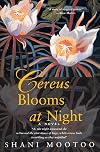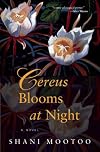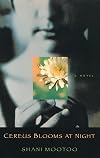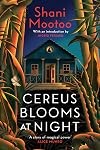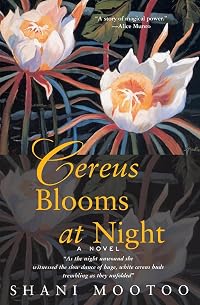
Cereus Blooms at Night
by Shani Mootoo
On This Page
Description
FINALIST FOR THE GILLER PRIZE FINALIST FOR THE ETHEL WILSON FICTION PRIZE Bold and lyrical, sensual and highly charged, Cereus Blooms at Night is the beautifully written, sensational first novel by Shani Mootoo, one of Canada's most exciting literary voices. At the core of this haunting multi-generational novel are the shifting faces of Mala--adventurer and protector, recluse, and madwoman. Told by the engaging voice of Tyler, Mala's vivacious male caretaker at the Paradise Alms show more House, Cereus Blooms at Night is layered with unforgettable scenes of a world where love and treachery collide. show lessTags
Recommendations














































Member Recommendations

Member Reviews
Recommended by multiple people, but especially my friend Laura, I picked up a copy of this and finally got around to reading it. The vibes are so perfectly magical realism: the intergenerational aspects, the story unfolding in jumps backward and forward through time, the lush atmosphere -- like you can feel the humidity through the page. Felt akin both to Rushdie and South American magical realism traditions.
But put queer people EVERYWHERE in the story. Just EVERYWHERE.
This story is heartbreaking and filled with abuse and injustice, and I have been on a streak of DNFing books like that, but what sets this apart is its resilience? We start in a present timeline that a long way from perfect, but has a promise of caretaking and community, show more and for me that made the dips into the past bearable. That and the abuse itself isn't what is centered, it's the girls and how they survive it.
I loved this, the whole way through. show less
But put queer people EVERYWHERE in the story. Just EVERYWHERE.
This story is heartbreaking and filled with abuse and injustice, and I have been on a streak of DNFing books like that, but what sets this apart is its resilience? We start in a present timeline that a long way from perfect, but has a promise of caretaking and community, show more and for me that made the dips into the past bearable. That and the abuse itself isn't what is centered, it's the girls and how they survive it.
I loved this, the whole way through. show less
This is an unusual but absolutely brilliant book. A few years ago when CBC published a list of 100 Novels that Make us Proud to Be Canadian I had read about 68 of them. I have added a few more and this one is the latest. Otherwise I probably never would have discovered this book. It came out in 1996 which was just when I was back in school and also working so I had very little time for reading.
Tyler is a nurse on the fictional island of Lantanacamara which is probably somewhere in the Caribbean. (The author is from Trinidad originally so she was probably using her background to create Lantanacamara.) He is hired at the Paradise Alms House but instead of using his nursing skills he is mainly doing janitorial work. Then Mala Ramachandin show more arrives at the home under police escort. She is all but comatose but Tyler starts taking care of her and slowly she comes back to life. Two gentlemen bring a slip of a Cereus plant for her and Tyler looks after it and gets the gardener to plant it. Some time later the two men return to visit Mala and Tyler starts to find out more about Mala's life. One of the men is Mala's age. Ambrose (Boyie) was at school with Mala. He made monthly deliveries of food to Mala until he was no longer able to do so. Then his son, Otoh, takes up the task. Ambrose and Otoh visit Mala at the Alms House often and soon Otoh is visiting on his own but he is there to see Tyler.
Sexual roles are fluid in this book; Otoh was actually born a female but he transformed his body to appear male and has passed as male for many years. Tyler is male but likes to wear women's clothing and makeup. Otoh and Tyler are fascinated by each other. However, Tyler is telling Mala's story so he resists adding details about his own life. He hopes that by making Mala's story public he can help find her sister, Asha, who disappeared many years ago. Mala asks continually where she is. This reader hopes that Asha and Mala were finally reunited but that is beyond the purview of this book.
As I said, this was a brilliant book. Highly recommended. show less
Tyler is a nurse on the fictional island of Lantanacamara which is probably somewhere in the Caribbean. (The author is from Trinidad originally so she was probably using her background to create Lantanacamara.) He is hired at the Paradise Alms House but instead of using his nursing skills he is mainly doing janitorial work. Then Mala Ramachandin show more arrives at the home under police escort. She is all but comatose but Tyler starts taking care of her and slowly she comes back to life. Two gentlemen bring a slip of a Cereus plant for her and Tyler looks after it and gets the gardener to plant it. Some time later the two men return to visit Mala and Tyler starts to find out more about Mala's life. One of the men is Mala's age. Ambrose (Boyie) was at school with Mala. He made monthly deliveries of food to Mala until he was no longer able to do so. Then his son, Otoh, takes up the task. Ambrose and Otoh visit Mala at the Alms House often and soon Otoh is visiting on his own but he is there to see Tyler.
Sexual roles are fluid in this book; Otoh was actually born a female but he transformed his body to appear male and has passed as male for many years. Tyler is male but likes to wear women's clothing and makeup. Otoh and Tyler are fascinated by each other. However, Tyler is telling Mala's story so he resists adding details about his own life. He hopes that by making Mala's story public he can help find her sister, Asha, who disappeared many years ago. Mala asks continually where she is. This reader hopes that Asha and Mala were finally reunited but that is beyond the purview of this book.
As I said, this was a brilliant book. Highly recommended. show less
This is the story of Mala, who we meet as she is being placed in a senior's home by the court. She may have committed a crime, but the court can't be sure even if a crime took place. Mala is being cared for by Tyler, a male nurse. In this book, gender is fluid -- at times, happily and at times bringing dire consequences. Mala's story is tragic and the novel grows darker as we become more aware of her home situation. The plot is very well executed....bringing us to ever deeper levels of understanding of the strongly drawn characters. And the writing! Reading this book was a sensory experience. I could smell the flowers and hear the music from the gramophone. Really good.
This was such a solid read that I paradoxically have very little to say about it.
Cereus blooms at night is the story of Mala Ramchandin, set at various stages during her life, but all in and around the same village. As a semi-senile she is barely tolerated at her nursing home, though one caretaker goes the extra mile and becomes quite close; he is the focalizer of these chapters. Prior to her (forced) admission there, she lived on her own in her family’s dilapidated home, shunned and feared by the village, though a former lover’s son secretly brings her food; he is the window into Mala’s life here. Only as a child is she her own main character, but even then her life is one of generalized abuse lightened by a few individual loves show more and friendships.
Much of the appeal in this book derives from that tension: a harsh life of poverty, violence, sexual abuse, psychological abuse, bullying,incest , shunning, abandonment and sacrifice made bearable by one or two largely secret friendships. And these happy patches do make things better, though they also make the nearly all-enveloping maltreatment comparatively harsher. Dealing with abuse involves sneaky rebellion, and may take place over a timespan counted in generations rather than years.
Several characters in this book are casually LGBTQ: Mala’s caretaker is gay;her mother runs off with a lesbian lover; her former lover’s son is trans. And by “casually” I mean that their orientation is barely remarked-upon and is not presented as an obstacle or as a conflict-generating device.
I thought this was a pretty good book, and memorable, too, and a very solid read written in beautiful language. show less
Cereus blooms at night is the story of Mala Ramchandin, set at various stages during her life, but all in and around the same village. As a semi-senile she is barely tolerated at her nursing home, though one caretaker goes the extra mile and becomes quite close; he is the focalizer of these chapters. Prior to her (forced) admission there, she lived on her own in her family’s dilapidated home, shunned and feared by the village, though a former lover’s son secretly brings her food; he is the window into Mala’s life here. Only as a child is she her own main character, but even then her life is one of generalized abuse lightened by a few individual loves show more and friendships.
Much of the appeal in this book derives from that tension: a harsh life of poverty, violence, sexual abuse, psychological abuse, bullying,
Several characters in this book are casually LGBTQ: Mala’s caretaker is gay;
I thought this was a pretty good book, and memorable, too, and a very solid read written in beautiful language. show less
This was a fantastic read but at times a very hard one; serious trigger warnings for child abuse (verbal, physical, sexual).
It begins as a beautifully sweet story about racial and sexual and gender identity; about family separations made by force or by choice, and about forbidden liaisons both healthy and unhealthy. Set in the country of Lantanacamara, colonised by the Shivering Northern Wetlands -- more an open code than fantasy countries -- the story focuses on three generations of locals, straight and gay, cis and trans, more and less inculturated by Wetlandish education. The narrator begins by disclaiming any significant role in the story; instantly I want to know more about him, and (though he was right that this is more Mala's show more story) I was not disappointed.
The main story, switching among its several timelines, grows darker and winds tighter with perfect pacing. Revelations are neither too delayed nor too forced. And as it heads towards the catastrophe we've foreseen, through horror worse than we could have imagined at the start, so it brings us towards its equally inevitable -- and no less satisfying -- eucatastrophe. show less
It begins as a beautifully sweet story about racial and sexual and gender identity; about family separations made by force or by choice, and about forbidden liaisons both healthy and unhealthy. Set in the country of Lantanacamara, colonised by the Shivering Northern Wetlands -- more an open code than fantasy countries -- the story focuses on three generations of locals, straight and gay, cis and trans, more and less inculturated by Wetlandish education. The narrator begins by disclaiming any significant role in the story; instantly I want to know more about him, and (though he was right that this is more Mala's show more story) I was not disappointed.
The main story, switching among its several timelines, grows darker and winds tighter with perfect pacing. Revelations are neither too delayed nor too forced. And as it heads towards the catastrophe we've foreseen, through horror worse than we could have imagined at the start, so it brings us towards its equally inevitable -- and no less satisfying -- eucatastrophe. show less
Truly a work of art. The book is as beautiful as it is horrifying. Like the cereus flower is beautiful and sweet on its dangerous cactus body. It pushes boundaries by making the very strange and the evil part of everyday life, revealing the trauma and horrors that are rampant in Paradise (ironic fictional city). Gender boundaries are masterfully blurred and renegotiated by the troubled characters. A book to pass on, a book to heal others. Some things should not remain silenced.
In language as lush and teeming as the insect and plant life she so carefully details, Mootoo presents a novel about love in its many forms. At the heart of it is the young, romantic love of Mala and Ambrose, shown in both its aspects, the sexual and the classically romantic. Theirs is the hub of the novel with spokes represented by other stories and variations on love--the lesbian love of Sarah and Lavinia, Esther's love for Ambrose so selfless she gives him up, Asha's sisterly love for Mala, and Mala's protective love for her, the thwarted, tragic, love of Chandin Ramchandin who lost both Sarah and Lavinia, a love that finally manifests itself in abuse and bitterness, the strange but beautiful love between Tyler and Otoh. Those 2 are show more central to a subtext of the novel, a search for identity and true gender. Aside from the rich prose, there is much to like here: the skillful way Mootoo tells her story, slowly opening her narrative bit by bit much as the cereus would bloom to reveal the fragrance and beauty of a happy conclusion, the bold and unusual characterizations, the steady dexterity with which she holds these complex relationships together. I'd expected much more magic realism than Mootoo gives us. She didn't need it--her storytelling is its own magic. But still, it's there, in Ambrose who sleeps all month except for the day he supplies Mala, for instance. And in the night the cereus blooms, a kind of agent or siren call to Otoh that also releases a brume of love over Mala's yard and surrounds and brings the awareness of love to these characters. That night of blooming cereus is the high point of the novel. I do like a novel about love, and I like this a lot. show less
Members
- Recently Added By
Lists

CBC Books - Canada's 100 (+ bonus 10): Which have you read?
110 works; 23 members

Speculative Fiction from around the World
610 works; 18 members
Author Information

12+ Works 1,059 Members
Awards and Honors
Common Knowledge
- People/Characters
- Mala Ramchandin / Pohpoh; Tyler; Ambroise Mohanty / Boyie; Otoh Mohanty; Chandin Ramchandin; Asha Ramchandin
- Important places
- Trinidad
- Dedication
- For my parents, Indra and Romesh
- First words
- By setting this story down, I, Tyler -- that is how I am known, simply as Tyler, or if you wanted to be formal, Nurse Tyler -- am placing trust in the power of the printed work to reach many people.
- Last words
- (Click to show. Warning: May contain spoilers.)You are, to her, the promise of a cereus-scented breeze on a Paradise night.
Classifications
Statistics
- Members
- 582
- Popularity
- 50,760
- Reviews
- 12
- Rating
- (3.68)
- Languages
- 5 — Dutch, English, German, Spanish, Swedish
- Media
- Paper, Audiobook, Ebook
- ISBNs
- 23
- ASINs
- 3