On This Page
Description
As the world moves into the twentieth century, Minke, one of the few European-educated Javanese, optimistically starts a new life in a new town: Betawi. With his enrollment in medical school and the opportunity to meet new people, there is every reason to believe that he can leave behind the tragedies of the past. But Minke can no more escape his past than he can escape his situation as part of an oppressed people under a foreign power. As his world begins to fall apart, Minke draws a small show more but fervent group around him to fight back against colonial exploitation. During the struggle, Minke finds love, friendship, and betrayal--with tragic consequences. And he goes from wanting to understand his world to wanting to change it. Pramoedya's full literary genius is again evident in the remarkable characters that populate the novel--and in his depiction of a people's painful emergence from colonial domination and the shackles of tradition. show lessTags
Recommendations




















Member Reviews
The first book in this quartet This Earth of Mankind made me cry. The second book Child of All Nations made me cry. This third installment of the Buru Quartet made me angry. Colonization just sucks. And when a nation of mixed cultures fight each other while working towards independence, freedom if achieved is tainted. Footsteps is the biggest of the quartet and the most political. From what I understand it is also the last of the first person narrative from Minke's point of view. One more to go and I really hope that Indonesia gets it together... but now in 2009 I know how this earth of mankind stands both politically and culturally and I don't know if Minke would be proud.
'So what is the use of the French Revolution then?' and her show more voice was so gentle, as it had always been ever since the first time I heard it. 'You said it was to free men from the burdens made by other men. Wasn't that it? That is not Javanese. A Javanese does something with no other motive than to do it. Orders come from Allah, from the gods, from the Raja. After a Javanese has carried out the order, he will feel satisfied because he has become himself. And then he waits for the next order. So the Javanese are grateful, they give thanks. They are not preyed upon by monsters within themselves.'
Although nominated for the Nobel Prize in Literature, Pramoedya Ananta Toer gave up his chance of ever winning when he died. Damn it, why didn't he wait a little longer before dying? show less
'So what is the use of the French Revolution then?' and her show more voice was so gentle, as it had always been ever since the first time I heard it. 'You said it was to free men from the burdens made by other men. Wasn't that it? That is not Javanese. A Javanese does something with no other motive than to do it. Orders come from Allah, from the gods, from the Raja. After a Javanese has carried out the order, he will feel satisfied because he has become himself. And then he waits for the next order. So the Javanese are grateful, they give thanks. They are not preyed upon by monsters within themselves.'
Although nominated for the Nobel Prize in Literature, Pramoedya Ananta Toer gave up his chance of ever winning when he died. Damn it, why didn't he wait a little longer before dying? show less
Footsteps (Jejak Langkah) is the third in the Pramoedya Ananta Toer’s Buru Quartet, the series of four novels tracing Indonesia's 'awakening' that Toer wrote while in prison on the island of Buru. (See my review of Book 2 for the background to this, and also for my thoughts about the translation and introduction which apply equally to this volume). Footsteps is a more 'political' novel, and belongs in that distinctive category of historical fiction as activism, that is, it's written by authors redressing the hidden stories and silences of colonised peoples in well-researched fiction. Toer had spent years researching the life of Tirto Adi Suryo, who was the inspiration for this quartet, but Toer's papers were all destroyed when he was show more arrested and held without trial for fourteen years.
Notwithstanding that setback, Toer created this novel from memory, telling the story of a man honoured in 2006 as a National Hero of Indonesia. Toer's central character Minke appears to be a reasonably authentic recreation of Tirto's life, (though the Wikipedia entry in English includes nothing about his personal life, which in the quartet so far, includes three wives.) As Max Lane explains in the Introduction, Tirto was editor of the first Native-owned newspaper and co-founder of the first magazine for women; he initiated a legal advisory service; he co-founded a modern political organisation devoted to developing what would become Indonesian nationalism; and he was a pioneer of indigenous literature in a language of the nation yet to be born.
NB: My use of terms to describe different ethnic groups and social divisions are those that are used in the book. 'Indonesians' would be anachronistic in the era of the Dutch East Indies, and Toer uses terms like Native, Indo, Indisch, and regional descriptors such as Javanese, Moluccan and Balinese to indicate racial differences while also indicating social differences with terms of address in different languages, like Mas, Gusti Kanjeng, Haji, Sinyo, Meneer, Mevrouw, Ndoro, Teukoe and Princess.
Books 1 & 2 — This Earth of Mankind (see here) and Child of All Nations (see here) trace the influences on Minke, born into the aristocatic priyani caste and expected to surrender to work as a salaried administrator like his father. But these characters show him a different path to take:
So, Footsteps starts in 1901 with Minke at the medical school for Natives. This school was a belated initiative by the Dutch in the wake of international embarrassment about their colonial regime, but its graduates are condemned to serve only as badly-paid doctors attempting to lift the life expectancy of Natives from a shocking 40 years. Minke makes few friends, but is visited by Ter Haar, a liberal Dutch journalist who improves his status at the school by engineering invitations to the Harmoni Club, where he meets Van Kollewijn, a liberal MP espousing the Ethical Policy aimed at improving the welfare of the Natives; General van Heutsz, the man who led the slaughter against the Acehnese; and Marie Van Zeggelen, an author who wrote books supportive of Native freedom including a biography of Kartini, (a pioneer of girls' education who is referenced in Footsteps as 'the girl from Jepara). These contacts with powerful people enable Minke to flout school rules with impunity, but he ends up abandoning his course to take up journalism.
Footsteps isn't a book that flows smoothly; Toer was at pains to make various political points, and so there are jerky sequences of events and occasionally awkward conversations that are included as activism rather than as part of a credible plot. His Native characters are generally more convincing than the stereotypes he uses to convey opinions held by colonials or ethnic identities not from the Indies. Two topics discussed in an unlikely conversation between a very young Minke and these powerful people are raised at the ironically-named Harmoni club:
Questions of (and activism in support of) recompense for Holland's moral and financial debt, and the territorial integrity of Papua and Aceh under Indonesian sovereignty remain pertinent today.
To read the rest of my review please visit https://anzlitlovers.com/2019/09/01/footsteps-the-buru-quartet-3-by-pramoedya-an... show less
Notwithstanding that setback, Toer created this novel from memory, telling the story of a man honoured in 2006 as a National Hero of Indonesia. Toer's central character Minke appears to be a reasonably authentic recreation of Tirto's life, (though the Wikipedia entry in English includes nothing about his personal life, which in the quartet so far, includes three wives.) As Max Lane explains in the Introduction, Tirto was editor of the first Native-owned newspaper and co-founder of the first magazine for women; he initiated a legal advisory service; he co-founded a modern political organisation devoted to developing what would become Indonesian nationalism; and he was a pioneer of indigenous literature in a language of the nation yet to be born.
NB: My use of terms to describe different ethnic groups and social divisions are those that are used in the book. 'Indonesians' would be anachronistic in the era of the Dutch East Indies, and Toer uses terms like Native, Indo, Indisch, and regional descriptors such as Javanese, Moluccan and Balinese to indicate racial differences while also indicating social differences with terms of address in different languages, like Mas, Gusti Kanjeng, Haji, Sinyo, Meneer, Mevrouw, Ndoro, Teukoe and Princess.
Books 1 & 2 — This Earth of Mankind (see here) and Child of All Nations (see here) trace the influences on Minke, born into the aristocatic priyani caste and expected to surrender to work as a salaried administrator like his father. But these characters show him a different path to take:
- Annalies, his first Indo (Eurasian) wife, who died after 'repatriation to the Netherlands, because her citizenship was reverted there in order to prevent her inheriting Javanese assets from her Dutch father;
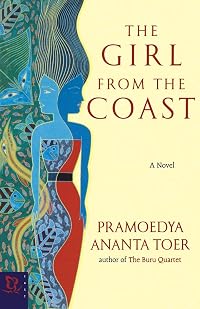
- Nyai Ontosoroh, Annalies' mother and concubine to a failed Dutch businessman, whose self-taught efforts rescued the business and whose courage and understanding of the modern colonial world alerted Minke to much injustice; (See The Girl from the Coast for Toer's representation of what concubinage was like);
- Jean Marais, a French veteran of the war in Aceh who taught Minke to connect with his own people rather than the Dutch at his elite school;
- Khouw Ah Soe, an activist for the progress of Chinese people in Java, who was killed by assassins from a Chinese secret society;
- Thoenodongso, a peasant who led an uprising against the colonial sugar barons;
- Magda Peters, his Dutch teacher at the elite HBS school, who recognised Minke as a future leader (and got herself sent back to Holland because of it); and
- Herbert de la Croix, a liberal Dutch administrator and his two daughters, who return to Holland in disillusionment.
So, Footsteps starts in 1901 with Minke at the medical school for Natives. This school was a belated initiative by the Dutch in the wake of international embarrassment about their colonial regime, but its graduates are condemned to serve only as badly-paid doctors attempting to lift the life expectancy of Natives from a shocking 40 years. Minke makes few friends, but is visited by Ter Haar, a liberal Dutch journalist who improves his status at the school by engineering invitations to the Harmoni Club, where he meets Van Kollewijn, a liberal MP espousing the Ethical Policy aimed at improving the welfare of the Natives; General van Heutsz, the man who led the slaughter against the Acehnese; and Marie Van Zeggelen, an author who wrote books supportive of Native freedom including a biography of Kartini, (a pioneer of girls' education who is referenced in Footsteps as 'the girl from Jepara). These contacts with powerful people enable Minke to flout school rules with impunity, but he ends up abandoning his course to take up journalism.
Footsteps isn't a book that flows smoothly; Toer was at pains to make various political points, and so there are jerky sequences of events and occasionally awkward conversations that are included as activism rather than as part of a credible plot. His Native characters are generally more convincing than the stereotypes he uses to convey opinions held by colonials or ethnic identities not from the Indies. Two topics discussed in an unlikely conversation between a very young Minke and these powerful people are raised at the ironically-named Harmoni club:
- Van Kollewjin talks about Holland owing a moral and financial debt to the Indies because exports under the Culture (Forced Cultivation) System saved Holland from bankruptcy, paid for Holland's infrastructure development and provided it with capital for expansion.
- Marie Van Zeggelen tackles General Van Heutsz over his use of the word 'unify' instead of 'expand' to describe the conquest of Aceh. He talks of 'pockets' of 'political enclaves' 'destabilising the Indies' and how they must be brought to 'acknowledge the sovereignty of Her Majesty'. Ter Haar and Van Zeggelen argue that they are independent states, and that the aim of these operations is conquest not unification. They ask what his plans are for East Papua and Southeast Papua, while sarcastically noting that West Papua is a heavy burden for the Indies.
Questions of (and activism in support of) recompense for Holland's moral and financial debt, and the territorial integrity of Papua and Aceh under Indonesian sovereignty remain pertinent today.
To read the rest of my review please visit https://anzlitlovers.com/2019/09/01/footsteps-the-buru-quartet-3-by-pramoedya-an... show less
Excellent historical novel of turn-of-century Java under Dutch colonial rule.
Ratings
Members
- Recently Added By
Lists

Books Read in 2024
4,623 works; 126 members
Author Information

76+ Works 2,945 Members
One of Indonesia's most prominent authors, Toer spent most of his adult life in prison; his works have frequently been banned by the government. Toer's first novel, The Fugitive (1950), was written during his internment by the Dutch. Toer became a leading figure in the Marxist literary group Lekra and was again incarcerated after the 1965 show more overthrow of Sukarno, joining thousands of other left-wing artists on the prison island of Buru. The author of over 30 works of fiction and nonfiction, Toer is best known for his Buru tetralogy, which traces the birth of nationalism in Indonesia. Most of the work was composed as narration to fellow prisoners, then later recorded and published after Toer's release in 1979. Although the events of the tetralogy take place in the past, they must be understood in the context of his experiences at Buru. In 1988 Toer received the PEN Freedom-to-Write Award. (Bowker Author Biography) show less
Some Editions
Awards and Honors
Notable Lists
Series

Common Knowledge
- Canonical title
- Footsteps
- Original title
- Jejak Langkah
- Original publication date
- 1985 (Indonesian) (Indonesian); 1985; 1990 (English) (English)
- People/Characters
- Minke; General Van Heutsz; Ter Haar; Ibu Baldrun; Engineer H. van Kollewign; Ang San Mei (show all 11); Thamrin Mohammed Thabrie; Sandiman; Miriam de la Croix; Hendrick Frischboten; Haji Moeloek
- Important places
- Indonesië; Indonesia; Bali, Indonesia; Betawi, Indonesia_Jakarta
- Dedication
- For those who have been forgotten, deliberately or otherwise
- First words
- The earth of Betawi finally spread out beneath my feet.
- Last words
- (Click to show. Warning: May contain spoilers.)And I didn't notice that I wore no shoes.
Classifications
- Genres
- Fiction and Literature, General Fiction, Historical Fiction
- DDC/MDS
- 899.22132 — Literature & rhetoric Asian Literature Literatures of non-Austronesian languages of Oceania, of Austronesian languages, of miscellaneous languages Malay and Austronesian languages Indonesian languages Indonesian (Bahasa Indonesia) Indonesian fiction 1900–2000
- LCC
- PL5089 .T8 .J4513 — Language and Literature Languages and literatures of Eastern Asia, Africa, Oceania Languages of Eastern Asia, Africa, Oceania Languages of Oceania Malayan (Indonesian) languages
- BISAC
Statistics
- Members
- 318
- Popularity
- 99,931
- Reviews
- 3
- Rating
- (3.92)
- Languages
- 8 — Dutch, English, French, German, Indonesian, Norwegian (Bokmål), Spanish, Swedish
- Media
- Paper, Ebook
- ISBNs
- 16
- ASINs
- 5