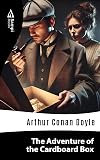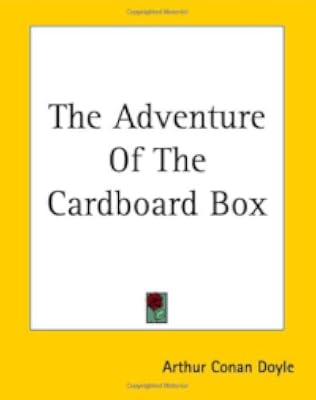
The Adventure of the Cardboard Box [short story]
by Arthur Conan Doyle 
His Last Bow - short stories 1908-1917 {Conan Doyle} (2), The Memoirs of Sherlock Holmes - short stories 1892-1893 {Conan Doyle} (2)
On This Page
Description
Craving a classic mystery tale? You can't go wrong with Arthur Conan Doyle, a towering figure in the origination of the detective fiction genre. This short story features master detective Sherlock Holmes attempting to pinpoint the origins of a mysterious and gory parcel..
Tags
Recommendations





























Member Reviews
This is not Sherlock Holmes at his best. The resolution of the story includes a long information dump in the form of a letter written by the guilty person. Sherlock Holmes isn’t supposed to need those.
This is the first classic detective story that I have ever read. Two factors influenced my decision to read this short story: 1. The title grabbed my attention and intrigued me! 2. I thought it was time to read a classic detective story, and I immediately decided to try Sherlock Holmes.
I was certainly not disappointed. I had no idea what to expect, but to be honest, the idea of two human ears being delivered in the cardboard box was not one of them!
I found it most interesting in the way Holmes and Watson went about their business. I agree with another reviewer who mentioned that it was remarkable what clues were deduced from some packaging and the ears themselves!
When Holmes became aware of the lifestyle of Miss Susan Cushing, and the show more further clues themselves, it didn't take him long to deduce that this was going to be a family related affair. So it soon became apparent that adultery, jealousy and drink, all had a major part to play, in this sad and gruesome, but nevertheless, entertaining and interesting plot.
If like me, you have never read a classic detective story before, but would like to, I can fully recommend and endorse starting with a short story like this. I'm already looking forward to reading my next detective story! show less
I was certainly not disappointed. I had no idea what to expect, but to be honest, the idea of two human ears being delivered in the cardboard box was not one of them!
I found it most interesting in the way Holmes and Watson went about their business. I agree with another reviewer who mentioned that it was remarkable what clues were deduced from some packaging and the ears themselves!
When Holmes became aware of the lifestyle of Miss Susan Cushing, and the show more further clues themselves, it didn't take him long to deduce that this was going to be a family related affair. So it soon became apparent that adultery, jealousy and drink, all had a major part to play, in this sad and gruesome, but nevertheless, entertaining and interesting plot.
If like me, you have never read a classic detective story before, but would like to, I can fully recommend and endorse starting with a short story like this. I'm already looking forward to reading my next detective story! show less
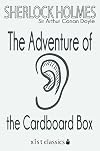
In this story, Miss Susan Cushing of Croydon receives a parcel in the post that contains two severed human ears packed in coarse salt. Inspector Lestrade of Scotland Yard suspects a prank by three medical students whom Miss Cushing was forced to evict because of their unruly behaviour. The parcel was sent from Belfast, the city of origin of one of the former boarders. Upon examining the parcel himself, Holmes is convinced that it is evidence of a serious crime. He reasons that a medical student with access to a dissection laboratory would likely use something other than plain salt to preserve human remains, and would be able to make a more precise cut than the roughly hacked ears suggest. The address on the package, roughly written and show more with a spelling correction, suggests to Holmes that the sender lacks education and is unfamiliar with Croydon. The knot in the string suggests to Holmes that they are looking for someone with sailing experience.
Holmes considers the solution so simple that he asks Lestrade not to mention his name in connection with it. A few simple questions to Miss Cushing, a few observations, a cable to Liverpool, and a visit to Miss Cushing's sister Sarah (Holmes was denied admittance by the doctor because she was having a "brain fever") convince Holmes that the ears belong to Miss Cushing's other sister, Mary, and her extramarital lover, and that they have been murdered. He is convinced that Mary's estranged husband, Jim Browner, is the murderer, and that Browner had sent the cardboard box containing the ears to the Cushing's house in Croydon (addressing it merely to "S. Cushing"), not realizing that Sarah was no longer resident there. Browner, who is an unpleasant man when drunk, had meant to horrify Sarah (rather than Susan) because he blamed Sarah for causing the trouble that culminated in his murder of his wife and her lover.
Browner is indeed a sailor, and Belfast was the first port where he had the chance to post the parcel. Lestrade, acting on Holmes's information, is waiting to arrest him when his ship reaches London. He confesses everything. He is presented with considerable sympathy, a simple man so tormented by guilt at his act that he would welcome being hanged. The real villain of the story - morally if not legally - is Sarah Cushing, who tried to seduce Browner herself and, when he rejected her advances, set out to wreck his marriage with her sister Mary.
Another very well written story, I recommend this one to all readers that appreciate a good mystery, mainly featuring Sherlock Holmes and Dr. Watson. show less
Holmes considers the solution so simple that he asks Lestrade not to mention his name in connection with it. A few simple questions to Miss Cushing, a few observations, a cable to Liverpool, and a visit to Miss Cushing's sister Sarah (Holmes was denied admittance by the doctor because she was having a "brain fever") convince Holmes that the ears belong to Miss Cushing's other sister, Mary, and her extramarital lover, and that they have been murdered. He is convinced that Mary's estranged husband, Jim Browner, is the murderer, and that Browner had sent the cardboard box containing the ears to the Cushing's house in Croydon (addressing it merely to "S. Cushing"), not realizing that Sarah was no longer resident there. Browner, who is an unpleasant man when drunk, had meant to horrify Sarah (rather than Susan) because he blamed Sarah for causing the trouble that culminated in his murder of his wife and her lover.
Browner is indeed a sailor, and Belfast was the first port where he had the chance to post the parcel. Lestrade, acting on Holmes's information, is waiting to arrest him when his ship reaches London. He confesses everything. He is presented with considerable sympathy, a simple man so tormented by guilt at his act that he would welcome being hanged. The real villain of the story - morally if not legally - is Sarah Cushing, who tried to seduce Browner herself and, when he rejected her advances, set out to wreck his marriage with her sister Mary.
Another very well written story, I recommend this one to all readers that appreciate a good mystery, mainly featuring Sherlock Holmes and Dr. Watson. show less
Ratings
Members
- Recently Added By
Author Information

3,998+ Works 169,555 Members
The most famous fictional detective in the world is Arthur Conan Doyle's Sherlock Holmes. However, Doyle was, at best, ambivalent about his immensely successful literary creation and, at worst, resentful that his more "serious" fiction was relatively ignored. Born in Edinburgh, Doyle studied medicine from 1876 to 1881 and received his M.D. in show more 1885. He worked as a military physician in South Africa during the Boer War and was knighted in 1902 for his exceptional service. Doyle was drawn to writing at an early age. Although he attempted to enter private practice in Southsea, Portsmouth, in 1882, he soon turned to writing in his spare time; it eventually became his profession. As a Liberal Unionist, Doyle ran, unsuccessfully, for Parliament in 1903. During his later years, Doyle became an avowed spiritualist. Doyle sold his first story, "The Mystery of the Sasassa Valley," to Chambers' Journal in 1879. When Doyle published the novel, A Study in Scarlet in 1887, Sherlock Holmes was introduced to an avid public. Doyle is reputed to have used one of his medical professors, Dr. Joseph Bell, as a model for Holmes's character. Eventually, Doyle wrote three additional Holmes novels and five collections of Holmes short stories. A brilliant, though somewhat eccentric, detective, Holmes employs scientific methods of observation and deduction to solve the mysteries that he investigates. Although an "amateur" private detective, he is frequently called upon by Scotland Yard for assistance. Holmes's assistant, the faithful Dr. Watson, provides a striking contrast to Holmes's brilliant intellect and, in Doyle's day at least, serves as a character with whom the reader can readily identify. Having tired of Holmes's popularity, Doyle even tried to kill the great detective in "The Final Problem" but was forced by an outraged public to resurrect him in 1903. Although Holmes remained Doyle's most popular literary creation, Doyle wrote prolifically in other genres, including historical adventure, science fiction, and supernatural fiction. Despite Doyle's sometimes careless writing, he was a superb storyteller. His great skill as a popular author lay in his technique of involving readers in his highly entertaining adventures. (Bowker Author Biography) show less
Arthur Conan Doyle has a Legacy Library. Legacy libraries are the personal libraries of famous readers, entered by LibraryThing members from the Legacy Libraries group.
Series


Work Relationships
Is contained in
Sherlock Holmes: Complete (56) Stories (Adventures, Memoirs, Return, His Last Bow, & The Case-Book) by Arthur Conan Doyle (indirect)
The Complete Sherlock Holmes: All 4 Novels and 56 Short Stories by Sir Arthur Conan Doyle (indirect)
Treasury of World Masterpieces "The Celebrated Cases of Sherlock Holmes" & "H.G. Wells (Treasury of World Masterpieces) by Sir Arthur Conan Doyle (indirect)
Sherlock Holmes - Edição Completa Romances & Contos (Em Portuguese do Brasil) by Arthur Conan Doyle (indirect)
Sherlock Holmes: The Complete Novels and Stories, Vol. 1 (Bantam Classics 1/2) by Arthur Conan Doyle (indirect)
Sherlock Holmes: The Complete Novels and Stories, Vol. 1 and 2 (Bantam) by Arthur Conan Doyle (indirect)
THE COMPLETE SHERLOCK HOLMES and THE COMPLETE TALES OF TERROR AND MYSTERY by Sir Arthur Conan Doyle (indirect)
British Mystery Megapack Volume 5 - The Sherlock Holmes Collection: 4 Novels and 43 Short Stories + Extras by Arthur Conan Doyle (indirect)
study in scarlet / sign of four / hound of the baskervilles / memoirs of sherlock holmes by Sir Arthur Conan Doyle (indirect)
The Adventures of Sherlock Holmes / The Memoirs of Sherlock Holmes / The Return of Sherlock Holmes / A Study in Scarlet by Sir Arthur Conan Doyle (indirect)
The New Annotated Sherlock Holmes: The Short Stories, Volume 1 of 2 (The Adventures of Sherlock Holmes + The Memoirs of Sherlock Holmes) by Arthur Conan Doyle (indirect)
Sherlock Holmes: Volume 2: Memórias de Sherlock Holmes | O cão dos Baskerville (Portuguese Edition) by Arthur Conan Doyle (indirect)
The Sherlock Holmes illustrated omnibus : The adventures of Sherlock Holmes, The memoirs of Sherlock Holmes, The hound of the Baskervilles, The return of Sherlock Holmes : a facsimile of the stories and the adventure as they were first published in the Strand magazine, London by Sir Arthur Conan Doyle (indirect)
A Study In Scarlet, The Sign of the Four, The Adventures of Sherlock Holmes, The Memoirs of Sherlock Holmes, The Return of Sherlock Holmes (Sherlock Holmes - Bouquin Complete works - volume 1/2) by Arthur Conan Doyle (indirect)
The Adventures of Sherlock Holmes, The Memoirs of Sherlock Holmes, The Return of Sherlock Holmes (Classics Omnibus) by Arthur Conan Doyle (indirect)
The adventures of Sherlock Holmes ; The memoirs of Sherlock Holmes ; The return of Sherlock Holmes ; The hound of the Baskervilles ; A study in ... the Bruce-Partington plans (Masters Library) by Arthur Conan Doyle (indirect)
A Study in Scarlet / The Sign of the Four / The Adventures of Sherlock Holmes / The Memoirs of Sherlock Holmes by Arthur C. Doyle (indirect)
Adventures of Sherlock Holmes / Memoirs of Sherlock Holmes / The Sign Of Four by Arthur Conan Doyle (indirect)
A Study in Scarlet / The Sign of Four / The Adventures of Sherlock Holmes / The Memoirs of Sherlock Holmes / The Hound of the Baskervilles (B&N Classics 1/2) by Arthur Conan Doyle (indirect)
Contains
Common Knowledge
- Canonical title
- The Adventure of the Cardboard Box [short story]
- Original title
- The Adventure of the Cardboard Box
- Alternate titles
- The Cardboard Box
- Original publication date
- 1893
- People/Characters
- Sherlock Holmes; John H. Watson; Susan Cushing; Inspector G. Lestrade; Sarah Cushing; Mary Cushing (show all 8); Jim Browner; Alec Fairbairn
- Important places
- 221B Baker Street, London, England, UK; Croydon, Surrey, England, UK; Cross Street, Croydon, Surrey, England, UK; Wallington, Surrey, England, UK; Liverpool, Lancashire, England, UK; New Brighton, Merseyside, England, UK
- Original language
- English
- Canonical DDC/MDS
- 823.0872
- Disambiguation notice
- The first London edition of the Memoirs in 1894 did not include "The Adventure of the Cardboard Box", although all twelve stories had appeared in the Strand Magazine.
"The Adventure of the Cardboard Box" was not publis... (show all)hed in the first British edition of 'The Memoirs of Sherlock Holmes', but it was published in the first American edition. The story was later published again in 1917 in His Last Bow. Even today, most American editions of the canon include it with His Last Bow, while most British editions keep the story in its original place, within the Memoirs. (from Wikipedia)
Classifications
Statistics
- Members
- 108
- Popularity
- 299,623
- Reviews
- 3
- Rating
- (3.43)
- Languages
- Dutch, English, German, Portuguese (Brazil)
- Media
- Paper, Audiobook, Ebook
- ISBNs
- 25
- ASINs
- 7