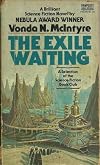
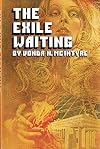
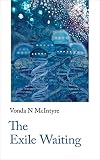
The Exile Waiting
by Vonda N. McIntyre
On This Page
Description
The Exile Waiting was the first novel by the Hugo and Nebula award-winning novelist Vonda N McIntyre, published in 1975. It introduces the world that McIntyre later made famous with her multi-award-winning Dreamsnake: a post-apocalyptic world in which Center, an enclosed domed city, is run by slave-owning families who control the planet's resources, and are strangling the city's economy by their decadence. Mischa is a thirteen-year old sneak thief, struggling to support her drug-addict elder show more brother Chris, and their predatory uncle who uses their telepathic link with their captive younger sister Gemmi to control them. The alien pseudosibs Subone and Subtwo have come to Earth to take over Center's resources. Subone is attracted by the decadent living on offer and begins to unlink from his sibling's conditioning. Subtwo has fallen unexpectedly in love with a slave. When Mischa defends Chris from Subone's malice, Subtwo hunts her beneath Center's foundations, and discovers how terrible Center's cruelty has been to its inhabitants with genetically distorted bodies and minds. They have to rescue them and leave, but how?Also included in this edition, the first republication of McIntyre's short story 'Cages', originally published in Quark 4 in 1972, in which she first created the pseudosibs and their terrible origins.Vonda N McIntyre's most well-known novel is Dreamsnake (1978), which won the 1979 Hugo and Nebula awards for Best Novel. She was a biologist by training, and the author of several Star Trek and Star Wars novels and many short stories. Her 1997 novel The Moon and the Sun was filmed in 2013 as The King's Daughter. She died in 2019. show lessTags
Recommendations


















Member Reviews
The Exile Waiting by Vonda N. McIntyre
Like many good books, I think The Exile Waiting can be read on different levels. If I was still in my teens, I would probably feel that it is simply an engaging post-apocalyptic adventure story. More mature readers, though, will likely identify the complex web of dysfunctional and tragic relationships as what stands out most clearly. And it is these relationships which power much of the story.
The Exile Waiting (1975) is set in the same world as Dreamsnake (1978), but cannot really be considered a prequel. The characters are all different and the stories are unrelated, although there are points of convergence. In Dreamsnake, the people who have to fend for themselves in the outside world seem to show more imagine the inhabitants of Center (an enclosed enclave, and supposedly the last bastion of civilization remaining after a global nuclear war) as enjoying a high standard of living and technology, but in The Exile Waiting we see that in some ways they suffer more than their outdoor counterparts. In Dreamsnake, tunnels behind certain desert caves in which cave panthers dwell are thought to lead into Center, and these dark galleries beneath the city are the focus for some of the most important events in The Exile Waiting. Similar to Dreamsnake, this novel also features a strong female lead character, in this case a determined young girl named Mischa.
The overarching theme of the book seems to be how people react and behave under various forms of slavery. Some of the characters are bound in physical slavery, and some are controlled by manipulative individuals or by their own fears and vices. One is dependent on a certain kind of drug. Prejudice and mistreatment due to perceived differences or disabilities is another theme, and Mischa has to conceal carefully the way in which she is different from the others around her. Eventually, many of those who on the surface appear strongest prove to be weak, and those considered the weakest triumph through their reserves of inner strength and their willingness to learn and adapt.
The above description probably sounds somewhat grim and depressing, but I found the novel quite uplifting. Other reviewers have identified certain details they see as weaknesses in the plot, but I did not even notice these and they did not affect my enjoyment in any way. I think this work is at least as good as Dreamsnake, although I would not like to choose between the two books. After finishing The Exile Waiting, the reader can also ponder on the meaning of the title. show less
Like many good books, I think The Exile Waiting can be read on different levels. If I was still in my teens, I would probably feel that it is simply an engaging post-apocalyptic adventure story. More mature readers, though, will likely identify the complex web of dysfunctional and tragic relationships as what stands out most clearly. And it is these relationships which power much of the story.
The Exile Waiting (1975) is set in the same world as Dreamsnake (1978), but cannot really be considered a prequel. The characters are all different and the stories are unrelated, although there are points of convergence. In Dreamsnake, the people who have to fend for themselves in the outside world seem to show more imagine the inhabitants of Center (an enclosed enclave, and supposedly the last bastion of civilization remaining after a global nuclear war) as enjoying a high standard of living and technology, but in The Exile Waiting we see that in some ways they suffer more than their outdoor counterparts. In Dreamsnake, tunnels behind certain desert caves in which cave panthers dwell are thought to lead into Center, and these dark galleries beneath the city are the focus for some of the most important events in The Exile Waiting. Similar to Dreamsnake, this novel also features a strong female lead character, in this case a determined young girl named Mischa.
The overarching theme of the book seems to be how people react and behave under various forms of slavery. Some of the characters are bound in physical slavery, and some are controlled by manipulative individuals or by their own fears and vices. One is dependent on a certain kind of drug. Prejudice and mistreatment due to perceived differences or disabilities is another theme, and Mischa has to conceal carefully the way in which she is different from the others around her. Eventually, many of those who on the surface appear strongest prove to be weak, and those considered the weakest triumph through their reserves of inner strength and their willingness to learn and adapt.
The above description probably sounds somewhat grim and depressing, but I found the novel quite uplifting. Other reviewers have identified certain details they see as weaknesses in the plot, but I did not even notice these and they did not affect my enjoyment in any way. I think this work is at least as good as Dreamsnake, although I would not like to choose between the two books. After finishing The Exile Waiting, the reader can also ponder on the meaning of the title. show less
I love how Vonda McIntyre writes. 'Dreamsnake' was one of my favorite books as a young teenager, but my local library didn't have all of her books, so I still have some to read!
I really liked 'The Exile Waiting,' but at the same time, I think I would have liked it even more if I had read it back in the early '80s.
It's got tons of cool stuff in it:
A wealthy, half-Japanese heir from a luxury planet, escaping a troubled relationship with his father, hitches a ride with a pair of experimentally-identical mercenaries and their band, aboard their starship, in order to accommodate the dying wish of his blind, poet lover to see Earth and be buried there.
Meanwhile, the young telepath Mischa, living in the dying, post-apocalyptic cavern cities show more of Earth, seeks a way off-planet for herself and her drug-addicted but artistically talented brother. Unfortunately, she's subject to the blackmail of her evil, Fagin-esque uncle, who forces her to steal for him using the mental abilities of her disabled sister...
Got all that? There's more!
And that's actually a weakness of the book. There are so many disparate and unusual characters, from different (and alien) backgrounds, that there isn't room in the not-very-long novel to properly explore them all. Many of their motivations remain opaque; their characters not fully explained. Not all of the actions seem logical, and the "science" is seriously questionable. (As far as that, I just chuck science out the window and call it science-fantasy. I LIKE post-apocalyptic mutants; who cares if that's not what radiation really does?!) And the latter portion of the book abruptly turns into an extended chase scene, which I felt was a bit unbelievable and unnecessary.
I love the imagery: caves full of gorgeous, crystal toxic-waste stalactites, elegant slave-women, bizarre troglodytes, stark space-age corridors, caverns full of skeletons, glowing with luminous fungus...
I like the repeated theme of different types of slavery, and the different ways in which one can become free.
Flaws and all, I'd still highly recommend the book. show less
I really liked 'The Exile Waiting,' but at the same time, I think I would have liked it even more if I had read it back in the early '80s.
It's got tons of cool stuff in it:
A wealthy, half-Japanese heir from a luxury planet, escaping a troubled relationship with his father, hitches a ride with a pair of experimentally-identical mercenaries and their band, aboard their starship, in order to accommodate the dying wish of his blind, poet lover to see Earth and be buried there.
Meanwhile, the young telepath Mischa, living in the dying, post-apocalyptic cavern cities show more of Earth, seeks a way off-planet for herself and her drug-addicted but artistically talented brother. Unfortunately, she's subject to the blackmail of her evil, Fagin-esque uncle, who forces her to steal for him using the mental abilities of her disabled sister...
Got all that? There's more!
And that's actually a weakness of the book. There are so many disparate and unusual characters, from different (and alien) backgrounds, that there isn't room in the not-very-long novel to properly explore them all. Many of their motivations remain opaque; their characters not fully explained. Not all of the actions seem logical, and the "science" is seriously questionable. (As far as that, I just chuck science out the window and call it science-fantasy. I LIKE post-apocalyptic mutants; who cares if that's not what radiation really does?!) And the latter portion of the book abruptly turns into an extended chase scene, which I felt was a bit unbelievable and unnecessary.
I love the imagery: caves full of gorgeous, crystal toxic-waste stalactites, elegant slave-women, bizarre troglodytes, stark space-age corridors, caverns full of skeletons, glowing with luminous fungus...
I like the repeated theme of different types of slavery, and the different ways in which one can become free.
Flaws and all, I'd still highly recommend the book. show less
In a recent exchange on Twitter with a friend, he wondered why McIntyre, a feminist sf writer and multi-award winner, was not as well known as Joanna Russ. McIntyre wrote a number of Star Trek tie-in novels, and so may have become associated with that rather than straight-up sf… Although a look at her bibliography on isfdb.org shows she wrote only 5 Trek novels (including novelizations of films II, III and IV), one SWEU novel, and, er, ten genre novels that aren’t tie-ins. The first of which was The Exile Waiting in 1975, although the version I read is the revised 1985 edition. It’s one of those sf novels which posits a world which includes slavery and children deliberately mutilated to make them more effective beggars. I really show more don’t understand why sf writers feels a need to populate their novels with either of these. True, these last twenty years we’ve seen technological progress increase inequality – please please please, someone make like Max Zorin and flood Silicon Valley – when you’d imagine technology would make things better for everyone equally. As someone once said – was it Bruce Sterling? – the market finds its own use for things; except it would be perhaps more accurate to say that Silicon Valley finds its own way to develop revenue streams from things that were otherwise free. (Multi-passenger Uber! Er, that’s a bus, you’ve just invented a bus. And so on.) But The Exile Waiting is 42 years old, revised 32 years ago, and what is about American sf that all roads lead to libertarian variations on the Great Depression? Mutilating kids? Seriously? Slavery? Really? It doesn’t matter that the protagonist of this novel is female and has agency, because the world in which she lives embodies the worst of US sf. At one point, she’s whipped because she sneaked her way into the palace, was caught and accused of stealing, and given no opportunity to explain herself. Anyway, a more extensive review of this should appear at some point on SF Mistressworks. I don’t think The Exile Waiting was typical of its time – in some respects, it’s an improvement on mid-seventies American sf – but in some areas it demonstrates remarkably little commentary on the tropes it uses, even in the revised edition, and even its above average prose can’t really save it. show less
Light-tubes spread across the ceiling like the gills of a mushroom. The instantaneous impression was one of chaos, of tiny gray projections climbing each other to reach the ceiling, spotted here and there with color or movement. Mischa knew the city well enough to see the underlying order: five parallel spiral ramps leading up the walls at a low pitch, giving access to the stacked dwellings. The helices were almost obliterated by years of building-over, use, and neglect. The walls of the cavern, crowded with single-unit box-houses piled against the stone, looked like shattered honeycombs. To Mischa's left, and below her, Stone Palace was an empty blotch of bare gray rock on the mural of disorder. Its two entrances were closed to the show more rest of the city; before it, the Circle, the wide sandy way that led around the perimeter of the cave, was almost deserted.
It's unlike me to wish that books were longer, as I normally like the older shorter sf books like this one, but in this case I could have done with more information about how Center actually worked. Blaisse tells SubOne and SubTwo that he only rules Center in alliance with the Families, but we never find out the any of the Families think about the agreement he makes with the aliens, and it was never explained exactly whySubOne killed Mischa's brother Chris , although this is because the point of view characters don't know these things. I would also like to have see more about Mischa's relationship with her Uncle and any other family members.
All in all, it just doesn't hang together as well as Dreamsnake. show less
It's unlike me to wish that books were longer, as I normally like the older shorter sf books like this one, but in this case I could have done with more information about how Center actually worked. Blaisse tells SubOne and SubTwo that he only rules Center in alliance with the Families, but we never find out the any of the Families think about the agreement he makes with the aliens, and it was never explained exactly why
All in all, it just doesn't hang together as well as Dreamsnake. show less
Set on the same post-apocalypse Earth as the author's novel Dreamsnake, this takes the reader inside the closed community of Center which was briefly encountered in that other novel (which I think was published after this one, but I've read them out of order). Center is the only technological society left on the planet and is the port of call for starships from the Sphere - the colonised worlds which have left Earth behind as a ruined backwater apart from traders who come to sell goods which cannot be obtained otherwise. Part of the story is told through the journal of a half Japanese young man who accompanies a dying navigator who wants to return to her home planet - he is sceptical that she could really have been born there, but with show more FTL (faster than light) travel, it is theoretically possible that she left Earth long ago. The rest concerns Mischa, a young thief who is also a kind of telepath - more like an empath really, as she senses the emotions of others.
Center is a dysfunctional society which features slavery and the deliberate maiming of children to turn them into beggars. The economy depends heavily on space travellers and also the caravaneers who travel over the desert to bring their goods in the season when the destructive sandstorms do not blow. It is run by hereditary families who control key aspects such as the nuclear power plant which provides the lighting etc - Center is a huge underground bunker, built into a cave system - and the trade with outsiders.
Mischa wants to leave Earth, taking her elder brother Chris who brought her up but is now a drug addict and depends on her to pay his tribute to their uncle. Their uncle forces Mischa to steal by using their sister Gemmie, a kind of destructive telepath who is able to 'call' in Mischa and Chris, and keep screaming until they have to give in. Because of Gemmie, it has been impossible to escape Center. When Mischa tries to appeal to the head of the family which deals with access to the space visitors, she is treated as a criminal and flogged. Then, during the sandstorm season, a ship lands - the one on which the space navigator and her young escort are passengers. Two beings, Subone and Subtwo, lead the raiders also onboard: they are the results of an experiment in which they were trained and linked mentally - now they are starting to grow apart in character, with Subone probably having murdered the experimenter.
The two sub "brothers" try to take over Center but soon discover the complexities of Center society and the need to keep the various families onboard. Subone takes to the decadence wholeheartedly whereas Subtwo is repelled by it although he becomes obsessed with the administrator of the space-dealing family: a slave whose only official name is Madame and whom he dreams of freeing. Meanwhile Mischa hopes to apply to the subs with more success, but falls foul of the growing split between them, Subone's violent nature, and Subtwo's reluctance to cut ties with him.
I first read this book years ago and enjoyed it, but I found it disappointing this time around. None of the characters seem well developed, perhaps because there are so many of them and it is quite a short book by modern standards. A big chunk is an extended chase sequence through the cave systems, which is not very interesting. Mischa is a bit of a Mary Sue character: when she is briefly given some education, she turns out to be a maths genius, for example. Certain things happen which are extremely convenient but remove conflict from the story; not what you would normally want in a novel. I didn't find the Center way of life particularly convincing. And I was hoping for an explanation of a puzzling sequence in Dreamsnake where the Center man who communicates with the characters in that story goes beserk when they mention that they want to clone Dreamsnakes as if there was a big backstory that was covered in this novel - but there is nothing about either cloning or any kind of snake, so his objection remains a mystery. So I can only really rate this at 2 stars. show less
Center is a dysfunctional society which features slavery and the deliberate maiming of children to turn them into beggars. The economy depends heavily on space travellers and also the caravaneers who travel over the desert to bring their goods in the season when the destructive sandstorms do not blow. It is run by hereditary families who control key aspects such as the nuclear power plant which provides the lighting etc - Center is a huge underground bunker, built into a cave system - and the trade with outsiders.
Mischa wants to leave Earth, taking her elder brother Chris who brought her up but is now a drug addict and depends on her to pay his tribute to their uncle. Their uncle forces Mischa to steal by using their sister Gemmie, a kind of destructive telepath who is able to 'call' in Mischa and Chris, and keep screaming until they have to give in. Because of Gemmie, it has been impossible to escape Center. When Mischa tries to appeal to the head of the family which deals with access to the space visitors, she is treated as a criminal and flogged. Then, during the sandstorm season, a ship lands - the one on which the space navigator and her young escort are passengers. Two beings, Subone and Subtwo, lead the raiders also onboard: they are the results of an experiment in which they were trained and linked mentally - now they are starting to grow apart in character, with Subone probably having murdered the experimenter.
The two sub "brothers" try to take over Center but soon discover the complexities of Center society and the need to keep the various families onboard. Subone takes to the decadence wholeheartedly whereas Subtwo is repelled by it although he becomes obsessed with the administrator of the space-dealing family: a slave whose only official name is Madame and whom he dreams of freeing. Meanwhile Mischa hopes to apply to the subs with more success, but falls foul of the growing split between them, Subone's violent nature, and Subtwo's reluctance to cut ties with him.
I first read this book years ago and enjoyed it, but I found it disappointing this time around. None of the characters seem well developed, perhaps because there are so many of them and it is quite a short book by modern standards. A big chunk is an extended chase sequence through the cave systems, which is not very interesting. Mischa is a bit of a Mary Sue character: when she is briefly given some education, she turns out to be a maths genius, for example. Certain things happen which are extremely convenient but remove conflict from the story; not what you would normally want in a novel. I didn't find the Center way of life particularly convincing. And I was hoping for an explanation of a puzzling sequence in Dreamsnake where the Center man who communicates with the characters in that story goes beserk when they mention that they want to clone Dreamsnakes as if there was a big backstory that was covered in this novel - but there is nothing about either cloning or any kind of snake, so his objection remains a mystery. So I can only really rate this at 2 stars. show less
Odd in the way that only older SF can be. It starts with two disparate story lines that fairly quickly merge as the characters meet.
The setting is fairly traditional, an expanding Sphere of humanity has explored out and abandoned Earth at it's centre, changing and mutating in a variety of physical and cultural manners unconstrained by energy or matter requirements.
The lesser voice is an itinerant traveller who meets a ancient blind navigator who's last wish is to return to Earth. Having no better life goals at the moment, he finds passage with a set of raiders led by a bizarre pair of cloned twins who share a fading mental connection as their life experience diverges. Meanwhile there is still life on Earth. Shattered and desolate show more ruined by centuries of nuclear war a city of sorts still exists ruled by a Lord, by consent of the main Families who all live sheltered lives by the grace of the raiders visits. However there is, as always a lower class, and among those a set of thieves. Our main character is one of those, and we slowly learn more about her family, and desires. One of which is to leave Earth and break the bonds that tie her both mentally and almost physically to her extended family. The out-season arrival of the latest ship provides and opportunity that she's not going to turn down.
Features a bit of a bizarre cave section - on a world so old it makes little sense to ask if it was intended to have been natural caves but it still doesn't seem to make a lot of sense. The rest is rather slow but involving fun that slowly makes sense and creates an increasing amount of tension that is well resolved. show less
The setting is fairly traditional, an expanding Sphere of humanity has explored out and abandoned Earth at it's centre, changing and mutating in a variety of physical and cultural manners unconstrained by energy or matter requirements.
The lesser voice is an itinerant traveller who meets a ancient blind navigator who's last wish is to return to Earth. Having no better life goals at the moment, he finds passage with a set of raiders led by a bizarre pair of cloned twins who share a fading mental connection as their life experience diverges. Meanwhile there is still life on Earth. Shattered and desolate show more ruined by centuries of nuclear war a city of sorts still exists ruled by a Lord, by consent of the main Families who all live sheltered lives by the grace of the raiders visits. However there is, as always a lower class, and among those a set of thieves. Our main character is one of those, and we slowly learn more about her family, and desires. One of which is to leave Earth and break the bonds that tie her both mentally and almost physically to her extended family. The out-season arrival of the latest ship provides and opportunity that she's not going to turn down.
Features a bit of a bizarre cave section - on a world so old it makes little sense to ask if it was intended to have been natural caves but it still doesn't seem to make a lot of sense. The rest is rather slow but involving fun that slowly makes sense and creates an increasing amount of tension that is well resolved. show less
Ratings
Members
- Recently Added By
Lists

infjsarah's wishlist
408 works; 2 members
Author Information

70+ Works 14,510 Members
Vonda Neel McIntyre was born in Louisville, Kentucky on August 28, 1948. She received a bachelor's degree in biology from the University of Washington in 1970 and studied genetics there as a postgraduate until ending her studies in 1971. In 1973, her short story, Of Mist, Grass, and Sand, won a Nebula Award for best novelette. Her novel, show more Dreamsnake, won a Nebula Award and a Hugo Award in 1978. She wrote five Star Trek novels including The Entropy Effect and Enterprise: The First Adventure. Her other novels included Curve of the World and The Moon and the Sun, which won a Nebula Award in 1997. She died from pancreatic cancer on April 1, 2019 at the age of 70. (Bowker Author Biography) show less
Some Editions
Awards and Honors
Awards
Series
Belongs to Publisher Series
Science Fiction Book Club (1261)
Work Relationships
Is contained in
Common Knowledge
- Original publication date
- 1975
- People/Characters
- Mischa; Jan Hikaru; Subtwo; Lord Blaisse; Chris; Madame (show all 17); Subone; Val; Kirillin; Kevin; Lady Clarissa; Saita; Draco; Gemmi; Mischa's Uncle; Simon; Crab
- Important places
- Center
- Epigraph
- Unlock,
set open,
set free,
the exile waiting in long anger, outside my home -- Ursula K. LeGuin - Dedication
- For Ursula and Charles
with fond memories of their
Charitable Home for Writers. - First words
- Jan Hikaru's Journal: Contacts in a spaceport bazaar are tenuous and quickly broken.
- Last words
- (Click to show. Warning: May contain spoilers.)From now on, I think, she'll have many prizes in her life.
- Blurbers
- Russ, Joanna; Zelazny, Roger
- Original language
- English
Classifications
Statistics
- Members
- 515
- Popularity
- 57,883
- Reviews
- 6
- Rating
- (3.16)
- Languages
- Dutch, English, German, Portuguese
- Media
- Paper, Audiobook, Ebook
- ISBNs
- 13
- ASINs
- 18