Sceptical Essays
by Bertrand Russell
On This Page
Description
'These propositions may seem mild, yet, if accepted, they would absolutely revolutionize human life.' With these words Bertrand Russell introduces what is indeed a revolutionary book. Taking as his starting-point the irrationality of the world, he offers by contrast something 'wildly paradoxical and subversive' - a belief that reason should determine human actions. Today, besieged as we are by the numbing onslaught of twenty-first-century capitalism, Russell's defence of scepticism and show more independence of mind is as timely as ever. In clear, engaging prose, he guides us through the key philosophical issues that affect our daily lives - freedom, happiness, emotions, ethics and beliefs - and offers no-nonsense advice. show lessTags
Recommendations
















Member Reviews
Not the best Russell I've read. The writing is good, and he has a way with a statement that perfectly encapsulates an idea, but the ideas in this one often sound naive, and maybe a little anarchist. The essay on education seems to presage the current trend in ridiculous pedagogy, which is leaving us with graduates who can barely read and cannot write a coherent sentence. Honestly, I understand that he didn't like Latin lessons; that doesn't mean we should turn education over to those who do the opposite of educating. His political ideas were at times naive and other times prescient; one could be forgiven for thinking his crystal ball led him to forewarn us of Donald Trump. Of course, it was just the ability to see where trends were show more heading, even then. Some of the trends began heading the other way, but over the course of a hundred years, swung back toward the way he predicted. So it was a mixed bag, as essay collections often are (even when written by Bertrand Russell). show less
This the first of Russell's works I have read.
In some ways it is hard to believe they were written in the 1920's - in other ways e.g. politically incorrect language, it is all too obvious.
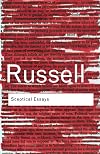
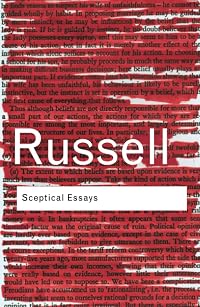
Thought-provoking and full of quotable quotes. In fact it was so tempting to give you some examples of this I would have in fact ended up quoting large parts of the whole book - which actually explains the book cover which depicts a page of text which has been completely highlighted by hand.
Russell makes the case for empiricism and rationality, pointing out that they work and recommending their use in parts of human life where they rarely seem to be applied even today. In particular his comments about books on alternative medicine, which evidence show more shows doesn't work, being published and selling well whilst books which contain the facts and warnings about dangerous alternative medicines can't even get a publisher.
Razor sharp wit abounds, some so sharp that you think he has missed his target (the candles remain in one piece and still alight after the rapier slash) but when you read on he hits the mark full on (and the still lighted top half of the candles drop to the floor).
Some of his arguments had this kind of delayed impact on me as well. His talk about "a unifying world power" is a classic example of what I mean. By the description alone his suggestion seems naive and silly but as you read on and he develops his arguments he doesn't seem that far away from where we are now.
I read this book in between burst of the last Harry Potter - I was sharing with my wife - and this seems a pretty good way to read it. To attempt it all at once may not give you chance to properly mentally digest the wide range of topics covered.
Overall this is worth the effort, and by if you intersperse it with something in a lighter vein like I accidentally did then it hardly seems like an effort at all.
3.5 out of 5 stars show less
In some ways it is hard to believe they were written in the 1920's - in other ways e.g. politically incorrect language, it is all too obvious.
Thought-provoking and full of quotable quotes. In fact it was so tempting to give you some examples of this I would have in fact ended up quoting large parts of the whole book - which actually explains the book cover which depicts a page of text which has been completely highlighted by hand.
Russell makes the case for empiricism and rationality, pointing out that they work and recommending their use in parts of human life where they rarely seem to be applied even today. In particular his comments about books on alternative medicine, which evidence show more shows doesn't work, being published and selling well whilst books which contain the facts and warnings about dangerous alternative medicines can't even get a publisher.
Razor sharp wit abounds, some so sharp that you think he has missed his target (the candles remain in one piece and still alight after the rapier slash) but when you read on he hits the mark full on (and the still lighted top half of the candles drop to the floor).
Some of his arguments had this kind of delayed impact on me as well. His talk about "a unifying world power" is a classic example of what I mean. By the description alone his suggestion seems naive and silly but as you read on and he develops his arguments he doesn't seem that far away from where we are now.
I read this book in between burst of the last Harry Potter - I was sharing with my wife - and this seems a pretty good way to read it. To attempt it all at once may not give you chance to properly mentally digest the wide range of topics covered.
Overall this is worth the effort, and by if you intersperse it with something in a lighter vein like I accidentally did then it hardly seems like an effort at all.
3.5 out of 5 stars show less
People who like Russell, like Russell! See what Russell thought were foundational issues in HIS time. He was 'anti-nuke'
100 RUS 5
Ratings
Members
- Recently Added By
Lists

The Works of Bertrand Russell
62 works; 1 member

Alan Kay's Reading List
103 works; 3 members
Author Information

431+ Works 39,547 Members
Bertrand Arthur William Russell (1872-1970) was a British philosopher, logician, essayist and social critic. He was best known for his work in mathematical logic and analytic philosophy. Together with G.E. Moore, Russell is generally recognized as one of the main founders of modern analytic philosophy. Together with Kurt Gödel, he is regularly show more credited with being one of the most important logicians of the twentieth century. Over the course of a long career, Russell also made contributions to a broad range of subjects, including the history of ideas, ethics, political and educational theory, and religious studies. General readers have benefited from his many popular writings on a wide variety of topics. After a life marked by controversy--including dismissals from both Trinity College, Cambridge, and City College, New York--Russell was awarded the Order of Merit in 1949 and the Nobel Prize for Literature in 1950. Noted also for his many spirited anti-nuclear protests and for his campaign against western involvement in the Vietnam War, Russell remained a prominent public figure until his death at the age of 97. (Bowker Author Biography) show less
Some Editions
Series
Belongs to Publisher Series
Common Knowledge
- Canonical title
- Sceptical Essays
- Original title
- Sceptical Essays; Sceptical essays
- Original publication date
- 1928
- Epigraph*
- Aimer et penser: c'est la véritable vie des esprits. (Voltaire)
- First words*
- Vorrei proporre alla benevola considerazione del lettore una teoria che potrà forse sembrare paradossale e sovversiva. La teoria è questa: che sarebbe opportuno non prestar fede a una proposizione fino a quando non vi sia u... (show all)n fondato motivo per supporla vera.
- Original language
- English
*Some information comes from Common Knowledge in other languages. Click "Edit" for more information.
Classifications
- Genres
- Philosophy, Nonfiction, General Nonfiction, Religion & Spirituality
- DDC/MDS
- 149.73 — Philosophy & psychology Philosophical schools of thought Other philosophical systems and doctrines Agnosticism Skepticism
- LCC
- B1649 .R93 .S3 — Philosophy, Psychology and Religion Philosophy (General) By period Modern By region or country
- BISAC
Statistics
- Members
- 540
- Popularity
- 55,395
- Reviews
- 5
- Rating
- (3.99)
- Languages
- 8 — English, Italian, Norwegian, Polish, Portuguese, Spanish, Swedish, Turkish
- Media
- Paper, Ebook
- ISBNs
- 26
- ASINs
- 20