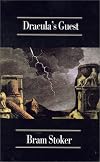
Dracula's Guest and Other Weird Tales
by Bram Stoker 
On This Page
Description
Best known for his masterpiece of horror, Dracula, Bram Stoker wrote a number of other novels and many short stories, all on supernatural themes or filled with a physical terror reminiscent of Poe.Tags
Recommendations




















Member Reviews
I confess that I have an embarrassing habit. Once every year, I devour Stoker's 'Dracula' like my very life depends upon it. As if the Prince Of Darkness, himself, sits perched upon my bedroom wall with an insidious smile lighting up his red lips.
What mortifies me is the fact that Francis Ford Coppola's envisioning of 'Dracula' amalgamates with Stoker's written word in my mind to produce a hideously malignant imagery. Who would have thought that Gary Oldman would become firmly entrenched as Dracula whenever the novel is mentioned?
But while Coppola stereotyped Dracula as a lovestruck soul looking to rip your throat (Ladies, any takers?), the beauty of Stoker's narrative lies in what you take from it. Indeed, who is Dracula? What made him show more a vampire? How did he convert his brides? We have a generation of films to fill in the blanks with directors providing their own compulsive take. But rarely do we form our own opinions.
While as a novel 'Dracula' is more tedious than summer school at a beach (the diary narrative is akin to walking on chipped glass-a tedious torture), it compels one to reflect on the escotericism of the unknown. Dracula enters our world through our blind spots, through our unknown to present us with a terrifying spectacle: that we are not omniscient. Despite our advances we still confront mystery after mystery.
Is Stoker than infecting us with nihilism if the unknown is so compellingly strong? I believe not. He reinforces the eventual triumph of morality over immorality (as we fear the unknown for it's absence of tangible/intangible elements we acknowledge), and the defeat of ignorance when one earns enough wisdom to confront the fear of the unknown.
This is what makes 'Dracula' timeless. Not the tedious narrative but it's semi-apocalyptic overtones and-let's be honest-Dracula himself. A specter loaded with infinite horrors. A product of the unknown.
And while Keanu Reeves massacred the role of Jonathan Harker in the Coppola retelling, it is the simplicity of Stoker's characters which makes the horror all the more petrifying. show less
What mortifies me is the fact that Francis Ford Coppola's envisioning of 'Dracula' amalgamates with Stoker's written word in my mind to produce a hideously malignant imagery. Who would have thought that Gary Oldman would become firmly entrenched as Dracula whenever the novel is mentioned?
But while Coppola stereotyped Dracula as a lovestruck soul looking to rip your throat (Ladies, any takers?), the beauty of Stoker's narrative lies in what you take from it. Indeed, who is Dracula? What made him show more a vampire? How did he convert his brides? We have a generation of films to fill in the blanks with directors providing their own compulsive take. But rarely do we form our own opinions.
While as a novel 'Dracula' is more tedious than summer school at a beach (the diary narrative is akin to walking on chipped glass-a tedious torture), it compels one to reflect on the escotericism of the unknown. Dracula enters our world through our blind spots, through our unknown to present us with a terrifying spectacle: that we are not omniscient. Despite our advances we still confront mystery after mystery.
Is Stoker than infecting us with nihilism if the unknown is so compellingly strong? I believe not. He reinforces the eventual triumph of morality over immorality (as we fear the unknown for it's absence of tangible/intangible elements we acknowledge), and the defeat of ignorance when one earns enough wisdom to confront the fear of the unknown.
This is what makes 'Dracula' timeless. Not the tedious narrative but it's semi-apocalyptic overtones and-let's be honest-Dracula himself. A specter loaded with infinite horrors. A product of the unknown.
And while Keanu Reeves massacred the role of Jonathan Harker in the Coppola retelling, it is the simplicity of Stoker's characters which makes the horror all the more petrifying. show less
The short stories in Dracula's Guest were compiled by Bram Stoker's widow and published in 1914, two years after his death. Nine stories are included. In my view, they range widely in quality, and in general, they do not reach the heights of Stoker's masterpiece, "Dracula". Of the stories, I found "The Judge's House" and "Burial of the Rats" to be especially notable. Understandably, they are widely reprinted in short story collections. Below are the stories, along with my rankings.
Dracula’s Guest 3*
The Judge’s House 4.5*
The Squaw 2*
The Secret of the Growing Gold 3*
The Gipsy Prophecy 3*
The Coming of Abel Behenna 2*
The Burial of the Rats 4*
A Dream of Red Hands 3*
Crooked Sands 2*
Dracula’s Guest 3*
The Judge’s House 4.5*
The Squaw 2*
The Secret of the Growing Gold 3*
The Gipsy Prophecy 3*
The Coming of Abel Behenna 2*
The Burial of the Rats 4*
A Dream of Red Hands 3*
Crooked Sands 2*
The title piece is an excised section of Dracula. Mrs S says in her preface that it was removed due to the length of the novel. I suspect though that it's excision was more provoked by the fact that it portrays Harker as an absolute muppet and really reveals far too much far too early. If you've read Dracula you my well find that the opening part, Harker's Journal, is by far the most powerful part of the book and this would interrupt the flow.
The remaining stories are for the most part overly predicable or pointless grisly stories. There are nice bits - the deaths in The Squaw are well done, for example and as Mrs S stresses, these are early and unrevised works. The humour of Crooken Sands is enjoyable too. I particularly enjoyed A show more Dream of Red Hands. I really do identify with Jacob Settle. Can't believe I'm admitting this online, but I do, so there. (I haven't actually murdered anyone.)
I think this would be most of interest to a Dracula fan. Stoker is obviously a man with something on his mind and there are elements of all the stories that put you in mind of that novel, not least of which is his obsession with the sense of dread, either in his characters or his audience. show less
The remaining stories are for the most part overly predicable or pointless grisly stories. There are nice bits - the deaths in The Squaw are well done, for example and as Mrs S stresses, these are early and unrevised works. The humour of Crooken Sands is enjoyable too. I particularly enjoyed A show more Dream of Red Hands. I really do identify with Jacob Settle. Can't believe I'm admitting this online, but I do, so there. (I haven't actually murdered anyone.)
I think this would be most of interest to a Dracula fan. Stoker is obviously a man with something on his mind and there are elements of all the stories that put you in mind of that novel, not least of which is his obsession with the sense of dread, either in his characters or his audience. show less
This is a collection of various tales, being Dracula's guest only one of them.
As for the tales themselves, my absolute favourite would definitely be the Judge's House, followed by the Dracula's Guest (which is a snippet that had been removed from Dracula).
Other noteworthy tales would also include The Squaw (extremely predictable, but with creepy imagery), The Burial of Rats (the reason for the title is pretty creepy, but lots of plus points for being the most action packed, since it features a chase scene), and The Secret of Growing Gold (reads much like a ghost story). Honourable mention for A Dream of Red Hands, which I found to be more original among the other tales, even if not exactly the most engaging. The rating would go show more something like this:
4* The Judge's House
4* Dracula's Guest
4* The Burial of Rats
3* The Squaw
3* The Secret of Growing Gold
3* A Dream of Red Hands
2* The Coming of Abel Behenna
2* The Gipsy Prophecy
2* Crooken Sands
As I said, the stories follow much the same plotline for the most part, which makes them extremely predictable when reading them all in a row. To be honest, the more stories I read, the more bored I became, because I could foresee overall what was coming. By the end, I just wanted to finish the book already, since the only story able to get me out of my 'stupor' in the second half was The Burial of Rats.
I'd still highly recommend The Judge's House and Dracula's Guest to anyone who liked Dracula however, I found those have the same wonderful eery and creepy atmosphere I loved in that book. Just those two tales alone make this book worth reading. show less
If you want to read vintage Stoker, start here - it's often agreed that Dracula's guest is better than the whole novel (though there's disagreement about whether or not he meant it to be part of the original).
Not one for reading alone in a creaky old house... particularly if it has rats.........
Not one for reading alone in a creaky old house... particularly if it has rats.........
Short story collection. The tales are nicely gruesome in general but a bit flat or too obvious. The last story might be the best and thats more of a horror comedy, but not enough to get it to 3 stars overall. The title story is a discarded piece of Dracula and a good decision to cut it in my opinion.
3.5 ★
My favorite was Dracula's Guest
You just can't compete with the aristocratic vampire.
I found some short stories more interesting than others.
They had elements of the supernatural , physical terror and always an unsettling
aura.
Since Bram Stoker wrote a number of novels and many short stories, I'll search for more.
5 AUDIO DISCS
My favorite was Dracula's Guest
You just can't compete with the aristocratic vampire.
I found some short stories more interesting than others.
They had elements of the supernatural , physical terror and always an unsettling
aura.
Since Bram Stoker wrote a number of novels and many short stories, I'll search for more.
5 AUDIO DISCS
Members
- Recently Added By
Lists

Books Read in 2019
4,052 works; 110 members

Jones & Newman: Best Horror Books Further Recommended Reading
577 works; 4 members
Author Information

620+ Works 62,373 Members
Bram Stoker was born in Dublin, Ireland on November 8, 1847. He was educated at Trinity College. He worked as a civil servant and a journalist before becoming the personal secretary of the famous actor Henry Irving. He wrote 15 works of fiction including Dracula, The Lady of the Shroud, and The Lair of the White Worm, which was made into film. He show more died on April 20, 1912. (Bowker Author Biography) show less
Bram Stoker has a Legacy Library. Legacy libraries are the personal libraries of famous readers, entered by LibraryThing members from the Legacy Libraries group.
Some Editions
Series
Belongs to Publisher Series
Work Relationships
Is contained in
Contains
Common Knowledge
- Canonical title
- Dracula's Guest and Other Weird Tales
- Original title
- Dracula's Guest and Other Weird Tales
- Alternate titles
- Dracula's Guest
- Original publication date
- 1914
- People/Characters
- Jonathan Harker; Dracula; Herr Delbrück; Johann (the coach driver)
- Important places
- Munich, Bavaria, Germany; Prague, Czech Republic
- Important events
- Walpurgis Night
- Dedication
- to my son
- First words
- When we started for our drive the sun was shining brightly on Munich, and the air was full of the joyousness of early summer.
- Last words
- (Click to show. Warning: May contain spoilers.)I am encouraged to think that he may have been in your neighbourhood as, though his letter is not dated, the envelope is marked with the postmark of "Yellon" which I find is in Aberdeenshire, and not far from the Mains of Crooken. 'I have the honour to be, dear sir, Yours very respectfully, Joshua Sheeny Cohen Benjamin (The MacCallum More)
- Original language
- English
- Canonical DDC/MDS
- 823.087381
- Disambiguation notice
- This collection of 9 short stories has been released under a number of variant titles. The title story Dracula's Guest also exists as a standalone work.
Classifications
- Genres
- Fiction and Literature, Horror
- DDC/MDS
- 823.087381 — Literature & rhetoric English & Old English literatures English fiction By type Genre fiction Adventure fiction Horror and ghost fiction Horror fiction Vampires and the undead
- LCC
- PR6037 .T617 — Language and Literature English English Literature 1900-1960
- BISAC
Statistics
- Members
- 765
- Popularity
- 36,825
- Reviews
- 20
- Rating
- (3.61)
- Languages
- 8 — Czech, English, Finnish, French, German, Polish, Portuguese, Spanish
- Media
- Paper, Audiobook, Ebook
- ISBNs
- 132
- UPCs
- 1
- ASINs
- 25