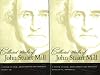
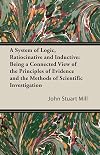
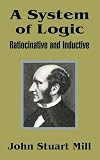
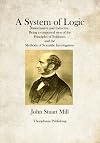
A System of Logic
by John Stuart Mill
On This Page
Description
This two-volume work, first published in 1843, was John Stuart Mill's first major book. It reinvented the modern study of logic and laid the foundations for his later work in the areas of political economy, women's rights and representative government. In clear, systematic prose, Mill disentangles syllogistic logic from its origins in Aristotle and scholasticism and grounds it in processes of inductive reasoning. An important attempt at integrating empiricism within a more general theory of show more human knowledge, the work is for anyone seeking a full understanding of Mill's thought. Volume 1 contains Mill's introduction, which elaborates upon his definition of logic as 'not the science of Belief, but the science of Proof, or Evidence'. It also discusses the central components of logical reasoning - propositions and syllogisms - in relation to Mill's theories of inductive reasoning and experimental method. show lessTags
Recommendations























Member Reviews
John Stuart Mill is a smart man. Maybe even too smart, as this book reveals, with its 622 pages on the workings of science. Mill traces how science can go from observations to inductions to deductions. It's solid, if exhausting, work, never missing a step, concept, or idea along the way. I find it interesting the way that Mill splits out the act of observation from logic, saying that it precedes reasoning. A useful warning, I think, for those of us who might want to think that all scientific acts are logical ones.
His dedication to the human and the ethical in all this is the most striking; he hopes science will show us that men and women are not all that different, and he argues that many generalizations about man and society assume show more that human nature never changes-- an argument that would later be one of the bases of On Liberty.
I used a lot of judicious skimming to get through this book quickly (I was reading it for my qualifying exams), but when I read some of the prose aloud to explain its tortured quality to comrades, I realized it wasn't tortured at all. Despite some difficult, theoretical subject matter, Mill writes attractively. Who else could make logic sound so beautiful? show less
His dedication to the human and the ethical in all this is the most striking; he hopes science will show us that men and women are not all that different, and he argues that many generalizations about man and society assume show more that human nature never changes-- an argument that would later be one of the bases of On Liberty.
I used a lot of judicious skimming to get through this book quickly (I was reading it for my qualifying exams), but when I read some of the prose aloud to explain its tortured quality to comrades, I realized it wasn't tortured at all. Despite some difficult, theoretical subject matter, Mill writes attractively. Who else could make logic sound so beautiful? show less
Front page has fallen out but I have it, other than that it is in pretty good shape.
Ratings
Members
- Recently Added By
Lists

Trinity College Booklist (1951): Class Three, Philosophy and Religion
80 works; 3 members

How to Read a Book's Recommended Reading List
309 works; 10 members
Author Information

299+ Works 19,752 Members
John Stuart Mill, Classical economist, was born in 1806. His father was the Ricardian economist, James Mill. John Stuart Mill's writings on economics and philosophy were prodigious. His "Principles of Political Economy, With Some of Their Applications to Social Philosophy," published in 1848, was the leading economics textbook of the show more English-speaking world during the second half of the 19th century. Some of Mill's other works include "Considerations on Representative Government," "Auguste Comte and Positivism," "The Subjection of Women," and "Three Essays on Religion." John Mill died in 1873. (Bowker Author Biography) show less
Some Editions
Series
Belongs to Publisher Series
Work Relationships
Common Knowledge
- Canonical title
- A System of Logic
- Original title
- A System of Logic, Ratiocinative and Inductive; Being a Connected View of the Principles of Evidence, and the Methods of Scientific Investigation
- Original publication date
- 1843
- First words
- It is so much the established practice of writers on logic to commence their treatises by a few general observations (in most cases, it is true, rather meagre) on Terms and their varieties, that it will, perhaps, scarcely be ... (show all)required from me, in merely following the common usage, to be as particular in assigning my reasons, as it is usually expected that those should be who deviate from it.
- Last words
- (Click to show. Warning: May contain spoilers.)I have indulged the hope that to some of those on whom the task will devolve of bringing those most important of all sciences into a more satisfactory state, these observations may be useful, both in removing erroneous, and in clearing up the true, conceptions of the means by which, on subjects of so high a degree of complication, truth can be attained. Should this hope be realized, what is probably destined to be the great intellectual achievement of the next two or three generations of European thinkers will have been in some degree forwarded.
- Disambiguation notice
- This work should be those editions where A System of Logic is published as a single work, whether that work is one volume or two. It should not include Logics that are part of a wider boxed set (e.g. of Mill's complete works... (show all)) or where the Logic has been published in two parts purchased seperately. This may take some time to get right!
Classifications
Statistics
- Members
- 211
- Popularity
- 155,276
- Reviews
- 2
- Rating
- (3.60)
- Languages
- English, German, Italian, Portuguese
- Media
- Paper, Ebook
- ISBNs
- 44
- ASINs
- 20