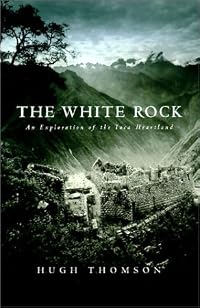
The White Rock: An Exploration of the Inca Heartland
by Hugh Thomson
On This Page
Description
More than twenty years ago, acclaimeddocumentary filmmaker and explorer Hugh Thomson first set off into the Peruviancloud forest on foot, to find a ruin called Llactapata which, although it hadbeen discovered by Hiram Bingham in 1912, had been "lost" again.Tags
Recommendations














Member Recommendations
Member Reviews
Erudite and entertaining, that is what travel books need to be. “The White Rock” (2001) by Hugh Thomson is exactly that. In 1982, still somewhere in his 20s, Mr. Thomson goes to Peru to re-discover an Inca ruin that was found, then lost again. This he achieves within the first 50 pages, or so, of the book, but luckily for us he spends the rest of his time looking for more, and traveling the old Inca empire. In the process, he comments on his interpretation of Inca ruins, the steep trails, the magnificent views, on the Inca past as it has been pieced together, and about the many adventurers who preceded him, foremost the “discoverer” of Machu Picchu, Hiram Bingham. In the process, he cleverly weaves together the history of the show more Incas, rise and internal strife, as well as rapid decline after the Spanish invasion. He returns in 1999, to finish where he left off, and pursue his quest for the latest Inca sites, pushed deepest into the jungle, and the ultimate fall of the last Inca. Great book, both before and during a trip to Peru! show less
This wonderful book combines the author's descriptions of his travels through a broad swath of Inca territory, deep insights into what's true and what's not true about Inca cultures and history, thoughtful comments on various explorers, anthropologists, and artists, and a lively writing style and interesting characters. It is a great introduction to the Inca world, and I was pleased to find an extensive glossary and bibliography, as well as a chronology, an Inca genealogy, photographs, and helpful maps.
At the age of 21, in 1981, and somewhat on a whim, Thomson traveled to Peru to find one of the "lost" cities of the Incas. Traveling the length and breadth of the Inca empire (which at its height stretched from Ecuador to Bolivia, show more although centered in the Andean heights of Peru), he met anthropologists, the local people, explorers, and more, and needless to say encountered various challenges. Some of the people he met were fascinating, such as the daughter of a photographer who took thousands of images of Inca ruins and people from the 20s up to 1950 when an earthquake destroyed many of his glass plates. As he recounts his travels, Thompson comes to realize that much of what we "know" about the Inca is not supported by evidence. As he says in his introduction (written after a return trip to the area many years later):
"As a powerful mythopoeic base on which to build fantasies of confrontation with an alien culture, the Inca world has few rivals. But just as the lure of the Inca myth has increased, so any actual understanding of the Inca themselves has become obscured, let alone of the nature of exploration in the Andes.
The White Rock is an attempt to present a clear-sighted view of that Inca culture, drawing on my journeys throughout the Inca heartland near Cuzco and across the vast empire they created. Along the way I travelled to some of the most remote Inca sites and talked to leading archaeologists and explorers working in the area.
As I did so, I became more and more aware of the discrepancy between popular preconceptions about the Inca and the actual evidence on the ground. . .
The very familiarity of Machu Picchu causes problems and can lead us to forget how very little we know about the people who built the place . . . I have taken Chuquipalta -- the "White Rock" of the title, deep in the Vilcabamba -- as being emblematic of that hidden and lost Inca world which is rarely visited and which I have tried to explore."
Throughout the book, Thomson emphasizes the people who built the famous and forgotten sites -- and in many cases their exploitation. For the Inca achieved their empire as so many others have, by conquering other tribes and then moving their members around to do the heavy lifting for them (and in the case of the Inca, moving huge rocks was literally heavy lifting). Among the building tasks were the famous Inca highway, stone roads, occasionally 10 feet wide, that snaked up and down the mountains and along ridges over hundreds of miles, a network of roads that the Andean nations are today trying to preserve (see this recent New York Times article.) Needless to say, the conquered tribes hated the Inca and thus tended to side with the Spanish conquistadors. Thomson has nothing good to say about the conquistadors, who were particularly brutal in Peru (although the Inca didn't take enough advantage of their high ground and the difficulty of bringing the Spanish horses up stone steps), and their successors who exploited the remaining Indians for mining under horrific conditions.
Among the interesting topics Thomson discusses are the role of the cities the Inca built; they were not mostly religious, as is commonly thought, but were often created because each new emperor had to build a new palace (the old emperor remained, mummified, in his old palace) and as vacation spots for the rulers. He also meditates on the stupendous views at many of these sites, and why the Incas may have chosen them, and their talented and magnificent use of stone work. He discusses the trading networks, with high-altitude crops exchanged for those from lower down from both the jungle and the sea, and explores why people now can't attain the level of agricultural productivity enjoyed by the Inca. He notes that no explorer would have "discovered" any of these ancient sites without the assistant of local guides who always knew they were there; talks about the work of various archaeologists including one, who he spent some time with on his initial journey, who helped local people rebuild the old irrigation canals; discusses the history of the Inca as they maintained their last stand against the conquistadors in a remote ares; and describes his travels, including adventures with buses, trucks, mules, people, food, and drink vividly.
This is a very rich book, filled with all kinds of information about the Inca and their culture, mixed with a lively appreciation of all the people who helped the young explorer. I learned a lot and I thoroughly enjoyed the journey. show less
At the age of 21, in 1981, and somewhat on a whim, Thomson traveled to Peru to find one of the "lost" cities of the Incas. Traveling the length and breadth of the Inca empire (which at its height stretched from Ecuador to Bolivia, show more although centered in the Andean heights of Peru), he met anthropologists, the local people, explorers, and more, and needless to say encountered various challenges. Some of the people he met were fascinating, such as the daughter of a photographer who took thousands of images of Inca ruins and people from the 20s up to 1950 when an earthquake destroyed many of his glass plates. As he recounts his travels, Thompson comes to realize that much of what we "know" about the Inca is not supported by evidence. As he says in his introduction (written after a return trip to the area many years later):
"As a powerful mythopoeic base on which to build fantasies of confrontation with an alien culture, the Inca world has few rivals. But just as the lure of the Inca myth has increased, so any actual understanding of the Inca themselves has become obscured, let alone of the nature of exploration in the Andes.
The White Rock is an attempt to present a clear-sighted view of that Inca culture, drawing on my journeys throughout the Inca heartland near Cuzco and across the vast empire they created. Along the way I travelled to some of the most remote Inca sites and talked to leading archaeologists and explorers working in the area.
As I did so, I became more and more aware of the discrepancy between popular preconceptions about the Inca and the actual evidence on the ground. . .
The very familiarity of Machu Picchu causes problems and can lead us to forget how very little we know about the people who built the place . . . I have taken Chuquipalta -- the "White Rock" of the title, deep in the Vilcabamba -- as being emblematic of that hidden and lost Inca world which is rarely visited and which I have tried to explore."
Throughout the book, Thomson emphasizes the people who built the famous and forgotten sites -- and in many cases their exploitation. For the Inca achieved their empire as so many others have, by conquering other tribes and then moving their members around to do the heavy lifting for them (and in the case of the Inca, moving huge rocks was literally heavy lifting). Among the building tasks were the famous Inca highway, stone roads, occasionally 10 feet wide, that snaked up and down the mountains and along ridges over hundreds of miles, a network of roads that the Andean nations are today trying to preserve (see this recent New York Times article.) Needless to say, the conquered tribes hated the Inca and thus tended to side with the Spanish conquistadors. Thomson has nothing good to say about the conquistadors, who were particularly brutal in Peru (although the Inca didn't take enough advantage of their high ground and the difficulty of bringing the Spanish horses up stone steps), and their successors who exploited the remaining Indians for mining under horrific conditions.
Among the interesting topics Thomson discusses are the role of the cities the Inca built; they were not mostly religious, as is commonly thought, but were often created because each new emperor had to build a new palace (the old emperor remained, mummified, in his old palace) and as vacation spots for the rulers. He also meditates on the stupendous views at many of these sites, and why the Incas may have chosen them, and their talented and magnificent use of stone work. He discusses the trading networks, with high-altitude crops exchanged for those from lower down from both the jungle and the sea, and explores why people now can't attain the level of agricultural productivity enjoyed by the Inca. He notes that no explorer would have "discovered" any of these ancient sites without the assistant of local guides who always knew they were there; talks about the work of various archaeologists including one, who he spent some time with on his initial journey, who helped local people rebuild the old irrigation canals; discusses the history of the Inca as they maintained their last stand against the conquistadors in a remote ares; and describes his travels, including adventures with buses, trucks, mules, people, food, and drink vividly.
This is a very rich book, filled with all kinds of information about the Inca and their culture, mixed with a lively appreciation of all the people who helped the young explorer. I learned a lot and I thoroughly enjoyed the journey. show less
The author is a British documentary film-maker/traveler historian. In the 1980s he launched an expedition into the Peruvian cloud forest to find an Inca ruin called Llactapata by the conquistadores, or Chuquipalta by the Inca. He found this profound temple -- the principal mochadero -- and many other ruins, and then researched "what it means".
Thompson does not merely describe the world, but explores its totemic uses and meanings. "We are used to the idea that the Incas quite literally worshipped stone, but few question why. "[187] Why did the Inca carve so much rock so well? The abundant and widespread carving of rock huacas were clearly designed for worship--many in shrines or montanas.
Thompson visited many lost cities and retraced show more the paths of the ancients and the conquistadores and traders. This book is not only an adventure travelogue, but also interwoven with cultural history and colorful personal anecdotes. Fluent in Spanish, with an interest in Quechua, and with the vast conspiracy of life in the Andes and the jungles, Thompson provides a cinematic, even eliptically spiritual, narrative. He revisits the earlier expeditions and work of many others -- from the nasty Pizarro brothers and the worse Aguirre, to the scholars such as Hiram Bingham, and the priestly Las Casas, scandal-mongering Calancha, and the documentarians, Dias, and Galeano. He is not familiar with many anthropologists or earlier Franciscans, such as Armentia. We enjoy frequent literary asides cast to Dante, Shakespeare, and even religious and popular icons.
I deeply appreciate the informed interconnectedness in time and space which Thompson draws us into: "...the enormous wealth that Potosi created for the Spanish Emperor...fuelled further misery in Europe with the prosecution of Spain's European wars. Potosi is a terrible reminder of how the Dark Ages continued past the Renaissance and of how the Spanish Conquest ended. It was to the sixteenth century what Auschwitz was to the twentieth." [117]
He also highlights the new frontiers of exploration in the sciences and biological realms, while noting that the archeology itself is far from having been completed. He concludes: "But the real appeal is that there are clearly still ruins waiting to be found out there: the cloud-forest and the Amazon have by no means given up all their secrets. Whether in Chachapoyas, where new finds are being made on a regular basis, in the more remote areas of the jungle Antisuyo or, just as importantly, in the forgotten recesses of libraries and archives, one thing is almost certain: the twenty-first century will see new discoveries being made, and with those new discoveries will come more knowledge of the Incas and their extraordinary Empire."
With Index, maps, chronology, Inca geneology, illustrations, b/w photographs, bibliography, and an interesting "Notes" section. This is a treasury. show less
Thompson does not merely describe the world, but explores its totemic uses and meanings. "We are used to the idea that the Incas quite literally worshipped stone, but few question why. "[187] Why did the Inca carve so much rock so well? The abundant and widespread carving of rock huacas were clearly designed for worship--many in shrines or montanas.
Thompson visited many lost cities and retraced show more the paths of the ancients and the conquistadores and traders. This book is not only an adventure travelogue, but also interwoven with cultural history and colorful personal anecdotes. Fluent in Spanish, with an interest in Quechua, and with the vast conspiracy of life in the Andes and the jungles, Thompson provides a cinematic, even eliptically spiritual, narrative. He revisits the earlier expeditions and work of many others -- from the nasty Pizarro brothers and the worse Aguirre, to the scholars such as Hiram Bingham, and the priestly Las Casas, scandal-mongering Calancha, and the documentarians, Dias, and Galeano. He is not familiar with many anthropologists or earlier Franciscans, such as Armentia. We enjoy frequent literary asides cast to Dante, Shakespeare, and even religious and popular icons.
I deeply appreciate the informed interconnectedness in time and space which Thompson draws us into: "...the enormous wealth that Potosi created for the Spanish Emperor...fuelled further misery in Europe with the prosecution of Spain's European wars. Potosi is a terrible reminder of how the Dark Ages continued past the Renaissance and of how the Spanish Conquest ended. It was to the sixteenth century what Auschwitz was to the twentieth." [117]
He also highlights the new frontiers of exploration in the sciences and biological realms, while noting that the archeology itself is far from having been completed. He concludes: "But the real appeal is that there are clearly still ruins waiting to be found out there: the cloud-forest and the Amazon have by no means given up all their secrets. Whether in Chachapoyas, where new finds are being made on a regular basis, in the more remote areas of the jungle Antisuyo or, just as importantly, in the forgotten recesses of libraries and archives, one thing is almost certain: the twenty-first century will see new discoveries being made, and with those new discoveries will come more knowledge of the Incas and their extraordinary Empire."
With Index, maps, chronology, Inca geneology, illustrations, b/w photographs, bibliography, and an interesting "Notes" section. This is a treasury. show less
A well-crafted hybrid of memoir, travel book and history. It begins with Thomson's quixotic decision as a 21-year-old, untrained, to go to Peru and re-find an Inca ruin that had been discovered, then lost again. In the decades since, he's become a more seasoned explorer and a documentary filmmaker, and his love for the mountainous areas of Peru is a constant.
Interwoven with his descriptions of the beautiful, punishing terrain and the abandoned complexes of the Inca are anecdotes of the bizarre characters that have explored the area, the relationship between people of the mountains and of the jungle, the demands of outsiders' tourism and spirituality on the Inca's image, and the often forgotten history of the Inca's last stand. The sites show more he explores are part of their "rump kingdom", the Vilcabamba, from which they held off the Spanish for decades with guerrilla tactics and cagey diplomacy. While unlike the reviewer from The New York Times Book Review, I am content to remain an 'armchair traveler' and leave these treks to Thomson, I am inspired to read further on the fascinating history of the Inca. show less
Interwoven with his descriptions of the beautiful, punishing terrain and the abandoned complexes of the Inca are anecdotes of the bizarre characters that have explored the area, the relationship between people of the mountains and of the jungle, the demands of outsiders' tourism and spirituality on the Inca's image, and the often forgotten history of the Inca's last stand. The sites show more he explores are part of their "rump kingdom", the Vilcabamba, from which they held off the Spanish for decades with guerrilla tactics and cagey diplomacy. While unlike the reviewer from The New York Times Book Review, I am content to remain an 'armchair traveler' and leave these treks to Thomson, I am inspired to read further on the fascinating history of the Inca. show less
A supple, idiosyncratic memoir about the author's early forays into the Cordillera Vilcabamba, refuge of the Inca royalty who survived the initial onslaught by the Spanish conquistadors. Thomson is an engaging stylist, as savvy about Inca history and architecture as he is about modern politics, biting flies, and American ex-pats, and his stories of exploring ruins are both erudite and amusing.
Hugh Thomson first went to Peruvian Andes at the age of 22. He was seeking a ruin that had been discovered a while ago, before being lost to time again. As a fresh faced youth, he found the Inca people and the places he visited compelling, confusing but most of all intoxicating. Walking in the footsteps of the great explorers, such as Bingham, who discovered Machu Picchu and Chambi a famous South American photographer, he travels across plains, over mountains and hacks through jungles in search of the people of this land. However, this book is more than that; it is a personal journey back through time to see the sights of the ancient civilisation and to learn of how it was destroyed by the brutal Spanish conquistadors.
Drawing on his show more experience of making documentaries Thomson has woven together the historical account of the Incas along with details of his two expeditions to the South American continent. As he went several times with a substantial gap in between the first and second visits, he has split his account over two sections. In each part, he writes about the people and places, the heart stopping moments when travelling in the mountains and jungles and of life in the towns and villages in Peru. The first trip was with two friends, but later he went alone, employing guides to accompany him as he sought the hidden world of the Inca. Whilst this is good, and I enjoyed it, I didn’t think it was as good as Tequila Oil, his trip to Mexico. Still worth reading though for an insight into the modern lands that sit on so much history. show less
Drawing on his show more experience of making documentaries Thomson has woven together the historical account of the Incas along with details of his two expeditions to the South American continent. As he went several times with a substantial gap in between the first and second visits, he has split his account over two sections. In each part, he writes about the people and places, the heart stopping moments when travelling in the mountains and jungles and of life in the towns and villages in Peru. The first trip was with two friends, but later he went alone, employing guides to accompany him as he sought the hidden world of the Inca. Whilst this is good, and I enjoyed it, I didn’t think it was as good as Tequila Oil, his trip to Mexico. Still worth reading though for an insight into the modern lands that sit on so much history. show less
Having been to Machu Picchu twice, this book is interesting in a casual way. Hugh Thompson was a university age English self-styled explorer with no experience when he went to Peru and managed to blunder (with a native guide) onto the site of a ruin that had been "lost" for 70 years. In true collegiate fashion, he seemed to have been as interested in how much alcohol they had to drink on their expeditions as in finding ruins, and little desire to actually study them.
However, the most intersting part of the book was the theories about why the Incas built Machu Picchu and other sites high in the mountains away from easy access to water and other amenities of the day. Since I get tired of archealolgists saying that everything they find is show more either religious or sexual or both, his theories were a refreshing change. show less
However, the most intersting part of the book was the theories about why the Incas built Machu Picchu and other sites high in the mountains away from easy access to water and other amenities of the day. Since I get tired of archealolgists saying that everything they find is show more either religious or sexual or both, his theories were a refreshing change. show less
Members
- Recently Added By
Author Information

Series
Belongs to Publisher Series
Common Knowledge
- Original title
- White Rock
- Important places
- Machu Picchu, Peru; Inca Empire
- First words
- The only sound is the inchoate cry of the arrieros moving through the high ridges to either side of me as we fan across the slope, losing sight of each other for long minutes in the body of the mountain.
- Quotations
- ...the enormous wealth that Potosi created for the Spanish Emperor...fuelled further misery in Europe with the prosecution of Spain's European wars. Potosi is a terrible reminder of how the Dark Ages continued past the Renais... (show all)sance and of how the Spanish Conquest ended. It was to the sixteenth century what Auschwitz was to the twentieth. [117]
We are used to the idea that the Incas quite literally worshipped stone, but few question why. [187] - Last words
- (Click to show. Warning: May contain spoilers.)But the real appeal is that there are clearly still ruins waiting to be found out there: the cloud-forest and the Amazon have by no means given up all their secrets. Whether in Chachapoyas, where new finds are being made on a regular basis, in the more remote areas of the jungle Antisuyo or, just as importantly, in the forgotten recesses of libraries and archives, one thing is almost certain: the twenty-first century will see new discoveries being made, and with those new discoveries will come more knowledge of the Incas and their extraordinary Empire.
- Blurbers
- Cockayne, Isabel
- Original language
- English
- Disambiguation notice
- Hugh Thompson is a British documentary film-maker/travel-writer, information at www.thewhiterock.co.uk.
Classifications
Statistics
- Members
- 253
- Popularity
- 127,647
- Reviews
- 9
- Rating
- (3.77)
- Languages
- Czech, English, Hungarian, Polish
- Media
- Paper, Ebook
- ISBNs
- 10
- ASINs
- 5