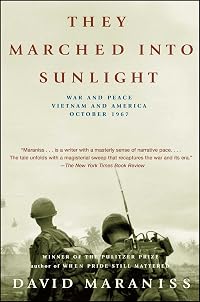
They Marched Into Sunlight: War and Peace Vietnam and America October 1967
by David Maraniss
On This Page
Description
Here is the epic story of Vietnam and the sixties told through the events of a few tumultuous days in October 1967. Maraniss weaves together three very different worlds of that time: the death and heroism of soldiers in Vietnam, the anger and anxiety of antiwar students back home, and the confusion and obfuscating behavior of officials in Washington. In the Long Nguyen Secret Zone of Vietnam, a renowned battalion of the First Infantry Division is marching into a devastating ambush that will show more leave sixty-one soldiers dead and an equal number wounded. On the University of Wisconsin campus in Madison, students are staging an obstructive protest at the Commerce Building against recruiters for Dow Chemical Company, makers of napalm and Agent Orange, that ends in a bloody confrontation with Madison police. And in Washington, President Lyndon Johnson is dealing with pressures closing in on him from all sides and lamenting to his war council, "How are we ever going to win?" Based on thousands of primary documents and 180 on-the-record interviews, the story unfolds day by day, hour by hour, and at times minute by minute, with a rich cast of characters -- military officers, American and Viet Cong soldiers, chancellors, professors, students, police officers, businessmen, mime troupers, a president and his men, a future mayor and future vice president -- moving toward battles that forever shaped their lives and evoked cultural and political conflicts that reverberate still. show lessTags
Recommendations


















Member Reviews
This thoroughly researched and captivating book presents events that occurred on two days in October 1967, both related to the Vietnam War. It focuses on a key battle in Vietnam and on the antiwar protests that occurred at the same time on the University of Wisconsin campus in Madison. The battle account describes the ambush of an infantry division by the Vietcong which resulted in the deaths of 64 soldiers and 75 wounded on the American side. Maraniss contrasts this with the Dow Chemical protests in Madison that led to a riot resulting in numerous injuries in the police’s brutal response. In each case, the reader is introduced to the key players in the events about to unfold. It is this rich detail that makes these two stories so show more engaging. Despite the large casts of characters, by the book’s end, all are familiar and fully drawn.
Drawing upon a trove of primary documents and close to 200 interviews, the author does a marvelous job of capturing the mood of the time among American servicemen in Vietnam and the students on an American campus. He also provides a brief overview of the later situations of the individuals profiled, updated to the book’s publication in 2003. In the final pages, Maraniss poignantly recounts a journey of one of the soldiers wounded in the 1967 ambush, in which he meets the commander of the Vietcong battalion his unit faced that day.
Having grown up in Madison, Maraniss puts his knowledge to good use. By juxtaposing the campus riots with a war’s heartbreaking ambush taking place on the same day, he has created a must read classic which condenses two days into a wider picture. Two thumbs up. show less
Drawing upon a trove of primary documents and close to 200 interviews, the author does a marvelous job of capturing the mood of the time among American servicemen in Vietnam and the students on an American campus. He also provides a brief overview of the later situations of the individuals profiled, updated to the book’s publication in 2003. In the final pages, Maraniss poignantly recounts a journey of one of the soldiers wounded in the 1967 ambush, in which he meets the commander of the Vietcong battalion his unit faced that day.
Having grown up in Madison, Maraniss puts his knowledge to good use. By juxtaposing the campus riots with a war’s heartbreaking ambush taking place on the same day, he has created a must read classic which condenses two days into a wider picture. Two thumbs up. show less
I did not want to read this book, chosen by my book club, but I am very glad I did. Maraniss shines a steady light on the Vietnam war and its consequences (for Americans, mostly). He drew me into the moment of his story and that led to me reflecting on my experience of the Sixties. A truly excellent book!
(posted on my blog: davenichols.net)
Few eras in US history contain the dichotomic events which were widespread during the late 1960s. In David Maraniss's book The Marched Into Sunlight, a fascinating narrative presents parallel stories of US Army soldiers being killed in the devastating abush at Ong Thanh, Vietnam, and the violence which exploded out of a student protest of napalm-manufacturer Dow Chemical Company on the campus of Wisconsin-Madison. These events, which took place over the course of just two days, provide a fascinating dual myopic capable of framing the chaos and distress so often felt by those who lived it. Maraniss's treatment of these events is humane, vivid, and completely engaging from the very beginning.
One of the show more parallel stories involves a battalion of US 1st Army soldiers, most of whom are draftees or draft-pressured enlistees who are entering the Vietnamese theater for the first time. A handful of experienced NCOs and a couple of capable leaders are all that stand between these men and crippling terror at times, though as events would later show, many of these same soldiers would demonstrate extraordinary courage and resolve in the face of tremendous fear, screams of dying friends, and sheets of hot lead.
The key battle for most of these men, and the only one covered in detail in Sunlight, was the ambush near the Ong Thanh river, where a full regiment of NVA troops decimated two and a half undersized companies of 1st Army soldiers. Maraniss's description of the battle makes the reader claustrophobic and anguished as the reality of the situation becomes clear. One of the most heart-breaking descriptions of military defeat I've read, the pain and horror of the experience conveys as well as any writing possibly can.
The other parallel story being told here involves student protesters during an especially-heated day in Madison, Wisconsin. Taking place the day after the ambush at Ong Thanh, the protest against the Dow Chemical Company started with aggressive protest leaders attempting to walk a fine line between peaceful hindrance and agitated confrontation. After a few terrible tactical decisions by campus leaders and city police officers, violence breaks out as police attempt to remove protesters from a building. As billy clubs pound the students, the violent situation explodes, with dozens of students and police injured and severe consequences resulting from the day's events.
Peppered with glimpses into LBJ's White House and top Army brass, Maraniss weaves a narrative which will suck in any reader interested in military history, social history, or the 1960s. Fascinating and in-depth portrayals of many people involved in each event await the reader, and the result is a book which is unique, haunting, and highly-recommended to all. One of the best narratives of war and history I've read this year. Five stars. show less
Few eras in US history contain the dichotomic events which were widespread during the late 1960s. In David Maraniss's book The Marched Into Sunlight, a fascinating narrative presents parallel stories of US Army soldiers being killed in the devastating abush at Ong Thanh, Vietnam, and the violence which exploded out of a student protest of napalm-manufacturer Dow Chemical Company on the campus of Wisconsin-Madison. These events, which took place over the course of just two days, provide a fascinating dual myopic capable of framing the chaos and distress so often felt by those who lived it. Maraniss's treatment of these events is humane, vivid, and completely engaging from the very beginning.
One of the show more parallel stories involves a battalion of US 1st Army soldiers, most of whom are draftees or draft-pressured enlistees who are entering the Vietnamese theater for the first time. A handful of experienced NCOs and a couple of capable leaders are all that stand between these men and crippling terror at times, though as events would later show, many of these same soldiers would demonstrate extraordinary courage and resolve in the face of tremendous fear, screams of dying friends, and sheets of hot lead.
The key battle for most of these men, and the only one covered in detail in Sunlight, was the ambush near the Ong Thanh river, where a full regiment of NVA troops decimated two and a half undersized companies of 1st Army soldiers. Maraniss's description of the battle makes the reader claustrophobic and anguished as the reality of the situation becomes clear. One of the most heart-breaking descriptions of military defeat I've read, the pain and horror of the experience conveys as well as any writing possibly can.
The other parallel story being told here involves student protesters during an especially-heated day in Madison, Wisconsin. Taking place the day after the ambush at Ong Thanh, the protest against the Dow Chemical Company started with aggressive protest leaders attempting to walk a fine line between peaceful hindrance and agitated confrontation. After a few terrible tactical decisions by campus leaders and city police officers, violence breaks out as police attempt to remove protesters from a building. As billy clubs pound the students, the violent situation explodes, with dozens of students and police injured and severe consequences resulting from the day's events.
Peppered with glimpses into LBJ's White House and top Army brass, Maraniss weaves a narrative which will suck in any reader interested in military history, social history, or the 1960s. Fascinating and in-depth portrayals of many people involved in each event await the reader, and the result is a book which is unique, haunting, and highly-recommended to all. One of the best narratives of war and history I've read this year. Five stars. show less
This is a very personal history since I went up to the University of Wisconsin in the fall of 1967 and experienced some of the moments chronicled in this history. Well-written and made more interesting by the contrast of the Vietnam experience with that of students at Madison, Wisconsin.
October, 1967 is when I arrived in Vietnam. Thought it would be an interesting read. It was very interesting. Mostly the parts about the protesting and organizing that developed in Madison, University of Wisc. Something I was aware of, but did not understand the depth of the of the anger and response on each side. The military portion was also of interest about the battalion size engaggement with a VC regiment. Errors in military judgment on the US side; efforts to somewhat cover up the mishandling of the battle on US commanders. The skill with which the VC setup and executed the ambush demonstrated their abilities and willingness to fight. More so that we were led to believe at the time. Well researched and well written.
Getting to know the members of the Black Lion army battalion makes the battle scene in which 61 of them died even more harrowing making the statement of one member ("The whole damn war is run by the book and Charlie can't read English so he gets all the breaks and we usually get killed) even more fitting. The second half of the book chronicles the riot against Dow Chemical at the University of Wisconsin Madison and the impact it had on the faculty student relationship. Vivid reminders of why war is not good for anyone.
I have a pretty close connection to this book's subject matter -- my father was stationed in Vietnam at the same place where the action in the book takes place, and I attended the University of Wisconsin-Madison. That's what initially drew me to the book, but the clear and yet descriptive writing style, coupled with the interesting subject matter, kept me reading. I normally don't have a lot of patience for nonfiction, and this book definitely isn't short. It took me quite awhile to finish it, but it's totally worth it.
Members
- Recently Added By
Lists

THE WAR ROOM
813 works; 24 members
Author Information

15+ Works 4,436 Members
David Maraniss is a Pulitzer Prize winning journalist who chronicled the Clinton era during his time at the Washington Post. After leaving the Washington Post, Maraniss wrote "First in His Class," a book about Clinton that won the American Society of Newspaper Editors Jesse Laventhal Prize. He has also published "The Clinton Enigma," a book show more interpreting the Clinton scandal. (Bowker Author Biography) show less
All Editions
Some Editions
Awards and Honors
Awards
Distinctions
Notable Lists
Common Knowledge
- Original title
- They Marched Into Sunlight: War and Peace, Vietnam and America, October 1967
- Original publication date
- 2003
- People/Characters
- Terry de la Mesa Allen, Jr.; Jim George; Clark Welch; Don Holleder; Vo Minh Triet; Paul Soglin (show all 13); Lyndon Baines Johnson; William H. Sewall; Joseph F. Kauffman; Ralph Hanson; Black Lions; Jonathan Stielstra; John Hancock Hay
- Important places
- Vietnam; University of Wisconsin-Madison; Washington, D.C., USA; Long Nguyen Secret Zone, Vietnam; Madison, Wisconsin, USA; Lai Khe, Vietnam
- Important events
- Vietnam War; Anti-Vietnam War movement; University of Wisconsin-Madison student protest against Dow Chemical Company (1967); Battle of Ong Thanh (1967)
- Related movies
- They Marched Into Sunlight (2013 | IMDb)
- Epigraph
- Some say that we shall never know and that to the Gods are like flies that the boys kill on a summer day, and some say, on the contrary, that the very sparrows do not lose a feather that has not been brushed away by the finge... (show all)r of God.
-- Thorton Wilder, The Bridge of San Luis Rey
Whatever may be the limitations which trammel inquiry elsewhere, we believe that the great state University of Wisconsin should ever encourage that continual and fearless sifting and winnowing by which alone the truth can be ... (show all)found.
--Wisconsin Board of Regents, 1894
Into sunlight the marched,
into dog day, into no saints day,
and were cut down.
They marched without knowing
how the air would be sucked from their lungs,
how their lungs would collapse,
how the world would ... (show all)twist itself, would
bend into the cruel angles.
Into the black understanding they marched
until the angels came
calling their names,
until they rose, one by one from the blood.
The light blasted down on them.
The bullets sliced through the razor grass
so there was not even time to speak.
The words would not let themselves be spoken.
Some of them died.
Some of them were not allowed to.
--Bruce Weigl, "Elegy" - Dedication
- To Elliott and Mary Maraniss, my parents
- First words
- The soldiers reported one by one and in loose bunches, straggling into Fort Lewis from late April to the end of May 1967, all carrying orders to join a unit called C Packet.
- Quotations
- "This whole damn war is run by the book and Charlie can't read English so he gets all the breaks and we usually get killed." --Mike Troyer (p. 146)
- Last words
- (Click to show. Warning: May contain spoilers.)I sat on a bench at the edge of the mountain, the statue rising behind me, and looked down past two old French cannons to the arc of white sand and blue-green sea far below, and thought about the USNS Pope, and how once, long ago, it came to a stop right at that spot, and the young soldiers of C Packet -- George, Grady, Landon, Troyer, Sena, Farrell, Griego, Colburn, Cron, Nagy, Garcia, Reece, McMeel, Warner, Tallent, Miller, Talor, McGath, and Schroder -- clambered down the Jacob's ladders, rolled in on the landing craft, made their way ashore, and marched into sunlight.
- Blurbers
- Isaacson, Walter
- Original language
- English
- Disambiguation notice
- Full title (2003): They marched into sunlight : war and peace, Vietnam and America, October 1967 / David Maraniss
Classifications
- Genres
- History, Nonfiction, General Nonfiction
- DDC/MDS
- 959.70431 — History & geography History of Asia Southeast Asia: Myanmar, Thailand, Laos, Cambodia, Vietnam Vietnam 1949- 1961–1975 Vietnamese War
- LCC
- DS558 .M35 — History of Europe, Asia, Africa and Oceania Asia History of Asia Southeast Asia French Indochina Vietnam. Annam Vietnamese Conflict
- BISAC
Statistics
- Members
- 697
- Popularity
- 40,830
- Reviews
- 12
- Rating
- (4.16)
- Languages
- English
- Media
- Paper, Audiobook, Ebook
- ISBNs
- 13
- ASINs
- 8