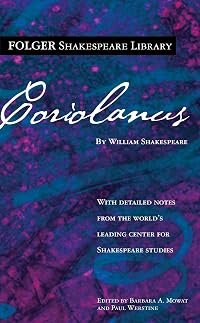
Coriolanus
by William Shakespeare
On This Page
Description
Rome is a city divided, nobility and common-people locked in mutual suspicion. The patrician Caius Marcius, later called Coriolanus, is Rome's greatest soldier, but his proud refusal to accommodate himself to the demands of the plebians leads to banishment and death.Tags
Recommendations













Member Recommendations

aulsmith Shakespeare's source
Member Reviews
A rare misfire, for me, when it comes to the work of William Shakespeare. Coriolanus seems primed for great tragic drama: a victorious Roman general ventures into the murky business of politics, where his blunt military manner and his arrogant pride don't do him any favours when it comes to forming alliances with senators, tribunes or the Roman plebs. So wounded is he by this rejection that he instead forms an alliance with Rome's enemy, the Volsces, and as a turncoat leads their bannermen to the gates of Rome. There is meat here for those who want to ponder the role of soldiers in a civic society, the benefits and drawbacks of political manoeuvring versus principled bluntness, or how a historical figure can be variously painted as a show more hero on the battlefield and a tyrant in the polls. "So our virtues Lie in th'interpretation of the time," Coriolanus' rival Tullus Aufidius says at the end of Act Four (pg. 275).
The problem was that it was hard to source any of this in the reading of Coriolanus; this is one of those unfortunate plays that can only really be appreciated if you're willing to delve into the scholarly analysis. In this, I was further hampered by the impenetrable introduction to my Arden edition of the play, but the play itself lacks the dynamism to really engage the reader. Coriolanus lacks the political intrigue of Julius Caesar and, with the titular general the only compelling character, we don't see his downfall delivered with the same dramatic blows that we do with the similar tragedy in Macbeth. Coriolanus himself remains at arm's length to the reader, with no soliloquy or signature scene to serve as insight into the character. There are whispers of dramatic potency – like Coriolanus' inevitable retort about the fluttering Volscians in Act Five, which condemns him (pg. 308) – but for the most part the play is a well-serviced mechanism, with nothing in its circular, patiently-turning gears to really excite the reader. show less
The problem was that it was hard to source any of this in the reading of Coriolanus; this is one of those unfortunate plays that can only really be appreciated if you're willing to delve into the scholarly analysis. In this, I was further hampered by the impenetrable introduction to my Arden edition of the play, but the play itself lacks the dynamism to really engage the reader. Coriolanus lacks the political intrigue of Julius Caesar and, with the titular general the only compelling character, we don't see his downfall delivered with the same dramatic blows that we do with the similar tragedy in Macbeth. Coriolanus himself remains at arm's length to the reader, with no soliloquy or signature scene to serve as insight into the character. There are whispers of dramatic potency – like Coriolanus' inevitable retort about the fluttering Volscians in Act Five, which condemns him (pg. 308) – but for the most part the play is a well-serviced mechanism, with nothing in its circular, patiently-turning gears to really excite the reader. show less
[Coriolanus] by [[William Shakespeare]].
While not the best of Shakespeare's tragedies, [Coriolanus] just may be the timeliest. Yes, it's a play about a soldier whose pride and love for his overbearing mother ultimately bring him down. But the driving force behind the plot is a pair of manipulating politicians who know how to spin things to their advantage and lead the fickle multitude by their noses.
While the people are more villains that victims, one can't help but notice that some things never change; here's one of them on their current government:
Care for us! True, indeed! They ne'er cared for us
yet: suffer us to famish, and their store-houses
crammed with grain; make edicts for usury, to
support usurers; repeal daily any wholesome show more act
established against the rich, and provide more
piercing statutes daily, to chain up and restrain
the poor. If the wars eat us not up, they will; and
there's all the love they bear us.
All one has to do to see the truth in that is take a look at the PA governor's proposed budget . . . or the federal budget, for that matter. It's Robin Hood in reverse: give to the rich and take from the poor. show less
While not the best of Shakespeare's tragedies, [Coriolanus] just may be the timeliest. Yes, it's a play about a soldier whose pride and love for his overbearing mother ultimately bring him down. But the driving force behind the plot is a pair of manipulating politicians who know how to spin things to their advantage and lead the fickle multitude by their noses.
While the people are more villains that victims, one can't help but notice that some things never change; here's one of them on their current government:
Care for us! True, indeed! They ne'er cared for us
yet: suffer us to famish, and their store-houses
crammed with grain; make edicts for usury, to
support usurers; repeal daily any wholesome show more act
established against the rich, and provide more
piercing statutes daily, to chain up and restrain
the poor. If the wars eat us not up, they will; and
there's all the love they bear us.
All one has to do to see the truth in that is take a look at the PA governor's proposed budget . . . or the federal budget, for that matter. It's Robin Hood in reverse: give to the rich and take from the poor. show less
13. Coriolanus by William Shakespeare
first performed: 1608
format: 384-page Signet Classic, 1966, revised 1988, newly revised 2002
acquired: November read: Feb 20 – Mar 28 time reading: 11:58, 2.4 mpp
rating: 3
genre/style: Classic Drama theme Shakespeare
locations: Early Roman Republic
about the author: April 23, 1564 – April 23, 1616
Editors
[[Reuben Brower]] – 1966, 1988, 2002
[[Sylvan Barnet]] – series editor
Source
[[Sir Thomas North]]’s 1579 translation of [[Plutarch]]’s Life of Caius Martius Coriolanus, from [The Lives of the Noble Grecians and Romans] (c. 120)
Criticism
[[A. C. Bradley]] - Coriolanus : British Academy Shakespeare Lecture, 1912 (printed in [A Miscellany], 1929)
[[Wyndham Lewis]] – from [The Lion and the Fox], show more 1955
[[D. A. Traversi]] – from [An Approach to Shakespeare], 1938
[[Joyce Van Dyke]] - Making a Scene: Language and Gesture in Coriolanus – from Shakespeare Survey 30, 1977
[[Bruce R. Smith]] - Sexual Politics in Coriolanus, 1988
[[S.Schoenbaum]] – Coriolanus on Stage and Screen, 2002
A few quotes from the Signet Classic edition:
- A. C. Bradley (1912):
- D. A. Traversi (1938):
- Wyndam Lewis (1955):
- Joyce Van Dyke (1988):
This was our latest Shakespeare in my Listy group read through is his plays. We're getting to the end, his less popular plays. And the feeling was pretty universal on this one; no one liked it. I found myself rushing through the script to try to finish. But it's not actually a bad play, or one where Shakespeare "flagged". These same Signet-cited critics spend some time breaking down how it's a very carefully written, carefully thought-out script.
The source of this play is 2nd century writer biographer Plutarch. Plutarch's Caius Marcus Coriolanus was a great mythical warrior of the early Roman Republic that was so coarse in personality that no one could stand him in person. He upset his own city so much that he was banished. And he planned his revenge by leading a foreign army to Rome's walls, on the brink of ransacking the city. Rome is saved by his mom, who makes a personal appeal to Coriolanus for mercy, and the unbendable warrior bends, becoming traitor to his own army.
In Shakespeare's hands his story becomes a dry ironic comedy. Coriolanus is a boy warrior, the warrior who never grew up, never learned to feel and empathize, so self-absorbed that he never realized there was anyone else around who was human other than mom. It is, in a way, a psychological study, filled with careful character observation. It's as sophisticated, in this sense, as some of his best plays. It just doesn't seem to really work as a drama. The warriors and their haughty praise of each other are tiring, a bunch of men fawning over stiff imagined narrow greatness. Even the playful homosexual elements can't lighten this one up.
Recommend to resilient completists who really want to check this one off.
2022
https://www.librarything.com/topic/337810#7804273 show less
first performed: 1608
format: 384-page Signet Classic, 1966, revised 1988, newly revised 2002
acquired: November read: Feb 20 – Mar 28 time reading: 11:58, 2.4 mpp
rating: 3
genre/style: Classic Drama theme Shakespeare
locations: Early Roman Republic
about the author: April 23, 1564 – April 23, 1616
Editors
[[Reuben Brower]] – 1966, 1988, 2002
[[Sylvan Barnet]] – series editor
Source
[[Sir Thomas North]]’s 1579 translation of [[Plutarch]]’s Life of Caius Martius Coriolanus, from [The Lives of the Noble Grecians and Romans] (c. 120)
Criticism
[[A. C. Bradley]] - Coriolanus : British Academy Shakespeare Lecture, 1912 (printed in [A Miscellany], 1929)
[[Wyndham Lewis]] – from [The Lion and the Fox], show more 1955
[[D. A. Traversi]] – from [An Approach to Shakespeare], 1938
[[Joyce Van Dyke]] - Making a Scene: Language and Gesture in Coriolanus – from Shakespeare Survey 30, 1977
[[Bruce R. Smith]] - Sexual Politics in Coriolanus, 1988
[[S.Schoenbaum]] – Coriolanus on Stage and Screen, 2002
A few quotes from the Signet Classic edition:
- A. C. Bradley (1912):
“perhaps no reader ever called it his favorite play.”
- D. A. Traversi (1938):
“Coriolanus has rarely satisfied the critics. Most of them have found it frigid and have even suggested that Shakespeare’s interest flagged in the writing of it”
- Wyndam Lewis (1955):
“But Coriolanus, as a figure, is of course the super-snob. Of all Shakespeare’s heroes he is the coldest, and the one that Shakespeare himself seems to have felt most coldly towards.”
- Joyce Van Dyke (1988):
“Coriolanus does not have much of a sense of play.”
This was our latest Shakespeare in my Listy group read through is his plays. We're getting to the end, his less popular plays. And the feeling was pretty universal on this one; no one liked it. I found myself rushing through the script to try to finish. But it's not actually a bad play, or one where Shakespeare "flagged". These same Signet-cited critics spend some time breaking down how it's a very carefully written, carefully thought-out script.
The source of this play is 2nd century writer biographer Plutarch. Plutarch's Caius Marcus Coriolanus was a great mythical warrior of the early Roman Republic that was so coarse in personality that no one could stand him in person. He upset his own city so much that he was banished. And he planned his revenge by leading a foreign army to Rome's walls, on the brink of ransacking the city. Rome is saved by his mom, who makes a personal appeal to Coriolanus for mercy, and the unbendable warrior bends, becoming traitor to his own army.
In Shakespeare's hands his story becomes a dry ironic comedy. Coriolanus is a boy warrior, the warrior who never grew up, never learned to feel and empathize, so self-absorbed that he never realized there was anyone else around who was human other than mom. It is, in a way, a psychological study, filled with careful character observation. It's as sophisticated, in this sense, as some of his best plays. It just doesn't seem to really work as a drama. The warriors and their haughty praise of each other are tiring, a bunch of men fawning over stiff imagined narrow greatness. Even the playful homosexual elements can't lighten this one up.
Recommend to resilient completists who really want to check this one off.
2022
https://www.librarything.com/topic/337810#7804273 show less
This particular play has probably got better since it was produced, if by "get better" we mean "become more thematically relevant." It may be set in Rome and superficially be a story about plebs and patricians, the Achillean hero and the swathe he cuts, but I don't think anyone who reads this in 2012 will fail to see it as a tragedy of the meritocracy. Caius Marcius doesn't inherit his place--he earns it at the gates of Corioles, and the nub of the play is the most sacrosanct dictum of the past decade, the breaking point of the present moment--that a society in which the cream can rise to the top, even if we grant that it is truly possible, is healthy.
The subject, in other words, is "greatness," and what constitutes it, and whether it show more can be harnessed. In Coriolanus, we see the pure neoliberal animal: "Me! My virtue! My reputation!" Not, certainly, "My bank account!", as he punishes the Roman looters, but it soon becomes evident to him that there is only one place further prestige can be got once he's conquered the battlefield, and that is in the arena of political power. Wealth and the esteem of your fellows and the ability to control them--all infinitely exchangeable currency in the end.
The reason the meritocracy is slippery and adaptable is that achievement of power always depends on convincing other people you are more deserving of it than them, and so this is also a play about class--the myth of social mobility in a society where Tullus Aufidius was as born to be second-best as the bamboozled, slow-on-the-uptake, almost self-loathing plebs were to be ruled. After they acclaim Coriolanus, their ostensible champions Brutus and Sicinius reveal themselves as more exploiters--only clumsy ones, unlike the coy powermonger Marcius--where they openly chide them for making the wrong decision, he refuses to show them his wounds, and they love him despite themselves. This is one way in which we've evolved--now a showing of wounds, a telling of one's battles with depression or alcohol or sex addiction, is mandatory. Or from another angle: It is Coriolanus's words, not his promises of friendship, that make him consul; cf. George W. Bush, the president you'd most want to have a beer with.* Then as now, it's good enough for people to hear about the wounds, or the WMDs: nobody's actually gonna check up.
There are elements of Coriolanus the celebrity or the political darling, clearly, but ultimately these arenas aren't dog-eat-dog enough for this symbol of the human need to rise, the man as temple to his own talent--so he reveals himself in his final form, the corporate titan. Rome won't pay you enough? Let's have no nationalist ecstasies--sign on with the corporate rival in Antium and stage a hostile takeover using your inside knowledge. This moment, incidentally, is also the first in which we get a sense that Tullus is more than just a second-rate Coriolanus--when he signs the Roman on, he is operating by the rules of the game, no doubt, but he also seems to really trust Coriolanus--to be capable of bonds of disinterested friendship.
This in contrast to Coriolanus--he is determined to build a better bloodbath, and sends his friend Memenius packing when the latter suggests that the lives of thousands might be worth more than his own legend. This is it right here--it's not even about making a profit; but I would argue that it's not really that for us either, not for the people at the top: it's about winning, and money is just our current way of keeping score. Coriolanus lives in a time where meritocracy is muddled by dynasties and vague ideas about blood and destiny and divinity, and it's these that Volumnia plays on when she convinces him not to sack Rome. It's the first sign of weakness in him, of Achillean, atavistic and self-regard, perhaps somewhat like unto staying a quant, keeping one's talent and craft pure, instead of taking that CEO job and crushing senators (ancient Rome indeed!) under your feet.
But as the "regions do smilingly revolt," blooded with the scent of the hero's slight humanity, the play's secret revolutionary hero reveals himself: Tullus has Coriolanus killed in a particularly vicious and cowardly way, covering himself in unfame. In doing so, again, he no doubt expresses the sincere envy and rage of the passed-over applicant, the sore loser. But he also evokes the widows and orphans of the Volsces, which Marcius never does except in a speculative and sort of perplexed way; he eliminates the enemy of the people, and that triumph of mediocrity is manifestly morally right. Coriolanus may die like a boss, but with cowards in charge, I bet we'd have fewer mores and better healthcare.
*and, like, really? Who the fuck are these people? A tragic play could be written about that survey alone. show less
The subject, in other words, is "greatness," and what constitutes it, and whether it show more can be harnessed. In Coriolanus, we see the pure neoliberal animal: "Me! My virtue! My reputation!" Not, certainly, "My bank account!", as he punishes the Roman looters, but it soon becomes evident to him that there is only one place further prestige can be got once he's conquered the battlefield, and that is in the arena of political power. Wealth and the esteem of your fellows and the ability to control them--all infinitely exchangeable currency in the end.
The reason the meritocracy is slippery and adaptable is that achievement of power always depends on convincing other people you are more deserving of it than them, and so this is also a play about class--the myth of social mobility in a society where Tullus Aufidius was as born to be second-best as the bamboozled, slow-on-the-uptake, almost self-loathing plebs were to be ruled. After they acclaim Coriolanus, their ostensible champions Brutus and Sicinius reveal themselves as more exploiters--only clumsy ones, unlike the coy powermonger Marcius--where they openly chide them for making the wrong decision, he refuses to show them his wounds, and they love him despite themselves. This is one way in which we've evolved--now a showing of wounds, a telling of one's battles with depression or alcohol or sex addiction, is mandatory. Or from another angle: It is Coriolanus's words, not his promises of friendship, that make him consul; cf. George W. Bush, the president you'd most want to have a beer with.* Then as now, it's good enough for people to hear about the wounds, or the WMDs: nobody's actually gonna check up.
There are elements of Coriolanus the celebrity or the political darling, clearly, but ultimately these arenas aren't dog-eat-dog enough for this symbol of the human need to rise, the man as temple to his own talent--so he reveals himself in his final form, the corporate titan. Rome won't pay you enough? Let's have no nationalist ecstasies--sign on with the corporate rival in Antium and stage a hostile takeover using your inside knowledge. This moment, incidentally, is also the first in which we get a sense that Tullus is more than just a second-rate Coriolanus--when he signs the Roman on, he is operating by the rules of the game, no doubt, but he also seems to really trust Coriolanus--to be capable of bonds of disinterested friendship.
This in contrast to Coriolanus--he is determined to build a better bloodbath, and sends his friend Memenius packing when the latter suggests that the lives of thousands might be worth more than his own legend. This is it right here--it's not even about making a profit; but I would argue that it's not really that for us either, not for the people at the top: it's about winning, and money is just our current way of keeping score. Coriolanus lives in a time where meritocracy is muddled by dynasties and vague ideas about blood and destiny and divinity, and it's these that Volumnia plays on when she convinces him not to sack Rome. It's the first sign of weakness in him, of Achillean, atavistic and self-regard, perhaps somewhat like unto staying a quant, keeping one's talent and craft pure, instead of taking that CEO job and crushing senators (ancient Rome indeed!) under your feet.
But as the "regions do smilingly revolt," blooded with the scent of the hero's slight humanity, the play's secret revolutionary hero reveals himself: Tullus has Coriolanus killed in a particularly vicious and cowardly way, covering himself in unfame. In doing so, again, he no doubt expresses the sincere envy and rage of the passed-over applicant, the sore loser. But he also evokes the widows and orphans of the Volsces, which Marcius never does except in a speculative and sort of perplexed way; he eliminates the enemy of the people, and that triumph of mediocrity is manifestly morally right. Coriolanus may die like a boss, but with cowards in charge, I bet we'd have fewer mores and better healthcare.
*and, like, really? Who the fuck are these people? A tragic play could be written about that survey alone. show less
The citizens of a republic run their greatest soldier out of town because they can't stand him and he can't stand them. As it happens, they can't live without each other - literally. This may be the greatest political drama written. It is also one of the great mother and son stories.
Several years ago I read this play as part of a class at the University of Chicago. It was a revelation that entranced me with its drama. Even so, the warrior Coriolanus is perhaps the most opaque of Shakespeare's tragic heroes, rarely pausing to soliloquise or reveal the motives behind his prideful isolation from Roman society. Instead, the play demonstrates his character through his actions and his relationships. The relationship with his mother, Volumnia, is the most important of these. The tension of her love for him reaches heights that are only exceeded by those of Coriolanus fame as a warrior for Rome.
This is not the Rome of the Caesars but that of the early days when the republic was in its formative stages. It was a city show more concerned with warring neighbors like the Volscians who are an ever-present enemy. While Caius Martius' success in battles with this enemy lead him to military honors and earn him the name Coriolanus, he does not have the temperamental qualities that would allow him use these accolades for political purposes. He is held back by his own nature and his situation leads to banishment by the crowds who once cheered him. His speech to them as he leaves Rome is memorable:
"You common cry of curs! whose breath I hate
As reek o' the rotten fens, whose loves I prize
As the dead carcasses of unburied men
That do corrupt my air, I banish you;
And here remain with your uncertainty!
Let every feeble rumour shake your hearts!
Your enemies, with nodding of their plumes,
Fan you into despair! Have the power still
To banish your defenders; till at length
Your ignorance, which finds not till it feels,
Making not reservation of yourselves,
Still your own foes, deliver you as most
Abated captives to some nation
That won you without blows! Despising,
For you, the city, thus I turn my back:
There is a world elsewhere."(Act III, Scene iii)
It is, for me, the best of the lesser-known of his plays and stands tall by the side of the other two great Roman history plays, Julius Caesar and Antony & Cleopatra. In particular, the psychological depth of the character of Coriolanus, his relationships with his mother and subject Romans, and the dramatic action make this play a delight to read. show less
This is not the Rome of the Caesars but that of the early days when the republic was in its formative stages. It was a city show more concerned with warring neighbors like the Volscians who are an ever-present enemy. While Caius Martius' success in battles with this enemy lead him to military honors and earn him the name Coriolanus, he does not have the temperamental qualities that would allow him use these accolades for political purposes. He is held back by his own nature and his situation leads to banishment by the crowds who once cheered him. His speech to them as he leaves Rome is memorable:
"You common cry of curs! whose breath I hate
As reek o' the rotten fens, whose loves I prize
As the dead carcasses of unburied men
That do corrupt my air, I banish you;
And here remain with your uncertainty!
Let every feeble rumour shake your hearts!
Your enemies, with nodding of their plumes,
Fan you into despair! Have the power still
To banish your defenders; till at length
Your ignorance, which finds not till it feels,
Making not reservation of yourselves,
Still your own foes, deliver you as most
Abated captives to some nation
That won you without blows! Despising,
For you, the city, thus I turn my back:
There is a world elsewhere."(Act III, Scene iii)
It is, for me, the best of the lesser-known of his plays and stands tall by the side of the other two great Roman history plays, Julius Caesar and Antony & Cleopatra. In particular, the psychological depth of the character of Coriolanus, his relationships with his mother and subject Romans, and the dramatic action make this play a delight to read. show less
This is one of my favourite Shakespeare plays with its undercurrents of hypocrisy and irony. Coriolanus is not likable; he looks down at the ordinary and has very stern views about charity but how the play unfolds had me gripped right to the end.
Members
- Recently Added By
Lists

Favorite Shakespeare plays?
37 works; 45 members

Plays I Like
230 works; 31 members

Books available on Open Library
171 works; 4 members
The Great Courses: Shakespeare's Tragedies
35 works; 1 member
Stage Plays/Screenplays/Dialogues/Anything Dialogue-Storytelling Related
81 works; 2 members
1:28 p.m.'s 350 Stage Plays Challenge
94 works; 3 members

Greatest Books, allegedly
484 works; 9 members
'Books You Can't Live Without: The Top 100', The Guardian, 2007
156 works; 7 members
My Play Collection
769 works; 3 members

School Made Us Read It
380 works; 196 members

Books We Resisted Reading
178 works; 110 members
Author Information

6,141+ Works 443,292 Members
William Shakespeare, 1564 - 1616 Although there are many myths and mysteries surrounding William Shakespeare, a great deal is actually known about his life. He was born in Stratford-Upon-Avon, son of John Shakespeare, a prosperous merchant and local politician and Mary Arden, who had the wealth to send their oldest son to Stratford Grammar School. show more At 18, Shakespeare married Anne Hathaway, the 27-year-old daughter of a local farmer, and they had their first daughter six months later. He probably developed an interest in theatre by watching plays performed by traveling players in Stratford while still in his youth. Some time before 1592, he left his family to take up residence in London, where he began acting and writing plays and poetry. By 1594 Shakespeare had become a member and part owner of an acting company called The Lord Chamberlain's Men, where he soon became the company's principal playwright. His plays enjoyed great popularity and high critical acclaim in the newly built Globe Theatre. It was through his popularity that the troupe gained the attention of the new king, James I, who appointed them the King's Players in 1603. Before retiring to Stratford in 1613, after the Globe burned down, he wrote more than three dozen plays (that we are sure of) and more than 150 sonnets. He was celebrated by Ben Jonson, one of the leading playwrights of the day, as a writer who would be "not for an age, but for all time," a prediction that has proved to be true. Today, Shakespeare towers over all other English writers and has few rivals in any language. His genius and creativity continue to astound scholars, and his plays continue to delight audiences. Many have served as the basis for operas, ballets, musical compositions, and films. While Jonson and other writers labored over their plays, Shakespeare seems to have had the ability to turn out work of exceptionally high caliber at an amazing speed. At the height of his career, he wrote an average of two plays a year as well as dozens of poems, songs, and possibly even verses for tombstones and heraldic shields, all while he continued to act in the plays performed by the Lord Chamberlain's Men. This staggering output is even more impressive when one considers its variety. Except for the English history plays, he never wrote the same kind of play twice. He seems to have had a good deal of fun in trying his hand at every kind of play. Shakespeare wrote 154 sonnets, all published on 1609, most of which were dedicated to his patron Henry Wriothsley, The Earl of Southhampton. He also wrote 13 comedies, 13 histories, 6 tragedies, and 4 tragecomedies. He died at Stratford-upon-Avon April 23, 1616, and was buried two days later on the grounds of Holy Trinity Church in Stratford. His cause of death was unknown, but it is surmised that he knew he was dying. (Bowker Author Biography) show less
All Editions
Some Editions
Series
Belongs to Publisher Series
New Penguin Shakespeare (NS3)
Wereldbibliotheek (21)
Penguin Shakespeare (B20)
The Yale Shakespeare (35)
Edition Holzinger (Shakespeare)
Work Relationships
Is contained in
Has the adaptation
Is abridged in
Has as a reference guide/companion
Has as a study
Has as a supplement
Has as a commentary on the text
Has as a student's study guide
Common Knowledge
- Canonical title
- Coriolanus
- Original title
- The Tragedy of Coriolanus
- Original publication date
- 1623
- People/Characters
- Coriolanus; Menenius Agrippa; Cominius; Titus Larcius; Volumnia; Virgilia (show all 8); Sicinius Velutus; Tullus Aufidius
- Important places
- Ancient Rome; Rome, Italy; Italy
- Important events
- 5th century
- Related movies
- Coriolanus (2011 | IMDb)
- First words
- Before we proceed any further, hear me speak.
- Last words
- (Click to show. Warning: May contain spoilers.)Assist.
- Publisher's editor
- Hibbard, G. R. (New Penguin Shakespeare)
- Disambiguation notice
- This work is for the complete Coriolanus only. Do not combine this work with abridgements, adaptations or "simplifications" (such as "Shakespeare Made Easy"), Cliffs Notes or similar study guides, or anything else that... (show all) does not contain the full text. Do not include any video recordings. Additionally, do not combine this with other plays.
This is Thomas Sheridan's 1757 adaptation of Coriolanus in which he combined bits of Shakespeare's version with bits of Thomson's version, while adding bits of his own. It should not be combined with the standard Shakespearea... (show all)n text.
Classifications
Statistics
- Members
- 3,183
- Popularity
- 5,450
- Reviews
- 56
- Rating
- (3.59)
- Languages
- 20 — Catalan, Chinese, Czech, Danish, Dutch, English, Finnish, French, German, Greek, Hungarian, Italian, Norwegian (Bokmål), Farsi/Persian, Polish, Portuguese, Russian, Spanish, Swedish, Turkish
- Media
- Paper, Audiobook, Ebook
- ISBNs
- 236
- UPCs
- 5
- ASINs
- 100