On This Page
Description
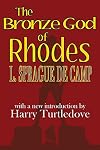
The Bronze God of Rhodes is written as the memoirs of Chares of Lindos. **** Chares of Lindos was a Greek sculptor born on the island of Rhodes. A pupil of Lysippos, Chares eventually built the Colossus of Rhodes, now considered to be one of the Seven Wonders of the Ancient World. **** These memoirs present the trials and tribulations (some of them hilarious) of the sculptor as he undertakes various projects and is forced into a number of adventures, particularly in Ptolemaic Egypt. **** show more This is the second historical novel that L. Sprague de Camp wrote (in order of writing), drawing upon his extensive and detailed historical knowledge of the period. show lessTags
Recommendations





















Member Reviews
Light, fluffy novel concerning Chares of Lindos, a sculptor, fl. 282 BC. The author has constructed a delightful story about Chares and others living at that time--we only know a few facts about any of them. Despite the title, most of the novel is taken up with the Siege of Rhodes by Demetrios Antigonou Poliokortes "The Besieger", both attack and ingenious defense. The defense was drawn out and took up most of the book. Partway through the siege [p.194], Chares, although an atheist, prays to Helios-Apollon and promises the god if victorious he will build him a gigantic statue in tribute. Chares is leader of a catapult crew. He sails to Egypt with others to implore Ptolomaios, King of Egypt, to help them. Much of the Egyptian story is show more taken up with a stolen robe of Demetrios's and attempts to retrieve it without being killed. Upon its presentation to Ptolemaios, the Rhodians beseech his help. Chares comes up with the idea of a "universal library"--the Great Library of Alexandria, only he gets no credit for it. The actual planning and construction of the statue takes up only a small part of the story. If facts are true about the building plans, they are most interesting. The author's Note is worth reading.
There is much humorous banter and comedy in the novel. I loved Kavaros the Kelt and his tall tales about his great-grandfather. The novel may not be Tolstoy but it is certainly enjoyable. I liked the way the author used different word order than English--mostly German-style with word order inversion and verbs standing last--to indicate the non-Rhodians and other Hellenes. I liked the sea battles--catapult to catapult--and the attempt to wrest the robe from the villain, Tis, whose stolen scrolls become the core of the Great Library.
Recommended. show less
There is much humorous banter and comedy in the novel. I loved Kavaros the Kelt and his tall tales about his great-grandfather. The novel may not be Tolstoy but it is certainly enjoyable. I liked the way the author used different word order than English--mostly German-style with word order inversion and verbs standing last--to indicate the non-Rhodians and other Hellenes. I liked the sea battles--catapult to catapult--and the attempt to wrest the robe from the villain, Tis, whose stolen scrolls become the core of the Great Library.
Recommended. show less
Set in Rhodes during the Successor Wars, Chares of Lindos is an arrogant but talented sculptor, who regularly gets people's backs up. He is, of course, the creator of the Colossus of Rhodes. A historical about a little-known sculptor set in Rhodes, Asia Minor and Egypt.
Recommended.
Recommended.
Ratings
Members
- Recently Added By
Author Information

325+ Works 25,044 Members
L. Sprague de Camp, winner of the World Fantasy Award for Life Achievement, was fluent in several languages and traveled the world. He was chased by a hippopotamus in Uganda and sea lions in the Galapagos Islands. He saw tigers and rhinoceroses from elephantback in India, and he was bitten by a lizard in the jungles of Guatemala. His fascinating show more autobiography. Time and Chance, won the 1997 Hugo Award for best nonfiction. L. Sprague de Camp passed away in May 2000 show less
Series

Common Knowledge
- Original publication date
- 1960
- Important places
- Ancient Greece
Classifications
- Genres
- Fiction and Literature, General Fiction, Fantasy, Historical Fiction
- DDC/MDS
- 813.52 — Literature & rhetoric American literature in English American fiction in English 1900-1999 1900-1945
- LCC
- PZ3 .D3555 — Language and Literature Fiction and juvenile belles lettres Fiction and juvenile belles lettres Fiction in English
- BISAC
Statistics
- Members
- 66
- Popularity
- 470,906
- Reviews
- 2
- Rating
- (4.05)
- Languages
- English
- Media
- Paper, Ebook
- ISBNs
- 4
- ASINs
- 4