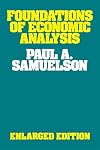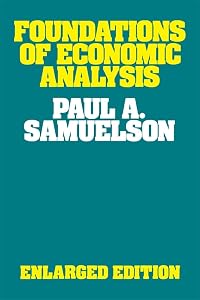
Foundations of Economic Analysis, Enlarged Edition (Harvard Economic Studies)
by Paul Samuelson
119 Members (4.75)
On This Page
Description
Recent statistical techniques, including nonlinear programming, have been added to a basic survey of equilibrium systems, comparative statistics, consumer behavior theory, and cost and production theory.Tags
Recommendations
























Member Reviews
Members
- Recently Added By
Author Information

84+ Works 1,509 Members
Paul Samuelson was the first American recipient of the Nobel Prize in economics. Born in Indiana, he did his undergraduate work at the University of Chicago and earned a Ph.D. at Harvard University, where he studied with Alvin Hansen. He taught for several decades at M.I.T. Samuelson's first major work was Foundations of Economic Analysis (1947), show more a mathematical treatment of economic theory and principles. Later he made extensive contributions to professional journals in virtually all areas of economic theory. Often he would be the first to offer a mathematical proof of a proposition when most other economists could sense it only intuitively. In 1948 he published the first edition of Economics, one of the most successful and influential college texts of our time. It provided an extremely comprehensive treatment of Keynesian economics and microeconomic principles, and played an important part in educating a generation of economists. Despite Samuelson's role in providing mathematical refinements for economic theory, he has always maintained a public posture, welcoming opportunities to share his views. He was an economic adviser to President John F. Kennedy and wrote a popular column for Newsweek from 1966 to 1981. He has generally favored an interventionist approach in policy matters, especially when it has involved using the tax system to battle poverty, fight inflation, or balance the budget. One of the world's most respected economists, Samuelson is responsible for rewriting considerable parts of economic theory. He has, in several areas, achieved results that rank among the classic theorems in economics. (Bowker Author Biography) show less
Series
Belongs to Publisher Series
Common Knowledge
- Original publication date
- 1947
- Epigraph
- Mathematics is a Language. -- J. Willard Gibbs
- Dedication
- To my parents
- First words
- Foreword -- It says something for the economics of publishing and the voracious appetite of the educated public that an advanced book like the present one should be reissued in paperback form.
Preface -- The original version of this book submitted to the David A. Wells Prize Committee of Harvard University in 1941 carried the subtitle, "The Operational Significance of Economic Theory." At that time most of the mat... (show all)erial presented was already several years old, having been conceived and written primarily in 1937. - Last words
- (Click to show. Warning: May contain spoilers.)The further development of analytical economics along the lines of comparative dynamics must rest with the future. It is to be hoped that it will aid in the attack on diverse problems -- from the trivial behavior of a single small commodity, to the fluctuations of important components of the business cycle, and even to the majestic problems of economic development.
- Blurbers
- Metzler, Lloyd A.
Classifications
- Genres
- Economics, Nonfiction, General Nonfiction, Business
- DDC/MDS
- 330.01 — Society, government, & culture Economics Jobs & Careers > Philosophy And Psychology
- LCC
- HB135 .S24 — Social sciences Economic theory. Demography Economic theory. Demography Methodology Mathematical economics. Quantitative methods
- BISAC
Statistics
- Members
- 119
- Popularity
- 272,313
- Rating
- (4.75)
- Languages
- English, Portuguese
- Media
- Paper
- ISBNs
- 6
- ASINs
- 2