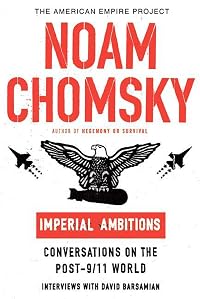
Imperial Ambitions: Conversations on the Post-9/11 World
by Noam Chomsky, David Barsamian
The American Empire Project
On This Page
Description
In this first collection of interviews since the bestselling 9-11, our foremost intellectual activist examines crucial new questions of U.S. foreign policy. In this important program of interviews conducted by award-winning radio journalist David Barsamian, Noam Chomsky discusses America's policies in the increasingly unstable world. With his famous insight, lucidity, and redoubtable grasp of history, Chomsky offers his views on the invasion and occupation of Iraq, the doctrine of show more "preemptive" strikes against so-called rogue states, and the prospects of the second Bush administration, warning of the growing threat to international peace posed by the U.S. drive for domination. In his inimitable style, Chomsky also dissects the propaganda system that fabricates a mythic past and airbrushes inconvenient facts out of history. Barsamian, recipient of the ACLU's Upton Sinclair Award for independent journalism, has conducted more interviews and radio broadcasts with Chomsky than has any other journalist. Enriched by their unique rapport, Imperial Ambitions explores topics Chomsky has never before discussed, among them the 2004 presidential campaign and election, the future of Social Security, and the increasing threat, including devastating weather patterns, of global warming. The result is an illuminating dialogue with one of the leading thinkers of our time-and a startling picture of the turbulent world in which we live. show lessTags
Recommendations

















Member Reviews
In this new set of interviews, America's foremost intellectual activist looks at new questions of US domestic and foreign policy.
In September 2002, the American government announced a new national security strategy. Instead of pre-emptive war, which might be covered by the UN Charter, the new strategy will be one of preventive war, which is not permitted at all under international law. In other words, America will rule the world by force, and if any challenge to that domination comes about, whether imagined, invented or perceived in the distance, America has the right to destroy that challenge before it becomes a threat.
The Bush Administration talks about going after countries that harbor terrorists. Orlando Bosch, described by the show more Justice Department as a threat to American security, is quietly living in Miami, recipient of a Presidential Pardon. In 1976, Bosch was involved in the shooting down of a Cuban airliner, killing 73 people, among other crimes. Emanuel Constant is responsible for the deaths of at least 4000 Haitians. He is living in Queens, New York, because America refuses to even respond to extradition requests, let alone actually say No. Such doctrines are unilateral; they grant America the right to harbor terrorists and use violence, but not anyone else.
The people around George Bush are very open about their desire to destroy the progressive achievements of the last 100 years. They have generally gotten rid of the progressive income tax. They are next going after Social Security and health care. They do not want a small government. They are interested in a huge, massively intrusive government, but one that works for them.
This is another excellent and eye-opening book from Chomsky and Barsamian. For another very interesting look at the way America and the world Really Works, this is highly recommended. show less
In September 2002, the American government announced a new national security strategy. Instead of pre-emptive war, which might be covered by the UN Charter, the new strategy will be one of preventive war, which is not permitted at all under international law. In other words, America will rule the world by force, and if any challenge to that domination comes about, whether imagined, invented or perceived in the distance, America has the right to destroy that challenge before it becomes a threat.
The Bush Administration talks about going after countries that harbor terrorists. Orlando Bosch, described by the show more Justice Department as a threat to American security, is quietly living in Miami, recipient of a Presidential Pardon. In 1976, Bosch was involved in the shooting down of a Cuban airliner, killing 73 people, among other crimes. Emanuel Constant is responsible for the deaths of at least 4000 Haitians. He is living in Queens, New York, because America refuses to even respond to extradition requests, let alone actually say No. Such doctrines are unilateral; they grant America the right to harbor terrorists and use violence, but not anyone else.
The people around George Bush are very open about their desire to destroy the progressive achievements of the last 100 years. They have generally gotten rid of the progressive income tax. They are next going after Social Security and health care. They do not want a small government. They are interested in a huge, massively intrusive government, but one that works for them.
This is another excellent and eye-opening book from Chomsky and Barsamian. For another very interesting look at the way America and the world Really Works, this is highly recommended. show less
As a person who has read several other books about the United States' imperialistic policy in the world, such as Naked Imperialism: The U.S. Pursuit of Global Dominance by John Bellamy Foster, such books as Noam Chomsky's Imperial Ambitions Conversations on the Post-9/11 World are a easy read and give you a brief introduction into into the political science topic of the United States' Imperialism. While the book itself is based on what Noam Chomsky thought the USA was doing in 2005, as of October 2011 very little has changed since the book was published and his analysis still holds.
This book is a collection of interviews with Noam Chomsky which discusses US policy, democracy, language of war and politics and many other themes. Required reading for an enlightening view of the US government and its people interacting with the world.
Liberal ideas personified. I have read most of what he has read and disagree with everything. A main inspiration for me becoming a conservative.
> La doctrine des bonnes intentions, de Noam CHOMSKY (Entretiens avec David Barsamian, Fayard, Paris, 2006, 237 p.)
Se reporter à la critique de Sylvain MAROIS
In: (2006). Compte rendu de [Essai]. Nuit blanche, (105), p. 72… ; (en ligne),
URL : https://id.erudit.org/iderudit/20029ac
Se reporter à la critique de Sylvain MAROIS
In: (2006). Compte rendu de [Essai]. Nuit blanche, (105), p. 72… ; (en ligne),
URL : https://id.erudit.org/iderudit/20029ac
Aug 23, 2020 (Edited)French
Ratings
Members
- Recently Added By
Author Information

585+ Works 47,676 Members
Noam Chomsky was born in Philadelphia, Pennsylvania on December 7, 1928. Son of a Russian emigrant who was a Hebrew scholar, Chomsky was exposed at a young age to the study of language and principles of grammar. During the 1940s, he began developing socialist political leanings through his encounters with the New York Jewish intellectual show more community. Chomsky received his Ph.D. from the University of Pennsylvania, where he studied linguistics, mathematics, and philosophy. He conducted much of his research at Harvard University. In 1955, he began teaching at MIT, eventually holding the Ferrari P. Ward Chair of Modern Language and Linguistics. Today Chomsky is highly regarded as both one of America's most prominent linguists and most notorious social critics and political activists. His academic reputation began with the publication of Syntactic Structures in 1957. Within a decade, he became known as an outspoken intellectual opponent of the Vietnam War. Chomsky has written many books on the links between language, human creativity, and intelligence, including Language and Mind (1967) and Knowledge of Language: Its Nature, Origin, and Use (1985). He also has written dozens of political analyses, including Manufacturing Consent: The Political Economy of the Mass Media (1988), Chronicles of Dissent (1992), and The Prosperous Few and the Restless Many (1993). (Bowker Author Biography) show less

20+ Works 2,705 Members
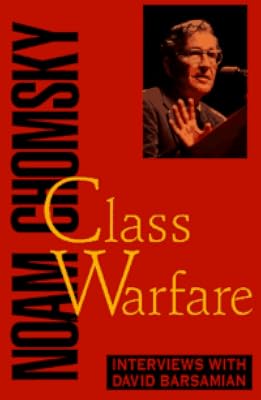
David Barsamian is a broadcast journalist and director of Alternative Radio. He is well known for his interviews of Noam Chomsky, which have been collected in several volumes. These include Chronicles of Dissent, Keeping the Rabble in Line: Interviews with David Barsamian, and Class Warfare: Interviews with David Barsamian. His interviews with show more Edward Said have also been collected, in The Pen and the Sword: Conversations with David Barsamian. (Bowker Author Biography) show less
Series

Belongs to Publisher Series
Common Knowledge
- Canonical title
- Imperial Ambitions: Conversations on the Post-9/11 World; Imperial Ambitions: Conversations on the Post-9/11 World
Classifications
- Genres
- Nonfiction, Politics and Government, General Nonfiction, History, Philosophy
- DDC/MDS
- 327.73009051 — Society, government, & culture Political science International Relations: Spies North America United States
- LCC
- E902 .C474 — History of the United States George W. Bush's administrations, 2001-2009
- BISAC
Statistics
- Members
- 687
- Popularity
- 41,859
- Reviews
- 5
- Rating
- (3.86)
- Languages
- 11 — Catalan, Dutch, English, Esperanto, Finnish, French, Japanese, Portuguese, Romanian, Serbian, Spanish
- Media
- Paper, Audiobook, Ebook
- ISBNs
- 21
- ASINs
- 6