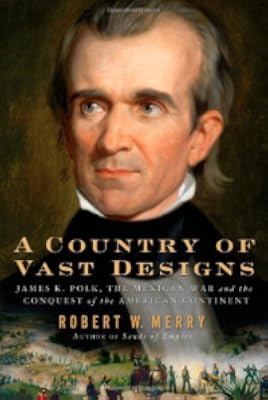
A Country of Vast Designs: James K. Polk, The Mexican War and the Conquest of the American Continent
by Robert W. Merry
On This Page
Description
Merry examines how, in a one-term presidency, James K. Polk completed the story of America's Manifest Destiny by expanding its territory across the continent.Tags
Recommendations






Member Reviews
James K. Polk outlined four goals for his administration just before taking office as the 11th president of the U.S. and accomplished all of them. So why doesn’t he get more respect?
This is the question that looms over Robert Merry’s account of this, the most effective of single-term presidencies. In an epilogue, entitled Legacy, he addresses it head-on and arrives at an answer not all readers will agree with.
Those four objectives were: reduce tariffs (previously used for protectionism, he aimed to limit their use to generating revenue, there being as yet no income tax to finance the work of the government); settle the long-vexing question of a national bank by establishing a federal treasury to hold deposits of government funds; show more end the dispute over Oregon, a large territory extending from the northern boundary of California to the southern boundary of Alaska, jointly claimed by the U.S. and Britain; and acquire California and the vast territory then called New Mexico from Mexico.
On the first two issues, the results showed he was right; trade increased and the currency stabilized. The settlement of the Oregon question seems so reasonable in retrospect that one wonders why it took so long to reach. It is the fourth question that continues to generate controversy and weigh on Polk’s reputation. Not so much whether California and the Southwest should be part of the U.S. — that seemed inevitable to many even at the time. The lingering uneasiness is in the way he went about it, provoking a war with Mexico ostensibly over Texas, which Mexico had already lost, as the easiest way of gaining the other territories he coveted yet consistently denied he was seeking to acquire. Not that one feels much sympathy with a Mexican government that fell into the war. It must be conceded as well that other nations, primarily Great Britain, had noticed the tenuous hold Mexico had on the long, underpopulated California coastline with its enviable harbors at San Francisco and San Diego. Polk was aware of this, and this added to his haste.
When Merry arrives at assessing Polk’s legacy, it is no surprise after reading his narrative that he comes down on the side of ends-justified means. Faced with a choice between its restless, expansive energy and its loudly proclaimed ideals of being a unique experiment in righteous government, the U.S. chose the former, without ever admitting, even to itself, that this meant rejecting the latter, except as lip service. Merry even cites “history” as an autonomous force as somehow justifying the way Polk achieved his aim (p. 476).
The reasons for Polk’s success lay not only in being on the right side of history, however defined, but also in his character. A personally unprepossessing man, he turned out to have unsuspected reservoirs of persistence, diligence and political guile to put at the service of his audacious vision. Merry consistently highlights these traits, as well as other, less attractive aspects of his character: “his suspicious sanctimony, his inability to establish a culture of teamwork, his tendency toward transparently sly maneuvers, his lack of personality traits used by true political leaders to bend others to their will” (p. 450). I found particularly unappealing his difficulty in seeing that anyone could have a legitimate reason for taking an opposing position to his. Of course, given the venality, vanity and naked ambition of many congressmen, senators, leading generals and even members of his own cabinet, perhaps he can be excused for this failing.
The cost of Polk’s single-minded devotion to his four aims was great on the personal level; he died three months after leaving office. The cost to the nation was tragic. His rapid acquisition of vast tracts of territory spelled the end of the Missouri Compromise, which for a quarter of a century had kept contrasting views of slavery from distracting the nation from other business. It now became the dominant issue, resulting twelve years later in the costliest, saddest war Americans ever engaged in.
One additional take-away from this book for me was the ponderous nature of both diplomacy and war-making in a time when it could take five weeks or more for instructions from Washington to reach their recipients, by which time events had usually changed circumstances (the instructions themselves were necessarily based on incomplete information that itself was at least five or six weeks old). No wonder that a president and his generals and envoys often swirled in a vortex of increasing mutual resentment and mistrust. The first few hundred miles of railroad track had been laid, the first few miles of telegraph cable strung, so this situation would soon change, but only relatively; there is still a huge fog factor dogging the decision-making process in times of crisis.
When Henry Adams looked back on the first century of American history, he remarked that he had chronicled in his multi-volume study the Jefferson and Madison administrations, while his friend John Hay had done the same for that of Abraham Lincoln. Adams wasn’t sure that the interval was worth the same expenditure of effort. I won’t venture to answer that, but it is definitely not so unimportant that it should be forgotten. Aside from my reservations over the author's overall endorsement of Polk's methods, Robert Merry, in crafting a well-written work of popular history, has rendered a great service. A very good read. show less
This is the question that looms over Robert Merry’s account of this, the most effective of single-term presidencies. In an epilogue, entitled Legacy, he addresses it head-on and arrives at an answer not all readers will agree with.
Those four objectives were: reduce tariffs (previously used for protectionism, he aimed to limit their use to generating revenue, there being as yet no income tax to finance the work of the government); settle the long-vexing question of a national bank by establishing a federal treasury to hold deposits of government funds; show more end the dispute over Oregon, a large territory extending from the northern boundary of California to the southern boundary of Alaska, jointly claimed by the U.S. and Britain; and acquire California and the vast territory then called New Mexico from Mexico.
On the first two issues, the results showed he was right; trade increased and the currency stabilized. The settlement of the Oregon question seems so reasonable in retrospect that one wonders why it took so long to reach. It is the fourth question that continues to generate controversy and weigh on Polk’s reputation. Not so much whether California and the Southwest should be part of the U.S. — that seemed inevitable to many even at the time. The lingering uneasiness is in the way he went about it, provoking a war with Mexico ostensibly over Texas, which Mexico had already lost, as the easiest way of gaining the other territories he coveted yet consistently denied he was seeking to acquire. Not that one feels much sympathy with a Mexican government that fell into the war. It must be conceded as well that other nations, primarily Great Britain, had noticed the tenuous hold Mexico had on the long, underpopulated California coastline with its enviable harbors at San Francisco and San Diego. Polk was aware of this, and this added to his haste.
When Merry arrives at assessing Polk’s legacy, it is no surprise after reading his narrative that he comes down on the side of ends-justified means. Faced with a choice between its restless, expansive energy and its loudly proclaimed ideals of being a unique experiment in righteous government, the U.S. chose the former, without ever admitting, even to itself, that this meant rejecting the latter, except as lip service. Merry even cites “history” as an autonomous force as somehow justifying the way Polk achieved his aim (p. 476).
The reasons for Polk’s success lay not only in being on the right side of history, however defined, but also in his character. A personally unprepossessing man, he turned out to have unsuspected reservoirs of persistence, diligence and political guile to put at the service of his audacious vision. Merry consistently highlights these traits, as well as other, less attractive aspects of his character: “his suspicious sanctimony, his inability to establish a culture of teamwork, his tendency toward transparently sly maneuvers, his lack of personality traits used by true political leaders to bend others to their will” (p. 450). I found particularly unappealing his difficulty in seeing that anyone could have a legitimate reason for taking an opposing position to his. Of course, given the venality, vanity and naked ambition of many congressmen, senators, leading generals and even members of his own cabinet, perhaps he can be excused for this failing.
The cost of Polk’s single-minded devotion to his four aims was great on the personal level; he died three months after leaving office. The cost to the nation was tragic. His rapid acquisition of vast tracts of territory spelled the end of the Missouri Compromise, which for a quarter of a century had kept contrasting views of slavery from distracting the nation from other business. It now became the dominant issue, resulting twelve years later in the costliest, saddest war Americans ever engaged in.
One additional take-away from this book for me was the ponderous nature of both diplomacy and war-making in a time when it could take five weeks or more for instructions from Washington to reach their recipients, by which time events had usually changed circumstances (the instructions themselves were necessarily based on incomplete information that itself was at least five or six weeks old). No wonder that a president and his generals and envoys often swirled in a vortex of increasing mutual resentment and mistrust. The first few hundred miles of railroad track had been laid, the first few miles of telegraph cable strung, so this situation would soon change, but only relatively; there is still a huge fog factor dogging the decision-making process in times of crisis.
When Henry Adams looked back on the first century of American history, he remarked that he had chronicled in his multi-volume study the Jefferson and Madison administrations, while his friend John Hay had done the same for that of Abraham Lincoln. Adams wasn’t sure that the interval was worth the same expenditure of effort. I won’t venture to answer that, but it is definitely not so unimportant that it should be forgotten. Aside from my reservations over the author's overall endorsement of Polk's methods, Robert Merry, in crafting a well-written work of popular history, has rendered a great service. A very good read. show less
In the roughly 60 years between the death of George Washington and the start of the Civil War, there are two primary narrative threads in American history: territorial expansion and the issue of slavery; the latter is generally told with focus on Congress, while territorial expansion seems to fall under the purview of the presidency. To be sure, these broad strokes vastly oversimplify the richness of the era explored by many historians, including Sean Wilentz in his meticulous volume, "The Rise of American Democracy."
Still, such a narrative implies the importance of three presidents: Thomas Jefferson, due to the Louisiana Purchase; Andrew Jackson, with his policy of Indian removal in large territories; and James K. Polk, during whose show more presidency the Oregon territory and the bulk of the American Southwest were added to the United States. While Jefferson and Jackson have received sufficient attention through the years to be remembered by most Americans, Polk is largely forgotten.
Robert Merry, longtime journalist and author, and once editor-in-chief of Congressional Quarterly, attempts to remedy this with his recent book, "A Country of Vast Designs: James K. Polk, the Mexican War, and the Conquest of the American Continent." Focusing largely on the Polk Administration, and the political context leading up to it, Merry suggests that the first dark horse president was the true heir of Jackson's political philosophy — something recognized even in Polk's nickname, "Young Hickory" (Jackson was known as Old Hickory).
The comparison certainly has limitations. Although Jackson and Polk both hailed from the state of Tennessee, and although Polk owed much of his career to his association with Jackson, Polk was clearly a different political animal than Jackson. While both men had tempers, particularly when crossed or opposed, Jackson was the consummate party builder. Polk, on the other hand, more introverted and perhaps more intellectual than Jackson, had less patience or interest in dealing with other politicians. In the end, where the presidency seemed to magnify Jackson's lion-sized personality, it practically consumed Polk, leaving him a physically broken man who died within months of leaving office.
Polk's determined and aggressive response to the era's Manifest Destiny makes him a seminal figure in American history, though. His strong, even bellicose, rhetoric led to the annexation of Texas on the eve of his inauguration and guided his approach to securing the Oregon Territory from Britain and large parts of the Southwest from Mexico. Despite the election warcry of "54' 40° or Fight!", Polk oversaw negotiations which divided Oregon with England. Instead, Polk's expansionism would foment war with Mexico, whose anti-American feelings had significantly increased with the annexation of Texas.
War highlighted Polk's key strengths and weaknesses. In creating the climate for war and in envisioning the American terms for peace, Polk demonstrated tenacity, a penchant for hard work, and inflexible purpose. However, Polk clashed with many people in prosecuting the war, including key generals, key cabinet officials, and the Whig opposition in Congress. Unlike Jackson, Polk had difficulty enforcing allegiance, especially with James Buchanan, his Secretary of State who consistently undermined his directives for his own political gain.
In a clear and exciting narrative, Merry presents the key compelling personalities and the drama of the brief period in the 1840s when the United States laid claim to territory and stretched, for the first time, from sea to shining sea. If perhaps he focuses less on slavery, economic issues, and the splintering of the American politic, he admirably achieves a well-written and compelling account of the period's territorial expansion, whose forgone conclusion emerges as a far dicier enterprise than historical certitude implies. show less
Still, such a narrative implies the importance of three presidents: Thomas Jefferson, due to the Louisiana Purchase; Andrew Jackson, with his policy of Indian removal in large territories; and James K. Polk, during whose show more presidency the Oregon territory and the bulk of the American Southwest were added to the United States. While Jefferson and Jackson have received sufficient attention through the years to be remembered by most Americans, Polk is largely forgotten.
Robert Merry, longtime journalist and author, and once editor-in-chief of Congressional Quarterly, attempts to remedy this with his recent book, "A Country of Vast Designs: James K. Polk, the Mexican War, and the Conquest of the American Continent." Focusing largely on the Polk Administration, and the political context leading up to it, Merry suggests that the first dark horse president was the true heir of Jackson's political philosophy — something recognized even in Polk's nickname, "Young Hickory" (Jackson was known as Old Hickory).
The comparison certainly has limitations. Although Jackson and Polk both hailed from the state of Tennessee, and although Polk owed much of his career to his association with Jackson, Polk was clearly a different political animal than Jackson. While both men had tempers, particularly when crossed or opposed, Jackson was the consummate party builder. Polk, on the other hand, more introverted and perhaps more intellectual than Jackson, had less patience or interest in dealing with other politicians. In the end, where the presidency seemed to magnify Jackson's lion-sized personality, it practically consumed Polk, leaving him a physically broken man who died within months of leaving office.
Polk's determined and aggressive response to the era's Manifest Destiny makes him a seminal figure in American history, though. His strong, even bellicose, rhetoric led to the annexation of Texas on the eve of his inauguration and guided his approach to securing the Oregon Territory from Britain and large parts of the Southwest from Mexico. Despite the election warcry of "54' 40° or Fight!", Polk oversaw negotiations which divided Oregon with England. Instead, Polk's expansionism would foment war with Mexico, whose anti-American feelings had significantly increased with the annexation of Texas.
War highlighted Polk's key strengths and weaknesses. In creating the climate for war and in envisioning the American terms for peace, Polk demonstrated tenacity, a penchant for hard work, and inflexible purpose. However, Polk clashed with many people in prosecuting the war, including key generals, key cabinet officials, and the Whig opposition in Congress. Unlike Jackson, Polk had difficulty enforcing allegiance, especially with James Buchanan, his Secretary of State who consistently undermined his directives for his own political gain.
In a clear and exciting narrative, Merry presents the key compelling personalities and the drama of the brief period in the 1840s when the United States laid claim to territory and stretched, for the first time, from sea to shining sea. If perhaps he focuses less on slavery, economic issues, and the splintering of the American politic, he admirably achieves a well-written and compelling account of the period's territorial expansion, whose forgone conclusion emerges as a far dicier enterprise than historical certitude implies. show less
From a political has been to the first dark horse President candidate to the first President to preside over a war ending with the annexation of foreign territory, the last five years of James K. Polk’s life changed a lot about the United States. A Country of Vast Designs: James K. Polk, the Mexican War, and the Conquest of the American Continent by Robert W. Merry reveals how America’s first dark horse President came to the White House and how he changed the office and the changed the nation through expansion to the Pacific.
Merry sets the stage to cover Polk’s presidency by setting up his election in 1844 with a history of the Jacksonian era to that point and place Polk and his main opponent Henry Clay occupied in it. After two show more electoral defeats, Polk’s attempt at a political comeback by being presumptive Democratic nominee Martin Van Buren’s running mate is upended with John Tyler’s decision to annex Texas that eventually resulted in the pro-annexation Polk to get the Presidential nomination instead of the anti-annexation Van Buren. His close victory over Clay appeared to call for Texas annexation and passed Congress just before his inauguration in March 1845. Merry then sets about explaining how Polk obtained his four goals for his promised single term (obtaining California, settling the Oregon dispute with Britain, lowering tariffs, and creating an independent treasury). The domestic priorities were covered in a few chapters, much of the book was on Polk’s negotiation Oregon and the situation with Mexico regarding Texas annexation, the border, and later the war. Polk’s administrative talents, working relationships with his cabinet (mostly Secretary of State James Buchanan), and relationships with members of Congress from both parties were detailed throughout the historical flow of events. Merry’s overview of Polk’s place in history amongst scholars and how he is viewed by the public is examined as an epilogue to a transformative single Presidential term.
Merry’s biographical work on James Polk is probably the best part of this historical examination of his presidency followed by his explanations of the internal fissures within the Democratic Party of the mid-to-late 1840s. His interpretation of Polk’s very hands on approach to day-to-day business in the White House on top of managing a foreign war culminating in his death soon after leaving office was well established. Also, his description of the Mexican’s internal political merry-go-round and factions leading up to and throughout the war was a welcome addition to the history. However, Merry’s analysis of the Whig Party and the slavery issue in this period are major issues of the book that should caution readers. The Whigs were portrayed as an elitist only view of America that only those it would benefit supported and that Henry Clay’s American System was soundly rejected, unfortunately the likes of Abraham Lincoln would disagree that the Whig platform was for elites and today’s debating of infrastructure improvements shows that in fact Clay’s American System still influences politics today. But Merry’s attempt to push the big blowup over slavery to being a result of the war with Mexico is problematic as Polk’s victory was the result of an anti-slavery party—the Liberty Party—costing Clay votes in New York and thus the election. It also paints over the fact that for over a decade John C. Calhoun had made every issue he could be about slavery to inflame fellow Southerners and that slavery itself was a banned topic in the House of Representatives because of the gag rule.
A Country of Vast Designs shows how during one single term the United States changed its trajectory both nationally and internationally. Robert W. Merry’s while providing a good biography of James K. Polk and the internal workings of his administration, but either misunderstands or completely misrepresents the opposition and the political role of slavery during this time thus giving a false impression to those not well versed in the era. show less
Merry sets the stage to cover Polk’s presidency by setting up his election in 1844 with a history of the Jacksonian era to that point and place Polk and his main opponent Henry Clay occupied in it. After two show more electoral defeats, Polk’s attempt at a political comeback by being presumptive Democratic nominee Martin Van Buren’s running mate is upended with John Tyler’s decision to annex Texas that eventually resulted in the pro-annexation Polk to get the Presidential nomination instead of the anti-annexation Van Buren. His close victory over Clay appeared to call for Texas annexation and passed Congress just before his inauguration in March 1845. Merry then sets about explaining how Polk obtained his four goals for his promised single term (obtaining California, settling the Oregon dispute with Britain, lowering tariffs, and creating an independent treasury). The domestic priorities were covered in a few chapters, much of the book was on Polk’s negotiation Oregon and the situation with Mexico regarding Texas annexation, the border, and later the war. Polk’s administrative talents, working relationships with his cabinet (mostly Secretary of State James Buchanan), and relationships with members of Congress from both parties were detailed throughout the historical flow of events. Merry’s overview of Polk’s place in history amongst scholars and how he is viewed by the public is examined as an epilogue to a transformative single Presidential term.
Merry’s biographical work on James Polk is probably the best part of this historical examination of his presidency followed by his explanations of the internal fissures within the Democratic Party of the mid-to-late 1840s. His interpretation of Polk’s very hands on approach to day-to-day business in the White House on top of managing a foreign war culminating in his death soon after leaving office was well established. Also, his description of the Mexican’s internal political merry-go-round and factions leading up to and throughout the war was a welcome addition to the history. However, Merry’s analysis of the Whig Party and the slavery issue in this period are major issues of the book that should caution readers. The Whigs were portrayed as an elitist only view of America that only those it would benefit supported and that Henry Clay’s American System was soundly rejected, unfortunately the likes of Abraham Lincoln would disagree that the Whig platform was for elites and today’s debating of infrastructure improvements shows that in fact Clay’s American System still influences politics today. But Merry’s attempt to push the big blowup over slavery to being a result of the war with Mexico is problematic as Polk’s victory was the result of an anti-slavery party—the Liberty Party—costing Clay votes in New York and thus the election. It also paints over the fact that for over a decade John C. Calhoun had made every issue he could be about slavery to inflame fellow Southerners and that slavery itself was a banned topic in the House of Representatives because of the gag rule.
A Country of Vast Designs shows how during one single term the United States changed its trajectory both nationally and internationally. Robert W. Merry’s while providing a good biography of James K. Polk and the internal workings of his administration, but either misunderstands or completely misrepresents the opposition and the political role of slavery during this time thus giving a false impression to those not well versed in the era. show less
This is a splendid book on a relatively unknown President, one whose reputation is much higher with professional historians than with the public. The key argument that Merry makes is that the borders of Texas had always been the Rio Grande, not the Nueces, and so that Polk's sending of Taylor to the eastern border of that river was not an act of war. He faults Mexico for
daring to fight a much stronger and more aggressive country. Still, one does not know where the truth lies, except that this was a good president who sought to preserve the union against all its foes, north and south, even though he favored slavery.
daring to fight a much stronger and more aggressive country. Still, one does not know where the truth lies, except that this was a good president who sought to preserve the union against all its foes, north and south, even though he favored slavery.
“By embracing the notion of acquiring not only Texas and Oregon, but also California and New Mexico, Polk brought to his presidency imperatives of boldness, persistence, force of will, and guile that went beyond anything anyone had before seen in him. Yet he brought those traits to the floor in such a way as to accomplish all of his ambitious presidential aspirations. Therein lies whatever greatness he may claim to a place in history."
This biography of eleventh US President James K. Polk focuses mainly on his political life, actions during his presidential term, and the expansion of the US into the western territories. It does not cover much about his personal life. The era of “Manifest Destiny” led to many controversies and show more disputes with other countries. Polk settled a dispute with Great Britain over the boundary of Oregon Territory and went to war with Mexico over the annexation of Texas.
For me, the most appealing parts of the book were the portraits of the personalities of the time, including Thomas Hart Benton, James Buchanan, John Calhoun, Henry Clay, John Fremont, Martin Van Buren, Daniel Webster, and many others. It really gives a good idea of what these people were like. It portrays the influence of Andrew Jackson, Polk’s mentor, long after Jackson’s presidential term was completed. The coverage of the Mexican American War is some of the most detailed I have ever read. Another highlight is the portrayal of the 1944 Democratic Convention in Baltimore where Polk became the first “dark horse” candidate. It also provides interesting information about the Wilmot Proviso, which foreshadowed the end of slavery.
While it covers many interesting events of history, the downside to this book is the level of detail. It drills down into the intricacies of political machinations and maneuvering. For me, this was overkill, but it may appeal to others. I guess it depends on how much detail you want to read about the politics of the time period. I feel like I gained knowledge from this book, but it was pretty dry reading. show less
This biography of eleventh US President James K. Polk focuses mainly on his political life, actions during his presidential term, and the expansion of the US into the western territories. It does not cover much about his personal life. The era of “Manifest Destiny” led to many controversies and show more disputes with other countries. Polk settled a dispute with Great Britain over the boundary of Oregon Territory and went to war with Mexico over the annexation of Texas.
For me, the most appealing parts of the book were the portraits of the personalities of the time, including Thomas Hart Benton, James Buchanan, John Calhoun, Henry Clay, John Fremont, Martin Van Buren, Daniel Webster, and many others. It really gives a good idea of what these people were like. It portrays the influence of Andrew Jackson, Polk’s mentor, long after Jackson’s presidential term was completed. The coverage of the Mexican American War is some of the most detailed I have ever read. Another highlight is the portrayal of the 1944 Democratic Convention in Baltimore where Polk became the first “dark horse” candidate. It also provides interesting information about the Wilmot Proviso, which foreshadowed the end of slavery.
While it covers many interesting events of history, the downside to this book is the level of detail. It drills down into the intricacies of political machinations and maneuvering. For me, this was overkill, but it may appeal to others. I guess it depends on how much detail you want to read about the politics of the time period. I feel like I gained knowledge from this book, but it was pretty dry reading. show less
This work covers a controversial period in which a President's foreign policy included expansion of the US through high handed diplomacy up to threat of war to actual war. The author does a commendable job in presenting the brief rise & nomination of Polk as President & his victory in 1844 over Clay the Whig candidate; the bitter rancor between the Van Buren supporters & Polk supporters which left a division that would later divide the Democrat Party in 1860; the unfolding drama within Polk's administration as the nation challenged both Britain over Oregon & Mexico over Texas. The conduct of the War with Mexico & the slavery question became inexorably tied together as it is discussed with considerable detail & showed the sad state of show more politics of the time. The author demonstrates the good & not so good characteristics of Polk whose headlong pursuit to obtain more territory only opened the door to questions long dormant but increasingly thrusted out into the open in public. Polk's handling of military affairs is discussed here as well as coping with ego centric Scott & Taylor (the eventual 1848 winner of the Presidency) yet managed to allow them free rein in conducting the war with Mexico. In one chapter, the author suggests that Polk may have been deceived to Santa Anna's intention allowing him to reach Mexico through American lines believing that Santa Anna would overthrow the government & give Polk better terms. Overall the book is even handed in every respect & allows the reader to see the various back & forth elements that pressured the Polk administration from every side. show less
James K. Polk, the eleventh president of the United States, is one of the most successful yet least known “consequential” occupant of that office. Polk’s presidency lasted only one term (he voluntarily chose not to seek an additional term); yet he added huge territories to the United States. In addition, he put government finances on a dependable basis by establishing an independent treasury and helping to pass an important tariff bill.
Robert Merry brings the enigmatic Polk to life with his detailed biography, A Country of Vast Designs. In it, we meet other colorful politicians like the great spokesman for the institution of slavery, South Carolina’s John C. Calhoun; the great compromiser, Kentucky’s Henry Clay; former show more president Martin Van Buren; and Daniel Webster of Massachusetts. In addition, we learn that Polk’s scheming, ambitious, inconsistent, and somewhat disloyal secretary of state, James Buchanan, often worked to thwart Polk’s policies in order to foster his own presidential aspirations. And in the background, exercising a significant influence on political discourse and Democratic Party politics even a decade after his own presidency, was Polk’s mentor Andrew Jackson.
Polk’s first major accomplishment after his presidential victory over Henry Clay was the settlement of the dispute over the Oregon Territory with Great Britain, with whom the United States had jointly administered the area since 1818. Through tough negotiation and the threat to go to war over the issue, Polk was able to settle on a boundary of 49 degrees north, ceding to Britain what is now British Columbia, but getting for the U.S. all of what is now Washington, Oregon, Idaho, and parts of Montana and Wyoming.
Polk also spearheaded the annexation of Texas, which greatly angered Mexico and triggered the Mexican War in 1846.
[Historians today generally concur with the assessment of Abraham Lincoln, a Congressman in 1848, who maintained that Polk had deceived Americans about the cause of the war, which he said ensued after incursions by Mexico across the border into America. Lincoln said in his typical style combining fact with humor:
"I carefully examined the President’s messages, to ascertain what he himself had said and proved upon the point. The result of this examination was to make the impression, that taking for true, all the President states as facts, he falls far short of proving his justification; and that the President would have gone farther with his proof, if it had not been for the small matter, that the truth would not permit him."
Lincoln averred that in fact, it was upon Mexican soil that the U.S. commenced hostilities, rather than the reverse. But the country, driven by the idea of “Manifest Destiny” to expand the country’s borders, and avid to get the large piece of territory at stake for its own, chose to ignore the facts.]
A key issue complicating the annexation of western land was the expansion of black slavery into the new territories. Polk’s position appears to have been much like Lincoln’s early opinion: he wanted first to preserve the Union at all cost.
Evaluation: Merry paints a sympathetic portrait of a remarkable president. Although well written, the book contains a great amount of detail on the maneuverings of politicians and cabinet members, which makes for thorough history but somewhat sluggish reading or listening. It is a comprehensive work for serious students of history, but may be a bit much for the casual reader.
(JAB) show less
Robert Merry brings the enigmatic Polk to life with his detailed biography, A Country of Vast Designs. In it, we meet other colorful politicians like the great spokesman for the institution of slavery, South Carolina’s John C. Calhoun; the great compromiser, Kentucky’s Henry Clay; former show more president Martin Van Buren; and Daniel Webster of Massachusetts. In addition, we learn that Polk’s scheming, ambitious, inconsistent, and somewhat disloyal secretary of state, James Buchanan, often worked to thwart Polk’s policies in order to foster his own presidential aspirations. And in the background, exercising a significant influence on political discourse and Democratic Party politics even a decade after his own presidency, was Polk’s mentor Andrew Jackson.
Polk’s first major accomplishment after his presidential victory over Henry Clay was the settlement of the dispute over the Oregon Territory with Great Britain, with whom the United States had jointly administered the area since 1818. Through tough negotiation and the threat to go to war over the issue, Polk was able to settle on a boundary of 49 degrees north, ceding to Britain what is now British Columbia, but getting for the U.S. all of what is now Washington, Oregon, Idaho, and parts of Montana and Wyoming.
Polk also spearheaded the annexation of Texas, which greatly angered Mexico and triggered the Mexican War in 1846.
[Historians today generally concur with the assessment of Abraham Lincoln, a Congressman in 1848, who maintained that Polk had deceived Americans about the cause of the war, which he said ensued after incursions by Mexico across the border into America. Lincoln said in his typical style combining fact with humor:
"I carefully examined the President’s messages, to ascertain what he himself had said and proved upon the point. The result of this examination was to make the impression, that taking for true, all the President states as facts, he falls far short of proving his justification; and that the President would have gone farther with his proof, if it had not been for the small matter, that the truth would not permit him."
Lincoln averred that in fact, it was upon Mexican soil that the U.S. commenced hostilities, rather than the reverse. But the country, driven by the idea of “Manifest Destiny” to expand the country’s borders, and avid to get the large piece of territory at stake for its own, chose to ignore the facts.]
A key issue complicating the annexation of western land was the expansion of black slavery into the new territories. Polk’s position appears to have been much like Lincoln’s early opinion: he wanted first to preserve the Union at all cost.
Evaluation: Merry paints a sympathetic portrait of a remarkable president. Although well written, the book contains a great amount of detail on the maneuverings of politicians and cabinet members, which makes for thorough history but somewhat sluggish reading or listening. It is a comprehensive work for serious students of history, but may be a bit much for the casual reader.
(JAB) show less
Members
- Recently Added By
Published Reviews
ThingScore 88
To their shock, many American-history readers who loved biographies of Adams, Lincoln, or Jackson will find among their 2009 holiday gifts a biography of—there's no disguising it—James K. Polk. If this happens to you, do not panic. Robert Merry has done the impossible: he has made Polk's presidency fascinating.
added by Shortride
A thorough, well-wrought political history of Polk’s presidency. The origins, conduct and results of the war with Mexico necessarily dominate the narrative, but Merry covers all of the other major issues and events, and many of the minor ones as well.
added by Shortride
Lists

Best Biographies of U.S. Presidents
61 works; 6 members

In Our Time books
4,934 works; 2 members
Talk Discussions
Past Discussions
Yet ANOTHER Book ("Fine Mess") I Read... in Pro and Con (August 2014)
Author Information

7 Works 1,482 Members
Robert W. Merry is the author of Where They Stand: A Country of Vast Designs, James K. Polk: Sands of Empire; and Taking on the Word. He covered government and politics for The Wall Street Journal for a decade and spent twenty-two years as an executive at Congressional Quarterly Inc., including twelve years as GEO. This is his fifth book. Merry show more lives with his wife in Langley, Washington, and Washington, D.G. show less
Awards and Honors
Distinctions
Common Knowledge
- Canonical title
- A Country of Vast Designs: James K. Polk, The Mexican War and the Conquest of the American Continent
- Original publication date
- 2009
- People/Characters
- James Knox Polk
- Important events
- Mexican-American War (1846 | 1848)
- Dedication
- To Susie, Who brightens my life like the dawn's first sunlight over the Cascades
- First words
- Introduction: Ritual of Democracy -- The Emergence of an Expansionist President -- Precisely at sunrise on the morning of March 4, 1845, the roar of cannon shattered the dawn's early quiet of Washington, D.C. -- twenty-eight... (show all) big guns fired in rapid succession. Thus did the American military announce to the nation's capital that it was about to experience the nation's highest ritual of democracy, the inauguration of the nation's executive leader and premier military commander. James Knox Polk was about to become that leader and commander.
- Last words
- (Click to show. Warning: May contain spoilers.)On June 15, 1849, at age fifty-three, he died peacefully in his bed.
(Click to show. Warning: May contain spoilers.)(Epilogue) But in the end he succedded and fulfilled the vision and dream of his constituency. In a democratic system, that is the ultimate measure of political success. - Blurbers
- Meacham, Jon; Isaacson, Walter; Thomas, Evan; Stewart, David
Classifications
- Genres
- History, Nonfiction, Biography & Memoir, General Nonfiction
- DDC/MDS
- 973.61092 — History & geography History of North America United States Antebellum Era (1845-1857) Martin Van Buren (1837-1841)
- LCC
- E417 .M1153 — History of the United States United States Revolution to the Civil War, 1775/1783-1861 By period Middle nineteenth century, 1845/1848-1861 Polk's administration, 1845-1849
- BISAC
Statistics
- Members
- 803
- Popularity
- 34,701
- Reviews
- 24
- Rating
- (3.92)
- Languages
- English
- Media
- Paper, Audiobook, Ebook
- ISBNs
- 8
- ASINs
- 13