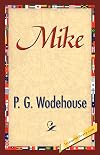
Mike
by P. G. Wodehouse
Tales of Wrykyn (Collections and Selections — ), Psmith (Collections and Selections — Prequel & 1), Wodehouse School Stories (Collections and Selections — Mike at Wrykyn)
On This Page
Description
Please visit www.ManorWodehouse.com to see the complete selection of P. G Wodehouse books available in the Manor Wodehouse Collection.Tags
Recommendations










Member Reviews
I'm working my way through a P.G. Wodehouse collection and the early works have been trying at times. The never-ending descriptions of sports at boys schools gets old. That was the case with this one as well. The first half was just one long tedious description of cricket. I don't know that I would have made it through the book had it not been for the appearance of PSmith in the second half of the book. PSmith is delightful, droll, clever and everything that Mike is not. He breathed fresh air into the book and the second half was a lovely, humorous, light-hearted fun little read. I would give the first half 1-2 stars and the second half a solid 4. Long live PSmith!
This is one of P. G. Wodehouse’s earliest and, in my opinion, one of his best works. Had it not been for the extensive sections on cricket – a sport that fails to interest me – I would’ve rated this five stars.
The majority of the non-cricket episodes are highly entertaining. The humour is great, especially in the top-notch dialogue, thanks to some superb character creations. My favourites are Psmith and Mr Outwood. Mike himself is also a likeable character, making a good hero.
It’s interesting to see how some things never change over the years, as the following quote demonstrates:
>Man’s inability to get out of bed in the morning is a curious thing. One may reason with oneself clearly and forcibly without the slightest effect. show more One knows that delay means inconvenience. Perhaps it may spoil one’s whole day. And one also knows that a single resolute heave will do the trick. But logic is of no use. One simply lies there. show less
The majority of the non-cricket episodes are highly entertaining. The humour is great, especially in the top-notch dialogue, thanks to some superb character creations. My favourites are Psmith and Mr Outwood. Mike himself is also a likeable character, making a good hero.
It’s interesting to see how some things never change over the years, as the following quote demonstrates:
>Man’s inability to get out of bed in the morning is a curious thing. One may reason with oneself clearly and forcibly without the slightest effect. show more One knows that delay means inconvenience. Perhaps it may spoil one’s whole day. And one also knows that a single resolute heave will do the trick. But logic is of no use. One simply lies there. show less
The last and best-known of Wodehouse's school novels. It has two distinct parts. In the first, "Mike at Wrykyn", we are introduced to Mike Jackson, the youngest boy in a family of great cricket players. His father even hires a professional player to coach the boys in the summer. At the beginning of the book, Mike is sent to a boarding school called Wrykyn, with a strong cricketing tradition. The first part of the book is about Mike's adventures at Wrykyn, both on the cricket field and elsewhere. It's a traditional boarding school story, with a lot of emphasis on sports, but also on other schoolboy escapades. Think "Tom Brown's School Days" but with a lot of cricket games.
The second part, "Mike and Psmith", takes place a few years later. show more Mike's father has withdrawn him from Wrykyn due to his bad grades and sent him against his will to Sedleigh, a smaller, less-prestigious school without a first class cricket team. Mike is disgusted at losing the opportunity to be the captain of the Wrykyn team and his intention is not to play for his new school. At Sedleigh, he meets and befriends Psmith, who is also new at the school, after being expelled from Eton. This second part is also a traditional boarding school story with plenty of cricket, but at the same time it's more similar to Wodehouse famous comedy writing (thanks to Psmith, a fast-talking, charmingly roguish character who shares the spotlight with Mike in this second part).
As a fan of boarding school stories, I always feel a disconnect when I read readers' reviews of Wodehouse's school stories. The people writing those reviews do not like school stories. They are fans of Wodehouse's comedy writing, and that's what they are looking for. Therefore, they like the second part of the novel much more than the first, since Psmith is precisely the type of character they want. I, on the other hand, liked both parts of the story about the same. The first part is more sport-focused, and the main plot is an underdog trying to secure a place in the school's first eleven in his first year there (underdog is a relative term here, because Mike is exceptionally talented at cricket, but also younger and physically weaker than the players he has to compete against to get on the team). The second part has a fair amount of cricket too, but Psmith steals the show.
To be honest, I sometimes got a bit tired of Psmith and all his talking, but he is funny, and I appreciated that, when it counts, his heart is in the right place.
Wodehouse assumes that his readers understand cricket here. If you know nothing of cricket, the descriptions of the matches and the cricket slang may be a bit tough for you, and you won't understand what exactly is going on, although you'll probably be able to follow what team and what players are doing well. I have some (very basic) notions of cricket and I like sport stories, so I was fine. For some readers, however, this might be a problem. show less
The second part, "Mike and Psmith", takes place a few years later. show more Mike's father has withdrawn him from Wrykyn due to his bad grades and sent him against his will to Sedleigh, a smaller, less-prestigious school without a first class cricket team. Mike is disgusted at losing the opportunity to be the captain of the Wrykyn team and his intention is not to play for his new school. At Sedleigh, he meets and befriends Psmith, who is also new at the school, after being expelled from Eton. This second part is also a traditional boarding school story with plenty of cricket, but at the same time it's more similar to Wodehouse famous comedy writing (thanks to Psmith, a fast-talking, charmingly roguish character who shares the spotlight with Mike in this second part).
As a fan of boarding school stories, I always feel a disconnect when I read readers' reviews of Wodehouse's school stories. The people writing those reviews do not like school stories. They are fans of Wodehouse's comedy writing, and that's what they are looking for. Therefore, they like the second part of the novel much more than the first, since Psmith is precisely the type of character they want. I, on the other hand, liked both parts of the story about the same. The first part is more sport-focused, and the main plot is an underdog trying to secure a place in the school's first eleven in his first year there (underdog is a relative term here, because Mike is exceptionally talented at cricket, but also younger and physically weaker than the players he has to compete against to get on the team). The second part has a fair amount of cricket too, but Psmith steals the show.
To be honest, I sometimes got a bit tired of Psmith and all his talking, but he is funny, and I appreciated that, when it counts, his heart is in the right place.
Wodehouse assumes that his readers understand cricket here. If you know nothing of cricket, the descriptions of the matches and the cricket slang may be a bit tough for you, and you won't understand what exactly is going on, although you'll probably be able to follow what team and what players are doing well. I have some (very basic) notions of cricket and I like sport stories, so I was fine. For some readers, however, this might be a problem. show less
This is a public school boy tale mostly about cricket. The version I read included a first half focusing on the title character Mike Jackson, a cricket genius who is sent to the family public school. The second hald was the tale of Mike and Psmith, exiled from respective top schools to a lowly ranked one. I'd already read the Mike and Psmith tale (excellent fun) so stopped after the first half in this volume.
The story of Mike is less entertaining without Psmith, the brilliant troublemaker. Mike Jackson likes cricket, and if you don't like cricket, or have trouble telling a yorker from a googly, you make find this tale rather tedious. It has a certain charm, told with Wodehouse's characteristic phrases, but the drama around Jackson's show more chances getting his cricket colours didn't draw me in to the tale as deeply as the more compelling story of Mike and Psmith against the school in the later tale.
If you enjoy a good game of summer cricket, or better, if you enjoy reading about good games of summer cricket, this might appeal, otherwise stick with the Psmith tales, filled with more humour, more eccentric characters, and more compelling story. show less
The story of Mike is less entertaining without Psmith, the brilliant troublemaker. Mike Jackson likes cricket, and if you don't like cricket, or have trouble telling a yorker from a googly, you make find this tale rather tedious. It has a certain charm, told with Wodehouse's characteristic phrases, but the drama around Jackson's show more chances getting his cricket colours didn't draw me in to the tale as deeply as the more compelling story of Mike and Psmith against the school in the later tale.
If you enjoy a good game of summer cricket, or better, if you enjoy reading about good games of summer cricket, this might appeal, otherwise stick with the Psmith tales, filled with more humour, more eccentric characters, and more compelling story. show less
As other reviewers have noted, there is lots of cricket in this. As an American who is not much interested in sports, much of the details about batting and bowling escaped me. However, I did get a kick out of the boys' shenanigans. I was surprised to discover that Psmith had introduced the P in his name himself (because there were too many plain Smiths and he didn't like Smythe!).
As other reviewers have noted, there is lots of cricket in this. As an American who is not much interested in sports, much of the details about batting and bowling escaped me. However, I did get a kick out of the boys' shenanigans. I was surprised to discover that Psmith had introduced the P in his name himself (because there were too many plain Smiths and he didn't like Smythe!).
Ðe firſt half is big on cricket; if you have ðe patience for ðe details on it, an intereſtiŋ portrait of cricket & Engliſh public ſchools before ðe Great War. Ðe ſecond half is all but dominated by ðe very intereſtiŋ character of Pſmiþ.
Members
- Recently Added By
Lists

Books Read in 2015
3,299 works; 129 members

Children's Literature 1900 - 1950 in order
413 works; 8 members
Author Information

656+ Works 110,601 Members
P. G. Wodehouse was born in Guildford, United Kingdom on October 15, 1881. After completing school, he spent two years as a banker at the Hong Kong and Shanghai Bank in London and then took a job as a sports reporter and columnist for the Globe newspaper. His first novel, The Pothunters, was published in 1902. He wrote over 100 novels and short show more story collections during his lifetime including A Perfect Uncle, Love Among the Chickens, The Swoop, P. Smith in the City, Meet Mr. Milliner, Doctor Sally, Quick Service, The Old Reliable, Uneasy Money, A Damsel in Distress, Jill the Reckless, The Adventures of Sally, A Pelican at Blandings, The Girl in Blue, and Aunts Aren't Gentlemen. His most famous characters, Bertie Wooster and his manservant, Jeeves, appeared in books such as Much Obliged, Jeeves. He also wrote lyrics for musical comedies and worked as screenwriter in Hollywood in the 1930s. In 1939, he bought a villa in Le Touquet on the coast of France. He remained there when World War II started in 1939. The following year, the Germans appropriated the villa, confiscated property, and arrested him. He was detained in various German camps for almost one year before being released in 1941. He went to Berlin and spoke of his experience in five radio talks to be broadcast to America and England. The talks themselves were completely innocuous, but he was charged with treason in England. He was cleared, but settled permanently in the United States. He became a citizen in 1955. He was made a Knight Commander of the Order of the British Empire in 1975. He died from a heart attack after a long illness on February 14, 1975 at the age of 93. (Bowker Author Biography) show less
Some Editions
Series

Tales of Wrykyn
5 works (Collections and Selections — )

Psmith
5 works (Collections and Selections — Prequel & 1)

Wodehouse School Stories
10 works (Collections and Selections — Mike at Wrykyn)
Belongs to Publisher Series
Work Relationships
Contains
Common Knowledge
- Canonical title
- Mike
- Original title
- Mike
- Alternate titles
- Enter Psmith; Mike and Psmith; Junior Jackson; Lost Lambs
- Original publication date
- 1909
- People/Characters
- Mike Jackson; Robert Jackson; Marjory Jackson; Firby-Smith aka Gazeka; Ronald Psmith; Jimmy Wyatt (show all 8); Billy Burgess; Mr. Wain
- Important places
- Wrykyn School, Wrykyn, England, UK (fictitious place)
- Dedication
- To Alan Durand
- First words
- It was a morning in the middle of April, and the Jackson family were consequently breakfasting in comparative silence.
- Quotations
- He had the same feeling for Mike that most boys of eighteen have for their fifteen-year-0ld brothers. He was fond of him in the abstract, but preferred him at a distance.
And here, I regret to say, Mike acted from the best motives, which is always fatal. - Last words
- (Click to show. Warning: May contain spoilers.)They staggered.
- Disambiguation notice
- "The story first appeared in the magazine The Captain, in two separate parts, collected together in the original version of the book; the first part, originally called "Jackson Junior", was republished in 1953 under th... (show all)e title Mike at Wrykyn, while the second half, called "The Lost Lambs" in its serialised version, was released as Enter Psmith in 1935 and then as Mike and Psmith in 1953 – this marks the first appearance of the popular character of Psmith." Wikipedia
Classifications
Statistics
- Members
- 160
- Popularity
- 204,222
- Reviews
- 8
- Rating
- (3.80)
- Languages
- English, Italian, Swedish
- Media
- Paper, Audiobook, Ebook
- ISBNs
- 32
- ASINs
- 8