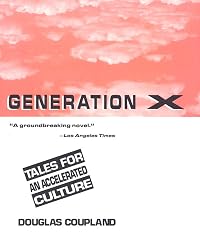
Generation X: Tales for an Accelerated Culture
by Douglas Coupland
On This Page
Description
Three twenty-something young adults, working at low-paying, no-future jobs, tell one another modern tales of love and death.Tags
Recommendations








Member Recommendations
Member Reviews
Douglas Coupland's Generation X, OPD 1991, makes clear that we have had the same problems for decades, and have failed to address them properly for decades--climate change, ecological breakdown, obscene capitalist rape of the commons for the sake of enriching the few, moral bankruptcy of the flight from combat. From before Gen X to Gen Z/alpha -- yesterday I picked up Vonnegut's Breakfast of champions, 1972, and that too reads as if written this morning.
There is no generational conflict. As always there is only the conflict between the oppressed, and the ruling class abetted by the comfy smugheads.
There is no generational conflict. As always there is only the conflict between the oppressed, and the ruling class abetted by the comfy smugheads.
Generation X is Douglas Coupland's acclaimed salute to the generation born in the late 1950s and 1960s--a generation known vaguely up to then as "twentysomething."Andy, Claire, and Dag, each in their twenties, have quit "pointless jobs done grudgingly to little applause" in their respective hometowns and cut themselves adrift on the California desert. In search of the drastic changes that will lend meaning to their lives, they've mired themselves in the detritus of American cultural memory. Refugees from history, the three develop an ascetic regime of story-telling, boozing, and working McJobs--"low-pay, low-prestige, low-benefit, no-future jobs in the service industry." They create modern fables of love and death among the cosmetic show more surgery parlors and cocktail bars of Palm Springs, disturbingly funny tales of nuclear waste, historical overdosing, and mall culture.A dark snapshot of the trio's highly fortressed inner world quickly emerges--landscapes peopled with dead TV shows, "Elvis moments," and semi-disposable Swedish furniture. And from these landscapes, deeper portraits emerge, those of fanatically independent individuals, pathologically ambivalent about the future and brimming with unsatisfied longings for permanence, for love, and for their own home. Andy, Dag, and Claire are underemployed, overeducated, intensely private, and unpredictable. Like the group they mirror, they have nowhere to assuage their fears, and no culture to replace their anomie. show less
I had the same problem with this book that I have with any book, piece of artwork, song, or movie that attempts to speak to and/or about my generation.
Part of the problem is the sheer weight of representation: in their attempts to wax philosophical on life and its accompanying angst, what most prominently stands out in the words of Claire, Dag and Andy is either the pretension that comes with making any grand gesture meant to stand for a collective consciousness or the disingenuous gravity that accompanies "Proclamations of the 'Truth'" (that's 'truthiness' to you Colbert fans).
Whenever I catch Juno or Empire Records or the like on television I get that same feeling - a sense of naughty delight at the winsome words coming off of the show more screen dampened by the realization that NO ONE REALLY TALKS LIKE THIS, and if they do, they are probably too caught up with their own words to really care to listen to anyone else's. Which is not to say that I'm a stickler for realism either, but in this book there is a clear line between the sad suck of reality and the semi-magical realism of the tales these three windbags tend to dream up, and the realism part just doesn't work.
But I'm being harsh. I have no problem with environmental and social responsibility, or a lessening of hyperconsumption in all its forms. And I admit, if I'd read this maybe 9 or 10 years ago I might've absolutely gobbled it up whole, but I find it all tiresome now. There is a lot that does ring true here, but the execution is sometimes taxing.
Maybe it is the author's intention that the characters just sound like a group of ungrateful, vacuous people taking up space, and if so then the job is done. Some parts of this genuinely made me laugh and some of the characterizations are done very well, but I have a hard time swallowing books that are filled with whining, particularly the kind of whining where there is a wink at how clever it all is to whine in such a way.
I also have a hard time with this notion that the answer is "out there," in some fading desert - a la Coehlo's The Alchemist (or, worse yet, in an underprivileged foreign country) just waiting for some 20-something lost American middle-class soul to pluck it from the ether. The act is seen here as courageous when it is really some imperialist orientalist romanticism that has more to do with avoiding answers than really finding them.
Not that I have any answers either, but still. show less
Part of the problem is the sheer weight of representation: in their attempts to wax philosophical on life and its accompanying angst, what most prominently stands out in the words of Claire, Dag and Andy is either the pretension that comes with making any grand gesture meant to stand for a collective consciousness or the disingenuous gravity that accompanies "Proclamations of the 'Truth'" (that's 'truthiness' to you Colbert fans).
Whenever I catch Juno or Empire Records or the like on television I get that same feeling - a sense of naughty delight at the winsome words coming off of the show more screen dampened by the realization that NO ONE REALLY TALKS LIKE THIS, and if they do, they are probably too caught up with their own words to really care to listen to anyone else's. Which is not to say that I'm a stickler for realism either, but in this book there is a clear line between the sad suck of reality and the semi-magical realism of the tales these three windbags tend to dream up, and the realism part just doesn't work.
But I'm being harsh. I have no problem with environmental and social responsibility, or a lessening of hyperconsumption in all its forms. And I admit, if I'd read this maybe 9 or 10 years ago I might've absolutely gobbled it up whole, but I find it all tiresome now. There is a lot that does ring true here, but the execution is sometimes taxing.
Maybe it is the author's intention that the characters just sound like a group of ungrateful, vacuous people taking up space, and if so then the job is done. Some parts of this genuinely made me laugh and some of the characterizations are done very well, but I have a hard time swallowing books that are filled with whining, particularly the kind of whining where there is a wink at how clever it all is to whine in such a way.
I also have a hard time with this notion that the answer is "out there," in some fading desert - a la Coehlo's The Alchemist (or, worse yet, in an underprivileged foreign country) just waiting for some 20-something lost American middle-class soul to pluck it from the ether. The act is seen here as courageous when it is really some imperialist orientalist romanticism that has more to do with avoiding answers than really finding them.
Not that I have any answers either, but still. show less
Douglas Coupland is a comic genius. 'Eleanor Rigby' was eerily perceptive and very droll, but this book is perfection - short, snappy and sharply humorous, sort of Brett Easton Ellis without the drugs.
Narrator Andy (although his 'voice' is almost unisex) and two best friends Claire and Dag are twenty-somethings living in Palm Springs. They tell each other stories to pass the time because nothing happens. It's hot, they go to work, sit by the pool, drive out into the middle of nowhere for picnics. But Coupland makes this work, because his characters are introspective, intelligent, abstract and also very real. I could feel the oppressive heat and boredom he describes, and empathise with their neurotic 'generation x' fears.
Coupland's show more writing is sharp, vivid but not pretentious - he captures the 'voice' of disaffected youth perfectly, with a wicked turn of phrase. One woman, nicknamed Elvissa, has a 'large, anatomically disproportionate head, like that of a woman who points to merchandise on a TV game show. This head is capped by an Elvis-oidal Mattel toy doll jet black hair-do that frames her skull like a pair of inverted single quotes'. A counter surface looks like the 'narrow horseshoe of flooring surrounding the toilet of an alcoholic, a lunar surface of leprotic cigarette burn sores'. Andy's father 'flounders through the empty rooms of the house like a tanker that has punctured its hull with its own anchor'. These are images that capture your imagination, making the reader 'see' without obvious comparisons what he is trying to say. Coupland should write a manual on how to phrase original metaphors and similes, he's that good.
There are also some very apt definitions of modern phrases and social conditions peppering the pages like footnotes - 'voter's block', 'diseases for kisses' or 'hyperkarma', 'paper rabies' - that fit perfectly, as well as Lichenstein cartoons and pithy 'bumper sticker' slogans. All in all a very 'visual' book, complete with dazzling neon pink cover! show less
Narrator Andy (although his 'voice' is almost unisex) and two best friends Claire and Dag are twenty-somethings living in Palm Springs. They tell each other stories to pass the time because nothing happens. It's hot, they go to work, sit by the pool, drive out into the middle of nowhere for picnics. But Coupland makes this work, because his characters are introspective, intelligent, abstract and also very real. I could feel the oppressive heat and boredom he describes, and empathise with their neurotic 'generation x' fears.
Coupland's show more writing is sharp, vivid but not pretentious - he captures the 'voice' of disaffected youth perfectly, with a wicked turn of phrase. One woman, nicknamed Elvissa, has a 'large, anatomically disproportionate head, like that of a woman who points to merchandise on a TV game show. This head is capped by an Elvis-oidal Mattel toy doll jet black hair-do that frames her skull like a pair of inverted single quotes'. A counter surface looks like the 'narrow horseshoe of flooring surrounding the toilet of an alcoholic, a lunar surface of leprotic cigarette burn sores'. Andy's father 'flounders through the empty rooms of the house like a tanker that has punctured its hull with its own anchor'. These are images that capture your imagination, making the reader 'see' without obvious comparisons what he is trying to say. Coupland should write a manual on how to phrase original metaphors and similes, he's that good.
There are also some very apt definitions of modern phrases and social conditions peppering the pages like footnotes - 'voter's block', 'diseases for kisses' or 'hyperkarma', 'paper rabies' - that fit perfectly, as well as Lichenstein cartoons and pithy 'bumper sticker' slogans. All in all a very 'visual' book, complete with dazzling neon pink cover! show less
I first read this book shortly after it came out and it started my love affair with Douglas Coupland. It wasn't until very recently that I reread it. I'd been afraid that it wouldn't have passed the test of time--that it would seem as dated as the movie Singles. Fortunately, I still found it to be quite enjoyable. However, what I've found over Douglas Coupland's career, is that I most enjoy his novels set in the Pacific Northwest. He writes of the environment with a greater sense of authority--no doubt from living his life in and around Vancouver. One of his greatest strengths, in my opinion, is capturing the "feel" of life in the PNW.
The three main characters in Generation X have turned away from the expected path of their peers, show more namely the acquisition of careers and material goods. They're looking for happiness and meaning in simpler ways and their jobs are simply a mean to an ends--their jobs aren't their lives, their jobs are simply something to keep food in their bellies and a roof over their heads while they look for real meaning elsewhere. Even now, almost 20 years after the novel was published, there's something beautiful about that idea. show less
The three main characters in Generation X have turned away from the expected path of their peers, show more namely the acquisition of careers and material goods. They're looking for happiness and meaning in simpler ways and their jobs are simply a mean to an ends--their jobs aren't their lives, their jobs are simply something to keep food in their bellies and a roof over their heads while they look for real meaning elsewhere. Even now, almost 20 years after the novel was published, there's something beautiful about that idea. show less
This could have been the beginning of something wonderful, but I feel that Coupland's work of late has been something of a let-down.
That said, the world will always have this perfectly formed slice of nineties anxiety. Life in the nuclear age - both in terms of technology, and the "nuclear family" - is expressed through the adventures of a delinquent group of friends living in the tragic rubble of California around Palm Springs: they don't belong there, and it tells.
That said, the world will always have this perfectly formed slice of nineties anxiety. Life in the nuclear age - both in terms of technology, and the "nuclear family" - is expressed through the adventures of a delinquent group of friends living in the tragic rubble of California around Palm Springs: they don't belong there, and it tells.
Wow, talk about reading a book at the right time in your life. If you’re in your twenties, fresh out of college, and in that phase where you’re trying to get your life sorted out, this is the book for you.
We live in a time where our options are limited and we’re forced to conform to “the system” – AKA you can’t get a good job without a college degree and most of us can’t get a college degree without putting ourselves into overwhelming debt, and then we can’t get jobs without experience but we can’t get experience without jobs. It’s a vicious cycle, but one we’re forced into. My father didn’t go to college but was still able to get a job that paid well enough to put him into the upper middle class. That’s not show more an option my generation has, and there’s this whole sense of “wtf is the point then?” among us.
Everything is bigger than us. Giant corporations control what we buy and what we can afford, the bank more or less controls everything else, including whether or not we’re qualified for a home, a car, or other things life has taught us are necessities but we learn are often outside our reach. Our protests don’t mean much, and the person with more money always seems to win. It’s frustrating to feel so small, and I think Generation X can be summed up by the following:
“We know that this is why the three of us left our lives behind us and came to the desert – to tell stories and to make our own lives worthwhile tales in the process.”
I love it. I love the idea of living my life through a story, because we all want our lives to have meaning. And the jealousy Andy feels at realizing the Baby Boomers hit the “genetic lottery” (able to attain good jobs and various luxuries without having to throw oneself into a lifetime of debt) is something I personally feel every time another student loan bill shows up in my mailbox or I get a call from a collection agent. The desire for a simpler time, to just run away to the desert and escape everything, resonates within me, and in that regard I really feel like I connected with this book.
I wouldn’t consider this a traditional book by any means. I didn’t really care for the characters so much as the ideas of the book. There wasn’t really a story (there were lots of tales within the book, but not really a cohesive storyline) – it was more the existence of the characters. I have no problem with this, but some might, so I thought it worth mentioning. However, the ending was really weird, I’m not going to lie. I’m still not sure what happened exactly, except perhaps Andy had some sort of spiritual experience he felt gave his life meaning. It’s my best guess. And the ending did throw me a bit, because it didn’t feel like it was part of the main book. But honestly, I loved this book too much to really care, because I felt like it was the truth of today written in a book. show less
We live in a time where our options are limited and we’re forced to conform to “the system” – AKA you can’t get a good job without a college degree and most of us can’t get a college degree without putting ourselves into overwhelming debt, and then we can’t get jobs without experience but we can’t get experience without jobs. It’s a vicious cycle, but one we’re forced into. My father didn’t go to college but was still able to get a job that paid well enough to put him into the upper middle class. That’s not show more an option my generation has, and there’s this whole sense of “wtf is the point then?” among us.
Everything is bigger than us. Giant corporations control what we buy and what we can afford, the bank more or less controls everything else, including whether or not we’re qualified for a home, a car, or other things life has taught us are necessities but we learn are often outside our reach. Our protests don’t mean much, and the person with more money always seems to win. It’s frustrating to feel so small, and I think Generation X can be summed up by the following:
“We know that this is why the three of us left our lives behind us and came to the desert – to tell stories and to make our own lives worthwhile tales in the process.”
I love it. I love the idea of living my life through a story, because we all want our lives to have meaning. And the jealousy Andy feels at realizing the Baby Boomers hit the “genetic lottery” (able to attain good jobs and various luxuries without having to throw oneself into a lifetime of debt) is something I personally feel every time another student loan bill shows up in my mailbox or I get a call from a collection agent. The desire for a simpler time, to just run away to the desert and escape everything, resonates within me, and in that regard I really feel like I connected with this book.
I wouldn’t consider this a traditional book by any means. I didn’t really care for the characters so much as the ideas of the book. There wasn’t really a story (there were lots of tales within the book, but not really a cohesive storyline) – it was more the existence of the characters. I have no problem with this, but some might, so I thought it worth mentioning. However, the ending was really weird, I’m not going to lie. I’m still not sure what happened exactly, except perhaps Andy had some sort of spiritual experience he felt gave his life meaning. It’s my best guess. And the ending did throw me a bit, because it didn’t feel like it was part of the main book. But honestly, I loved this book too much to really care, because I felt like it was the truth of today written in a book. show less
Members
- Recently Added By
Lists

The Best of Canadian Literature
235 works; 33 members
CBC Books - Canada's 100 (+ bonus 10): Which have you read?
110 works; 23 members

Best Workplace Fiction
47 works; 18 members

Significant works of postmodern fiction
86 works; 25 members

Books I've Read More Than Once
602 works; 49 members

Nineties
43 works; 10 members

1990s
309 works; 17 members

BBC Radio 4 Bookclub
341 works; 13 members

LibraryThingers' 1001 Books You Must Read Before You Die
442 works; 30 members

Story Within a Story
65 works; 17 members

Canada Reads Winners and Nominees
129 works; 9 members

CBC's Great Canadian Reading List
149 works; 5 members
Five star books
1,767 works; 110 members
Best Books of the 20th Century
193 works; 5 members

Books Read in 2004
212 works; 7 members
First Novels
373 works; 17 members

Favorite Books from the 1990s
32 works; 3 members

Read
293 works; 4 members

Biggest Disappointments
606 works; 168 members

Gen X Library
245 works; 4 members
Cult Classics
30 works; 1 member

NTS Book Channel
316 works; 1 member
I Can't Finish This Book
189 works; 22 members
Author Information

44+ Works 38,750 Members
Douglas Coupland was born December 30, 1961 on a Canadian military base in Baden-Soellingen, Germany. He graduated from Sentinel Secondary School in West Vancouver in 1979 and went on to McGill University. He was unhappy there and went on to Emily Carr College of Art and Design. He has said that these were the best four years of his life. He show more graduated in 1984 with a focus on sculpture and moved on to study at the European Design Institute in Milan. He also completed a two-year course in Japanese business science in Hawaii in 1986.He soon began writing for magazines as a means of paying the bills. He soon started work on his first novel Generation X: Tales for an Accelerated Culture which was published in 1991. His second novel Shampoo Planet focused on the generation after Generation X and was published in 1992. This generation was termed "Global Teens". His career has consisted of writing, sculpting, and editing and he also hosted The Search for Generation X, a PBS documentary, 1991. Douglas Coupland has also worked on a magazine called Wired . He wrote a short story about the life of the employees of Mocrosoft Corporation. This short story provided inspiration for his novel Microserfs. (Bowker Author Biography) show less
Some Editions
Awards and Honors
Awards
Series
Belongs to Publisher Series
Common Knowledge
- Canonical title*
- Generatie X
- Original title
- Generation X
- Original publication date
- 1991
- People/Characters
- Andy; Dag; Claire
- Important places
- Palm Springs, California, USA; Mojave Desert, California, USA; Baja California, Mexico; California, USA
- Epigraph*
- "Her hair was totally 1950s Indina Woolworth perfume
clerk. You know-sweet and dumb-she'll marry her way
out of the trailer park some day soon. But the dress was
early '60s Aeroflot stewardess-you know-th... (show all)at really sad
blue the Russians used before they all started wanting to
buy Sonys and having Guy Laroche design their Politburo
caps. And such make-up! Perfect '70s Mary Quant, with
these little PVC floral appliqué earrings that looked like
antiskid bathtub stickers from a gay Hollywood tub circe
1956. She really caught the sadness-she was the hippest
person there. Totally."
TRACEY, 27
"They're my children. Adults or not, I just can't kick them
out of the house. It would be cruel. And besides-they're
great cooks."
HELEN, 52 - First words
- Back in the late 1970s, when I was fifteen years old, I spent every penny I then had in the bank to fly across the continent in a 747 jet to Brandon, Manitoba, deep in the Canadian prairies, to witness a total eclipse of the ... (show all)sun.
- Quotations
- "You see, when you're middle class, you have to live with the fact that history will ignore you. You have to live with the fact that history will never champion your causes and that history will never feel sorry for you. It i... (show all)s the price paid for day-to-day comfort and silence. And because of this price, all happinesses are sterile; all sadnesses go unoticed. And any small moments of intense, flaring beauty such as this morning's will be utterly forgotten, dissolved by time like a super-8 film left out in the rain, without sound, and quickly replaced by thousands of silently growing trees."
- Last words
- (Click to show. Warning: May contain spoilers.)I can't remember whether I said thank you.
*Some information comes from Common Knowledge in other languages. Click "Edit" for more information.
Classifications
Statistics
- Members
- 5,691
- Popularity
- 2,327
- Reviews
- 64
- Rating
- (3.68)
- Languages
- 21 — Czech, Danish, Dutch, English, Estonian, Finnish, French, German, Greek, Hungarian, Italian, Japanese, Latvian, Lithuanian, Norwegian (Bokmål), Polish, Portuguese, Romanian, Russian, Spanish, Swedish
- Media
- Paper, Ebook
- ISBNs
- 57
- ASINs
- 17