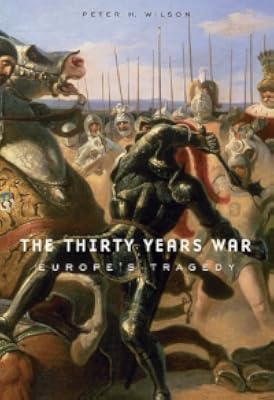
The Thirty Years War: Europe's Tragedy
by Peter H. Wilson
On This Page
Description
A deadly continental struggle, the Thirty Years War devastated seventeenth-century Europe, killing nearly a quarter of all Germans and laying waste to towns and countryside alike. In a major reassessment, Wilson argues that religion was not the catalyst, but one element in a lethal stew of political, social, and dynastic forces that fed the conflict--a conflict that ultimately transformed the map of the modern world.Tags
Recommendations






Member Recommendations


Member Reviews
Peter Wilson's book is about more than the war that consumed central Europe in the 17th century. To adequately explain the factors that led up to it and influenced its outcome, he describes the context of politics and government in the Holy Roman Empire. This vast, unwieldy, and yet surprisingly effective institution was at the center of the struggle, as Protestants and Catholics struggle to coexist within it in the years following the Peace of Augsburg in 1555. Fragile as it was, this peace was strained by the efforts of successive Habsburg emperors to strengthen their power within the empire, an effort that fueled Protestant anxieties that the Habsburgs would use this power to advance the Catholic faith at their expense.
Yet Wilson show more makes a persuasive argument that the war was more about politics than religion. Though confessional issues sparked the initial outbreak, the war often led to cross-confessional alliances that set co-religionists against each other. Here Wilson builds upon his extensive discussion of prewar politics to highlight the dynastic ambitions of people like Frederick V of Palatine and Maximilian of Bavaria and their efforts to use the war to advance their interests. Nobody exemplified this better than Gustavus Adolphus, the Swedish king whose intervention reversed the string of Imperial victories. Though his death deprived the rebels of their greatest leader, the war dragged on thanks to the support provided by the French, whose rise to European dominance coincided with the conflict.
All of this is described in an elaborate narrative designed to give the reader an understanding of the factors at work in the conflict and how the war turned out the way it did. The text is dense with the names of people and locations, yet this helps convey the considerable complexity of events. Simply put, this is the best history of the war available, and with remain the definitive source for anyone interested in the conflict for years to come. show less
Yet Wilson show more makes a persuasive argument that the war was more about politics than religion. Though confessional issues sparked the initial outbreak, the war often led to cross-confessional alliances that set co-religionists against each other. Here Wilson builds upon his extensive discussion of prewar politics to highlight the dynastic ambitions of people like Frederick V of Palatine and Maximilian of Bavaria and their efforts to use the war to advance their interests. Nobody exemplified this better than Gustavus Adolphus, the Swedish king whose intervention reversed the string of Imperial victories. Though his death deprived the rebels of their greatest leader, the war dragged on thanks to the support provided by the French, whose rise to European dominance coincided with the conflict.
All of this is described in an elaborate narrative designed to give the reader an understanding of the factors at work in the conflict and how the war turned out the way it did. The text is dense with the names of people and locations, yet this helps convey the considerable complexity of events. Simply put, this is the best history of the war available, and with remain the definitive source for anyone interested in the conflict for years to come. show less
Mr. Wilson has a gift, somewhat unequalled for the time period he cares for; that of making clear to the reader extraordinarily complex events.
He reexamines them under the light of the Holy Roman Empire and those leaders Gustave Adolphe of Sweden, Louis XIV of France and the Ottomans who use their maces, canons or swords to hit at its fringes.
Whether religious, economical, legal, fiscal, societal or military his analyses give the reader the clues to understand.
Wilson's touch on events is never boring as too many history books give dates, places and events without concern for how dainty they can be to absorb.
Particularly well described is the importance of the "Spanish Road", how the cost of the military could contribute to the demise show more of an empire, that of Philip III of Spain while the Dutch were wiser in the administration of their resources.
Now it may be granted that when you wake up in the morning the importance of the Peace of Vervins signed on May 2 1598 between Henry IV of France and Philip II of Spain may escape you, but like all the events of this period, they changed the landscape to bring us closer to the Europe we now know.
If you like history without the squeamishness, you will like the Thirty Years War; Europe's Tragedy and fly through its 997 pages. show less
He reexamines them under the light of the Holy Roman Empire and those leaders Gustave Adolphe of Sweden, Louis XIV of France and the Ottomans who use their maces, canons or swords to hit at its fringes.
Whether religious, economical, legal, fiscal, societal or military his analyses give the reader the clues to understand.
Wilson's touch on events is never boring as too many history books give dates, places and events without concern for how dainty they can be to absorb.
Particularly well described is the importance of the "Spanish Road", how the cost of the military could contribute to the demise show more of an empire, that of Philip III of Spain while the Dutch were wiser in the administration of their resources.
Now it may be granted that when you wake up in the morning the importance of the Peace of Vervins signed on May 2 1598 between Henry IV of France and Philip II of Spain may escape you, but like all the events of this period, they changed the landscape to bring us closer to the Europe we now know.
If you like history without the squeamishness, you will like the Thirty Years War; Europe's Tragedy and fly through its 997 pages. show less
I am currently reading this book and struggling in the process. The thirty years war is intrinsically confusing (e.g. there are dozens of figures with shifting alliances and borders and everyone seems to be named Frederick or Ferdinand). This book manages to make a confusing epoch even more confusing.
My personal feeling is that this book really does contain the right level of detail but the details are presented in ways that maximize confusion. For example, within one paragraph, events jump from one end of Europe to the other based upon references to obscure little villages.
I would recommend this book only for people that already know the subject in detail and have a commanding knowledge of the geography and villages of Europe.
My personal feeling is that this book really does contain the right level of detail but the details are presented in ways that maximize confusion. For example, within one paragraph, events jump from one end of Europe to the other based upon references to obscure little villages.
I would recommend this book only for people that already know the subject in detail and have a commanding knowledge of the geography and villages of Europe.
Deep and comprehensive. Almost too comprehensive — there's a cast of thousands here, and keeping all the real historical personages straight was very difficult. But a good introduction to an important and overlooked period of history.
5253. The Thirty Years War Europe's Tragedy, by Peter H. Wilson (read 10 Mar 2015) Even though I read and hugely appreciated C. V. Wedgwood's book on the 30 Years War--it was my Book of the Year in 1968--I thought I should read this more recent book. It is indeed a formidable work (852 pages of text, 72 pages of Notes) but I found it much less enjoyable since it drowns one in detail. Not only do we have maps of the famous battles (which battles I remembered well from my class in Modern European History taught by Father Bill Green at Loras in 1946-1947) White Mountain in 1620, Breitendfeld in 1631, Nordlingen in 1634, but we also have accounts and maps of 22 other battles. I confess I felt overwhelmed by detail which no doubt would be show more appreciated by a war gamer but I felt it did not hold my interest well. After the book opens with an account of the Defenestration of Prague on May 23, 1618, it is not till page 269 that the war begins--the lead-up to the war was not that necessary, I could not help but feel. The book certainly shows the dire effects of the war on the areas of Europe affected, and there is much about the account full of interest. But I am not eager to read more about the war after slogging through these pages. show less
An absolutely fabulous book. One that takes accepted history by the scruff of the neck and gives it a good facts based shakeout.
By wiping away some of the lazy assumptions or confessional bias in previous works, Wilson has done history and readers a great service.
I was struck once again as I read through the text just what a disaster the war was for central Europe and how much damage it did to development.
By wiping away some of the lazy assumptions or confessional bias in previous works, Wilson has done history and readers a great service.
I was struck once again as I read through the text just what a disaster the war was for central Europe and how much damage it did to development.
Nine hundred pages on one of the bloodiest wars in European history. A considerable portion of Germans, when polled, consider this to be the worst war in Germany's history, including both World Wars!
Perfect Christmas-time reading.
This is a very thorough one-volume overview of the Thirty Years War, providing some 290 pages of background before finally reaching the Defenestration of Prague.
The machinations of the Swedes, the Spanish and Austrian Habsburgs, the French, and the separate duchies, kingdoms, and bishoprics of the Holy Roman Empire are a bit hard to follow at times, although the author does try extremely hard to make it all follow some chronology. The battles and tactics are described well, as is society before, during, and the show more aftermath of this long struggle.
Out of all of this mess, the Dutch finally received their independence, and the very idea of the nation-state was born, perhaps being the spark of the whole modern era in Europe. Out of the hottest crucibles of war, the Enlightenment rose. show less
Perfect Christmas-time reading.
This is a very thorough one-volume overview of the Thirty Years War, providing some 290 pages of background before finally reaching the Defenestration of Prague.
The machinations of the Swedes, the Spanish and Austrian Habsburgs, the French, and the separate duchies, kingdoms, and bishoprics of the Holy Roman Empire are a bit hard to follow at times, although the author does try extremely hard to make it all follow some chronology. The battles and tactics are described well, as is society before, during, and the show more aftermath of this long struggle.
Out of all of this mess, the Dutch finally received their independence, and the very idea of the nation-state was born, perhaps being the spark of the whole modern era in Europe. Out of the hottest crucibles of war, the Enlightenment rose. show less
Members
- Recently Added By
Published Reviews
ThingScore 75
"This is one of the few blind spots in what is otherwise a wonderfully comprehensive and detailed account. Although not always an easy read, it is unfailingly instructive and stimulating."
added by bookfitz
"It is to Wilson’s credit that he can both offer the reader a detailed account of this terrible and complicated war and step back to give due summaries. His scholarship seems to me remarkable, his prose light and lovely, his judgments fair."
added by bookfitz
The war fought between 1618 and 1648 remains, by many measures, the most destructive in Europe's history. During those years the Holy Roman Empire—which governed most of the European continent east of the Rhine—lost as many as eight million subjects, or a staggering 20% of its population. This amount to three times Europe's death rate during World War II. Whole swaths of central Europe show more were depopulated, abandoned to wild pigs and wolves. show less
added by dstallings
Lists

Best Military History Books
123 works; 21 members

Non-Fiction Worth Reading
1,015 works; 254 members

All Things Germany
321 works; 4 members

All Things France
100 works; 8 members

r/History Recommended Reading List
603 works; 12 members
THE WAR ROOM
813 works; 24 members

In Our Time books
4,934 works; 2 members

Books recommended in the history category on FiveBooks.com
329 works; 4 members
Author Information

21+ Works 2,230 Members
Peter H. Wilson is Chichele Professor of the History of War at the University of Oxford and the author of The Thirty Years War: Europe's Tragedy.
Awards and Honors
Work Relationships
Common Knowledge
- Original title
- The Thirty Years War: Europe's Tragedy
- Original publication date
- 2009
- People/Characters
- Gustavus Adolphus; Johann Tserclaes, Graf von Tilly; Albrecht von Wallenstein; Rudolf II, Holy Roman Emperor; Matthias, Holy Roman Emperor; Ferdinand II, Holy Roman Emperor (show all 51); Frederick V, Elector Palatine; John George I, Elector of Saxony; Christian, Duke of Brunswick-Lüneburg; Cardinal Richelieu; Maximilian I, Elector of Bavaria; Carl Gustaf Wrangel; Axel Oxenstierna; Henri de la Tour d'Auvergne, Vicomte de Turenne; Ferdinand III, Holy Roman Emperor; Louis II de Bourbon, 4th Prince de Condé, Duc d'Enghien (Louis Le Grand Condé | ); Louis XIII, King of France; Christian IV, King of Denmark; Ernst, Graf von Mansfeld; Ambrogio Spinola, 1st Marquis of the Balbases; Maurice of Nassau, Prince of Orange; Luis de Velasco y Velasco, 1st Marquess of Belvedere, 2nd Count of Salazar; Hendrik, count van den Bergh; Charles Bonaventure de Longueval, Count of Bucquoy; Francisco de Melo, Governor of the Habsburg Netherlands; Field Marshal Lennart Torstensson; Gottfried Heinrich Graf zu Pappenheim; Ottavio Piccolomini; Peter Melander, Count of Holzappel; Dodo zu Innhausen und Knyphausen; Field Marshal Jobst Maximilian von Gronsfeld; Lothar Dietrich Freiherr von Bönninghausen; George, Duke of Brunswick-Lüneburg; Charles Emmanuel I, Duke of Savoy; Matthias Gallas, Graf von Campo und Herzog von Lucera; Johann Reichsgraf von Aldringen; Field Marshal Johan Banér; Bernard of Saxe-Weimar; Georg Friedrich, Margrave of Baden-Durlach; Horace Vere, 1st Baron Vere of Tilbury; Sigismund III Vasa, King of the United Polish–Lithuanian Commonwealth; Władysław IV Vasa, King of the United Polish–Lithuanian Commonwealth; Franz Freiherr von Mercy; George Villiers, 1st Duke of Buckingham; James VI and I, King of Scots and King of England; Charles I, King of England, Scotland, and Ireland; Gabriel Bethlen; Gustav Horn, Count of Pori; Philip IV of Spain; Urban VIII, Pope; Innocent X, Pope
- Important places*
- Praag, Tsjechië; La Rochelle, Nouvelle-Aquitaine, Frankrijk; Neurenberg, Beieren, Duitsland; Heidelberg, Baden-Württemberg, Duitsland; Stralsund, Mecklenburg-Vorpommern, Duitsland; Augsburg, Beieren, Duitsland (show all 34); Osnabrück, Nedersaksen, Duitsland; Münster, Noord-Rijnland-Westfalen, Duitsland; Leipzig, Saksen, Duitsland; Lützen, Saksen-Anhalt, Duitsland; Nördlingen, Beieren, Duitsland; Wittstock, Brandenburg, Duitsland; Jankov, Benešov District, Tsjechië; Magdeburg, Saksen-Anhalt, Duitsland; Fleurus, Henegouwen, België; Bergen op Zoom, Noord-Brabant, Nederland; Breda, Noord-Brabant, Nederland; Jülich, Noord-Rijnland-Westfalen, Duitsland; Rocroi, Grand-Est, Frankrijk; Mantua, Lombardije, Italië; Montferrat, Piemonte, Italië; Valtellina Valley, Lombardije, Italië; Graubünden, Zwitserland (kanton); Hohentwielfort, Baden-Württemberg, Duitsland; Stadtlohn, Noord-Rijnland-Westfalen, Duitsland; Rheinfelden, Aargau, Zwitserland; Bad Wimpfen, Baden-Württemberg, Duitsland; Lutter am Barenberge, Nedersaksen, Duitsland; Wolgast, Mecklenburg-Vorpommern, Duitsland; Freiburg im Breisgau, Baden-Württemberg, Duitsland; Tuttlingen, Baden-Württemberg, Duitsland; Bad Mergentheim, Baden-Württemberg, Duitsland; Lens, Hauts-de-France, Frankrijk; Donauwörth, Beieren, Duitsland
- Important events
- Peace of Augsburg (1555); Thirty Years' War (1618 | 1648); Defenestration of Prague (1618-05-23); Battle of White Mountain (1620-11-08); Siege of Jülich (1621 | 1622); Battle of Fleurus (1622) (show all 40); Siege of Bergen-op-Zoom (1622); Battle of Wimpfen (1622-05-06); Siege of Heidelberg (1622-07-23 | 1622-09-19); Battle of Stadtlohn (1623-08-06); Siege of Breda (1624 | 1625); Polish-Swedish War (1626 | 1629); Battle of Lutter (1626-08-17); Siege of Saint-Martin-de-Ré (1627); Anglo-French War (1627 | 1629); War of the Mantuan Succession (1628 | 1631); Battle of Stralsund (1628); Treaty of Stettin (1630); First Battle of Breitenfeld (1631); Sack of Magdeburg (1631); Battle of Wolgast (1631); Siege of Nuremberg (1632); Battle of Lützen (1632); Battle of the Alte Veste (1632); Siege of Rheinfelden (1633); First Battle of Nördlingen (1634); Peace of Prague (1635); Battle of Wittstock (1636); Battle of Rheinfelden (1638); Second Battle of Breitenfeld (1642); Battle of Rocroi (1643); Battle of Tuttlingen (1643); Battle of Freiburg (1644); Battle of Jankau (1645); Second Battle of Nördlingen (1645); Battle of Mergentheim (1645); Battle of Zusmarshausen (1648); Battle of Lens (1648); Battle of Prague (1648); Peace of Westphalia (1648)
- Dedication
- For my family
- First words
- Shortly after 9 a.m. on Wednesday 23 May 1618, Vilem Slavata found himself hanging from a window of the Hradschin castle in Prague.
- Quotations
- ...militancy proves especially dangerous when combined with political power. It creates a delusional sense in those who rule of being chosen by God for a divine purpose and reward. It encourages the conviction that their norm... (show all)s alone are absolute, their form of government is automatically superior to all others and their faith is the only true religion. Such fundamentalists demonize 'the other' as evil in the psychological equivalent of declaring war, cutting off all possibility of dialogue or compromise. They no longer feel obliged to treat opponents as human beings.
...the voices from the seventeenth century still speak to us from the innumerable texts and images we are fortunate to possess. They offer a warning of the dangers of entrusting power to those who feel summoned by God to war,... (show all) or feel that their sense of justice and order is the only valid one. - Last words
- (Click to show. Warning: May contain spoilers.)They offer a warning of the dangers of entrusting power to those who feel summoned by God to war, or feel that their sense of justice and order is the only one valid.
- Blurbers
- Kennedy, Paul
- Original language
- English
*Some information comes from Common Knowledge in other languages. Click "Edit" for more information.
Classifications
- Genres
- History, Nonfiction, General Nonfiction, Religion & Spirituality
- DDC/MDS
- 940.24 — History & geography History of Europe History of Europe Europe: Renaissance, Reformation, Enlightenment, Napolean 30 years war 1618-48
- LCC
- D258 .W55 — History of Europe, Asia, Africa and Oceania History (General) Modern history, 1453- 1601-1715. 17th century Thirty Years' War, 1618-1648
- BISAC
Statistics
- Members
- 1,037
- Popularity
- 24,932
- Reviews
- 13
- Rating
- (3.85)
- Languages
- English, German, Polish, Spanish
- Media
- Paper, Audiobook, Ebook
- ISBNs
- 14
- ASINs
- 9