On This Page
Description
As the declining Roman Empire fights for its life and emerging Christianity fights for our souls, Hypatia of Alexandria is the last great voice of reason. A woman of sublime genius in a man's world, Hypatia stands head and shoulders above not only all women... but all men. --Back cover.Tags
Recommendations












Member Recommendations

Member Reviews
At the top of this book’s copyright page it states: “This is a work of fiction. Though based on the known facts of the life of Hypatia of Alexandria, the events and characters inscribed herein spring from the author’s imagination.” An understatement if ever there was one.
What is known for sure is this. Alexandria on the Nile delta really was at one time the world’s foremost centre of learning (although by 391, the year this novel opens, it had already been in intellectual decline for centuries). The book’s heroine, Hypatia, really was the daughter of Theon, Egypt’s most renowned mathematician; and the family were wealthy, privileged and Greek. Hypatia herself was mathematician, astronomer, lecturer (on ethics for show more example) and an accomplished instrument-maker. As for her beliefs, she is definitely known to have been a Neo-platonist. She eventually became the most brilliant teacher in Alexandria, revered throughout both halves of the Roman Empire. And, finally, she really was lynched and hacked to death by Christians, for political reasons—a murder the Church later did its best to cover up by almost completely writing her out of history.
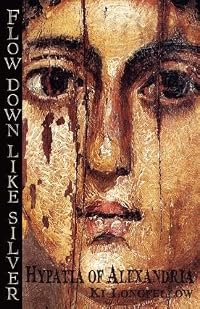
Everything else in this book is made up. For a start, no images of her survive, so the picture on its cover (and on the covers of any other books about her) isn’t her. She was born around 355 or so, not 370ish as in this story, so would have been about sixty years old when murdered in 415—not young, or even middle-aged, as always portrayed. She was a lifelong celibate, so the relationship with Minkah—and the earlier sexual adventures hinted at—are all made up. “Minkah” himself is made up. There’s no evidence that the real Hypatia favoured Aristarchus’s heliocentric picture of the cosmos, as she does here. Even less is known about her family than about her, so the nonsense about her father spending the last decade of his life hiding in bed is exactly that. It’s not known whether she had brothers and sisters—“Lais” and “Jone” are also made up. More seriously, the Serapium (the temple in which Hypatia lectured) was demolished in 391 and it simply isn’t known whether it contained any remnant of the city’s former (and long-vanished) Great Library—so the stuff about rescuing its parchment scrolls from the flames and hiding them in caves in the Egyptian desert is all made up.
Since her death, Hypatia’s name has been appropriated and abused endlessly. Because she was celibate for example, the medieval Church (ironically and grotesquely) claimed her as a symbol of chastity. In a later age she came to be seen as a champion of free-thinking, martyred by intolerance and fanaticism, or of rationality smothered by superstition. Later still, feminists claimed her. Today, the cinema, television and, of course, novelists are all busily exploiting her for their own ends. None of them can have more than the faintest inkling of what the real Hypatia of Alex was like as a human being because no one knows, and (until we invent a working time machine) no one will. Even worse, though, plainly none of them much care. If nothing else, this novel has given me a bit of insight, a glimpse anyway, into how modern myths take shape. Does anybody, anywhere on this entire wretched planet of ours, care about truth? show less
What is known for sure is this. Alexandria on the Nile delta really was at one time the world’s foremost centre of learning (although by 391, the year this novel opens, it had already been in intellectual decline for centuries). The book’s heroine, Hypatia, really was the daughter of Theon, Egypt’s most renowned mathematician; and the family were wealthy, privileged and Greek. Hypatia herself was mathematician, astronomer, lecturer (on ethics for show more example) and an accomplished instrument-maker. As for her beliefs, she is definitely known to have been a Neo-platonist. She eventually became the most brilliant teacher in Alexandria, revered throughout both halves of the Roman Empire. And, finally, she really was lynched and hacked to death by Christians, for political reasons—a murder the Church later did its best to cover up by almost completely writing her out of history.
Everything else in this book is made up. For a start, no images of her survive, so the picture on its cover (and on the covers of any other books about her) isn’t her. She was born around 355 or so, not 370ish as in this story, so would have been about sixty years old when murdered in 415—not young, or even middle-aged, as always portrayed. She was a lifelong celibate, so the relationship with Minkah—and the earlier sexual adventures hinted at—are all made up. “Minkah” himself is made up. There’s no evidence that the real Hypatia favoured Aristarchus’s heliocentric picture of the cosmos, as she does here. Even less is known about her family than about her, so the nonsense about her father spending the last decade of his life hiding in bed is exactly that. It’s not known whether she had brothers and sisters—“Lais” and “Jone” are also made up. More seriously, the Serapium (the temple in which Hypatia lectured) was demolished in 391 and it simply isn’t known whether it contained any remnant of the city’s former (and long-vanished) Great Library—so the stuff about rescuing its parchment scrolls from the flames and hiding them in caves in the Egyptian desert is all made up.
Since her death, Hypatia’s name has been appropriated and abused endlessly. Because she was celibate for example, the medieval Church (ironically and grotesquely) claimed her as a symbol of chastity. In a later age she came to be seen as a champion of free-thinking, martyred by intolerance and fanaticism, or of rationality smothered by superstition. Later still, feminists claimed her. Today, the cinema, television and, of course, novelists are all busily exploiting her for their own ends. None of them can have more than the faintest inkling of what the real Hypatia of Alex was like as a human being because no one knows, and (until we invent a working time machine) no one will. Even worse, though, plainly none of them much care. If nothing else, this novel has given me a bit of insight, a glimpse anyway, into how modern myths take shape. Does anybody, anywhere on this entire wretched planet of ours, care about truth? show less
Ever since I finished The Secret Magdalene, I've been waiting for the second in this writer's trilogy of the Divine Feminine. The Secret Magdalene stunned me. It took me places few books go. So obviously I was one of the first to get this book and to read it, or at least the first to review it here. {author:Ki Longfellow]'s first book was about Mary Magdalene, but not the Magdalene who's been so abused for so long. Flow Down Like Silver takes place 350 years later in the city of Alexandria, Egypt, the very city Longfellow's Magdalene spent her youth in, practicing the ancient Passion of Osiris. There was no Christianity in her day, but by the time Hypatia lived Christianity existed side by side with the old faiths and ancient mystery show more teachings. In cities all over the Roman world the struggle was on between them for the human soul. Before Christianity all these teachings tolerated each other. But the new faith tolerated nothing but itself. Hypatia of Alexandria was the last and greatest teacher of philosophy and the mystery schools. She was the last and greatest mathematician. She was and lovely and men sought her out from all over the known world for her learning and her beauty. As a "pagan" (which is a Christian term that is not used as a compliment), she was unashamed of her body and used it as she alone decreed. She valued her own mind, never taking anything on "faith." She was almost modern in her sense of self and her freedom from males. But the time was coming when a woman like Hypatia would no longer be tolerated in the new world fashioned by a new faith. This wonderful book makes us see a world and a woman we should never have forgotten. In the last few pages of this truly gripping book, I admit it, I cried. To think there would be nothing like her until 14 centuries later when Newton took up mathematics where Hypatia so abruptly left off.
I knew I would love the writing. Longfellow writes gorgeous lyrical prose. But I'd never heard of Hypatia. Now that I have, I honor her as much as those who once honored her while she lived. And there is a very strong connection here to Mary Magdalene, one that surprised and delighted me. Highly recommended. Another beautiful book. And I loved the cover! show less
I knew I would love the writing. Longfellow writes gorgeous lyrical prose. But I'd never heard of Hypatia. Now that I have, I honor her as much as those who once honored her while she lived. And there is a very strong connection here to Mary Magdalene, one that surprised and delighted me. Highly recommended. Another beautiful book. And I loved the cover! show less
Waited eagerly for this second in Longfellow's trilogy beginning with The Secret Magdalene. The wait was very worth it. Hypatia has long been a interest of mine: her beauty and brains and influence and fame, all erased from history by a religion that feared her. Longfellow's portrayal is historical imagining since there is so little available left to base a "true" tale. Instead Longfellow has written a possible plausible tale of great beauty and horror. I know I would love it, and I did. It's a faster read than her Magdalene but no less profound.
I had such high expectations for this book and I was not dissapointed at all. It is wonderful. This is the story of Hypatia, a brilliant and independent woman living in Eygpt several hundred years after the birth of Jesus. It tells us about this incredible woman and her struggles at a time when Christianity is forcing its way across civilization. Longfellow's writing is absolutely beautiful. There are very few books in this world that I would want to read a second time, but this is certainly one of them, if only for the pleasure of Longfellow's beautifully written words.
Just read the last page ten minutes ago and when I let it settle a bit I think I might just start all over. What a read and what a writer. Feel the same about The Secret Magdalene. These are not just historical tales so you can live in the past. These are stories to savor in your soul.
If Longfellow's The Secret Magdalene was any less than it is, then this book would deserve 5 stars. It's a matter of comparison. If this was Hypatia, I love her. If these were her times, and I'm sure they were since Longfellow's research is exhaustive, then hail to Hypatia, my new hero. Where is her statue?
If I was a writer I would write a wonderful review, I love this book so much. I do not understand people now or then. Why go out to hurt someone just because they don't feel or think like you do? It made no difference what you did or did not believe in...someone was out to get you. Why can't we be like little children and love everyone and everything? I don't know the answer. As brilliant as Hypatia was she didn't either. I love the characters and how they seem to intertwine together. To make it short and sweet I LOVE THIS BOOK.
Members
- Recently Added By
Author Information

12 Works 1,204 Members
Series

Common Knowledge
- Canonical title
- Flow Down Like Silver
- Original publication date
- 2009
- People/Characters
- Hypatia of Alexandria
- Important places
- Alexandria, Egypt; Egypt; Ancient Egypt
Classifications
Statistics
- Members
- 288
- Popularity
- 111,212
- Reviews
- 8
- Rating
- (4.41)
- Languages
- English
- Media
- Paper, Ebook
- ISBNs
- 1
- ASINs
- 1