
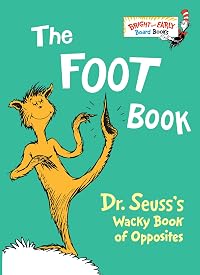
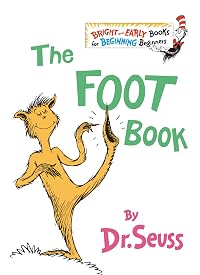
The Foot Book: Dr. Seuss's Wacky Book of Opposites {abridged board book}
by Dr. Seuss
On This Page
Description
Beginner's text describes all sorts of feet doing all sorts of things.Tags
Recommendations






Member Reviews
This was such a cute freaking book, I can't even! Dr. Seuss takes a seemingly normal and everyday topic (in this case feet) and turns it into a wonderful exploration of the world. We go from exploring outown feet by night and day to meeting all the new and interesting feet of our myriad neighbours. Sure, there's no abject plotlines, but as our feet take us on this journey Seuss does his best to present us with interesting tableaus, strange characters, and clever rhymes to showcase all that our feet can do.
I liked reading this book for many different reasons. This book uses repetition as a tool to make the book more predictable and easier for the reader to follow along. The repetition also creates a rhythm and flow to the story. For example the word feet is repeated on every page at least once. This helps to create a pattern throughout the book. In addition, I like that the author incorporates some educational information into the text by writing about opposites. Some examples of opposites in the story include, “left foot, right foot” and “wet foot, dry foot.” Although it seems simple, it is a great way for young readers to be introduced to this topic in a fun format. The message of this book is to embrace differences. All of the show more characters introduced in the story had different types of feet they were all still friends and had fun together. This helps to show that we should embrace our differences and accept those of others. show less
Thick, chewable board pages for the youngest future reader. Great drawings and catchy rhymes, as usual, in a quirky, podial parable of diversity.
I liked The Foot Book for a few reasons. I think it was a great way to introduce rhyming words, opposites and the difference of feet and foot to beginning and young readers. The writing flows very well throughout the book as well. The illustrations went perfect for the context of the book as well. An example of this, the illustrations were large and clear when pointing out left foot and right foot. The message of this story is to teach about the difference of foot and feet and teaching rhyming words.
I think that the books Plot/Theme is that they are talking about feet and how everyone is different but they all get around the same way. I like this book because it is funny, interesting and a good book to read to children. I would like to use this in my teaching because it shows how everyone is different but we should all get along and even tho we are different we all still get around by using our "feet". I think that this book is great for anyone to read but more specifically Pre K- 5th grade i would have to say. I think that this would be a good theme for diversity, culture and kindness/friendliness. I like this book because it shows how diverse everyone is.
I liked Dr. Suess's book, The Foot Book, for many reasons. First, I liked the authors use of negative space in his illustrations to portray many different scenes on one page. For example, he describes "small feet," "big feet," and "pig feet" all on one page and separates the drawings with white space to show that they are not meant to be walking together. I also liked his use of repetition to emphasize the main idea. He repeats the word foot or feet throughout the entire book, but combines it with a different adjective each time. For example, on one page he writes, "Slow feet, Quick feet, Trick feet, Sick Feet." The main idea of the story is that there are all different types of people from all different walks of life.
This is a beginner book for young kids, but being written by Dr. Seuss means that it is a good one. I would be hesitant to say that even with the best of authors, but Dr. Seuss’s books are a step above the rest. This was the first book I memorized as a child. I read it so often that I memorized every word in the entire book. There is something magical about it that makes you never want to put it down. Besides being a good way to teach opposites and rhyme, it is an all-around funny, imaginative story. But, as with many Dr. Seuss stories, the best part is by far the illustrations. The far out, imaginative and downright crazy style of the drawings would captivate any young child. For this reason, among others, I give this book a four out show more of five. The main idea of this book is to teach kids opposites. show less
Members
- Recently Added By
Lists

Favorite Childhood Books
1,646 works; 514 members
Author Information

794+ Works 358,388 Members
Theodor Seuss Geisel was born in Springfield, Massachusetts on March 2, 1904. He wrote and illustrated more than 45 picture books under the pseudonym Dr. Seuss. His first picture book, And to Think That I Saw It on Mulberry Street, was published in 1937. His other books included The Cat in the Hat, The Butter-Battle Book, The Lorax, The Bippolo show more Seed and Other Lost Stories, Fox in Socks: Dr. Seuss's Book of Tongue Tanglers, What Pet Should I Get?, and Oh, the Places You'll Go. In 1984, he received a Pulitzer Prize for his contributions to children's literature. He died of oral cancer on September 24, 1991 at the age of 87. (Bowker Author Biography) show less
Series
Belongs to Publisher Series
Work Relationships
Is an adaptation of
Common Knowledge
- Canonical title
- The Foot Book: Dr. Seuss's Wacky Book of Opposites {abridged board book}
- Disambiguation notice
- This is an abridged version for babies, please do not combine with the original unabridged work.
Classifications
Statistics
- Members
- 5,725
- Popularity
- 2,286
- Reviews
- 65
- Rating
- (3.82)
- Languages
- English, Spanish
- Media
- Paper
- ISBNs
- 6
- UPCs
- 1
- ASINs
- 6