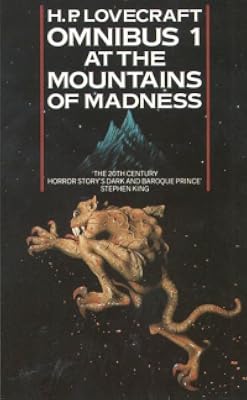
The H. P. Lovecraft Omnibus 1: At the Mountains of Madness and Other Novels
by H. P. Lovecraft
H. P. Lovecraft Omnibus (1), Lovecraft Arkham House Collections (2)
On This Page
Description
The finest works of H P Lovecraft, renowned as one of the great horror writers of all time. A major figure in twentieth-century supernatural fiction, H P Lovecraft produced works of enduring power. He has influenced the whole spectrum of those working in the horror genre, from Stephen King to the creators of hit TV show Buffy the Vampire Slayer. Gathered together in this volume are seven of his greatest works, including the three short novels, The Case of Charles Dexter Ward, At the show more Mountains of Madness and The Dream-Quest of Unknown Kadath. Timeless in their appeal, these classics of the sinister and the macabre hold the power to truly terrify. show lessTags
Recommendations
















Member Reviews
The horror in At the Mountains of Madness is not in sadistic descriptions of slashings, torturings, mutilations and bloodletting, but rather in the slow build-up of the feeling that humanity is not alone in the universe and that the other inhabitants, if they consider us at all, don't really think much of us. The only times the history of the Elder Things mentions us it is as either an amusing animal kept for entertainment or as a foodstuff.
The horror is that there are unfathomable depths of pre-history, that humankind are very much late-comers and that, if we are not careful, we might come to the notice of things that could wipe us away with little thought.
Nonetheless, the Elder Things are portrayed as one of the few, if not the only, show more of Lovecraft's non-human races with which we can feel any sympathy. He remarks that, despite the terrible toll they take upon the expedition, they were not evil things of their kind and that they had not acted any differently than would we in the same circumstances. The fate of the Elder Things is one that evokes a feeling of pity.
I've read that this story de-mythologises the Cthulhu Mythos and recasts the stories as science fiction rather than as tales of the supernatural and cosmic horror, but I don't think that is necessarily correct. Although the Elder Things are described as being composed of normal matter and having originated somewhere within our own mundane dimension, Lovecraft specifically states that the Star Spawn of Cthulhu and the Mi-Go are composed, at least partly, of some exotic material and that their origins lie outside the realm we know. Also, credit must be given to Lovecraft's characterisation, something that he is not often accorded: the story is written from the perspective of a scientist who has interpretted the history of the Elder Things through pictorial representations. Naturally the narrator's own world-view, that of scientific materialism, infuses his interpretation.
One of Lovecraft's best. show less
The horror is that there are unfathomable depths of pre-history, that humankind are very much late-comers and that, if we are not careful, we might come to the notice of things that could wipe us away with little thought.
Nonetheless, the Elder Things are portrayed as one of the few, if not the only, show more of Lovecraft's non-human races with which we can feel any sympathy. He remarks that, despite the terrible toll they take upon the expedition, they were not evil things of their kind and that they had not acted any differently than would we in the same circumstances. The fate of the Elder Things is one that evokes a feeling of pity.
I've read that this story de-mythologises the Cthulhu Mythos and recasts the stories as science fiction rather than as tales of the supernatural and cosmic horror, but I don't think that is necessarily correct. Although the Elder Things are described as being composed of normal matter and having originated somewhere within our own mundane dimension, Lovecraft specifically states that the Star Spawn of Cthulhu and the Mi-Go are composed, at least partly, of some exotic material and that their origins lie outside the realm we know. Also, credit must be given to Lovecraft's characterisation, something that he is not often accorded: the story is written from the perspective of a scientist who has interpretted the history of the Elder Things through pictorial representations. Naturally the narrator's own world-view, that of scientific materialism, infuses his interpretation.
One of Lovecraft's best. show less
‘The Case of Charles Dexter Ward’ by Howard Phillips Lovecraft is more than a weird tale, it’s a deeply unsettling novella, akin to the most disturbing episode of ‘Who Do You Think You Are?’ ever made.
The story is, in many ways, the perfect horror story. It deals with madness, terror, the loss of self and grave personal danger both physical and particularly mental. It is deeply, deeply creepy. It is deeply, deeply good.
It also reaches out across a gulf of time and distance, being set at the beginning of the twentieth Century in New England, transporting the reader to the darker places of the world, mind and soul.
It is also charmingly atmospheric. There is a compelling sense of antiquity about the story that sets just the right show more tone. Charles establishes a laboratory in the attic of the family home. How charming, today any domestic lab facilities are normally to be found in the basements of residential establishments, or so I am led to believe. The only time anyone does any ‘research’ involving lab work in the upper stories of a domestic dwelling is when they are dabbling in hydroponics, and then they normally have the good manners to cover the windows with tin foil.
Considering his studies and their effect on him, Charles would have been far better off fashioning any tin foil into a protective hat.
There’s also the family doctor. Initially this thoroughly decent chap’s role is confined to merely making house calls on an increasingly erratic Charles, who like some troublesome teen is causing his parents no end of worry. Such care is fantastic enough in itself (but then again this is a work of fiction), but as the story develops he investigates Charles’s case and takes active, very active, steps to remedy the situation, including grappling with dark forces beyond the ken of normal man in order to save not just the body of his patient, but his very soul.
Obviously, the Ward family have BUPA.
Charles Dexter ward is a young man with an established and genuine, if slightly odd, passion for antiquities.
Harmless? Of course not.
This passion may be a product of growing up in ‘witch haunted’ parts of New England, with provocatively gloomy architecture and many a thought-provoking spire, but his studies lead him to develop an interest in his own ancestry, culminating in the discovery of an ancestor so awful that most writings about him have been destroyed.
Time to walk away? I think so.
Charles does not and unearths a portrait of his far from illustrious ancestor, who bears a striking resemblance to Charles himself.
Charles’ health begins to deteriorate soon after and, well, if ever there were a book to read while peeping through your fingers (a well known defence against all known, and some unknown forms, of supernatural threat), this is the one.
Lovecraft weaves terror and tragedy expertly and, while Charles brings misfortune upon himself as interest becomes compulsion becomes obsession becomes something much, much darker, he is still deserving of sympathy. When the academic, especially the historian, reaches out and actually touches the past, the hidden past, the forbidden past, might not we excuse them taking measures that others might consider anti-social, abnormal and oh, yes, illegal?
The tragedy is that it is not so much the supernatural horror that is the chief threat to young Charles (and it must be remembered that he is a young man and prone to a young man’s follies), but his own thirst for knowledge, the more forbidden the better.
There’s a reason why forbidden knowledge is forbidden, it’s because at some point, somebody decided to throw a lock around that knowledge. But there’s nothing like the passage of centuries to make modern man think they know better than the locksmen who witnessed first hand what horror is, and sought to expunge it from history.
This is a fascinating story, and not unlike a historical study itself as we share first in Charles’s dark discovers, and then those of Dr Willett even darker ones.
And, of course, now that the once great sauce is manufactured abroad, Lovecraft remains the only authentic H.P. worth consuming.
A horror classic. show less
The story is, in many ways, the perfect horror story. It deals with madness, terror, the loss of self and grave personal danger both physical and particularly mental. It is deeply, deeply creepy. It is deeply, deeply good.
It also reaches out across a gulf of time and distance, being set at the beginning of the twentieth Century in New England, transporting the reader to the darker places of the world, mind and soul.
It is also charmingly atmospheric. There is a compelling sense of antiquity about the story that sets just the right show more tone. Charles establishes a laboratory in the attic of the family home. How charming, today any domestic lab facilities are normally to be found in the basements of residential establishments, or so I am led to believe. The only time anyone does any ‘research’ involving lab work in the upper stories of a domestic dwelling is when they are dabbling in hydroponics, and then they normally have the good manners to cover the windows with tin foil.
Considering his studies and their effect on him, Charles would have been far better off fashioning any tin foil into a protective hat.
There’s also the family doctor. Initially this thoroughly decent chap’s role is confined to merely making house calls on an increasingly erratic Charles, who like some troublesome teen is causing his parents no end of worry. Such care is fantastic enough in itself (but then again this is a work of fiction), but as the story develops he investigates Charles’s case and takes active, very active, steps to remedy the situation, including grappling with dark forces beyond the ken of normal man in order to save not just the body of his patient, but his very soul.
Obviously, the Ward family have BUPA.
Charles Dexter ward is a young man with an established and genuine, if slightly odd, passion for antiquities.
Harmless? Of course not.
This passion may be a product of growing up in ‘witch haunted’ parts of New England, with provocatively gloomy architecture and many a thought-provoking spire, but his studies lead him to develop an interest in his own ancestry, culminating in the discovery of an ancestor so awful that most writings about him have been destroyed.
Time to walk away? I think so.
Charles does not and unearths a portrait of his far from illustrious ancestor, who bears a striking resemblance to Charles himself.
Charles’ health begins to deteriorate soon after and, well, if ever there were a book to read while peeping through your fingers (a well known defence against all known, and some unknown forms, of supernatural threat), this is the one.
Lovecraft weaves terror and tragedy expertly and, while Charles brings misfortune upon himself as interest becomes compulsion becomes obsession becomes something much, much darker, he is still deserving of sympathy. When the academic, especially the historian, reaches out and actually touches the past, the hidden past, the forbidden past, might not we excuse them taking measures that others might consider anti-social, abnormal and oh, yes, illegal?
The tragedy is that it is not so much the supernatural horror that is the chief threat to young Charles (and it must be remembered that he is a young man and prone to a young man’s follies), but his own thirst for knowledge, the more forbidden the better.
There’s a reason why forbidden knowledge is forbidden, it’s because at some point, somebody decided to throw a lock around that knowledge. But there’s nothing like the passage of centuries to make modern man think they know better than the locksmen who witnessed first hand what horror is, and sought to expunge it from history.
This is a fascinating story, and not unlike a historical study itself as we share first in Charles’s dark discovers, and then those of Dr Willett even darker ones.
And, of course, now that the once great sauce is manufactured abroad, Lovecraft remains the only authentic H.P. worth consuming.
A horror classic. show less
This is not a review of the whole omnibus but only the tale 'The Dream-Quest of Unknown Kadath'. It is not the first time I have read this story, though whether the second or third time I don't recall. It is the first time I've read it for itself and not part of the collection. I enjoyed it much more than previous times (it is one of the later works in the volume) and read it more closely. I was inspired to reread it by a role-playing game campaign I am currently running and by a retrospective on the work by James Maliszewski of Grognardia.
'Dream-Quest' chronicles veteran dreamer Randolph Carter's search for a magnificent city of his dreams. The Dreamland he ventures through has many wonders, but lurking beneath all are the horrors of show more the Outer Gods, and the Crawling Chaos Nyarlathothep. In other words, H.P. Lovecraft's mature Cthulhu Mythos ideas. There were many outright fantastic elements, such as Carter's raid on the Moonbeast crag near Iquanok with a boatload of Ghouls -- at such times Randolph seemed more like a shadowed John Carter from Barsoom. One thing which struck me on this reading is the interconnected histories of various groups of humans and otherwise around the dread plateau of Leng, and the sad tragedies of the men of Leng and Iquanok, touched as they are by otherworldly things. Another oddity was another Outer God, Nodens who is barely described but who seems in opposition to Nyarlathotep and therefore possibly not an enemy of mankind. Carter braves all this and more in his quest for lost beauty, and it is this which sets the Dreamlands tales apart from those set in the 'real' world of Arkham, Miskatonic University, Dunwich and the rest. Carter flinches but does not flee from the sanity-blasting horrors he sees. He stays true to his quest throughout. In the dream, these terrors are perhaps more bearable. This is fantasy with horror elements, like a dark fairy tale. show less
'Dream-Quest' chronicles veteran dreamer Randolph Carter's search for a magnificent city of his dreams. The Dreamland he ventures through has many wonders, but lurking beneath all are the horrors of show more the Outer Gods, and the Crawling Chaos Nyarlathothep. In other words, H.P. Lovecraft's mature Cthulhu Mythos ideas. There were many outright fantastic elements, such as Carter's raid on the Moonbeast crag near Iquanok with a boatload of Ghouls -- at such times Randolph seemed more like a shadowed John Carter from Barsoom. One thing which struck me on this reading is the interconnected histories of various groups of humans and otherwise around the dread plateau of Leng, and the sad tragedies of the men of Leng and Iquanok, touched as they are by otherworldly things. Another oddity was another Outer God, Nodens who is barely described but who seems in opposition to Nyarlathotep and therefore possibly not an enemy of mankind. Carter braves all this and more in his quest for lost beauty, and it is this which sets the Dreamlands tales apart from those set in the 'real' world of Arkham, Miskatonic University, Dunwich and the rest. Carter flinches but does not flee from the sanity-blasting horrors he sees. He stays true to his quest throughout. In the dream, these terrors are perhaps more bearable. This is fantasy with horror elements, like a dark fairy tale. show less
Horribly boring, this book is not the Lovecraft mabum opus people think it to be. Long, overwrought, weak characters with minimal plot, the entire book is basically an excuse for Lovecraft to nerd out on the boring traditions of his alien lifeforms. Page upon page is devoted to pure exposition, where the bizarre architecture of the room can fill paragraphs to no effect. And all to often Lovecraft weakly relies on language that describe something as undescribable, "beyond rational comprehension," and hence, he chickens out from actually doing his due work as a writer. This book is only for the hardest of hardcore Lovecraft completionists, and is otherwise a frustratingly uneventful waste of time.
I have been listening to the H.P. Lovecraft Literary Podcraft s it works through Lovecraft's stories in chronological order. I started off reading the stories on my iPod but decide that I didn't like reading the longer stories that way, so I bought a three volume Omnibus of his stories, and now it is only the ghost-written stories he wrote for other people that I need to read on-line. I started listening to the podcast in October 2010 from the first episode, and had caught up with the early episodes by the first week of January 2011. I have been reading each story before listening to the podcast episode(s) about it, and the podcast has now reached the point that I have read all the stories in Volume 1 of the Omnibus, so I can finally show more review one oft he volumes.
Then through that star-specked darkness there did come a normal sound. It rolled from the higher hills, and from all the jagged peaks around it was caught up and echoed in a swelling pandaemoniac chorus. It was the midnight yell of the cat, and Carter knew at last that the old village folk were right when they made low guesses about the cryptical realms which are known only to cats, and to which the elders among cats repair by stealth nocturnally, springing from high housetops. Verily, it is to the moon's dark side that they go to leap and gambol on the hills and converse with ancient shadows, and here amidst that column of foetid things Carter heard their homely, friendly cry, and thought of the steep roofs and warm hearths and little lighted windows of home.
from The Dream-Quest of Unknown Kadath
This book contains Lovecraft's three short novels, "The Dream-Quest of Unknown Kadath", "The Case of Charles Dexter Ward" and "At the Mountains of Madness", plus four short stories, three of them featuring Randolph Carter, the hero of the Dream-Quest of Unknown Kadath". The other is a rather unpleasant story called "The Dreams in the Witch House".
Unlike most of Lovecraft's protagonists, Randolph Carter is a born adventurer and tends not to faint in the face of unnameable horrors! On a journey through the dreamlands in search of the lost city that he used to visit in his dreams, he makes friends with the ghouls, and his kindness to small kittens is rewarded when the heroic band of cats who spend their nights on the moon battling evil alien cats, rescue him from the toad-things which have captured him. This isn't the only story in which cats play a big part, and Lovecraft is obviously a cat-lover, mentioning in "The Dream-Quest of Unknown Kadath" that "Inquanok holds shadows which no cat can endure, so that in all that cold twilight realm there is never a cheering purr or a homely mew."
"The Dream-Quest of Unknown Kadath" rambles about and has frequent longeurs, as it was Lovecraft's first attempt at a novel and it's thought that he didn't intend it to be published, but I still preferred it to "The Case of Charles Dexter Ward" which has an annoyingly oblivious protagonist heading to an obvious doom (as does "The Dreams in the Witch House"). "At the Mountains of Madness", the last of Lovecraft's three novels, is an exciting tale of Antarctic adventure, complete with huskies and a lost civilisation. Lovecraft liked to use British English spellings and got really annoyed when his editors changed them, and I noticed that he uses the British "torch" rather than the American "flashlight" in several stories (the protagonists mention worrying about running out of batteries, so it's clear that it is referring to electric torches rather than naked flames). show less
Then through that star-specked darkness there did come a normal sound. It rolled from the higher hills, and from all the jagged peaks around it was caught up and echoed in a swelling pandaemoniac chorus. It was the midnight yell of the cat, and Carter knew at last that the old village folk were right when they made low guesses about the cryptical realms which are known only to cats, and to which the elders among cats repair by stealth nocturnally, springing from high housetops. Verily, it is to the moon's dark side that they go to leap and gambol on the hills and converse with ancient shadows, and here amidst that column of foetid things Carter heard their homely, friendly cry, and thought of the steep roofs and warm hearths and little lighted windows of home.
from The Dream-Quest of Unknown Kadath
This book contains Lovecraft's three short novels, "The Dream-Quest of Unknown Kadath", "The Case of Charles Dexter Ward" and "At the Mountains of Madness", plus four short stories, three of them featuring Randolph Carter, the hero of the Dream-Quest of Unknown Kadath". The other is a rather unpleasant story called "The Dreams in the Witch House".
Unlike most of Lovecraft's protagonists, Randolph Carter is a born adventurer and tends not to faint in the face of unnameable horrors! On a journey through the dreamlands in search of the lost city that he used to visit in his dreams, he makes friends with the ghouls, and his kindness to small kittens is rewarded when the heroic band of cats who spend their nights on the moon battling evil alien cats, rescue him from the toad-things which have captured him. This isn't the only story in which cats play a big part, and Lovecraft is obviously a cat-lover, mentioning in "The Dream-Quest of Unknown Kadath" that "Inquanok holds shadows which no cat can endure, so that in all that cold twilight realm there is never a cheering purr or a homely mew."
"The Dream-Quest of Unknown Kadath" rambles about and has frequent longeurs, as it was Lovecraft's first attempt at a novel and it's thought that he didn't intend it to be published, but I still preferred it to "The Case of Charles Dexter Ward" which has an annoyingly oblivious protagonist heading to an obvious doom (as does "The Dreams in the Witch House"). "At the Mountains of Madness", the last of Lovecraft's three novels, is an exciting tale of Antarctic adventure, complete with huskies and a lost civilisation. Lovecraft liked to use British English spellings and got really annoyed when his editors changed them, and I noticed that he uses the British "torch" rather than the American "flashlight" in several stories (the protagonists mention worrying about running out of batteries, so it's clear that it is referring to electric torches rather than naked flames). show less
The book is introduced by then-editor of Arkham House, James Turner, who came to an intimate understanding of E'ch-Pi-El from having edited the final two volumes of Lovecraft's SELECTED LETTERS. Although his Introduction cannot compare to the one that China Mieville wrote for The Modern Library edition of AT THE MOUNTAINS OF MADNESS--THE DEFINITIVE EDITION, it is very fine indeed.
"At the Mountains of Madness" begins the collection, and it is recognized as a classic by mature and intelligent critics. I found it difficult to read and comprehend when I first tried to read it at an early age, but now it is a work that I return to again and again, with deeper appreciation. The writing is so fine, and the prose style is quite precise for show more such a long work, each and every word adding to the effective of a masterpiece. There is nothing dull, as some clueless critics have complained, about the presentation of the antient race and their world, and some of the horrific touches are amazingly effective. One wonderful touch is to find that first one of the Great Old Ones have been dissected by the explorers; and then, horrifically, we discover that one of the men have been dissected by the inhuman race -- superb! And the moment when the two main characters witness the overwhelming terror manifested by the appearance of a shoggoth remains one of the scariest moments in all of Literature.
Next comes my second-favourite work by Lovecraft, his short novel THE CASE OF CHARLES DEXTER WARD. I have always considered this an unedited work, for Lovecraft never prepared a final typed version. The entire handwritten manuscript may now be viewed online, and it reveals that Lovecraft worked diligently on the novel, revising as he went along. The manuscript also reveals how much we owe to those editors who decipher'd it for publication--it is a chaotic mess! WARD has been called the author's "love letter" to his beloved birth city, but it is also an exceptionally fine and captivating classic of supernatural fiction, dense, packed with unimaginable horrors, and utterly original. The myth that Lovecraft was incapable of creating interesting characters is belied by the forceful and satanic portrayal of one of weird fiction's finest villains, the monstrous Joseph Curwen. One of the really original aspects of the novel is its handling of supernaturalism, which is presented with an air of vital realism, incredible as the goings-on may be.
"The Shunned House" is a novel play on the vampire theme, handled with expert mood and mystery. "The Dreams in the Witch House" is a very odd tale, not completely successful and in some places very weak--its use of Nyarlathotep in the role of a satanic Black Man never comes to life. The very early "The Statement of Randolph Carter," written almost one century ago in 1919, introduces a character that returns with each of the other following works, including another short novel, "The Dream-Quest of Unknown Kadath," which (like WARD) was left unpolished by Lovecraft.
One of the original touches to Lovecraft's fiction is that it reveals in a multitude of ways his personality, his dreams and intelligence, his grotesque racism and pure love of Literature. He was a remarkable fellow, extremely pleasant as may be seen in his published correspondence, and a damn prick, as evidenced in his treatment of his Jewish wife. I judge him first and foremost as an artist, and as such he was absolutely first-rate. His excellence as an artist is now established by his publication by Penguin Classics and The Library of America. Soon we can add W. W. Norton to the list, as this year they will publish a handsome fully illustrated folio edition, THE NEW ANNOTATED H. P. LOVECRAFT, identical in format to their three-volume THE NEW ANNOTATED SHERLOCK HOLMES. show less
"At the Mountains of Madness" begins the collection, and it is recognized as a classic by mature and intelligent critics. I found it difficult to read and comprehend when I first tried to read it at an early age, but now it is a work that I return to again and again, with deeper appreciation. The writing is so fine, and the prose style is quite precise for show more such a long work, each and every word adding to the effective of a masterpiece. There is nothing dull, as some clueless critics have complained, about the presentation of the antient race and their world, and some of the horrific touches are amazingly effective. One wonderful touch is to find that first one of the Great Old Ones have been dissected by the explorers; and then, horrifically, we discover that one of the men have been dissected by the inhuman race -- superb! And the moment when the two main characters witness the overwhelming terror manifested by the appearance of a shoggoth remains one of the scariest moments in all of Literature.
Next comes my second-favourite work by Lovecraft, his short novel THE CASE OF CHARLES DEXTER WARD. I have always considered this an unedited work, for Lovecraft never prepared a final typed version. The entire handwritten manuscript may now be viewed online, and it reveals that Lovecraft worked diligently on the novel, revising as he went along. The manuscript also reveals how much we owe to those editors who decipher'd it for publication--it is a chaotic mess! WARD has been called the author's "love letter" to his beloved birth city, but it is also an exceptionally fine and captivating classic of supernatural fiction, dense, packed with unimaginable horrors, and utterly original. The myth that Lovecraft was incapable of creating interesting characters is belied by the forceful and satanic portrayal of one of weird fiction's finest villains, the monstrous Joseph Curwen. One of the really original aspects of the novel is its handling of supernaturalism, which is presented with an air of vital realism, incredible as the goings-on may be.
"The Shunned House" is a novel play on the vampire theme, handled with expert mood and mystery. "The Dreams in the Witch House" is a very odd tale, not completely successful and in some places very weak--its use of Nyarlathotep in the role of a satanic Black Man never comes to life. The very early "The Statement of Randolph Carter," written almost one century ago in 1919, introduces a character that returns with each of the other following works, including another short novel, "The Dream-Quest of Unknown Kadath," which (like WARD) was left unpolished by Lovecraft.
One of the original touches to Lovecraft's fiction is that it reveals in a multitude of ways his personality, his dreams and intelligence, his grotesque racism and pure love of Literature. He was a remarkable fellow, extremely pleasant as may be seen in his published correspondence, and a damn prick, as evidenced in his treatment of his Jewish wife. I judge him first and foremost as an artist, and as such he was absolutely first-rate. His excellence as an artist is now established by his publication by Penguin Classics and The Library of America. Soon we can add W. W. Norton to the list, as this year they will publish a handsome fully illustrated folio edition, THE NEW ANNOTATED H. P. LOVECRAFT, identical in format to their three-volume THE NEW ANNOTATED SHERLOCK HOLMES. show less
I checked this out from the library to get a taste of Lovecraft. It's an okay collection, spoiled mainly by the final four Randolph Carter stories--to be fair, the last story, Through the Gates of the Golden Key, isn't bad, but The Dream-Quest of Unknown Kadath is so dreadfully dull that I took a pause in the middle of it to read another book for a month.
The first four stories, however, are great. And of those, the first two, At the Mountains of Madness and The Case of Charles Dexter Ward are outstanding. In fact, the jacket text called the latter "Lovecraft's most precisely-wrought work of horror" and I would have to agree. This collection is worth picking up for those two alone.
The first four stories, however, are great. And of those, the first two, At the Mountains of Madness and The Case of Charles Dexter Ward are outstanding. In fact, the jacket text called the latter "Lovecraft's most precisely-wrought work of horror" and I would have to agree. This collection is worth picking up for those two alone.
Members
- Recently Added By
Lists

Weird and Weirder Fiction
270 works; 35 members

Books Read in 2017
4,249 works; 129 members
Author Information

1,932+ Works 74,044 Members
Howard Phillips Lovecraft, 1890 - 1937 H. P. Lovecraft was born on August 20, 1890 in Providence, Rhode Island. His mother was Sarah Susan Phillips Lovecraft and his father was Winfield Scott Lovecraft, a traveling salesman for Gorham & Co. Silversmtihs. Lovecraft was reciting poetry at the age of two and when he was three years old, his father show more suffered a mental breakdown and was admitted to Butler Hospital. He spent five years there before dying on July 19, 1898 of paresis, a form of neurosyphillis. During those five years, Lovecraft was told that his father was paralyzed and in a coma, which was not the case. His mother, two aunts and grandfather were now bringing up Lovecraft. He suffered from frequent illnesses as a boy, many of which were psychological. He began writing between the ages of six and seven and, at about the age of eight, he discovered science. He began to produce the hectographed journals, "The Scientific Gazette" (1899-1907) and "The Rhode Island Journal of Astronomy" (1903-07). His first appearance in print happened, in 1906, when he wrote a letter on an astronomical matter to The Providence Sunday Journal. A short time later, he began writing a monthly astronomy column for The Pawtuxet Valley Gleaner - a rural paper. He also wrote columns for The Providence Tribune (1906-08), The Providence Evening News (1914-18), The Asheville (N.C.) Gazette-News (1915). In 1904, his grandfather died and the family suffered severe financial difficulties, which forced him and his mother to move out of their Victorian home. Devastated by this, he apparently contemplated suicide. In 1908, before graduating from high school, he suffered a nervous breakdown. He didn't receive a diploma and failed to get into Brown University, both of which caused him great shame. Lovecraft was not heard from for five years, re-emerging because of a letter he wrote in protest to Fred Jackson's love story in The Argosy. His letter was published in 1913 and caused great controversy, which was noted by Edward F. Daas, President of the United Amateur Press Association (UAPA). Daas invited Lovecraft to join the UAPA, which he did in early 1914. He eventually became President and Official Editor of the UAPA and served briefly as President of the rival National Amateur Press Association (NAPA). He published thirteen issues of his own paper, The Conservative (1915-23) and contributed poetry and essays to other journals. He also wrote some fiction which titles include "The Beast in the Cave" (1905), "The Alchemist" (1908), "The Tomb" and "Dagon" (1917). In 1919, Lovecraft's mother was deteriorating, mentally and physically, and was admitted to Butler Hospital. On May 24, 1921, his mother died from a gall bladder operation. While attending an amateur journalism convention in Boston, Lovecraft met his future wife Sonia Haft Greene, a Russian Jew. They were married on March 3, 1924 and Lovecraft moved to her apartment in Brooklyn. Sonia had a shop on Fifth Avenue that went bankrupt. In 1925, Sonia went to Cleveland for a job and Lovecraft moved to a smaller apartment in the Red Hook district of Brooklyn. In 1926, he decided to move back to Providence. Lovecraft had his aunts bar his wife, Sonia, from going to Providence to start a business because he couldn't have the stigma of a tradeswoman wife. They were divorced in 1929. After his return to Providence, he wrote his greatest fiction, which included the titles "The Call of Cthulhu" (1926), "At the Mountains of Madness" (1931), and "The Shadow Out of Time" (1934-35). In 1932, his aunt, Mrs. Clark, died; and he moved in with his other aunt, Mrs. Gamwell, in 1933. Suffering from cancer of the intestine, Lovecraft was admitted to Jane Brown Memorial Hospital and on March 15, 1937 he died. (Bowker Author Biography) show less
Some Editions
Series


Work Relationships
Contains
Common Knowledge
- Canonical title
- The H. P. Lovecraft Omnibus 1: At the Mountains of Madness and Other Novels
- Original publication date
- 1985 (anthology) (anthology)
- Important places
- Antarctica; Providence, Rhode Island, USA; Dreamlands; Rhode Island, USA; USA
- First words
- I am forced into speech because men of science have refused to follow my advice without knowing why.
- Last words
- (Click to show. Warning: May contain spoilers.)In a vast room hung with strangely figured arras and filled with olibanum fumes, Etienne Laurent de Marigny often sits listening with vague sensations to the abnormal rhythms of that hieroglyphed coffin-shaped clock.
- Original language
- English
- Canonical DDC/MDS
- 813.087340
- Disambiguation notice
- This collection contains 7 stories ("At the Mountains of Madness", "The Case of Charles Dexter Ward", "Dreams in the Witch-House", "The Statement of Randolph Carter", "The Dream-Quest of Unknown Kadath", "The Silver Key", and... (show all) "Through the Gates of the Silver Key") and SHOULD NOT BE COMBINED with other, differing collections.
Classifications
- Genres
- Horror, Fiction and Literature, Fantasy
- DDC/MDS
- 813.087340 — Literature & rhetoric American literature in English American fiction in English By type Genre fiction Adventure fiction Horror fiction; Ghost fiction Weird fiction Cosmic horror
- LCC
- PS3523 .O833 .A6 — Language and Literature American literature American literature Individual authors 1900-1960
- BISAC
Statistics
- Members
- 1,110
- Popularity
- 22,910
- Reviews
- 14
- Rating
- (4.21)
- Languages
- Czech, English
- Media
- Paper, Ebook
- ISBNs
- 6
- ASINs
- 11