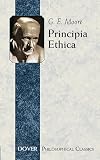
Principia Ethica
by G. E. Moore
On This Page
Description
First published in 1903, this volume revolutionized philosophy and forever altered the direction of ethical studies. A philosopher's philosopher, G. E. Moore was the idol of the Bloomsbury group, and Lytton Strachey declared that Principia Ethica marked the rebirth of the Age of Reason. This work clarifies some of moral philosophy's most common confusions and redefines the science's terminology. Moore's focus on conceptual analysis as a method of achieving clarity made him a founder of the show more current philosophical trend toward analytic and linguistic elements. His simplicity of style and precise use of everyday language exercised an enormous influence on the development of analytic philosophy, and they contribute to the continuing resonance of his compelling arguments. Book jacket. show lessTags
Recommendations
























Member Reviews
Moore provided the some of the Bloomsbury set with the appropriate philosophical leverage (ethical non-naturalism) to spring themselves from the Victorian-cum-Edwardian ethos. Quite striking during its time for those of a certain aesthetic cast of mind. Not as tough a slog as Whitehead, but not light reading, either. I have a grasp of the naturalistic fallacy and the open question argument, but Moore's paradox? Wittgenstein kept chewing on it like a dog worrying a bone. Caveat lector!
I don't have the proper context in philosophical reading to know where the ideas in Moore's book fit into the larger philosophy canon, but I found this book to be worthwhile from a dabbler's perspective. Moore discusses the purpose of ethics, the naturalistic fallacy, hedonism, and the ideal. He states that good "does denote a simple and indefinable notion" and explains the problems that occur when we identify good with something other than good. It seems that this concept would be important to remember. Elements of both hedonism and the naturalistic fallacy seem to be included in many works of literary fiction, but I haven't particularly labeled the naturalistic fallacy in past reading. Moore is definitely recommended but not easy.
For it is the business of Ethics, I must insist, not only to obtain true results, but also to find valid reasons for them. The direct object of Ethics is knowledge and not practice; and any one who uses the naturalistic fallacy has certainly not fulfilled this first object, however correct his practical principles may be.
Ratings
Members
- Recently Added By
Lists

Modern Library 100 Best Nonfiction Books
100 works; 8 members

Filosofía - Clásicos
217 works; 1 member
Author Information

25+ Works 1,404 Members
George Edward Moore was one of the giants in the formation of analytic philosophy in the English-speaking world. During most of his professional life, he was affiliated with Cambridge University---as a student and as a fellow at Trinity College, from 1892 to 1896 and from 1898 to 1904, respectively; as a university lecturer from 1911 to 1925; as a show more professor of mental philosophy and logic from 1925 until his retirement in 1939. Moore's philosophical contributions touch on three areas: philosophical method, moral philosophy, and theory of knowledge. His philosophical method is exhibited in his unrelenting effort to discover and elucidate the meanings of philosophical concepts and in his appeal to common sense. This method is evident in his work in ethics and epistemology. Principia Ethica (1903) established him as the foremost critic of ethical naturalism; his conceptions of goodness as an indefinable quality and of intrinsic value as organic unity were influential not only in philosophical circles but also among the artists and writers of the Bloomsbury group. Moore's work in epistemology was expressed in a large number of articles distinguished for their nicety of analysis. They span six decades, revealing a thinker who moved out of idealism into realism and then moved back and forth among the varieties of realism on such questions as the status of sense data, that is, whether they exist, and if they exist, whether they are physical parts of things or are mental representations only. (Bowker Author Biography) show less
Some Editions
Awards and Honors
Series
Belongs to Publisher Series
Textos filosòfics (15)
Common Knowledge
- Original title
- Principia ethica
- Original publication date
- 1903
- Epigraph
- Everything is what it is and not another thing.
BISHOP BUTLER - Dedication
- DOCTORIBUS AMICISQUE CANTABRIGIENSIBUS
DISCIPULUS AMICUS CANTABRIGIENSIS
PRIMITIAS
D. D. D.
AUCTOR - First words
- Io ritengo che le difficoltà e i dissensi di cui la storia dell'etica è piena come quella di tutti gli altri campi della filosofia siano dovuti principalmente a una causa molto semplice: al fatto, cioè, che spesso si tenta... (show all) di rispondere a una domanda senza prima chiarire precisamente quale sia la domanda cui si vuole dare risposta.
- Original language
- Inlgese
Classifications
Statistics
- Members
- 753
- Popularity
- 37,119
- Reviews
- 3
- Rating
- (3.83)
- Languages
- 7 — Catalan, English, French, German, Portuguese, Romanian, Spanish
- Media
- Paper, Audiobook, Ebook
- ISBNs
- 36
- ASINs
- 21