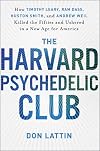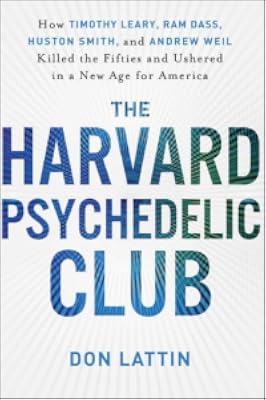
The Harvard Psychedelic Club: How Timothy Leary, Ram Dass, Huston Smith, and Andrew Weil Killed the Fifties and Ushered in a New Age for America
by Don Lattin
On This Page
Description
"[Don Lattin] has created a stimulating and thoroughly engrossing read." --Dennis McNally, author of A Long Strange Trip: The Inside History of the Grateful Dead, and Desolate Angel: Jack Kerouac, the Beat Generation, and America It is impossible to overstate the cultural significance of the four men described in Don Lattin's The Harvard Psychedelic Club. Huston Smith, tirelessly working to promote cross-cultural religious and spiritual tolerance. Richard Alpert, a.k.a. Ram Dass, inspiring show more generations with his mantra, "be here now." Andrew Weil, undisputed leader of the holistic medicine revolution. And, of course, Timothy Leary, the charismatic, rebellious counter-culture icon and LSD guru. Journalist Don Lattin provides the funny, moving inside story of the "Cambridge Quartet," who crossed paths with the infamous Harvard Psilocybin Project in the early 60's, and went on to pioneer the Mind/Body/Spirit movement that would popularize yoga, vegetarianism, and Eastern mysticism in the Western world. show lessTags
Recommendations













Member Reviews
While undertaking a course on the psychology of religious conversion at the Graduate Theological Union, Bay Area religion writer Don Lattin cast back in his memory for his own “personal conversion narrative.” Like many of his generation, Lattin had experimented with psychedelics with—in retrospect, predictably—polarized results.
What this reflection led Lattin to consider was that his encounters with LSD, both good and bad, were the beginning of a long process of spiritual awakening. A process closer, perhaps, to the journey of Huston Smith (who Lattin personifies as The Teacher), than the more convoluted roads that Timothy Leary (The Trickster), Ram Dass né Richard Alpert (The Seeker), and Andrew Weil (The Healer) show more traveled.
Originally called in to help Smith finish his biography, Tales of Wonder, Lattin was approached to tell this story, a fascinating tale of an incredible time in human history. The editors at HarperOne realized they had inadvertently found just the right guy to do it justice.
With a subtitle of “How Timothy Leary, Ram Dass, Huston Smith, and Andrew Weil killed the fifties and ushered in a new age for America,” the uninitiated may have the impression that the four men worked in consort toward that goal, however, the interesting push and pull of these four strong and very distinct personalities is what gives this story its legs.
Weil’s betrayal of Leary and Alpert that resulted in their expulsion from Harvard was the most shocking revelation of the early years of the quartet’s transformation. It is surprising, even with the hindsight that the two men had to leave the confines of the institution—one way or another—to become what they ultimately became, that an enlightened person like Ram Dass still can’t forgive the young Weil, a man that arguably no longer exists.
The Harvard Psychedelic Club is a fast-paced read, with faces both famous and infamous popping up throughout the entire ride. The men independently show up with almost Zelig regularity at every important moment that collectively led to a shattering of the calcified paradigm of post-war American culture.
While Weil was busy becoming the guru of the organic health movement, and Leary was spending a good deal of time and effort staying one step ahead of the law, Smith and Dass explored the Far East, found affirmation and enlightenment in India and Japan, and ultimately brought those lessons and attitudes back to a United States hungry for deeper meaning.
It is these spiritual ramifications of the psychedelic experience that Lattin considers important, and, like many at the time, he discounts Leary’s messianic tendencies as being antithetical to the possibility of positive change through inner exploration. Leary’s surviving cohorts seem to hold him responsible for the unfortunate cessation of serious scientific research into the use of these drugs at the same time they realize that, as an archetypal “trickster,” he was playing as inevitable a part in the passion play as they had been.
Lattin sums up the quartet’s tumultuous history in his conclusion as such: “All four of these characters played a role in the social and spiritual changes that made the sixties such a pivotal decade in recent American history. They stirred up the water and then rode a wave of social change. The difference is that Timothy Leary never found … the stability needed to bring those changes into his life in a positive, long-lasting way. Instead of finding an anchor, Leary tried to walk on the water.”
He then addresses a generation that, for a large part, has turned its back on the lessons learned in the era of questioning “the materialist, consumerist mind-set into which we were raised.” Lattin points out that, “Now more than ever, we need to remember the lessons of that idealistic era. It’s time, once again, to find new ways to live together with equality, justice, and compassion.”
Amen, brother. show less
What this reflection led Lattin to consider was that his encounters with LSD, both good and bad, were the beginning of a long process of spiritual awakening. A process closer, perhaps, to the journey of Huston Smith (who Lattin personifies as The Teacher), than the more convoluted roads that Timothy Leary (The Trickster), Ram Dass né Richard Alpert (The Seeker), and Andrew Weil (The Healer) show more traveled.
Originally called in to help Smith finish his biography, Tales of Wonder, Lattin was approached to tell this story, a fascinating tale of an incredible time in human history. The editors at HarperOne realized they had inadvertently found just the right guy to do it justice.
With a subtitle of “How Timothy Leary, Ram Dass, Huston Smith, and Andrew Weil killed the fifties and ushered in a new age for America,” the uninitiated may have the impression that the four men worked in consort toward that goal, however, the interesting push and pull of these four strong and very distinct personalities is what gives this story its legs.
Weil’s betrayal of Leary and Alpert that resulted in their expulsion from Harvard was the most shocking revelation of the early years of the quartet’s transformation. It is surprising, even with the hindsight that the two men had to leave the confines of the institution—one way or another—to become what they ultimately became, that an enlightened person like Ram Dass still can’t forgive the young Weil, a man that arguably no longer exists.
The Harvard Psychedelic Club is a fast-paced read, with faces both famous and infamous popping up throughout the entire ride. The men independently show up with almost Zelig regularity at every important moment that collectively led to a shattering of the calcified paradigm of post-war American culture.
While Weil was busy becoming the guru of the organic health movement, and Leary was spending a good deal of time and effort staying one step ahead of the law, Smith and Dass explored the Far East, found affirmation and enlightenment in India and Japan, and ultimately brought those lessons and attitudes back to a United States hungry for deeper meaning.
It is these spiritual ramifications of the psychedelic experience that Lattin considers important, and, like many at the time, he discounts Leary’s messianic tendencies as being antithetical to the possibility of positive change through inner exploration. Leary’s surviving cohorts seem to hold him responsible for the unfortunate cessation of serious scientific research into the use of these drugs at the same time they realize that, as an archetypal “trickster,” he was playing as inevitable a part in the passion play as they had been.
Lattin sums up the quartet’s tumultuous history in his conclusion as such: “All four of these characters played a role in the social and spiritual changes that made the sixties such a pivotal decade in recent American history. They stirred up the water and then rode a wave of social change. The difference is that Timothy Leary never found … the stability needed to bring those changes into his life in a positive, long-lasting way. Instead of finding an anchor, Leary tried to walk on the water.”
He then addresses a generation that, for a large part, has turned its back on the lessons learned in the era of questioning “the materialist, consumerist mind-set into which we were raised.” Lattin points out that, “Now more than ever, we need to remember the lessons of that idealistic era. It’s time, once again, to find new ways to live together with equality, justice, and compassion.”
Amen, brother. show less
This is a very interesting book chronicling the the lives of the four men most involved in the popularization of psychedelic drugs. I like the way Lattin presents them as archetypes: Leary, the Trickster; Ram Dass, the Seeker; Smith, the Teacher; and Weil, the Healer. Weil comes off very poorly at first as vindictive and self serving, but he grows. All four men grow except Leary - he stays the Trickster: dishonest, self-promoting partier to the end. Strangely, in spite of success and acclaim in their chosen fields, only Huston Smith, the religious teacher is able to sustain a personal relationship. Maybe his ability to disengage from observational reality in the pursuit of religion is the same attribute that allows him to maintain an show more interpersonal relationship with his wife for over 60 years.
I was interested in Lattin's claim that the over promotion of psychedelics helped launch the war on drugs and strengthened the conservative movement. Only The Trickster could have foreseen such an outcome. show less
I was interested in Lattin's claim that the over promotion of psychedelics helped launch the war on drugs and strengthened the conservative movement. Only The Trickster could have foreseen such an outcome. show less
This is an entertaining, informative, and relatively brief (228 pages of text) overview of the interactions of four men involved in the Harvard psychedelic drug trials of the early 1960s. Timothy Leary is probably the most infamous, but Ram Dass (né Richard Alpert) has had a more lasting and positive influence on the lives of Westerners interested in delving into enlarging conscious awareness. The other two main subjects are Andrew Weil (more on him in a moment), and Huston Smith, an early partner in an effort to see if religious experience could be had by use of a biological or chemical substance.
Alpert and Leary were not the first researchers to test LSD on Harvard students. In the 1950s the CIA used undergraduates, having as cover show more two medical doctors who worked with the blessing of Harvard. The CIA's goal was to see if LSD could be used as chemical warfare. (One of their test subjects was Theodore Kuczynski, later the Unibomber.) Leary and Alpert came on the scene a few years later, setting up the Harvard Psilocybin Project through the school's Center for Personality Research. Hundreds of graduate students, professors, and prison inmates were voluntarily given doses, although, untypical of drug trials, one or more of the Project's staff usually took the drugs with the volunteers. The researchers were barred from using undergraduates, and freshman Weil, who wanted very badly to participate and, on his own, experimented widely, became angry when he was turned down. Another undergraduate student, Ronnie Winston, who was a friend of both Weil's and Alpert's, was given some drugs, although not as part of the study. The vindictive Weil used his position as a reporter for the Harvard Crimson to bring them down. Not only did he serve as an informant for school authorities who were uneasy about the Project, but when no one would give evidence, he blackmailed Winston and his parents, threatening to name Winston in the exposé if they didn't come forward. Weil got his statement, the school got its ammunition, and Alpert and Leary were fired. Weil apologized years later after finding himself the subject of a similar attack, so perhaps karma has been served.
Famous people and events of the era populate the pages. Aldous Huxley and Allen Ginsburg appear frequently, and the Haight-Ashury district of San Francisco, the Rolling Stones, the Fillmore, and other famous names rotate through the story. Near the end the author gives a synopsis of his subjects' lives for the last couple of decades. Leary, of course, crashed and burned, and he died in 1996. Ram Dass has been a spiritual teacher and guide for many of the Boomers, especially since [Be Here Now] was published in 1971. Smith went on to educate several generations on the underlying similarities in the teachings of the major religions, and to fight what he saw as the monstrosity of the doctrine of eternal damnation. And then there is Andrew Weil, now a famous doctor, speaker and author, who got his start by betraying Alpert and Leary. I find it hard to have much forgiveness, but it's also true that without that betrayal, Ram Dass might never have made his journey to India and returned to America to benefit so many. The experiments publicized for the first time some intriguing possibilities for the human mind, which, while not maintainable without drugs by the majority of those experimenting, were still an indication of untapped abilities. At the least, we learned more about ourselves. And for some who experimented, the whole world was changed.
A couple of tidbits of special interest:
"In his book What the Dormouse Said: How the Sixties Shaped the Personal Computer Industry, John Markoff shows how key Silicon Valley pioneers, including Apple cofounder Steve Jobs, and Douglas Engelbart, the man who invented the mouse, were inspired, in part, by their psychedelic experiences."
Leary was arrested several times for having small quantities of marijuana. Each time he was sentenced to 10 years in jail. The first arrest was made by G. Gordon Liddy of Watergate fame.
The Beatles' song "Come Together" was written in honor of Leary's gubernatorial run against Ronald Reagan. show less
Alpert and Leary were not the first researchers to test LSD on Harvard students. In the 1950s the CIA used undergraduates, having as cover show more two medical doctors who worked with the blessing of Harvard. The CIA's goal was to see if LSD could be used as chemical warfare. (One of their test subjects was Theodore Kuczynski, later the Unibomber.) Leary and Alpert came on the scene a few years later, setting up the Harvard Psilocybin Project through the school's Center for Personality Research. Hundreds of graduate students, professors, and prison inmates were voluntarily given doses, although, untypical of drug trials, one or more of the Project's staff usually took the drugs with the volunteers. The researchers were barred from using undergraduates, and freshman Weil, who wanted very badly to participate and, on his own, experimented widely, became angry when he was turned down. Another undergraduate student, Ronnie Winston, who was a friend of both Weil's and Alpert's, was given some drugs, although not as part of the study. The vindictive Weil used his position as a reporter for the Harvard Crimson to bring them down. Not only did he serve as an informant for school authorities who were uneasy about the Project, but when no one would give evidence, he blackmailed Winston and his parents, threatening to name Winston in the exposé if they didn't come forward. Weil got his statement, the school got its ammunition, and Alpert and Leary were fired. Weil apologized years later after finding himself the subject of a similar attack, so perhaps karma has been served.
Famous people and events of the era populate the pages. Aldous Huxley and Allen Ginsburg appear frequently, and the Haight-Ashury district of San Francisco, the Rolling Stones, the Fillmore, and other famous names rotate through the story. Near the end the author gives a synopsis of his subjects' lives for the last couple of decades. Leary, of course, crashed and burned, and he died in 1996. Ram Dass has been a spiritual teacher and guide for many of the Boomers, especially since [Be Here Now] was published in 1971. Smith went on to educate several generations on the underlying similarities in the teachings of the major religions, and to fight what he saw as the monstrosity of the doctrine of eternal damnation. And then there is Andrew Weil, now a famous doctor, speaker and author, who got his start by betraying Alpert and Leary. I find it hard to have much forgiveness, but it's also true that without that betrayal, Ram Dass might never have made his journey to India and returned to America to benefit so many. The experiments publicized for the first time some intriguing possibilities for the human mind, which, while not maintainable without drugs by the majority of those experimenting, were still an indication of untapped abilities. At the least, we learned more about ourselves. And for some who experimented, the whole world was changed.
A couple of tidbits of special interest:
"In his book What the Dormouse Said: How the Sixties Shaped the Personal Computer Industry, John Markoff shows how key Silicon Valley pioneers, including Apple cofounder Steve Jobs, and Douglas Engelbart, the man who invented the mouse, were inspired, in part, by their psychedelic experiences."
Leary was arrested several times for having small quantities of marijuana. Each time he was sentenced to 10 years in jail. The first arrest was made by G. Gordon Liddy of Watergate fame.
The Beatles' song "Come Together" was written in honor of Leary's gubernatorial run against Ronald Reagan. show less
Interesting characters and a fascinating era. Undergraduate-caliber writing and analysis but worth reading if it's an era or topic of interest.
I first heard of Ram Das back in 1973 when I listened to The Fourth Tower of Inverness and I've wanted to know more about him. That's why I wanted to read this. I'm glad I did, and even if it bursted a few bubbles about the four men, it has inspired me to reread Huston Smith and to find out more about Weil.
I was firstreads-less for a year because I wasn't able to review the first firstreads I had won (after writing a 'review' about why I hadn't reviewed it earlier, bam, I win my 2nd firstreads book). Just in case lacking a review prevents one from winning again, I'm sticking this filler in for now.
Real review forthcoming...if the weather doesn't thwart the postalperson from delivering the book this time.
-------------------------------
I'm one of the few people who have never been high or stoned (or even drunk). The 'recreational' substances have never sounded very fun to me and I don't know much about them other than what I picked up in passing on the playground and health classes. As a child in the '80s, I got the message pounded into me show more that 'drugs are bad.' Just say no! The D.A.R.E. officer would drive that dorky car (looked like a stationwagon with the back roof cut away) to my school every year for his presentation on drugs. I blame him for my confusion about LSD, when he described it as having the appearance of a "pencil eraser" with "fancy designs." But he also told us to tug on the stripe on the side of his pant leg to get his attention (this was when I was of an age where I was below waist-height, about five), and I thought he wanted us to "pants" him (I'm sorry, officer, I just wanted to get your attention!). Still cracks me up.
All the useless autobiographical trivia was meant to frame how I came to this book, with only a general knowledge of drugs and that decade associated with psychedelics. I hope I get the facts right: This book briefly describes each man's background, maybe a couple pages per, skimming up to the year 1960 when Timothy Leary tried psilocybin mushrooms. Leary and Alpert ostensibly began their psilocybin and LSD experiments with the intention of benefiting society in some way, such as by reducing recidivism in criminals on the hypothesis that a feeling of 'connectedness' would cause good behavior. Mainly, they tried to see if the high would intensify the religious experience and lead to increased spirituality. To this end, Huston Smith was brought in as an expert in world religions, to try to interpret the trips from the perspective of faith. This obviously all got sidetracked. Leary was too cocky, Weil played the role of villain, Leary and Alpert were ousted from Harvard, and experiments continued at Millbrook. As word got out, LSD attracted crowds of those just looking for a good time. The early emphasis of having the right set and setting for the positive and spiritual was lost. By the time they all reached San Francisco, it was a party with LSD fuel. Leary did crazy things. Alpert and Weil had perspective-changing experiences in India. Many years later, they all look back.
I wish there had been more detail with the experiments, Millbrook, and disillusionment, but the book was pretty short, about 200 pages with largish font. Much of the book seemed to be based on personal interviews with all living key characters. It certainly reads sort of disjointedly, a little bit as if written by drug-addled stories from memory. That's not entirely fair, but I was getting aggravated by the chronology – an event would be described, but oh, it was rooted in this thing from 10 years ago which was followed by this thing 3 years later but 5 years prior this happened and that leads to...huh?
Other things I didn't like:
2) The 4 main figures were given names like a RPG – The Seeker, The Healer, The Teacher, The Trickster – and I found this a little distracting (my mind continued the list: the Druid, the Rogue, the Archer, the Orc, the Harkonnen…). Each chapter had a section on each man and,
3) I have doubts that Andrew Weil should have been given equal weight, though he was key in kicking events into motion, so to speak, and later in life became well-known. It felt like he was included so that the team would have 4 members before the quest began.
4) The author did research, which is good and required and expected, but he seemed unable to pare it down to the important parts. Up until I turned 6 and was faced with a jigsaw puzzle piece that I couldn't fit, I would find a likely place and pound it down with my fist...the author pounded little anecdotes into place like a 6 year old, unable to wait to find a better place to tell them or let them go. I remember having that problem when I tried to write research papers in school, piecing together all that information collected with so much effort. It must be even more difficult with a story told to his face in person by Smith or Alpert. But geez, for a publication it would’ve been nice if he’d exerted himself a little more.
Maybe not the best book about this subject, but not bad for someone ignorant about the subject like me. It was free! The bibliography lists some books to follow up on, for more depth.
I've been asked why I never do drugs or drink. It relaxes, everybody does it, don't you want to fit in, are you a narc...I used to try to excuse myself by saying that I was afraid I would turn out to be an angry drunk/stoner and then everybody would suffer when I used my kung fu (that I learned by watching kung fu movies). This book gives a better explanation, when it quoted Alpert's Indian guru - these highs can allow you "to visit the consciousness of a saint but won't let you stay there" (pg. 152). Why go for the temporary artificial when you can work on the permanent reality, whether it's a spiritual path or just general happiness or something else. I'm not preaching abstinence, just that I choose no for my own self (plus I'm idiotic enough w/o chemical enhancement). And I bet I could kill with my little finger when drunk. I keep sober for everyone else's good. show less
Real review forthcoming...if the weather doesn't thwart the postalperson from delivering the book this time.
-------------------------------
I'm one of the few people who have never been high or stoned (or even drunk). The 'recreational' substances have never sounded very fun to me and I don't know much about them other than what I picked up in passing on the playground and health classes. As a child in the '80s, I got the message pounded into me show more that 'drugs are bad.' Just say no! The D.A.R.E. officer would drive that dorky car (looked like a stationwagon with the back roof cut away) to my school every year for his presentation on drugs. I blame him for my confusion about LSD, when he described it as having the appearance of a "pencil eraser" with "fancy designs." But he also told us to tug on the stripe on the side of his pant leg to get his attention (this was when I was of an age where I was below waist-height, about five), and I thought he wanted us to "pants" him (I'm sorry, officer, I just wanted to get your attention!). Still cracks me up.
All the useless autobiographical trivia was meant to frame how I came to this book, with only a general knowledge of drugs and that decade associated with psychedelics. I hope I get the facts right: This book briefly describes each man's background, maybe a couple pages per, skimming up to the year 1960 when Timothy Leary tried psilocybin mushrooms. Leary and Alpert ostensibly began their psilocybin and LSD experiments with the intention of benefiting society in some way, such as by reducing recidivism in criminals on the hypothesis that a feeling of 'connectedness' would cause good behavior. Mainly, they tried to see if the high would intensify the religious experience and lead to increased spirituality. To this end, Huston Smith was brought in as an expert in world religions, to try to interpret the trips from the perspective of faith. This obviously all got sidetracked. Leary was too cocky, Weil played the role of villain, Leary and Alpert were ousted from Harvard, and experiments continued at Millbrook. As word got out, LSD attracted crowds of those just looking for a good time. The early emphasis of having the right set and setting for the positive and spiritual was lost. By the time they all reached San Francisco, it was a party with LSD fuel. Leary did crazy things. Alpert and Weil had perspective-changing experiences in India. Many years later, they all look back.
I wish there had been more detail with the experiments, Millbrook, and disillusionment, but the book was pretty short, about 200 pages with largish font. Much of the book seemed to be based on personal interviews with all living key characters. It certainly reads sort of disjointedly, a little bit as if written by drug-addled stories from memory. That's not entirely fair, but I was getting aggravated by the chronology – an event would be described, but oh, it was rooted in this thing from 10 years ago which was followed by this thing 3 years later but 5 years prior this happened and that leads to...huh?
Other things I didn't like:
2) The 4 main figures were given names like a RPG – The Seeker, The Healer, The Teacher, The Trickster – and I found this a little distracting (my mind continued the list: the Druid, the Rogue, the Archer, the Orc, the Harkonnen…). Each chapter had a section on each man and,
3) I have doubts that Andrew Weil should have been given equal weight, though he was key in kicking events into motion, so to speak, and later in life became well-known. It felt like he was included so that the team would have 4 members before the quest began.
4) The author did research, which is good and required and expected, but he seemed unable to pare it down to the important parts. Up until I turned 6 and was faced with a jigsaw puzzle piece that I couldn't fit, I would find a likely place and pound it down with my fist...the author pounded little anecdotes into place like a 6 year old, unable to wait to find a better place to tell them or let them go. I remember having that problem when I tried to write research papers in school, piecing together all that information collected with so much effort. It must be even more difficult with a story told to his face in person by Smith or Alpert. But geez, for a publication it would’ve been nice if he’d exerted himself a little more.
Maybe not the best book about this subject, but not bad for someone ignorant about the subject like me. It was free! The bibliography lists some books to follow up on, for more depth.
I've been asked why I never do drugs or drink. It relaxes, everybody does it, don't you want to fit in, are you a narc...I used to try to excuse myself by saying that I was afraid I would turn out to be an angry drunk/stoner and then everybody would suffer when I used my kung fu (that I learned by watching kung fu movies). This book gives a better explanation, when it quoted Alpert's Indian guru - these highs can allow you "to visit the consciousness of a saint but won't let you stay there" (pg. 152). Why go for the temporary artificial when you can work on the permanent reality, whether it's a spiritual path or just general happiness or something else. I'm not preaching abstinence, just that I choose no for my own self (plus I'm idiotic enough w/o chemical enhancement). And I bet I could kill with my little finger when drunk. I keep sober for everyone else's good. show less
I liked it -- a good intro to Timothy Leary & the beginning of the psychedelic era. My review is at my blog.
Members
- Recently Added By
Published Reviews
ThingScore 75
Club skates by on the strength of the human drama at the story’s core: specifically, the untold story of Weil’s sensational Harvard Crimson exposés, and how they yanked Leary and Alpert out of academia and into middle America’s crosshairs.
added by Shortride
In this rollicking if lightweight group biography, Mr. Lattin does a lovely, gently humorous job of setting this scene and bringing these men together.
added by Shortride
Lists

Counterculture History
34 works; 3 members

Nonordinary States of Consciousness
184 works; 7 members
Author Information
6 Works 512 Members
Don Lattin is an award-winning author and journalist. His five previously published books include The Harvard Psychedelic Club, a national bestseller that won the California Book Award Silver Medal for nonfiction. His feature articles have been published in dozens of leading magazines and newspapers, including the New York Times and San Francisco show more Chronicle, where Lattin worked as a staff writer for twenty years. show less
Awards and Honors
Common Knowledge
- Alternate titles
- Harvard Psychodelic Club
- People/Characters
- Ram Dass; Richard Alpert; Timothy Leary; Andrew Weil; Huston Smith; Aldous Huxley (show all 8); Allen Ginsberg; Ronnie Winston
- Important places
- Harvard University, Cambridge, Massachusetts, USA; Newton, Massachusetts, USA; San Francisco, California, USA
- Important events
- Harvard Psilocybin Project (1960-1962)
Classifications
- Genres
- Nonfiction, History, Sociology, General Nonfiction, Biography & Memoir, Religion & Spirituality
- DDC/MDS
- 973.9220922 — History & geography History of North America United States 1901- Cold War, Vietnam War, Digital Age (1953-2001) Dwight D. Eisenhower, 2nd Term (1953-1961) Sputnik Crisis, Little Rock Crisis, National Aeronautics and Space Act Biography
- LCC
- BF209 .H34 .L38 — Philosophy, Psychology and Religion Psychology Psychology Psychotropic drugs and other substances
- BISAC
Statistics
- Members
- 314
- Popularity
- 101,942
- Reviews
- 9
- Rating
- (3.60)
- Languages
- English, Spanish
- Media
- Paper, Audiobook, Ebook
- ISBNs
- 7
- ASINs
- 4