On This Page
Description
A simplified prose retelling of Shakespeare's play about the strange events that take place in a forest inhabited by fairies who magically transform the romantic fate of two young couples.Tags
Recommendations


















Member Reviews
Looking back on past relationships, it often seems as if the outcome was predetermined. This, of course, is just hindsight working in conjunction with a human desire for a clear, direct path. But, what if there were indeed forces guiding our romances? Shakespeare lampoons that very idea in his classic, A Midsummer Night's Dream, adapted here in picture-book form by Bruce Coville and Dennis Nolan.
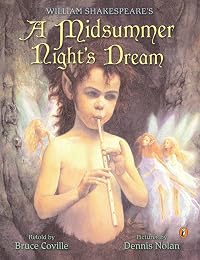
A dramatized Athenian world populated both by love-lorn humans and fairies, one would expect Nolan's illustrations to pop off the page. He does not disappoint. The artwork is beautiful, perfectly capturing the whimsical world of the text.
Though Coville does skimp over some aspects of the original tale, readers will hardly notice. Veterans of show more Shakespeare will note that the "play within a play" towards the end of the work was scaled down considerably, however, young readers won't miss a beat.
In a back-of-the-book note, Coville details his motivation for writing a picture-book version of Shakespeare's A Midsummer Night's Dream, saying it was meant to be "a gateway of greater enjoyment" of Shakespeare's works. I feel confident in saying his goal was achieved. show less
A dramatized Athenian world populated both by love-lorn humans and fairies, one would expect Nolan's illustrations to pop off the page. He does not disappoint. The artwork is beautiful, perfectly capturing the whimsical world of the text.
Though Coville does skimp over some aspects of the original tale, readers will hardly notice. Veterans of show more Shakespeare will note that the "play within a play" towards the end of the work was scaled down considerably, however, young readers won't miss a beat.
In a back-of-the-book note, Coville details his motivation for writing a picture-book version of Shakespeare's A Midsummer Night's Dream, saying it was meant to be "a gateway of greater enjoyment" of Shakespeare's works. I feel confident in saying his goal was achieved. show less
A Midsummer Night's Dream is such a refreshing break from the other picture books by Bruce Coville inspired from Shakespeare's works. Although I think Shakespeare is best known for his more tragic works, stories like this should be just as celebrated. I would choose to read this picture book to a pair of kindergarteners whereas I would never share a work like Hamlet or Macbeth with them because of more mature themes. This is a unique story that can be simplified for younger audiences but can also be analyzed by older students. This inspired me to read more of Shakespeare's work and discover a newfound appreciation for them.
I wish Coville would have adapted Macbeth and Hamlet like this one. I don't have an issue with the original Shakespearean dialogue, I encourage it, but I'm always worried kids will have trouble understanding it. This one is great for little kids because it simplifies the play without losing the meaning or magic. The author notes at the end are great for further studies: "Why don't you write the stories for us so we can understand them better. Then, when we are grown up, we shall understand the plays so much better!" I love this quote because it is so important to do this! If the kids can understand the language, they can understand the play.
I wasn't too crazy about the artwork in this one. The fairies came across as bony and a bit show more disturbing. I do like how colorful everything was. show less
I wasn't too crazy about the artwork in this one. The fairies came across as bony and a bit show more disturbing. I do like how colorful everything was. show less
Beautiful illustrations accompany one of Shakespeare's most popular comedies. I love the author's note at the end where he indicates how important the illustrations are since readers often have a difficult time distinguishing Hermia, Lysander, Demetrius, and Helena. This version presents the "play within a play" idea without confusion; I think students struggle with the Bottom/Quince play second story that happens simultaneously.
Ratings
Members
- Recently Added By
Published Reviews
ThingScore 100
Coville follows up his version of The Tempest... with a retelling of another of Shakespeare's most popular plays. The fundamental story of magic, mischief and the trials and tribulations of love is preserved through well-chosen use of the original language and Coville's heady prose.... Major plot lines are clearly and concisely rendered, but it is the portrayal of the various levels of humor show more -- from Bottom's buffoonery to Puck's gleeful magic-making -- that really captures the essence of the play. Nolan's... sumptuous, painterly watercolors highlight the theatrical setting of the spellbound wood. ... A first-rate entree to the Bard. show less
added by CourtyardSchool
Lists

Shakespeare Retellings for Elementary Kids
100 works; 2 members
Author Information

199+ Works 28,032 Members
Bruce Coville was born in Syracuse, New York, on May 16, 1950. He spent one year at Duke University in North Carolina. Coville started working seriously at becoming a writer when he was seventeen. He was not able to start selling stories right away, so he had many other jobs, including toymaker, gravedigger, cookware salesman, and assembly line show more worker. Eventually, Coville became an elementary teacher, and worked with second and fourth graders. Coville married Katherine Dietz an artist, and they began trying to create books together. It wasn't until 1977 that they finally sold their first book, The Foolish Giant. They joined together on two other books after that, Sarah's Unicorn and The Monster's Ring, and followed them with Goblins in the Castle, Aliens Ate My Homework, and The World's Worst Fairy Godmother. (Bowker Author Biography) show less
All Editions
Some Editions
Awards and Honors
Awards
Notable Lists
Series

Work Relationships
Is contained in
Is an adaptation of
Common Knowledge
- Canonical title
- William Shakespeare's A Midsummer Night's Dream
- Original publication date
- 1996
Classifications
Statistics
- Members
- 332
- Popularity
- 95,395
- Reviews
- 4
- Rating
- (4.11)
- Languages
- English
- Media
- Paper
- ISBNs
- 2
- ASINs
- 4