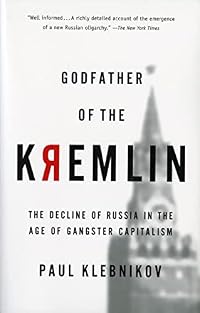
Godfather of the Kremlin: The Decline of Russia in the Age of Gangster Capitalism
by Paul Klebnikov
On This Page
Description
Boris Berezovsky's business career has been meteoric. In just six years he managed to seize control of Russia's largest auto manufacturer, largest TV network, national airline, and one of the world's biggest oil companies. When Moscow's gangster families battled one another in the Great Mob War of 1993-1994, Berezovsky was in the thick of it. He was badly burned by a car bomb; his driver was decapitated. A year later, Berezovsky emerged as the prime suspect in the assassination of the show more director of the TV network he acquired. Although plagued by scandal, he enjoyed President Yeltsin's support, serving as the personal "financial advisor" to Yeltsin and his family. In 1996, Berezovsky organized the financing of Yeltsin's re-election campaign-a campaign marred by fraud, embezzlement, and attempted murder. Berezovsky became the president's most influential political advisor, playing a key role in forming governments and dismissing prime ministers. Having labored to privatize the economy, Berezovsky privatized the state. Based on hundreds of taped interviews with top businessmen and government officials, as well as on secret police reports, contractual documents, and surveillance tapes, Godfather of the Kremlin is both a gripping story and a unique historical document. show lessTags
Recommendations








Member Reviews
Boris Berezovsky is a murderer and racketeer who was chased out of Russia by President Putin, and is now in asylum in England (reason: no fair trial in Russia). He is also, in all likelihood, the murderer of the author of this book.
Klebnikov gives the best account that I have read, of the economic and social catastrophe of the Yeltsin presidency, and the way in which Berezovsky first used his Chechen mafia contacts, and later his membership of Yeltsin's inner circle in the early 1990's, to "privatize" (for himself ) the profits of Russia's major enterprises. His tactic was to enter in a friendly way, a company such a Autovaz (Russia's largest auto manufacturer), set up associate companies, knock out the management then bleed the show more enterprise through the overseas associates (turning it into a loss maker). Entry became much easier with the Yeltsin circle's support and he successfully moved against Aeroflot (national airline), ORT (national TV broadcaster) and the giant Russian raw materials companies, with management dissenters being unaccountably murdered.
The theft turned to overdrive when he and his associates (also Jewish and who came to be known as the oligarchs) came up with the idea of lending the Yeltsin government money in return for shareholdings in the major Russian raw materials companies. "Loans for Shares" developed into a series of rigged auctions with the connivance of Yeltsin's family (particularly his daughter Tanya Dyachenko - a personal friend of Berezovsky). As a example, Khodorkovsy obtained 45% of the Yukos oil company for only 159 million dollars, when the true market value of this share was revealed as 2.798 million dollars (stock market value 01-08-97). All this, while ordinary Russians were, as usual, abandoned to their fate in a hyperinflating, lawless society in which previously middle class professionals were reduced to penury.
When talking about these ex communists turned businessmen, the outsider General Aleksandr Lebed correctly stated that, "They have always regarded ordinary people as garbage: the stones at the foot of the pyramids." show less
Klebnikov gives the best account that I have read, of the economic and social catastrophe of the Yeltsin presidency, and the way in which Berezovsky first used his Chechen mafia contacts, and later his membership of Yeltsin's inner circle in the early 1990's, to "privatize" (for himself ) the profits of Russia's major enterprises. His tactic was to enter in a friendly way, a company such a Autovaz (Russia's largest auto manufacturer), set up associate companies, knock out the management then bleed the show more enterprise through the overseas associates (turning it into a loss maker). Entry became much easier with the Yeltsin circle's support and he successfully moved against Aeroflot (national airline), ORT (national TV broadcaster) and the giant Russian raw materials companies, with management dissenters being unaccountably murdered.
The theft turned to overdrive when he and his associates (also Jewish and who came to be known as the oligarchs) came up with the idea of lending the Yeltsin government money in return for shareholdings in the major Russian raw materials companies. "Loans for Shares" developed into a series of rigged auctions with the connivance of Yeltsin's family (particularly his daughter Tanya Dyachenko - a personal friend of Berezovsky). As a example, Khodorkovsy obtained 45% of the Yukos oil company for only 159 million dollars, when the true market value of this share was revealed as 2.798 million dollars (stock market value 01-08-97). All this, while ordinary Russians were, as usual, abandoned to their fate in a hyperinflating, lawless society in which previously middle class professionals were reduced to penury.
When talking about these ex communists turned businessmen, the outsider General Aleksandr Lebed correctly stated that, "They have always regarded ordinary people as garbage: the stones at the foot of the pyramids." show less
Ratings
Members
- Recently Added By
Lists

All Things Russia
459 works; 11 members
Author Information
3 Works 126 Members
Paul Klebnikov holds a Ph.D. in Russian history from the London School of Economics. He is a senior editor at Forbes and has reported on Russia since 1989. A fluent Russian speaker, he has won four press awards for his writing on Russian business
Classifications
- Genres
- Nonfiction, Economics, History, General Nonfiction, Biography & Memoir, Business
- DDC/MDS
- 338.092 — Society, Government, and Culture Economics Production Biography And History Biography
- LCC
- HC340.12 .K555 — Social sciences Economic history and conditions Economic history and conditions By region or country
- BISAC
Statistics
- Members
- 123
- Popularity
- 262,145
- Reviews
- 1
- Rating
- (4.28)
- Languages
- English, French
- Media
- Paper
- ISBNs
- 3