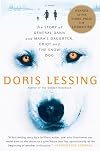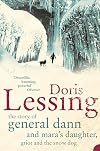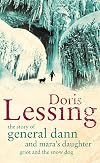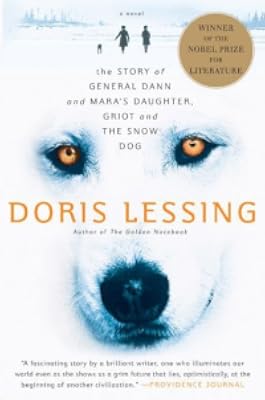
Story of General Dann and Mara's Daughter, Griot and the Snow Dog: A Novel
by Doris Lessing
Mara and Dann (2)
On This Page
Description
Dann is grown up now, hunting for knowledge and despondent over the inadequacies of his civilization. With his trusted companions--Mara's daughter, his hope for the future; the abandoned child-soldier Griot, who discovers the meaning of love and the ability to sing stories; and the snow dog, a faithful friend who brings him back from the depths of despair--Dann embarks on a strange and captivating adventure in a suddenly colder, more watery climate in the north.Tags
Recommendations

















Member Reviews
The frequent description “future fable” just exactly describes this wonderful novel, a richly detailed tapestry of lives and themes and meditations on the world as it might well become. The tale of the young man Dann, who had experienced and accomplished so much in a preceding novel, is both deeply sympathetic and sad, and this reader, any reader in fact, does not need to have read the prequel to make connections with his character.
The story is set some millennia on from now, at a time when a thaw is beginning in the new Ice Age that has seen the glaciers and ice sheets reach the southern shores of Europe and lower the sea levels in the Mediterranean. Dann and his contemporaries inhabit the northern fringes of Africa (somewhere show more around present-day Tunisia perhaps) where rumours of war are commonplace and refugees are frequent. There are recognisable descendants of Africans, Asians and Europeans peopling this world but the action is mostly set in the ruins of ‘the Centre’, where museum exhibits and sealed-in books provide a barely translucent window on a past rapidly disappearing from view and receding from human understanding.
The language of The Story of General Dann is simply couched but never simplistic. The novel is suffused with the theme of narrative, from Dann’s brief occupation as a story-teller to Griot’s attempt to make real the storyline in his own head: the rise of a leader who will inspire an army, recover lost knowledge and found a new civilisation; and others have already pointed out the obvious, that the name Griot is a West African term for a story-teller.
Dann himself is suffering from a bipolar disorder exacerbated by the fallout from forced opium use in his earlier life. The theme of polarities is echoed in many other ways, not least in the use of differently coloured cloaks by different armies, red by one, black by another. Dann is hero-worshipped by Griot, a former boy-soldier, who hopes that Dann will provide a focus for order, direction, conquest and the preservation of knowledge – all the elements in fact that may allow a dimly-perceived civilisation to be resurrected in the marshy foothills of the Atlas mountains. All are groping in the dark, and while there is a resolution of sorts in the closing pages of the novel, it is clear that civilisation will have to emerge anew rather than from the ruins of its former manifestation.
The final point I want to make concerns Lessing’s portrayal of the female characters in the book. It is in these individuals – Dann’s deluded and drug-addicted former partner, his bullying daughter, his niece (the daughter of his sister Mara), the natural healer – that the author’s fable-telling is most manifest. Yes, these are individuals, but they are also almost stereotypes, and while we feel for them – their strengths, their foibles, their victimhoods, their successes – they appear, as with the male characters, somewhat distant. This is not just because they are in some never-never land in the far future; it is because, I think, these characters could be each and every one of us if we found ourselves in such a situation. And if it makes us pause and think, ‘Would we manage any better in such circumstances?’ then that is only one of many positive aspects of this thoughtful and haunting novel.
The Story of General Dann reminds me of Ursula Le Guin’s speculative novels: there is the same melancholy, the avoidance of trite formulae, the consideration of the individual’s relationship to society. Though this is my first Lessing story, its predecessor Mara and Dann: an adventure is already tempting me from the bookshelves.
http://wp.me/p2oNj1-qO show less
The story is set some millennia on from now, at a time when a thaw is beginning in the new Ice Age that has seen the glaciers and ice sheets reach the southern shores of Europe and lower the sea levels in the Mediterranean. Dann and his contemporaries inhabit the northern fringes of Africa (somewhere show more around present-day Tunisia perhaps) where rumours of war are commonplace and refugees are frequent. There are recognisable descendants of Africans, Asians and Europeans peopling this world but the action is mostly set in the ruins of ‘the Centre’, where museum exhibits and sealed-in books provide a barely translucent window on a past rapidly disappearing from view and receding from human understanding.
The language of The Story of General Dann is simply couched but never simplistic. The novel is suffused with the theme of narrative, from Dann’s brief occupation as a story-teller to Griot’s attempt to make real the storyline in his own head: the rise of a leader who will inspire an army, recover lost knowledge and found a new civilisation; and others have already pointed out the obvious, that the name Griot is a West African term for a story-teller.
Dann himself is suffering from a bipolar disorder exacerbated by the fallout from forced opium use in his earlier life. The theme of polarities is echoed in many other ways, not least in the use of differently coloured cloaks by different armies, red by one, black by another. Dann is hero-worshipped by Griot, a former boy-soldier, who hopes that Dann will provide a focus for order, direction, conquest and the preservation of knowledge – all the elements in fact that may allow a dimly-perceived civilisation to be resurrected in the marshy foothills of the Atlas mountains. All are groping in the dark, and while there is a resolution of sorts in the closing pages of the novel, it is clear that civilisation will have to emerge anew rather than from the ruins of its former manifestation.
The final point I want to make concerns Lessing’s portrayal of the female characters in the book. It is in these individuals – Dann’s deluded and drug-addicted former partner, his bullying daughter, his niece (the daughter of his sister Mara), the natural healer – that the author’s fable-telling is most manifest. Yes, these are individuals, but they are also almost stereotypes, and while we feel for them – their strengths, their foibles, their victimhoods, their successes – they appear, as with the male characters, somewhat distant. This is not just because they are in some never-never land in the far future; it is because, I think, these characters could be each and every one of us if we found ourselves in such a situation. And if it makes us pause and think, ‘Would we manage any better in such circumstances?’ then that is only one of many positive aspects of this thoughtful and haunting novel.
The Story of General Dann reminds me of Ursula Le Guin’s speculative novels: there is the same melancholy, the avoidance of trite formulae, the consideration of the individual’s relationship to society. Though this is my first Lessing story, its predecessor Mara and Dann: an adventure is already tempting me from the bookshelves.
http://wp.me/p2oNj1-qO show less
Like its predecessor, a strange and sparse book.
It's set far off in the future, at the end of an ice age, and everything we know and are today has been all but forgotten. Scrips and scraps from our time and those civilizations which have risen and fallen in between have survived, but the ignorance of our descendants renders those things largely unusable.
Themes of loss, hope, love, family, drug abuse and more permeate the slight plot. I just finished the book and my head is humming with it all. I feel a lack of closure but that could well be the point. I may come back and add more, possibly even a rating, but I need to sit with it first.
It's set far off in the future, at the end of an ice age, and everything we know and are today has been all but forgotten. Scrips and scraps from our time and those civilizations which have risen and fallen in between have survived, but the ignorance of our descendants renders those things largely unusable.
Themes of loss, hope, love, family, drug abuse and more permeate the slight plot. I just finished the book and my head is humming with it all. I feel a lack of closure but that could well be the point. I may come back and add more, possibly even a rating, but I need to sit with it first.
https://nwhyte.livejournal.com/2961084.html
The setting is a post-apocalyptic world where Europe is covered by melting ice sheets, the Mediterranean has dried up but slowly starting to fill again, and the remnants of humanity are trying to hold onto and maybe rebuild civilisation. Dann is thrust into a leadership role despite his bad health, and, surrounded by his companions of the title, is drawn into a quest to save a library of knowledge from the old days. The prose is terse, but the setting and the characters conveyed effectively, Dann's personal drama very closely linked to the question of what will happen to the cultural heritage now under threat from the changing climate. It's also fairly short.
The setting is a post-apocalyptic world where Europe is covered by melting ice sheets, the Mediterranean has dried up but slowly starting to fill again, and the remnants of humanity are trying to hold onto and maybe rebuild civilisation. Dann is thrust into a leadership role despite his bad health, and, surrounded by his companions of the title, is drawn into a quest to save a library of knowledge from the old days. The prose is terse, but the setting and the characters conveyed effectively, Dann's personal drama very closely linked to the question of what will happen to the cultural heritage now under threat from the changing climate. It's also fairly short.
In the NE corner of Africa, in nowadays Morocco, ancient people had built a huge"Centre," filled with the shared knowledge and machines if Yerrup, or Urrup, before the Ice came and forced the humans to Africa. Here, General Dann and his ever-faithful Captain Griot assemble the"Red Blanket Army" out of the never-ending arrival of refugees from the war-torn East.
Lessing knows how to tell a good tale, and the ending makes it clear that General Dann, Captain Griot, Ali the doctor and tutor of Tamar, Dann's niece, will be back.
Lessing knows how to tell a good tale, and the ending makes it clear that General Dann, Captain Griot, Ali the doctor and tutor of Tamar, Dann's niece, will be back.
Not nearly as amazing as Mara and Dann, but then, I think it was not meant to be. I do enjoy the tidiness of finding out what happens after Mara and Dann, but at the end of this book, I am again wanting to know what happens next. And I wish Mara had lived.
Not the best thing Lessing ever wrote, so don't start here. And for goodness' sake, read Mara and Dann before jumping into this one. Prequels are there for a reason.
Not the best thing Lessing ever wrote, so don't start here. And for goodness' sake, read Mara and Dann before jumping into this one. Prequels are there for a reason.
This is the second book in a very interesting series about a brother and sister in a post-apocalyptic world, thousands of years after global warming has caused Africa to be the only inhabitable continent.
This book begins with Dann and Mara choosing a place to settle down, and concentrates upon their relationships and struggle to build a better future with (and for) their friends and family.
As with the previous book, the characters are complex and interesting. This book was slower paced, and less cohesive than the first book in the series, but still engrossing and a good continuation of the first book.
This book begins with Dann and Mara choosing a place to settle down, and concentrates upon their relationships and struggle to build a better future with (and for) their friends and family.
As with the previous book, the characters are complex and interesting. This book was slower paced, and less cohesive than the first book in the series, but still engrossing and a good continuation of the first book.
So this is the first Doris Lessing book I've read and I can safely say that if you haven't read any Lessing, don't, and i mean DON'T, make this your introductory book into her works. The Washington Post said it best with this short line:"...its title outweighs its contents". That is so true! I do love the title; I've read it hundreds of times. I should have stopped there. I would have been satisfied...
Members
- Recently Added By
Author Information

262+ Works 37,132 Members
Doris Lessing was born in Kermanshah, Persia (later Iran) on October 22, 1919 and grew up in Rhodesia (the present-day Zimbabwe). During her two marriages, she submitted short fiction and poetry for publication. After moving to London in 1949, she published her first novel, The Grass Is Singing, in 1950. She is best known for her 1954 Somerset show more Maugham Award-winning experimental novel The Golden Notebook. Her other works include This Was the Old Chief's Country, the Children of Violence series, the Canopus in Argos - Archives series, and Alfred and Emily. She has received numerous awards for her work including the 2001 Prince of Asturias Prize in Literature, the David Cohen British Literature Prize, and the 2007 Nobel Prize for Literature. She died on November 17, 2013 at the age of 94. (Bowker Author Biography) show less
Some Editions
Series

Belongs to Publisher Series
btb (73687)
Common Knowledge
- Canonical title*
- Die Geschichte von General Dann und Maras Tochter, von Griot und dem Schneehund
- Original title
- The Story of General Dann and Mara's Daughter, Griot and the Snow Dog
- Original publication date
- 2005
- People/Characters
- Griot; Dann; Kass; Ali; Marianthe; Durk (show all 14); Ruff the snow dog; Kira; Shabis; Tamar; Rhea; Leta; Donna; Felissa
- Important places
- Ifrik; the Middle Sea; the Centre; the Farm; Yerrup; Tundra
- First words
- A slight move to one side or the other -- a mere hand's breadth -- and Dann must fall.
- Last words
- (Click to show. Warning: May contain spoilers.)"Well, yes, Griot, it would certainly be stupid. I agree with you there."
- Original language*
- Englisch
*Some information comes from Common Knowledge in other languages. Click "Edit" for more information.
Classifications
Statistics
- Members
- 311
- Popularity
- 102,797
- Reviews
- 9
- Rating
- (3.90)
- Languages
- 6 — Dutch, English, French, German, Italian, Spanish
- Media
- Paper, Ebook
- ISBNs
- 20
- ASINs
- 5