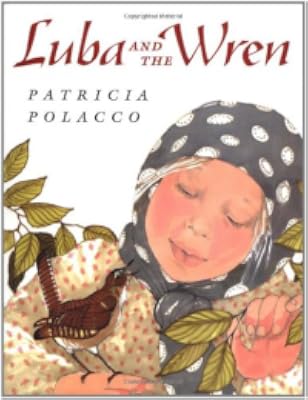
Luba and the Wren
by Patricia Polacco
On This Page
Description
In this variation on the story of "The Fisherman and His Wife," a young Ukrainian girl must repeatedly return to the wren she has rescued to relay her parents' increasingly greedy demands.Tags
Recommendations


Member Reviews
Walking through the forest, Luba finds a wren trapped in a net. Releasing the tiny bird, she is told that a wish will be granted. Wanting nothing, Luba returns home to parents who are dismayed at her lack of ignorance. Instructing her to go back into the forest and request a larger home with fertile ground, Luba hesitantly asks the wren for this favor.
Upon returning home, she finds a lovely home and surrounding area. Dissatisfied with their new acquisition, Luba is instructed to find the bird once again and to ask for a palace. Hesitantly, she asks the wren for yet another wish.
Week after week, her greedy parents want newer, larger abodes and, now, they want titles and power. Becoming Tsar and Tsarina of Russia, they demand to be God.
As show more embarrassed and chagrined Luba asks for these things, she knows her parents are missing the mark of happiness.
The illustrations in this book are incredible!
In particular, the gentle face of Luba is stunning. show less
Upon returning home, she finds a lovely home and surrounding area. Dissatisfied with their new acquisition, Luba is instructed to find the bird once again and to ask for a palace. Hesitantly, she asks the wren for yet another wish.
Week after week, her greedy parents want newer, larger abodes and, now, they want titles and power. Becoming Tsar and Tsarina of Russia, they demand to be God.
As show more embarrassed and chagrined Luba asks for these things, she knows her parents are missing the mark of happiness.
The illustrations in this book are incredible!
In particular, the gentle face of Luba is stunning. show less
Patricia Polacco, whose autobiographical picture-books, from Thank You, Mr. Falker to Uncle Vova's Tree, are unfailingly poignant, here turns her attention to the world of folklore, creating in Luba and the Wren a Ukrainian variant of the tale-type best known as The Fisherman and His Wife. When kind-hearted young Luba saves a little wren in the forest, and is offered a reward, her parents are incensed to learn that she didn't ask for a finer house, and more productive farmland, and send her back into the forest to rectify the situation. But when their wish is granted, they soon find that they want more, growing more and more greedy as each new demand is granted...
Although I am generally a fan of Patricia Polacco's work, and found the show more illustrations in Luba and the Wren as appealing as those in any of the author's other titles, I did have some mixed feelings about it, as a folkloric adaptation. I kept thinking, as I was reading, of the many Russian variants of this tale type that already exist - from Pushkin's The Magic Gold Fish, to The Fisherman and the Magic Fish (which can be found, among other places, in Russian Lacquer, Legends and Fairy Tales) - and wondering whether Polacco had sought out any genuine Ukrainian versions, before penning her own. This is definitely one that Polacco fans will want to check out, but I can't shake my sense of regret that she didn't show more respect for her source material, and include a little note about the tale, and what version she used for inspiration... show less
Although I am generally a fan of Patricia Polacco's work, and found the show more illustrations in Luba and the Wren as appealing as those in any of the author's other titles, I did have some mixed feelings about it, as a folkloric adaptation. I kept thinking, as I was reading, of the many Russian variants of this tale type that already exist - from Pushkin's The Magic Gold Fish, to The Fisherman and the Magic Fish (which can be found, among other places, in Russian Lacquer, Legends and Fairy Tales) - and wondering whether Polacco had sought out any genuine Ukrainian versions, before penning her own. This is definitely one that Polacco fans will want to check out, but I can't shake my sense of regret that she didn't show more respect for her source material, and include a little note about the tale, and what version she used for inspiration... show less
I really like this book but, more importantly, the kids I know LOVE this book! So I’m meeting in the middle and giving it a 4.
I actually live in Ukraine (going on four years now). There is another American family here who’s children I read to often. This one of their absolute favourites and that range in ages 1-19. (There are eight of them and they all love it.)
THE STORY - the story has a VERY Ukrainian/Russian/Soviet feel to the way it reads. It also uses some bigger or smarter words that you didn’t often see in a children’s book. That makes it great for expanding vocabulary. The story is pretty straight forward but it also contains deeper aspects that older readers catch on too but younger readers may miss. An example of this show more is how the weather changes as the story progresses.
I also appreciate the lesson it offers in, just bc someone in authority tells you too, should you? The same question could apply to peer pressure. Does doing it actually help things or make them worse?
The core lesson is clearly about contentment though.
THE ART - the illustrations are very colourful and lovely and the colors and style is what I’d expect from this region.
LENGTH - this book does have a lot of text so be prepared for that. It is not a quick 2 minute read. I’m a slow reader and it usually takes me 15-30 minutes to get through depending on how much the kids want to stop and look at the pictures. show less
I actually live in Ukraine (going on four years now). There is another American family here who’s children I read to often. This one of their absolute favourites and that range in ages 1-19. (There are eight of them and they all love it.)
THE STORY - the story has a VERY Ukrainian/Russian/Soviet feel to the way it reads. It also uses some bigger or smarter words that you didn’t often see in a children’s book. That makes it great for expanding vocabulary. The story is pretty straight forward but it also contains deeper aspects that older readers catch on too but younger readers may miss. An example of this show more is how the weather changes as the story progresses.
I also appreciate the lesson it offers in, just bc someone in authority tells you too, should you? The same question could apply to peer pressure. Does doing it actually help things or make them worse?
The core lesson is clearly about contentment though.
THE ART - the illustrations are very colourful and lovely and the colors and style is what I’d expect from this region.
LENGTH - this book does have a lot of text so be prepared for that. It is not a quick 2 minute read. I’m a slow reader and it usually takes me 15-30 minutes to get through depending on how much the kids want to stop and look at the pictures. show less
How many people would take a wish and run with it? Not Luba. Luba is very content with her life. Her family is poor, and they live in a small house. She stumbles upon a wren that is tangled in a net and sets it free. In return he tells her he will grant her any wish she wants. Luba tells the wren she is happy and does not wish for anything. Luba runs home to tell her parents what happened to her that day in the forest, and their reaction is one that will change Luba's life drastically. They make Luba wish for them to have a bigger house, then the become rich, and eventually ruler. Throughout this story, it makes the readers think of the saying "be careful what you wish for because you never know what it may bring you." All Luba's show more parents wish for is materialistic things to become happier which they are never satisfied with in the end; they always end up wishing for something more. This story helps children understand that money, materials, and power does not bring happiness to anyone because one will never be satisfied. Only family and love can bring true happiness to a person. In the end of the story, Luba's parents realize that their family is the only thing that can bring them true happiness. show less
This book is about a little Ukrainian girl who finds a magical wren who grants wishes. Because she wants for nothing, Luba asks the Wren to grant her parents wishes, which are selfish and power-thirsty. This is a great book with beautiful illustrations of historical Ukraine. At one point, this book is quite scary and readers will want to turn the pages to see what happens next. Patricia Polacco never fails.
The author retells the story of the Fisherman and his Wife with Russian characters. Luba helps a wren who offers to repay her by granting her anything that she wishes. Her parents want to be change their lives to be rich and powerful, but Luba objects. The lesson is "be careful what you wish for." It might not bring you the happiness you are seeking. This story will appeal to young readers because the main character is a child. In this story she knows more about the simplicity of true happiness than her parents, but cannot convince them.The author also is the illustrator. she has depicted scenes from the story is bright watercolors. The images evoke Russia and Russian culture in the 1800s from the style of the buildings to the clothing show more worn by the characters. show less
This is a lovely story. It has all the qualities of a folktale or traditional tale, but is just a little different in it's portrayal of parental greed, and I must wonder if it is a new creation of the author based on traditional folktale styles. A very good read, this features lessons for children, but not in an overly didactic manner. The setting in the Ukraine is such that it feels like it could be exchanged for almost anywhere. As an outsider, I cannot tell if this title has an authentic Ukrainian feel, and I don't feel like I learned much about that area from the book, though that is not necessary the point of this story. The author herself does have a Russian background, which makes the presentation more trustworthy.
Librarians show more could easily feature this title for storytimes, it is a fun read with a good message. show less
Librarians show more could easily feature this title for storytimes, it is a fun read with a good message. show less
Members
- Recently Added By
Lists

A Child's Book Tour of Russia
45 works; 4 members

A Child's Book Tour of Ukraine
29 works; 2 members

Ukrainian Culture
17 works; 2 members
Author Information

81+ Works 56,997 Members
Patricia Polacco was born in Lansing, Michigan on July 11, 1944. She attended Oakland Tech High School in Oakland, California before heading off to the California College of Arts and Crafts in Oakland, then Laney Community College in Oakland. She then set off for Monash University, Mulgrave, Australia and the Royal Melbourne Institute of show more Technology, Melbourne, Australia where she received a Ph.D in Art History, Emphasis on Iconography. After college, she restored ancient pieces of art for museums. She didn't start writing children's books until she was 41 years old. She began writing down the stories that were in her head, and was then encouraged to join the Society of Children's Book Writers and Illustrators. There she learned how to put together a dummy and get a story into the form of a children's picture book. Her mother paid for a trip to New York, where the two visited 16 publishers in one week. She submitted everything she had to more than one house. By the time she returned home the following week, she had sold just about everything. Polacco has won the 1988 Sydney Taylor Book Award for The Keeping Quilt, and the 1989 International Reading Association Award for Rechenka's Eggs. She was inducted into the Author's Hall of Fame by the Santa Clara Reading Council in 1990, and received the Commonwealth Club of California's Recognition of Excellence that same year for Babushka's Doll, and again in 1992 for Chicken Sunday. She also won the Golden Kite Award for Illustration from the Society of Children's Book Writers and Illustrators for Chicken Sunday in 1992, as well as the Boston Area Educators for Social Responsibility Children's Literature and Social Responsibility Award. In 1993, she won the Jane Adams Peace Assoc. and Women's Intl. League for Peace and Freedom Honor award for Mrs. Katz and Tush for its effective contribution to peace and social justice. She has won Parent's Choice Honors for Some Birthday in 1991, the video Dream Keeper in 1997 and Thank You Mr. Falker in 1998. In 1996, she won the Jo Osborne Award for Humor in Children's Literature. Her titles The Art of Miss. Chew and The Blessing Cup made The New York Times Best Seller List. (Bowker Author Biography) show less
Common Knowledge
- Canonical title
- Luba and the Wren
Classifications
Statistics
- Members
- 362
- Popularity
- 87,228
- Reviews
- 15
- Rating
- (3.96)
- Languages
- English
- Media
- Paper
- ISBNs
- 8