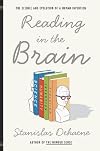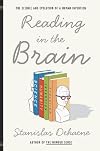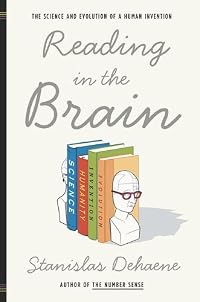
Reading in the Brain: The Science and Evolution of a Human Invention
by Stanislas Dehaene
On This Page
Description
In this riveting investigation, Stanislas Dehaene provides an accessible account of the brain circuitry of reading and explores what he calls the "reading paradox": Our cortex is the product of millions of years of evolution in a world without writing, so how did it adapt to recognize words?Tags
Recommendations










Member Reviews
My new favorite cognitive neuroscientist. Rarely do people describe non-fiction by saying "it stuck with me," but this work really did. The chapter about the evolution of logographic and letter forms alone is worth the price of admission. What I wouldn't give to study in France under this man (who is, by the way, only in his forties).
In 2009, French cognitive neuroscientist Stanislas Dehaene proposed in his book Reading in the Brain a hypothesis to describe brain activity in humans when they read. He calls it neuronal recycling, and it’s based on a few elementary facts.
Writing systems and reading have been around for only about 5,000 years, much too short a timeframe for humans to evolve brain structures tailored specifically to reading. So, obviously, humans did not evolve reading as a skill. Dehaene’s thesis is based on MRIs of peoples’ brains while they read, and research into the anatomy of primate brains. In chimpanzee and macaque brain structures, neurologists have learned that synapses within the occipital and inferior temporal areas fire when the show more subject is shown certain shapes.
Dehaene has also found the analagous areas in human brains in use while a person is reading. In simple terms, the author’s hypothesis states that reading “hijacks” these brain structures evolved to recognize certain critical shapes and directed their use to recognizing letters and words. From there, writing systems have adapted to take advantage of some apparently pre-programmed, or evolved, primate brain functions. The result is a literate population who can communicate in great detail with the dead, and can leave communications for future generations after they themselves are dead. It’s obviously a superpower.
A survey of writing systems through the last few thousand years revealed some intriguing parallels. For instance, most characters are composed of roughly three strokes that can be traced without ever lifting or stopping the pen or stylus. Dehaene proposes that this formula corresponds to the way the neurons’ react to increasing complexity of the symbols. In all writing systems across the world, characters appear to have evolved to an almost optimal combination that can easily be grasped the multi-tiered way the brain works as we read. At lower levels of our visual comprehending system, the strokes themselves consist of two, three or four line segments. At one level up, in our alphabetical systems, multiletter units such as word roots, prefixes, suffixes, and grammatical endings are almost invariably two, three, or four letters long. In Chinese, most characters consist in a combination of two, three, or four semantic and phonetic subunits. Visually speaking, all writing systems seem to rely on a pyramid of shapes whose golden section is the number 3 plus or minus 1.
I confess there are chapters in this book I did not read. They were very technical, written for other neuroscientists, covering dyslexia and the implications for the teaching of reading. The level of detail here is deep and comprehensive. The style is straightforward and clear, comprehensible to any adult reader. I did get the diverting feeling as I read, as I’m sure Dehaene did while writing, that readers of his book had to engage in this marvelous, unique skill, while learning about the marvelous, unique skill they were using. Quite enjoyable. show less
Writing systems and reading have been around for only about 5,000 years, much too short a timeframe for humans to evolve brain structures tailored specifically to reading. So, obviously, humans did not evolve reading as a skill. Dehaene’s thesis is based on MRIs of peoples’ brains while they read, and research into the anatomy of primate brains. In chimpanzee and macaque brain structures, neurologists have learned that synapses within the occipital and inferior temporal areas fire when the show more subject is shown certain shapes.
Dehaene has also found the analagous areas in human brains in use while a person is reading. In simple terms, the author’s hypothesis states that reading “hijacks” these brain structures evolved to recognize certain critical shapes and directed their use to recognizing letters and words. From there, writing systems have adapted to take advantage of some apparently pre-programmed, or evolved, primate brain functions. The result is a literate population who can communicate in great detail with the dead, and can leave communications for future generations after they themselves are dead. It’s obviously a superpower.
A survey of writing systems through the last few thousand years revealed some intriguing parallels. For instance, most characters are composed of roughly three strokes that can be traced without ever lifting or stopping the pen or stylus. Dehaene proposes that this formula corresponds to the way the neurons’ react to increasing complexity of the symbols. In all writing systems across the world, characters appear to have evolved to an almost optimal combination that can easily be grasped the multi-tiered way the brain works as we read. At lower levels of our visual comprehending system, the strokes themselves consist of two, three or four line segments. At one level up, in our alphabetical systems, multiletter units such as word roots, prefixes, suffixes, and grammatical endings are almost invariably two, three, or four letters long. In Chinese, most characters consist in a combination of two, three, or four semantic and phonetic subunits. Visually speaking, all writing systems seem to rely on a pyramid of shapes whose golden section is the number 3 plus or minus 1.
I confess there are chapters in this book I did not read. They were very technical, written for other neuroscientists, covering dyslexia and the implications for the teaching of reading. The level of detail here is deep and comprehensive. The style is straightforward and clear, comprehensible to any adult reader. I did get the diverting feeling as I read, as I’m sure Dehaene did while writing, that readers of his book had to engage in this marvelous, unique skill, while learning about the marvelous, unique skill they were using. Quite enjoyable. show less
A very interesting, but incredibly long-winded account of almost everything scientists have learned about how the brain performs the human-unique task of reading. It was a relief that, in the last chapter of the book, the author concedes that the book is very long-winded (so he shouldn’t be too offended by the first sentence of this review). However if you enjoy reading, you will most likely tolerate the great minutia covered for the insight and understanding that the book provides. The explanation of dyslexia was informative (it is not simply that Dyslexic individuals reverse letters or words). An interesting aside was the discussion of the strange spelling of the English language, and why it is unlikely that it could be usefully show more simplified. Scientists have determined that a specific part of the brain is responsible for identifying letters and for permitting reading. From that, the author then asks how this could be, given that reading developed over a period of time too short to be explained by evolution. A natural question is whether the ability to read has sacrificed other abilities (such as the ability to “read” animal tracks as in Hunter/Gather society). It seems that this question has not been answered, and the author's discussion here was less complete than everywhere else.
A very good book. Well worth the time spent reading it. show less
A very good book. Well worth the time spent reading it. show less
Every page has something new and informative, although there is a little too much repitition of certain points. One of my fondest hopes is that someday what is called "literary criticism" will refer to examination of how an author is able to subtly manipulate neural circuitry through orthography, as opposed to the centuries of arid bloviation about historicism or deconstruction or the "liberal tradition" that is currently the domain of the English Department.
Author Dehaene, who has some very impressive credentials, has made an exhaustive exploration of how the human brain reads. What he has concluded is that we ‘recycle’ parts of the brain that were evolved to do other things. Humans have been evolving for several million years, but only reading for a few thousand- a new structure just for reading couldn’t have been created in that time. And reading arose in several geographical areas around the same time- the chances of a special mutation for reading happening in all those places is pretty slim.
Hundreds of experiments, from EEGs, fMRIs, split brain surgeries, tests on people who have had strokes or other brain damage, have found how reading works. From how the eye functions, to the show more recognition of letters on paper, to turning them mentally into sound, and putting those sounds together into words, Dehaene has traced the path. He gives his opinions on what seem to be the best way to teach reading, but also calls for large experiments in teaching reading to resolve, once and for all, what is the best, most efficient way to teach all- not just average children but adult illiterates and people with dyslexia.
The book is very interesting, but it can be slow going. He gives the conditions and results of test after test, and tells us what the information gained tells us about reading. What the reader learns about their brain makes it worth sticking with the book. show less
Hundreds of experiments, from EEGs, fMRIs, split brain surgeries, tests on people who have had strokes or other brain damage, have found how reading works. From how the eye functions, to the show more recognition of letters on paper, to turning them mentally into sound, and putting those sounds together into words, Dehaene has traced the path. He gives his opinions on what seem to be the best way to teach reading, but also calls for large experiments in teaching reading to resolve, once and for all, what is the best, most efficient way to teach all- not just average children but adult illiterates and people with dyslexia.
The book is very interesting, but it can be slow going. He gives the conditions and results of test after test, and tells us what the information gained tells us about reading. What the reader learns about their brain makes it worth sticking with the book. show less
In this book, Stanislas Dehaene sets out to answer this question: how is it that the human brain can read printed material so easily, although not enough time has passed between the invention of writing and now to allow our brains to evolve? His answer: neuronal recycling. The brain adapts neuronal circuits originally designed for one purpose to the new one: reading.
Along the way, Professor Dehaene discusses such fascinating material as the invention of writing, brain imaging of people as they read, and what is it about the human brain that allows us to create a culture. Written in an engaging style and loaded with case studies, this is a wonderful book for anyone who has ever wondered what exactly is going on in his brain while he show more reads. Professor Dehaene also provides some insights into reading methods for teachers and into dyslexia for concerned parents. show less
Along the way, Professor Dehaene discusses such fascinating material as the invention of writing, brain imaging of people as they read, and what is it about the human brain that allows us to create a culture. Written in an engaging style and loaded with case studies, this is a wonderful book for anyone who has ever wondered what exactly is going on in his brain while he show more reads. Professor Dehaene also provides some insights into reading methods for teachers and into dyslexia for concerned parents. show less
Reading is an amazing thing: English readers’ brains can recognize an “a” in multiple fonts, upper and lower case, even though these variants often look nothing like one another; they can also easily figure out words that are scrambled except for their first and last letters, and convert identical ambiguous cursive letters into “c” or “e” depending on which makes sense of a word. (Readers in other languages can do plenty of things that seem like they should be more difficult than they are too, but English turns out to be the European-derived language with the most complex interactions between pronunciation and writing/spelling, which makes English readers take a couple extra years to become proficient compared to, for show more example, Italian readers.) This book has lots of detail about exactly what goes on in the brain as children learn to read, some of it pretty numbing, but I enjoyed the discussion of the complexity of reading, including what goes wrong in dyslexia and tentative approaches to making reading easier to master for people who have dyslexia. show less
Members
- Recently Added By
Lists

Books Read in 2016
4,666 works; 199 members

Works cited in Palimpsest: A History of the Written Word by Matthew Battles
79 works; 2 members
Author Information

Stanislas Dehaene teaches at the Collge de France and is Director of the Cognitive Neuroimaging Research Unit at INSERM.
Some Editions
Awards and Honors
Work Relationships
Is abridged in
Common Knowledge
- Canonical title*
- Les neurones de la lecture
- Original title
- Les neurones de la lecture
- Original publication date
- 2007-08-30 (1e édition originale française, Odile Jacob) (1e édition originale française, Odile Jacob)
- Epigraph*
- Introduction
"Retiré dans la paix de cces déserts
En compagnie de peu de livres, mais savatns,
Je converse avec les défunts
Et écoute les morts avec les yeux"
Francisco DE QUEVEDO - Dedication
- For Ghislaine
- First words*
- Préface
par Jean-Pierre Changeux
Depuis l'émergence des neurosciences dans les années 1970, des progrès considérables ont été réalisés dans la connaissance de notre cerveau. [...]
Introduction
La science de la lecture
Vous entamez la lecture de ce livre. Sans que vous en preniez conscience, votre cerveau accomplit une remarquable prouesse. [...] - Blurbers
- Sacks, Oliver; Wolf, Maryanne; LeDoux, Joseph; Falk, Dean; Engel, Howard
- Original language*
- Français
*Some information comes from Common Knowledge in other languages. Click "Edit" for more information.
Classifications
Statistics
- Members
- 856
- Popularity
- 31,740
- Reviews
- 22
- Rating
- (3.96)
- Languages
- 6 — English, French, German, Italian, Portuguese, Spanish
- Media
- Paper, Ebook
- ISBNs
- 16
- ASINs
- 10