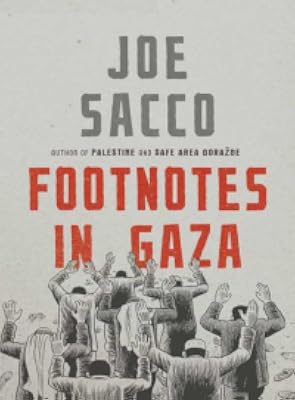
Footnotes in Gaza
by Joe Sacco
On This Page
Description
"From the great cartoonist-reporter, a sweeping, original investigation of a forgotten crime in the most vexed of places. Rafah, a town at the bottommost tip of the Gaza Strip, is a squalid place. Raw concrete buildings front trash-strewn alleys. The narrow streets are crowded with young children and unemployed men. On the border with Egypt, swaths of Rafah have been bulldozed to rubble. Rafah is today and has always been a notorious flashpoint in this bitterest of conflicts. Buried deep in show more the archives is one bloody incident, in 1956, that left 111 Palestinians dead, shot by Israeli soldiers. Seemingly a footnote to a long history of killing, that day in Rafah-- cold-blooded massacre or dreadful mistake-- reveals the competing truths that have come to define an intractable war. In a quest to get to the heart of what happened, Joe Sacco immerses himself in daily life of Rafah and the neighboring town of Khan Younis, uncovering Gaza past and present. Spanning fifty years, moving fluidly between one war and the next, alive with the voices of fugitives and schoolchildren, widows and sheikhs, Footnotes in Gaza captures the essence of a tragedy" -- from publisher's web site. show lessTags
Recommendations





Member Recommendations


Member Reviews
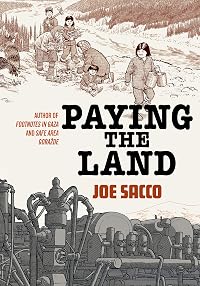
Well, this was devastating. Joe Sacco’s work is meticulous, well-researched, and beautifully illustrated, meaning it's fantastic at capturing the sense of despair. Set between 2001 and 2003, at the onset of the Iraq War, the book chronicles Sacco’s investigative journey into two massacres in Rafah and Khan Younis, carried out by Israeli forces in 1956. Even in the early 2000s, the people Sacco interviewed were outraged and exhausted by decades of violence and neglect by the global community. Reading this at the end of 2024, with the horrors Palestinians have faced since October 2023, is almost unbearable. The historical atrocities Sacco meticulously recounts feel small in the shadow of the escalated crisis today. I first encountered show more Sacco’s work through Paying the Land, which shed light on injustices faced by Indigenous communities in Canada. That led me to Footnotes in Gaza as part of my effort to better understand Palestine. While this review could focus entirely on Sacco’s work, it’s impossible to separate the material from the context, it’s a brutal reminder that the injustices he documented have only intensified. The first-hand accounts are heart-wrenching and enraging. Sacco doesn’t just deliver history, he demands that we bear witness. I will continue reading everything he publishes, but I wish he had nothing more to document. This book is beyond educational, vital, but it hurts deeply, especially because it’s all true and things have only worsened. show less
Brilliant. At first I thought that Sacco's own presence in the narrative might be distracting. But as the book goes on, it becomes clear that his inclusion is crucial to an understanding of the complexities of Palestine and of this graphic 'novel'. What right does Sacco have to interfere in this conflict? Why should he investigate the past when the future is so troubled? Why should the conflict be turned into art?
Even for readers aware of what is happening in Palestine, it is hard to believe some of the injustices recorded. And they are all the more powerful, given the care Sacco takes to demonstrate the unreliablity of memory: while individual memories cannot be trusted, the documenting of multiple memories provides damning proof of show more atrocities past and present. show less
Even for readers aware of what is happening in Palestine, it is hard to believe some of the injustices recorded. And they are all the more powerful, given the care Sacco takes to demonstrate the unreliablity of memory: while individual memories cannot be trusted, the documenting of multiple memories provides damning proof of show more atrocities past and present. show less
The first time you crack open Footnotes in Gaza you are taken aback by the powerful imagery. True, it is a graphic novel so it is supposed to be full of black and white squares full of images but keep this in mind, it's nonfiction. It messes with your mind. You associate comics with the Sunday funnies...you know, comedy, light-hearted. So, to see images of war in a comic-strip format is confusing. But, your mind adjusts. From the very first pages you get a sense of what you are in for, "It is the story of footnotes to a sideshow of a forgotten war. The war pitted Egypt against the strange alliance of Britain, France and Israel in 1956" (p 8). Footnotes in Gaza has a strange effect on the reader. More graphic than a dry newspaper show more account, Sacco's illustrations shove the violence and hatred into the forefront. And, yet despite being less graphic than actual photographs, the images linger in your mind... show less
Joe Sacco is not just a pioneer in the field of comics journalism; he’s about the only one standing in it. His previous works on Palestine and Bosnia have won worldwide acclaim, and now he narrows his lens further, onto a single month in the Gaza Strip in 1956. In two towns filled with Palestinian refugees, almost four hundred men and boys were killed by Israeli soldiers searching for enemy combatants. The events in the towns of Rafah and Khan Younis were barely mentioned in international news, and have largely been erased from history. But for the surviving families, the tragedy has fueled decades of violent hated against Israelis. Joe Sacco spent two years in the Gaza Strip investigating events of half a century ago, documenting the show more memories of each individual who was there in painstaking detail.
The visual aspect of this book is critical; because of it we are able to move seamlessly between past and present, and put faces behind the horrible stories being told. Sacco’s art is precise and evocative like it never has been before, bringing history (and a far-away present) to life. While Sacco makes it clear from the outset that his sympathies lie with the Palestinians, he never wavers in his journalistic integrity, cross-examining each witness and questioning each inaccuracy. This is a tremendous and important document of a forgotten footnote of history, one that deserves to be read by all those who care about the roots of the Israeli-Palestinian conflict. show less
The visual aspect of this book is critical; because of it we are able to move seamlessly between past and present, and put faces behind the horrible stories being told. Sacco’s art is precise and evocative like it never has been before, bringing history (and a far-away present) to life. While Sacco makes it clear from the outset that his sympathies lie with the Palestinians, he never wavers in his journalistic integrity, cross-examining each witness and questioning each inaccuracy. This is a tremendous and important document of a forgotten footnote of history, one that deserves to be read by all those who care about the roots of the Israeli-Palestinian conflict. show less
This is one of the best books I have read. Sacco's art tell the stories of two horrible events from early in the Israel Palestine conflict. His technique is to show the painstakingly difficult path a journalist must follow to do a good job. The graphic format effectively shows more than it tells. There is an almost perfect balance between history and the current situation in Gaza. Some supporters of Israel call the book biased, but Sacco goes to great lengths to show how he gathered his information and how he often omitted details, usually more damning to Israel as unreliable. He paints a sympathetic picture of Palestinians, that is true, but he also points out the misconceptions and propaganda that influence their thoughts.
This is a hard book to review. As I was reading it I was wondering if there can be such a thing as an "objective" book about this conflict between Israel and the Palestinian people. What I find most striking about this is the narrative about these two horrendous events in 1956, cast in the shadow of the daily indignities faced by these same people in the present day.
I was reminded of Zinn's 'A Peoples History' reading this book, because it talks about events that just weren't covered in the history books you read in school. I never heard anything negative about the behavior of the Israeli army growing up, only about the horrors perpetrated by PLO terrorists. So in a way this is a gripping book because you feel as though you are show more uncovering something that has been covered up for a long time.
To Sacco's credit, he is upfront about the difficulties in constructing a narrative based upon oral histories. Its easy to see how stories told and retold can begin to take on the form of the told story over 50 years. Its clear that there is some truth in this book, and it is an ugly truth.
I recommend this book. Its not entirely objective, but I dont know if any texts on this topic are. show less
I was reminded of Zinn's 'A Peoples History' reading this book, because it talks about events that just weren't covered in the history books you read in school. I never heard anything negative about the behavior of the Israeli army growing up, only about the horrors perpetrated by PLO terrorists. So in a way this is a gripping book because you feel as though you are show more uncovering something that has been covered up for a long time.
To Sacco's credit, he is upfront about the difficulties in constructing a narrative based upon oral histories. Its easy to see how stories told and retold can begin to take on the form of the told story over 50 years. Its clear that there is some truth in this book, and it is an ugly truth.
I recommend this book. Its not entirely objective, but I dont know if any texts on this topic are. show less
Another Graphic Novel that manages to bring one so close in that one feels one has somehow been there. Like in “This One Summer” (another graphic novel I reviewed), one is brought into intimate connection with the experience of the subject matter. Their are numerous interviewees and their descriptions of the same events vary, but somehow it seems to make the overall feel more vivid. I am left feeling as though I have made a journey, have spent some time in the south Gaza, with all these people. It is a desperate, chaotic place, but human strength and resilience stands out all the more.
The book is quite a unique and remarkable project. I was excited to find out about the concept of “Graphic Journalism” and I wasn’t disappointed show more by Sacco’s tremendous account-recording. In fact there is so much revealed and so much detail to the events that it is hard to pick where to start about the subject. I don’t know whether to go on about the individual atrocities that are revealed to the world, or the hidden history of the oppression of the Palestinians.
It is always described as a two-sided story, with suffering on either side, but is it not, within and without, a case of multiple divide-and-conquer?
Make no mistake. Palestine has been and continues to be brutalized and it has been going on right from the beginnings of the state of Israel and continues apace now. It is shocking and obscene and shameful because we allow it to be watered down in our media, allow it to pop up once-in-awhile as the flavour-of-the-week and be forgotten about in favor of affairs and boob-jobs. show less
The book is quite a unique and remarkable project. I was excited to find out about the concept of “Graphic Journalism” and I wasn’t disappointed show more by Sacco’s tremendous account-recording. In fact there is so much revealed and so much detail to the events that it is hard to pick where to start about the subject. I don’t know whether to go on about the individual atrocities that are revealed to the world, or the hidden history of the oppression of the Palestinians.
It is always described as a two-sided story, with suffering on either side, but is it not, within and without, a case of multiple divide-and-conquer?
Make no mistake. Palestine has been and continues to be brutalized and it has been going on right from the beginnings of the state of Israel and continues apace now. It is shocking and obscene and shameful because we allow it to be watered down in our media, allow it to pop up once-in-awhile as the flavour-of-the-week and be forgotten about in favor of affairs and boob-jobs. show less
Members
- Recently Added By
Published Reviews
ThingScore 100
Built around two forgotten incidents (the 1956 mass killings of Palestinians in Rafah and Khan Younis), it is a book that digs deep, exploring the relationship of past and present, memory and experience -- rigorously reported yet always aware of the elusive nature of testimony, the way that stories solidify and harden over time.
added by Shortride
Lists

Recommended Comics / Graphic Novels
595 works; 122 members

Middle East and Maghreb Graphic Novels
46 works; 3 members
Club Read's Graphic Stories Recommendations
127 works; 2 members

Top Five Books of 2018
802 works; 265 members

Books Referenced by Khalidi's The Hundred Years' War on Palestine
181 works; 1 member
Author Information

56+ Works 7,550 Members
Awards and Honors
Common Knowledge
- Canonical title
- Footnotes in Gaza
- Original title
- Footnotes in Gaza
- Original publication date
- 2009
- Dedication*
- To the people of Gaza
- First words*
- I've gotta say, my pal Mark has got it made.
- Last words*
- (Click to show. Warning: May contain spoilers.)And I rememberd how often I sat with old men who tried my patience, who rambled on, who got things mixed up, who skipped ahead, eho dodn't remember the barbed wire at the gate or when the mukhtars stood up or where the jeeps were parked, how often I sighed and mentally rolled my eyes because I knew mora about that day than they did.
*Some information comes from Common Knowledge in other languages. Click "Edit" for more information.
Classifications
Statistics
- Members
- 864
- Popularity
- 31,498
- Reviews
- 27
- Rating
- (4.33)
- Languages
- 13 — Czech, Dutch, English, French, German, Italian, Norwegian (Bokmål), Norwegian, Polish, Portuguese (Brazil), Spanish, Swedish, Turkish
- Media
- Paper, Ebook
- ISBNs
- 20
- ASINs
- 4