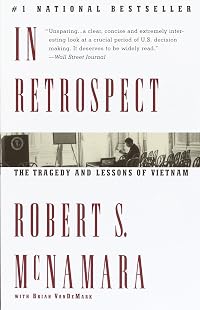
In Retrospect: The Tragedy and Lessons of Vietnam
by Robert S. McNamara
On This Page
Description
Robert S. McNamara, secretary of defense for Presidents Kennedy and Johnson, helped lead America into Vietnam. McNamara believed that the fight against communism in Asia was worth the sacrifice of American lives, and yet he eventually came to believe that the war was, in fact, unwinnable. Outnumbered by those who wanted to continue fighting, he left the Johnson administration and his involvement in Vietnam behind. He refused any public comment on the war, and for almost three decades has show more kept his silence - until the nineties. Drawing on his personal experience and a wealth of documentation - much of it only declassified decades later, and some presented here for the first time ever - McNamara has crafted an insider account of Vietnam policy making. He reveals exactly how we stumbled into the war, and exactly why it quickly became so difficult to pull out. McNamara takes us into the Oval Office for late-night discussions with the president, into the halls of the Pentagon as military strategy is argued, and into the chambers of Congress as policy is debated. He also reveals his own inner torment as the war effort becomes increasingly frustrating, and then utterly disastrous. The result is a book that is not only history of the highest order, but also revealing portrait of the trials of leadership.--adapted from publisher description. show lessTags
Recommendations















Member Reviews
This wasn't really a "tell all" about McNamara's role in Vietnam, but more an attempt to rehabilitate his reputation. It addressed some of the biggest problems with the war (the unexamined belief in the domino theory, the lack of understanding of nationalism as a key motivation of the Vietnamese, that the South Vietnamese forces were essentially unwilling or incapable to win, and that the escalations we chose, especially the air war, were insufficient to win, but merely a way of "doing something"), but his own role was limited to wishing he had challenged more assumptions by other people.
It's good that there has been some reflection on the causes of the war, but the real problem was something deeper. When a large and powerful country show more can choose to enter a war by choice and doesn't really have much stake in the outcome, it can prosecute that war in a completely ineffectual way. The country should be able to defend itself robustly, and maintain an absolute deterrent force, but wars of choice should not be the role of the military. We would be better off if such non-existential conflicts were waged entirely by private organizations, through something like a letter of marque or corporate security forces, and they would be far more efficient in their use of force -- in the case of the Vietnamese conflict, the reasonable policy would have been working with the nationalist/pro-independence movement and establishing a truly independent state, potentially neutral or even allied with the US, rather than continuing a colonial war and turning it into an anti-Communist crusade when it didn't need to be. show less
It's good that there has been some reflection on the causes of the war, but the real problem was something deeper. When a large and powerful country show more can choose to enter a war by choice and doesn't really have much stake in the outcome, it can prosecute that war in a completely ineffectual way. The country should be able to defend itself robustly, and maintain an absolute deterrent force, but wars of choice should not be the role of the military. We would be better off if such non-existential conflicts were waged entirely by private organizations, through something like a letter of marque or corporate security forces, and they would be far more efficient in their use of force -- in the case of the Vietnamese conflict, the reasonable policy would have been working with the nationalist/pro-independence movement and establishing a truly independent state, potentially neutral or even allied with the US, rather than continuing a colonial war and turning it into an anti-Communist crusade when it didn't need to be. show less
This book is a memoir, in many ways an apologia, and I read it as such. I also read some of the reviews and criticisms that were written at the time of its publication. I believe that there are lessons for us to learn from the war in Vietnam. I believe that, regardless of one’s viewpoint as to the rightness or justness of the war, there is considerable evidence that it was poorly managed and executed. McNamara made a noteworthy effort to ensure the accuracy of his recollections of the years he served as Secretary of Defense under President Kennedy and then continuing under President Johnson but in the end he wrote a very personal, almost intimate, story of those years. Stylistically, I think he repeated his central ideas and themes so show more often as to approach insulting the capability of his readers to grasp and remember them. I also found that his use of first names, although heightening the intimate tone, interfered with readability; I frequently had to refer to the Personae section to figure out exactly who he was referring to. In the end, I am happy to have finally read this book; it adds to my knowledge and insights about those years that were such a formative factor in my young adulthood. show less
Very good look into both the Kennedy and Johnson Administrations during the Vietnam War from 1960-1968. Robert McNamara is very candid with his opinions of why the direction taken by Washington during these pivotal years were flawed, and he lays much of the blame on himself and many of the preconceived notions of containment and the monolithic nature of Communism during this period. A very excellent read for anybody looking to see the Establishment's side of Vietnam beyond the popular image of warmongering politicians and generals.
McNamara got a lot of grief when he published this. I am glad he did: it is better to say you were wrong, even belatedly, than to say nothing. Very thoroughly docomented. Since McNamara put together the Pentagon Papers and did not attempt to block their publication, he can be said to have admitted he was wrong in 1971 while the war was still in progress.
If only more key decision makers on the world stage would make similar literary undertakings. This is RS McNamara's account of his early career and subsequent term as Secretary of Defence under presidents Kennedy and Johnson, focussing on the Vietnam war.
There is not much in way of new material or revelations, but it does provide the reader with an insight that cannot be gained by reading other books covering the same area. The main text is followed by extensive appendices covering other interesting material such as McNemara's role as head of the world bank and he has some interesting suggestions about ensuring nuclear non-proliferation. Personally, I would liked to have read more details about McNamara's relationships with other show more officials.
McNamara's writing style is easy to follow and I'd suggest that this is one of the most digestible accounts of the how the US administration handled the conflict. show less
There is not much in way of new material or revelations, but it does provide the reader with an insight that cannot be gained by reading other books covering the same area. The main text is followed by extensive appendices covering other interesting material such as McNemara's role as head of the world bank and he has some interesting suggestions about ensuring nuclear non-proliferation. Personally, I would liked to have read more details about McNamara's relationships with other show more officials.
McNamara's writing style is easy to follow and I'd suggest that this is one of the most digestible accounts of the how the US administration handled the conflict. show less
This is a great memoir by an influential man who was uniquely involved in the whole Vietnam issue. He writes with candor and reflection. Even though this is a memoir you don't get the sense that he is trying to gloss over the "bad" parts or minimize his mistakes. He freely says "this was a huge mistake on my part" (or on Kennedy's part). He gives thorough explanations of why certain decisions were made and what he wish he would have done.
I highly recommend this for not only the people interested in Robert S. McNamara or this time period but for everyone in general since we need to learn our mistakes as a nation that way we do not repeat them (look at Iraq right now).
There is also a documentary, which is a 2 hour interview with Robert show more S. McNamara that I believe is called "in retrospect" and it focuses on Robert S. McNamara's lessons he learned in Vietnam. I may have the title of the movie wrong but I highly recommend you pick up that movie after you read this book. show less
I highly recommend this for not only the people interested in Robert S. McNamara or this time period but for everyone in general since we need to learn our mistakes as a nation that way we do not repeat them (look at Iraq right now).
There is also a documentary, which is a 2 hour interview with Robert show more S. McNamara that I believe is called "in retrospect" and it focuses on Robert S. McNamara's lessons he learned in Vietnam. I may have the title of the movie wrong but I highly recommend you pick up that movie after you read this book. show less
3000 In Retrospect: The Tragedy and Lessons of Vietnam, by Robert S. McNamara with Brian VanDeMark (read 9 Aug 1997) I found this a fascinating read. I think he makes his points very well. What I don't know is that he would have done anything different if he did it over again (without the benefit of hindsight). It is easy to say we should have pulled out in 1965 knowing what has happened, but it is difficult to say wise men would have done so in 1965 knowing what they knew then. I think McNamara is a smart man and much of what he says in this book makes lots of sense.
Members
- Recently Added By
Lists

You Couldn't Pay Me to Read That (Take 2)
203 works; 86 members
Author Information

14+ Works 1,636 Members
Robert S. McNamara was born in San Francisco, California on June 9, 1916. He received a degree in economics and philosophy from the University of California (Berkeley) in 1937 and a master's degree from the Harvard Graduate School of Business Administration in 1939. He worked for one year at the accounting firm of Price, Waterhouse in San show more Francisco, and then in August 1940 returned to Harvard to teach in the business school. During World War II, he served in the Army Air Force. In 1946, he started working for the Ford Motor Company as manager of planning and financial analysis and on November 9, 1960, he became the first president of Ford Motor Company from outside the family of Henry Ford. He was the Secretary of Defense for both the Kennedy and Johnson Administrations and served from 1961 to 1968. He served as the head of World Bank from 1968 to 1981. He died on July 6, 2009 at the age of 93. (Bowker Author Biography) show less
All Editions
Some Editions
Awards and Honors
Distinctions
Series
Belongs to Publisher Series
Common Knowledge
- Canonical title*
- Avec le recul. La tragédie du Vietnam et ses leçons
- Original title
- In retrospect. The tragedy and lessons of Vietnam
- Original publication date
- 1995-04-12 (1e édition originale américaine, Times Books) (1e édition originale américaine, Times Books); 1996-04-03 (1e traduction et édition française, L'épreuve des faits, Seuil (1e traduction et édition française, L'épreuve des faits, Seuil)
- People/Characters
- Lyndon Baines Johnson; John F. Kennedy; Robert S. McNamara
- Important places
- Vietnam
- Important events
- Vietnam War (1959 | 1975)
- Original language*
- Anglais (Etats-Unis) (Etats-Unis)
*Some information comes from Common Knowledge in other languages. Click "Edit" for more information.
Classifications
- Genres
- History, Nonfiction, General Nonfiction, Biography & Memoir
- DDC/MDS
- 959.7043373 — History & geography History of Asia Southeast Asia: Myanmar, Thailand, Laos, Cambodia, Vietnam Vietnam 1949- 1961–1975 Vietnamese War Participation of countries, localities, groups American participation
- LCC
- DS558 .M44 — History of Europe, Asia, Africa and Oceania Asia History of Asia Southeast Asia French Indochina Vietnam. Annam Vietnamese Conflict
- BISAC
Statistics
- Members
- 1,193
- Popularity
- 20,931
- Reviews
- 14
- Rating
- (3.68)
- Languages
- Chinese, English, French, German
- Media
- Paper, Audiobook, Ebook
- ISBNs
- 15
- ASINs
- 6