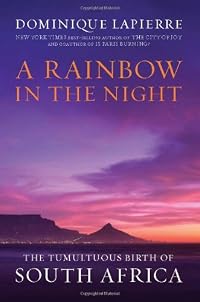
A Rainbow in the Night: The Tumultuous Birth of South Africa
by Dominique Lapierre
On This Page
Description
In 1652 a small group of Dutch farmers landed on the southernmost tip of Africa. Sent by the powerful Dutch India Company, their mission was simply to grow vegetables and supply ships rounding the cape. The colonists, however, were convinced by their strict Calvinist faith that they were among God's ?Elect," chosen to rule over the continent. Their saga?bloody, ferocious, and fervent?would culminate three centuries later in one of the greatest tragedies of history: the establishment of a show more racist regime in which a white minority would subjugate and victimize millions of blacks. Called ap show lessTags
Recommendations



























Member Reviews
Former Paris Match reporter and philanthropist Lapierre writes a passionate and lively history of South Africa from the landing of the Dutch East India Company’s small group of lettuce farmers under the direction of Jan van Riebeeck in 1652 to the election of Nelson Mandela as the first black president of a multi-racial country in 1994. The emphasis is on the twentieth century, what happened after the Great Trek of the Afrikaners into the interior and their bloody battles with the British, the Zulus, and the other native inhabitants. It tells of the foundation of the Nationalist Party, and an inner group of them, the Broederbond, inspired and taught by the Nazis in Hitler’s Germany, gained control of the government in 1948 and show more immediately started its harsh form of segregation called apartheid separating the races with no pretense of equality. Lapierre recounts the struggle against this regime interspersed with the stories of Nelson Mandela and those of Christiaan Barnard and Helen Lieberman two upper class whites who ignored the legal restrictions of apartheid by actively working to aid their fellow black and colored residents of South Africa. The history is by no means impartial, Lapierre communicates his own points of view throughout the text. He does not spare the exclamation points! This however, just enlivens his text. show less
I have to admit, I didn't know much about Africa's history. This book has made a huge impact on me and I ached for the people of Africa and what they had to endure the apartheid. There are a few pages of photos included in the book which I think was a great addition. Although the subject matter was at times very difficult to read, I'm glad I finished it. There was also a great deal of other information that I found very interesting. I loved reading about the day to day lives of the people. My favorite was Chris Barnard. I was amazed by his carreer and also loved reading about his family life. I thought this would read like a text book, but I was wrong. It's like reading fiction, and it's hard to put down. It's a book I think everyone show more needs to read this, especially those of us who really don't know much about the history of Africa. show less
Mr. Lapierre relates the history of South Africa from 1652 when Dutchman Jan van Riebeeck lands in the Cape to plant lettuce to 1994 when Nelson Mandela becomes South Africa’s first black president. There are great hardships and great triumphs described and the perseverance of the African people is remarkable and commendable. Mr. Lapierre states in his bibliography that he “wanted to recount, as accurately as possible, a fabulous human epic” which I find he does very well. I admit that I didn’t know much about South Africa’s history and after reading Mr. Lapierre’s historical account have been awakened to the devastation that apartheid had caused for the South African people.
The book contains informative and moving images show more and the appendices contain a short summary of what each noted person is doing today, some excerpts of the seventeen hundred laws and measures instituted by apartheid legislators, a chronology, a glossary, a bibliography, an explanation and some information on charitable organizations, image credits, acknowledgments and a very thorough index. I commend Mr. Lapierre’s hard work in researching and writing this book and his humanitarian efforts to help destitute children in India, Africa, and South America to where half of the royalties of this book are donated.
Thank you to Mr. Lapierre and De Capo Press for giving me the opportunity to review this book. show less
The book contains informative and moving images show more and the appendices contain a short summary of what each noted person is doing today, some excerpts of the seventeen hundred laws and measures instituted by apartheid legislators, a chronology, a glossary, a bibliography, an explanation and some information on charitable organizations, image credits, acknowledgments and a very thorough index. I commend Mr. Lapierre’s hard work in researching and writing this book and his humanitarian efforts to help destitute children in India, Africa, and South America to where half of the royalties of this book are donated.
Thank you to Mr. Lapierre and De Capo Press for giving me the opportunity to review this book. show less
Je suis une fois de plus séduit par les talents de conteur de Dominique Lapierre. Après avoir lu ô Jérusalem, je découvre cette fois l’histoire de l’Afrique du Sud. C’est un récit, non romancé mais passionnant qui commence avec l’établissement d’un petit comptoir au Cap par la compagnie des Indes néerlandaises en 1652. Objectif : faire pousser des salades pour ravitailler les navires en route pour les Indes.
Petit à petit, les « boers », poussés par leur foi calviniste, vont s’étendre vers l’intérieur des terres et s’affranchir de la tutelle d’Amsterdam en prenant le nom d’Afrikaners. Ils s’imposeront face aux tribus locales et résisteront même 4 ans à 10 contre 1 face à l’armée de la reine show more Victoria. Les Anglais s’approprient finalement l’or et les diamants du pays. Mais les afrikaners sont toujours là, avec leur conception du « développement séparé ». C’est en 1948 que le parti le plus extrémiste va gagner les élections et instaurer l’apartheid, le pire régime raciste depuis le IIIème Reich.
La deuxième partie du livre raconte comment le régime de l’Apartheid a régné sur l’Afrique du Sud de 1948 à 1990. Cela m’a permis de réaliser jusqu’à quel point la haine et le racisme peuvent aveugler les hommes et comment une minorité blanche a pu oppresser l’immense majorité de la population noire pendant aussi longtemps. J’admire encore plus Nelson Mandela pour avoir réussi à pardonner après avoir été emprisonné pendant 27 ans dans des conditions horribles. Il a même réussi à abattre l’apartheid en 1990 en évitant un bain de sang.
Ce livre est un excellent moyen de mettre en perspective les morceaux d’histoire déjà connus et de raconter l’histoire si atypique de ce pays. show less
Petit à petit, les « boers », poussés par leur foi calviniste, vont s’étendre vers l’intérieur des terres et s’affranchir de la tutelle d’Amsterdam en prenant le nom d’Afrikaners. Ils s’imposeront face aux tribus locales et résisteront même 4 ans à 10 contre 1 face à l’armée de la reine show more Victoria. Les Anglais s’approprient finalement l’or et les diamants du pays. Mais les afrikaners sont toujours là, avec leur conception du « développement séparé ». C’est en 1948 que le parti le plus extrémiste va gagner les élections et instaurer l’apartheid, le pire régime raciste depuis le IIIème Reich.
La deuxième partie du livre raconte comment le régime de l’Apartheid a régné sur l’Afrique du Sud de 1948 à 1990. Cela m’a permis de réaliser jusqu’à quel point la haine et le racisme peuvent aveugler les hommes et comment une minorité blanche a pu oppresser l’immense majorité de la population noire pendant aussi longtemps. J’admire encore plus Nelson Mandela pour avoir réussi à pardonner après avoir été emprisonné pendant 27 ans dans des conditions horribles. Il a même réussi à abattre l’apartheid en 1990 en évitant un bain de sang.
Ce livre est un excellent moyen de mettre en perspective les morceaux d’histoire déjà connus et de raconter l’histoire si atypique de ce pays. show less
Jan 12, 2013French
6 de abril de 1652. Un puñado de jardineros holandeses desembarca en la punta sur del continente africano. Su misión: hacer crecer lechugas para la tripulación de la poderosa Compañía de las Indias Orientales de Amsterdam, diezmada por el escorbuto. En esta aventura agrícola no existe ambición alguna de conquista colonial. Pero estos hombre, y los inmigrantes que se unen a ellos, pronto desafían las junglas infestadas de bestias salvajes y de moscas tse-tse para adentrarse en el corazón del continente. Van a escribir el primer capítulo de la historia de un país que todavía no existe: Sudáfrica.
Dec 11, 2022Spanish
Ratings
Members
- Recently Added By
Author Information

46+ Works 8,333 Members
Series
Belongs to Publisher Series
Common Knowledge
- Canonical title*
- Un arc-en-ciel dans la nuit
- Original title
- Un arc-en-ciel dans la nuit
- Original publication date
- 2009-11
- People/Characters
- Nelson Mandela; Helen Lieberman; Jan van Riebeeck; Christiaan Barnard
- Important places
- Cape Town, Western Cape, South Africa; Robben Island, South Africa; Johannesburg, South Africa
- Important events
- Apartheid
- Epigraph
- Each one of us is as intimately attached to the soil of this beautiful country as are the famous jacaranda trees of Pretoria and the mimosa trees of the bushweld...--a rainbow nation at peace with itself and the world. --Nel... (show all)son Mandela
- Dedication
- To Helen Lieberman and to all those--whites, blacks, and coloreds--who put an end to apartheid oppression and brought about the triumph of freedom, unity, truth, and reconciliation.
- First words
- Pillage, rape, murder: it was a sixteenth-century crusade against heresy so violent it was almost unique in history. Hollands' northern provinces were engulfed in flames and blood, occupied by savage troops sent from pious S... (show all)pain.
- Last words
- (Click to show. Warning: May contain spoilers.)The former occupant of Robben Island's cell 466-64 would be at the helm, trying to work a second miracle and keep his promise to build a rainbow nation capable of bringing forth a biblical "new earth".
*Some information comes from Common Knowledge in other languages. Click "Edit" for more information.
Classifications
Statistics
- Members
- 176
- Popularity
- 184,840
- Reviews
- 5
- Rating
- (3.81)
- Languages
- 6 — Dutch, English, French, Italian, Portuguese (Portugal), Spanish
- Media
- Paper, Audiobook, Ebook
- ISBNs
- 24
- ASINs
- 3