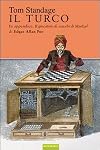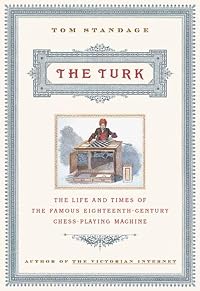
The Turk: The Life and Times of the Famous Eighteenth-Century Chess-Playing Machine
by Tom Standage
On This Page
Description
On an autumn day in 1769, a Hungarian nobleman, Wolfgang von Kempelen, was summoned to witness a conjuring show at the imperial court of Maria Theresa, Empress of Austria-Hungary. So unimpressed was Kempelen by the performance that he impetuously declared he could do better himself. It was a boast that would change the course of his life.Tags
Recommendations

















Member Recommendations
Member Reviews
Picture a bygone era ripe with new inventions. This was the industrial revolution. Everyone is coming up with something practical to make life easier or something clever to wow the public's imagination. Wolfgang von Kempelen's creativity was sparked when he attended a conjuring show at the court of Austria-Hungary's empress, Maria Theresa. Kempelen felt he could impress the empress further with his own ingenuity. She gave him six months to prepare a show of his own and at the end of the six months a mechanical Turkish dressed chess player was born. Outfitted with a high turban and a long smoking pipe, the automaton appeared to be capable of thought as he singlehandedly beat even the most skilled chess player at his own game. Kempelen show more allowed his audience to peer into the machine's inner workings and yet they still couldn't figure it out. the automaton became even more lifelike and mysterious when his second owner, Johann Maezel, introduced speech. The Turk, as the mechanical chess player became known, could talk! Instead of nodding three times, the automaton could tell his opponents, "check" in French further adding to his mystique. Like the boy who came to life in Pinocchio, the Turk was pure magic.
For eighty-seven years the Turk wowed audiences all across Europe and the eastern United States (Baltimore, Philadelphia, New York, and Boston primarily) before a raging fire extinguished his career. The mystery was not the how the automaton worked. Not really. The bigger and better mystery was how, for all those years and kept by multiple owners, the secret did not get out.
It is sad to think the Turk is not squirreled away in some fantastic museum. I fantasize about turning a corner, coming into a dusty room and standing face to face with the mechanical man in a turban who could say, "echec." show less
For eighty-seven years the Turk wowed audiences all across Europe and the eastern United States (Baltimore, Philadelphia, New York, and Boston primarily) before a raging fire extinguished his career. The mystery was not the how the automaton worked. Not really. The bigger and better mystery was how, for all those years and kept by multiple owners, the secret did not get out.
It is sad to think the Turk is not squirreled away in some fantastic museum. I fantasize about turning a corner, coming into a dusty room and standing face to face with the mechanical man in a turban who could say, "echec." show less
In an age when chess-playing computers are hardly a novelty, it might be hard to imagine just how remarkable people found Wolfgang von Kempelen’s automaton. Though little remembered beyond a handful of afficionados today, Kempelen’s Turk was a remarkable novelty in its day, one that delighted the Habsburg court and was taken on a triumphal tour of Europe. After Kempelen’s death, the Turk passed into the hands of a showman named Johann Maelzel, who again toured Europe with it before taking it to the United States, where it remained until its destruction in a Philadelphia fire in 1858.
Tom Standage describes all of this in an entertainingly-written account of the Turk. After a succinct account of its origins and the background of show more 18th century automata, he covers the Turk’s history through the decades in an enthralling tale. Perhaps his greatest success is in keeping the explanation of exactly how the machinery actually played chess until the end, thus allowing the reader to share in contemporaries’ amazement of, and speculation as to, the Turk’s secrets. In doing so, he captures some of the wonder that people felt for something so commonplace today – an achievement as remarkable in its own way as Kempelen’s device was in its day.
This sense of wonder is critical to understanding the Turk’s broader impact on history. As Standage demonstrates, the Turk inspired Edmund Cartwright’s automation of weaving, Charles Babbage’s speculations in early computing, and even Edgar Allan Poe’s invention of the detective story. Even after the Turk’s demise, it continued to inspire attempts to build a chess-playing machine, attempts that the author goes on in to summarize in a concluding chapter. Such efforts, as Standage shows, address the ongoing question of the relationship between people and machines, one that makes the history of this unusual device relevant to readers even today. show less
Tom Standage describes all of this in an entertainingly-written account of the Turk. After a succinct account of its origins and the background of show more 18th century automata, he covers the Turk’s history through the decades in an enthralling tale. Perhaps his greatest success is in keeping the explanation of exactly how the machinery actually played chess until the end, thus allowing the reader to share in contemporaries’ amazement of, and speculation as to, the Turk’s secrets. In doing so, he captures some of the wonder that people felt for something so commonplace today – an achievement as remarkable in its own way as Kempelen’s device was in its day.
This sense of wonder is critical to understanding the Turk’s broader impact on history. As Standage demonstrates, the Turk inspired Edmund Cartwright’s automation of weaving, Charles Babbage’s speculations in early computing, and even Edgar Allan Poe’s invention of the detective story. Even after the Turk’s demise, it continued to inspire attempts to build a chess-playing machine, attempts that the author goes on in to summarize in a concluding chapter. Such efforts, as Standage shows, address the ongoing question of the relationship between people and machines, one that makes the history of this unusual device relevant to readers even today. show less
Another one I read in 2003. My journal notes from the time:
>>This is about the 18th century chess playing machine. This author also wrote The Victorian Internet, which I read a while back. . . .This book works in a similar way to the other one. The author documents the Turk's history, in the process illustrating its time period very well. Reading about the different speculations at the time of how the Turk worked was very interesting, even Benjamin Franklin played against it, and much later Edgar Allan Poe tried to decipher its secrets. The part about Poe was interesting since the author showed how the investigation or inquiry into the Turk foreshadowed the method of his detective characters. In the end, the Turk's secrets were show more revealed. A magician who builds a replica explains the process. Last chapter draws a parallel to Big Blue playing chess with Kasparov. Overall, the book was a pleasant read. A good historical narrative and a nice way to see how the past touches the present."
The strength of the book as well is the fact that the secret is not revealed until the very end, and I am not telling now because I want people to read it. show less
>>This is about the 18th century chess playing machine. This author also wrote The Victorian Internet, which I read a while back. . . .This book works in a similar way to the other one. The author documents the Turk's history, in the process illustrating its time period very well. Reading about the different speculations at the time of how the Turk worked was very interesting, even Benjamin Franklin played against it, and much later Edgar Allan Poe tried to decipher its secrets. The part about Poe was interesting since the author showed how the investigation or inquiry into the Turk foreshadowed the method of his detective characters. In the end, the Turk's secrets were show more revealed. A magician who builds a replica explains the process. Last chapter draws a parallel to Big Blue playing chess with Kasparov. Overall, the book was a pleasant read. A good historical narrative and a nice way to see how the past touches the present."
The strength of the book as well is the fact that the secret is not revealed until the very end, and I am not telling now because I want people to read it. show less
On an autumn day in 1769, a Hungarian nobleman named Wolfgang von Kempelen attended a conjuring show at the court of Maria Theresa, empress of Austria-Hungary. So unimpressed was Kempelen by the performance that he declared he could do better himself. Maria Theresa held him to his word and gave him six months to prepare a show of his own. Kempelen did not disappoint; he returned to the court the following spring with a mechanical man, fashioned from wood, powered by clockwork, dressed in a stylish Turkish costume—and capable of playing chess. The Turk, as this contraption became known, was an instant success, and Tom Standage’s book chronicles its illustrious career in Europe and America over the next eighty five years. Associated show more over time with a host of historical figures, including Benjamin Franklin, Catherine the Great, Napoleon Bonaparte, Charles Babbage, and Edgar Allan Poe, Kempelen’s creation unwittingly also helped to inspire the development of the power loom, the computer, and the detective story. Everywhere it went, the Turk baffled spectators and provoked frenzied speculation about whether a machine could really think. Many rival theories were published, but they served only to undermine each other. Part historical detective story, part biography, The Turk relates the saga of the machine’s remarkable and checkered career against the backdrop of the industrial revolution, as mechanical technology opened up dramatic new possibilities and the relationship between people and machines was being redefined. Today, in the midst of the computer age, it has assumed a new significance, as scientists and philosophers continue to debate the possibility of machine intelligence. To modern eyes, the Turk now seems to have been a surprisingly farsighted invention, and its saga is a colorful and important part of the history of technology. show less
It did make me want to play chess. But the level of mystery that kept me hooked the first few chapters degenerated into a blow-by-blow historical account that was less than riveting, so that I eventually skipped ahead to the end just to see exactly what The Turk's gimmick turned out to be. I won't spoil it by telling you. You'll have to read it for yourself. And after I did, it was fun to go back and read the history of it.
Fascinating descriptions of 17th-18th century technology. I'd like to find out a lot more about automatons now - a subject I'd never really considered.
Fascinating descriptions of 17th-18th century technology. I'd like to find out a lot more about automatons now - a subject I'd never really considered.
In 1769, Hungarian machinist and engineer Wolfgang von Kempelen made a simple assertion that he could build a chess-playing automaton in six months. When he presented it to and defeated the Empress Maria Theresa, he was commanded to take it on tour all over Europe to show the world what proper engineering could accomplish. In its eighty-five year life span, it had several owners, traversed the Atlantic, and crossed the paths of Napoleon, Charles Babbage, and even Edgar Allan Poe. Tom Standage does a wonderful job of following the life of the machine and relaying the reactions of all who came across it. He even reveals its secrets. A quick and engaging read.
http://lifelongdewey.wordpress.com/2013/01/08/794-the-turk-by-tom-standage/
http://lifelongdewey.wordpress.com/2013/01/08/794-the-turk-by-tom-standage/
I found the whole thing fun and intriguing in the beginning... but I think this may be a story better-suited to an article rather than a full book. I soon became bored with the repetitive detail and abandoned the book.
Members
- Recently Added By
Published Reviews
ThingScore 100
An enjoyable romp through history, made more enjoyable by its cast of celebrities and rogues. Recommended especially to history buffs and chess aficionados.
added by legallypuzzled
Lists

Top Five Books of 2015
811 works; 240 members

Works referenced in The Turk by Tom Standage
37 works; 1 member

Books Cited in Blueprint by Nicholas Christakis
261 works; 1 member
Author Information

21+ Works 7,216 Members
Tom Standage is a journalist and author from England. A graduate of Oxford University, he has worked as a science and technology writer for The Guardian, as the business editor at The Economist, has been published in Wired, The New York Times, and The Daily Telegraph. His non-fiction works include The Victorian Internet, A History of the World in show more Six Glasses, An Edible History of Humanity (on the New York Times bestseller list in 2014), and Writing on the Wall: Social Media -- The First 2,000 Years. (Bowker Author Biography) show less
Awards and Honors
Distinctions
Common Knowledge
- People/Characters
- Jacques de Vaucanson; Wolfgang von Kempelen; Maria Theresa; Benjamin Franklin; François-André Danican Philidor; Carl Gottlieb von Windisch (show all 18); Catherine the Great; John Joseph Merlin; Charles Babbage; Napoleon Bonaparte; Johann Nepomuk Maelzel; Beethoven, Ludwig van, 1770-1827; Garry Kasparov; P. T. Barnum; Edgar Allan Poe; Alan Turing; Robert Willis; The Turk
- Important places
- Austria; Europe; France; Barnum's American Museum, Manhattan, New York, New York, USA; London, England, UK; Manhattan, New York, New York, USA (show all 12); New York, USA; New York, New York, USA; Paris, France; Schönbrunn Palace, Vienna, Austria; USA; Vienna, Austria
- First words
- [Preface] On an autumn day in 1769, Wolfgang von Kempelen, a thirty-five-year-old Hungarian civil servant, was summoned to the imperial court in Vienna by Maria Theresa, empress of Austria-Hungary, to witness the performance ... (show all)of a visiting French conjuror.
[Chapter 1] Automata are the forgotten ancestors of almost all modern technology. - Last words
- (Click to show. Warning: May contain spoilers.)The wily automaton has had the greatest last laugh after all.
- Blurbers
- Singh, Simon; Winchester, Simon
Classifications
- Genres
- Nonfiction, History, General Nonfiction, Technology, Science & Nature, Biography & Memoir
- DDC/MDS
- 794.17 — Arts & recreation Recreation, sports, and performing arts Indoor games of skill Chess Special forms
- LCC
- GV1447 .S74 — Geography, Anthropology and Recreation Recreation. Leisure Recreation. Leisure Games and amusements Indoor games and amusements Board games. Move games
- BISAC
Statistics
- Members
- 464
- Popularity
- 65,833
- Reviews
- 10
- Rating
- (3.77)
- Languages
- 5 — Dutch, English, German, Italian, Turkish
- Media
- Paper, Ebook
- ISBNs
- 13
- ASINs
- 2