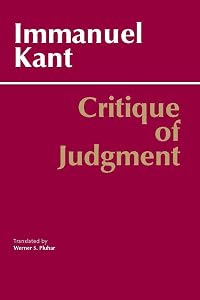
Critique of Judgment
by Immanuel Kant
On This Page
Description
The Critique of the Power of Judgment (a more accurate rendition of what has hitherto been translated as the Critique of Judgment) is the third of Kant's great critiques following the Critique of Pure Reason and the Critique of Practical Reason. This translation of Kant's masterpiece follows the principles and high standards of all other volumes in The Cambridge Edition of the Works of Immanuel Kant. This volume, first published in 2000, includes: the indispensable first draft of Kant's show more introduction to the work; an English edition notes to the many differences between the first (1790) and second (1793) editions of the work; and relevant passages in Kant's anthropology lectures where he elaborated on his aesthetic views. All in all this edition offers the serious student of Kant a dramatically richer, more complete and more accurate translation. show lessTags
Recommendations











Member Recommendations
Member Reviews
É claro que o livro dá a pensar e consolida duas categorias estéticas importantes - o belo e o sublime, e como outras coisas de Kant, está cheio de propostas soluções criativas. Entretanto a terceira crítica pesa um pouco no arranjo não muito convincente, como se a faculdade de julgar fosse espremida entre o entendimento e a razão, e tivesse de se encaixar entre ambos, de cima para baixo (a divisão em os momentos do belo e do sublime passam essa mensagem). Somado a isso, há o fato de que nesse livro fica ainda mais aparente o principal problema do estilo kantiano: as repetições de explicações frequentes mas que habilmente conseguem nos fazer não entender a cada reiteração, como se fosse preciso renovar continuamente a show more faculdade do (des)entendimento. A cisão do belo com o lógico e consequente papel do gênio ligado a uma espécie de natureza indomitável, além das vagas ideias estéticas são historicamente interessantes, mas precisam de distanciamento na leitura (e não Kant, jardinagem não é um tipo de pintura, mas ok). A exploração do esquematismo (a imaginação como tendo funções produtivas e recognitivas) é instigante; as incursões nas ideias problemáticas da razão é fraca, como algures, mas aqui mais longa, e a pressuposição de uma necessidade de atribuição teleológica à natureza não convince, embora seja astuciosa. Mais que nas outras duas críticas, as 100 páginas introdutórias poderiam vir ao final. show less
Perhaps one element of good philosophy should be that the argument be at least moderately straightforward. Maybe Kant is just deep, but I perceive a lot of leaps to conclusions based on a huge amount of new, creative concepts as the springboard. I have not studied enough of this to be definite, but my suspicion is that Kant is considered a great philosopher by a brand of intellectuals that can use such indeterminate fluff to justify their views about how philosophy leads to current sociological and political trends. For example: "Skill can hardly be developed in the human race otherwise than by means of inequality among men." I rate this a 4 only because it holds such an esteemed spot in the development of modern philosophy, but it's show more not the type of argument that convinces me. show less
Not as great as its "older brother" the First Critique (the Critique of Pure Reason), but an interesting book nonetheless and one which presents the strongest imaginable rebuttal to the idea that "good taste is subjective".
The notion of “aesthetic purposiveness” in judgments that ascribe beauty to something, unlike a mere expression of taste, lays claim to general validity, yet it cannot be said to be cognitive because it rests on feeling, not on argument. The explanation lies in the fact that, when a person contemplates an object and finds it beautiful, there is a certain harmony between his imagination and his understanding, of which he is aware from the immediate delight that he takes in the object. Imagination grasps the object and yet is not restricted to any definite concept, whereas a person imputes the delight that he feels to others because it springs from the free play of his cognitive faculties, which are the same in all humans.
In college, I was taught as an undergraduate, that Kant united the European Continental and British philosopher and the streams of rationalism and empiricism with their future directions, where in the spirit of Ogden Nash, "If you convinced me and I convinced you, would there not then still be two points of view?" - both traditions changed profoundly, so one could see lines crossing IN Kant's analytical thinking.
super interesting - most people know Kant from his ethics, but his work on philosophy of aesthetics is also substantial
Në këtë periudhë, duke vazhduar traditat natyraliste shkencore të filozofisë materialiste, Kant-i parashtroi një varg idesh hipotezash mbi zhvillimin e natyrës, të cilat i “dhanë fund sundimit absolut të mënyrës metafizike të mendimit në shkencat e natyrës”. Nisur nga ligjet e Kepler-it, të Njuton-it dhe përllogaritjet e Lajbnic-it, ai është, gjithashtu, dhe autori i hipotezave të famshme mbi formimin e planetëve nga mjegullnajat (re grimcash dhe pluhuri), mbi ekzistencën e galaktikave të tjera jashtë galaktikës sonë, mbi ndikimin e baticave dhe zbaticave në rrotullimin e tokës rreth vetes, mbi prejardhjen natyrore të racave të sotme njerëzore, etj
Members
- Recently Added By
Published Reviews
Med "Kritikk av dømmekraften" avslutter Kant (1724-1804) sitt kritiske prosjekt. Den tredje kritikken danner et bindeledd mellom hans erkjennelseslære og moralfilosofi, og tar for seg dømmekraftens bruk i kunst og vitenskap. I de to første kritikkene trakk han opp fornuftens formale grenser. Det er ... Les mer
Med "Kritikk av dømmekraften" avslutter Kant (1724-1804) sitt kritiske prosjekt. show more Den tredje kritikken danner et bindeledd mellom hans erkjennelseslære og moralfilosofi, og tar for seg dømmekraftens bruk i kunst og vitenskap. I de to første kritikkene trakk han opp fornuftens formale grenser. Det er verkets første del, "Kritikk av den estetiske dømmekraft", som er oversatt her. Der fremsetter Kant sin estetikk. show less
Med "Kritikk av dømmekraften" avslutter Kant (1724-1804) sitt kritiske prosjekt. show more Den tredje kritikken danner et bindeledd mellom hans erkjennelseslære og moralfilosofi, og tar for seg dømmekraftens bruk i kunst og vitenskap. I de to første kritikkene trakk han opp fornuftens formale grenser. Det er verkets første del, "Kritikk av den estetiske dømmekraft", som er oversatt her. Der fremsetter Kant sin estetikk. show less
added by kirstenlund
Lists

100 Books to Read in a Lifetime (That Are Older Than 200 Years)
415 works; 176 members

Filosofía - Clásicos
217 works; 1 member

How to Read a Book's Recommended Reading List
309 works; 10 members

Philosophy, Politics and Economics
61 works; 1 member
Author Information

The greatest of all modern philosophers was born in the Baltic seaport of Konigsberg, East Prussia, the son of a saddler and never left the vicinity of his remote birthplace. Through his family pastor, Immanuel Kant received the opportunity to study at the newly founded Collegium Fredericianum, proceeding to the University of Konigsberg, where he show more was introduced to Wolffian philosophy and modern natural science by the philosopher Martin Knutzen. From 1746 to 1755, he served as tutor in various households near Konigsberg. Between 1755 and 1770, Kant published treatises on a number of scientific and philosophical subjects, including one in which he originated the nebular hypothesis of the origin of the solar system. Some of Kant's writings in the early 1760s attracted the favorable notice of respected philosophers such as J. H. Lambert and Moses Mendelssohn, but a professorship eluded Kant until he was over 45. In 1781 Kant finally published his great work, the Critique of Pure Reason. The early reviews were hostile and uncomprehending, and Kant's attempt to make his theories more accessible in his Prolegomena to Any Future Metaphysics (1783) was largely unsuccessful. Then, partly through the influence of former student J. G. Herder, whose writings on anthropology and history challenged his Enlightenment convictions, Kant turned his attention to issues in the philosophy of morality and history, writing several short essays on the philosophy of history and sketching his ethical theory in the Foundations of the Metaphysics of Morals (1785). Kant's new philosophical approach began to receive attention in 1786 through a series of articles in a widely circulated Gottingen journal by the Jena philosopher K. L. Reinhold. The following year Kant published a new, extensively revised edition of the Critique, following it up with the Critique of Practical Reason (1788), treating the foundations of moral philosophy, and the Critique of Judgment (1790), an examination of aesthetics rounding out his system through a strikingly original treatment of two topics that were widely perceived as high on the philosophical agenda at the time - the philosophical meaning of the taste for beauty and the use of teleology in natural science. From the early 1790s onward, Kant was regarded by the coming generation of philosophers as having overthrown all previous systems and as having opened up a whole new philosophical vista. During the last decade of his philosophical activity, Kant devoted most of his attention to applications of moral philosophy. His two chief works in the 1790s were Religion Within the Bounds of Plain Reason (1793--94) and Metaphysics of Morals (1798), the first part of which contained Kant's theory of right, law, and the political state. At the age of 74, most philosophers who are still active are engaged in consolidating and defending views they have already worked out. Kant, however, had perceived an important gap in his system and had begun rethinking its foundations. These attempts went on for four more years until the ravages of old age finally destroyed Kant's capacity for further intellectual work. The result was a lengthy but disorganized manuscript that was first published in 1920 under the title Opus Postumum. It displays the impact of some of the more radical young thinkers Kant's philosophy itself had inspired. Kant's philosophy focuses attention on the active role of human reason in the process of knowing the world and on its autonomy in giving moral law. Kant saw the development of reason as a collective possession of the human species, a product of nature working through human history. For him the process of free communication between independent minds is the very life of reason, the vocation of which is to remake politics, religion, science, art, and morality as the completion of a destiny whose shape it is our collective task to frame for ourselves. (Bowker Author Biography) Philosopher Immanuel Kant was born in 1724 in Konigsberg, East Prussia. He studied at the University of Konigsberg, where he would act as a lecturer and professor after a brief career as a private tutor. Kant was an incredibly influential philosopher, his theories having impact on the likes of Schopenhauer and Hegel. Kant's most prominent works include Critique of Pure Reason (1781), Foundations of the Metaphysics of Morals (1785) and Critique of Practical Reason (1788). He died in 1804. (Bowker Author Biography) show less
Some Editions
Series
Belongs to Publisher Series
Work Relationships
Is contained in
Is abridged in
Common Knowledge
- Canonical title
- Critique of Judgment
- Original title
- Kritik der Urteilskraft
- Alternate titles
- Critique of Judgement
- Original publication date
- 1790
- Original language*
- saksa
*Some information comes from Common Knowledge in other languages. Click "Edit" for more information.
Classifications
Statistics
- Members
- 2,494
- Popularity
- 7,778
- Reviews
- 17
- Rating
- (4.02)
- Languages
- 21 — Catalan, Czech, Danish, Dutch, English, Finnish, French, German, Greek, Hungarian, Italian, Latvian, Lithuanian, Norwegian (Bokmål), Polish, Portuguese, Russian, Serbian, Spanish, Swedish, Turkish
- Media
- Paper, Audiobook, Ebook
- ISBNs
- 137
- ASINs
- 35