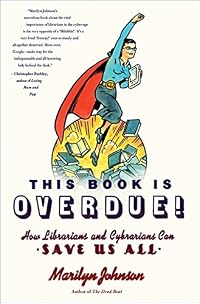
This Book is Overdue!: How Librarians and Cybrarians Can Save Us All
by Marilyn Johnson 
On This Page
Description
Language Arts. Reference. Nonfiction. Buried in information? Cross-eyed over technology? From the bottom of a pile of paper and discs, books, e-books, and scattered thumb drives comes a cry of hope: Make way for the librarians! They want to help. They're not selling a thing. And librarians know best how to beat a path through the googolplex sources of information available to us, writes Marilyn Johnson, whose previous book, The Dead Beat, breathed merry life into the obituary-writing show more profession. This Book Is Overdue! is a romp through the ranks of information professionals and a revelation for readers burned out on the cliches and stereotyping of librarians. Blunt and obscenely funny bloggers spill their stories in this book, as do a tattooed, hard-partying children's librarian; a fresh-scrubbed Catholic couple who teach missionaries to use computers; a blue-haired radical who uses her smartphone to help guide street protestors; a plethora of voluptuous avatars and cybrarians; the quiet, law-abiding librarians gagged by the FBI; and a boxing archivist. These are just a few of the visionaries Johnson captures here-pragmatic idealists who fuse the tools of the digital age with their love for the written word and the enduring values of free speech, open access, and scout-badge-quality assistance to anyone in need. Those who predicted the death of libraries forgot to consider that in the automated maze of contemporary life, none of us-neither the experts nor the hopelessly baffled-can get along without human help. And not just any help; we need librarians who won't charge us by the question or roll their eyes, no matter what we ask. Who are they? What do they know? And how quickly can they save us from being buried by the digital age? show lessTags
Recommendations









Member Recommendations
Member Reviews
One full star off for snarky reference to avoiding dog ownership and absence of similar judgment on cat-ownership's insanity.
I thoroughly enjoyed (most of) this book. It's true that I'm a recent re-convert to library usage, after many years of avoiding them because of one old prune-faced, pursey-lipped hag's humiliation of me: She wouldn't let twelve-year-old me check out Stranger in a Strange Land "because it has S-E-X in it" until my mother approved. Mama's rejoinder to that was, "Honey, so does life. If you're lucky." (Actually, she was middle-aged, plump, and wore a HUGE cross around her neck...when she was done with her mischief, I made my mother laugh by saying, "too bad it wasn't the crown of thorns.")
But the many and various show more challenges that libraries face are completely transparent to the public that uses them. We just expect that they'll keep on being there, checking books out to us, providing online resources for our kids and grandkids, being waystations for us when our own Internet connections go down or whatever. We're not fond of paying for the libraries, either, as demonstrated by the readiness of governments of all sizes to cut their acquisition, staffing, maintenance budgets to the bone and beyond, to the point of amputation.
Fortunately, The Librarian is a resolute and resilient subspecies of Homo "sapiens", and has cleverly disguised itself in some very odd places...Google "Second Life" sometime and go for a walk on the Weird Side! Lots of librarians talked to author Johnson, and told her tales of woe; but she heard paeans of praise and odes to joy, too, and reports each and all of these classes of utterance with clarity and asperity.
Libraries and librarians have moved onto the World Wide Web with verve and enthusiasm...but back in RL, things aren't so rosy. The New York Public Library's iconic building at Forty-second and Fifth will, for the first time in forty years, house a circulating library. It comes at the cost of the Asian and Russian collections, but what the hell...the money from redeveloping the Mid-Manhattan Branch's site into yet another hotel will do some good, too, right? But...and this is where I get madder than hell...can any amount of material gain make up for the loss to the culture of the world that two collections of rare, irreplaceable material objects (the papers of the Tsarist government! the contents of a monastery's library!) properly curated and indexed represent? I presume the fact that I bother to phrase the question tells you what MY answer is.
I said in another review that "{h}istory is the beautiful, brightly lit foam on top of the annihilating tsunami of the unrecorded past. History books are the spectrographic analysis of the light glinting off that foam." Yes, but I left out a key component: Without a library to house, organize, cross-reference, FIND that book, what good does the damned thing do?
Support your local library in a PRACTICAL way. And go hug a librarian. show less
I thoroughly enjoyed (most of) this book. It's true that I'm a recent re-convert to library usage, after many years of avoiding them because of one old prune-faced, pursey-lipped hag's humiliation of me: She wouldn't let twelve-year-old me check out Stranger in a Strange Land "because it has S-E-X in it" until my mother approved. Mama's rejoinder to that was, "Honey, so does life. If you're lucky." (Actually, she was middle-aged, plump, and wore a HUGE cross around her neck...when she was done with her mischief, I made my mother laugh by saying, "too bad it wasn't the crown of thorns.")
But the many and various show more challenges that libraries face are completely transparent to the public that uses them. We just expect that they'll keep on being there, checking books out to us, providing online resources for our kids and grandkids, being waystations for us when our own Internet connections go down or whatever. We're not fond of paying for the libraries, either, as demonstrated by the readiness of governments of all sizes to cut their acquisition, staffing, maintenance budgets to the bone and beyond, to the point of amputation.
Fortunately, The Librarian is a resolute and resilient subspecies of Homo "sapiens", and has cleverly disguised itself in some very odd places...Google "Second Life" sometime and go for a walk on the Weird Side! Lots of librarians talked to author Johnson, and told her tales of woe; but she heard paeans of praise and odes to joy, too, and reports each and all of these classes of utterance with clarity and asperity.
Libraries and librarians have moved onto the World Wide Web with verve and enthusiasm...but back in RL, things aren't so rosy. The New York Public Library's iconic building at Forty-second and Fifth will, for the first time in forty years, house a circulating library. It comes at the cost of the Asian and Russian collections, but what the hell...the money from redeveloping the Mid-Manhattan Branch's site into yet another hotel will do some good, too, right? But...and this is where I get madder than hell...can any amount of material gain make up for the loss to the culture of the world that two collections of rare, irreplaceable material objects (the papers of the Tsarist government! the contents of a monastery's library!) properly curated and indexed represent? I presume the fact that I bother to phrase the question tells you what MY answer is.
I said in another review that "{h}istory is the beautiful, brightly lit foam on top of the annihilating tsunami of the unrecorded past. History books are the spectrographic analysis of the light glinting off that foam." Yes, but I left out a key component: Without a library to house, organize, cross-reference, FIND that book, what good does the damned thing do?
Support your local library in a PRACTICAL way. And go hug a librarian. show less
With fascinating chapters such as "Information Sickness" and "Follow That Tattooed Librarian," Marilyn Johnson's This Book is Overdue gives the reader a quirky but informative look beyond the librarian stereotype. I am a reader who loves her county library - in fact we're on a first name basis, "The George" and I. I have always had a great appreciation for librarians, but This Book is Overdue has reinforced my belief that public libraries and the librarians who tirelessly work to bring books to the masses, are vitally important to the future of mankind.
Marilyn Johnson's This Book is Overdue illuminates the things today's librarians are doing to combat misinformation, to keep up with the latest trends in technology, to fight censorship, show more to make a difference in their communities, and quite literally, to change the world. There is so much to take in, so many aspects of libraries that I had never thought about before - the amount of information Johnson gives is a little overwhelming. Nevertheless, I think librarians could benefit from reading This Book is Overdue if only to search out new ideas to make their libraries better.
The only negative I have after reading This Book is Overdue is a lack of solid organization. With so much information and research, it is important to have a level of focus that was not achieved here. If the chapters had been tied together a bit more tightly, it might have made for a better book overall. On the whole however, This Book is Overdue is an extremely engrossing and thought-provoking look at the future of libraries and librarians. I would recommend it highly to anyone interested in the ways technology has shaped and changed the face of libraries forever. show less
Marilyn Johnson's This Book is Overdue illuminates the things today's librarians are doing to combat misinformation, to keep up with the latest trends in technology, to fight censorship, show more to make a difference in their communities, and quite literally, to change the world. There is so much to take in, so many aspects of libraries that I had never thought about before - the amount of information Johnson gives is a little overwhelming. Nevertheless, I think librarians could benefit from reading This Book is Overdue if only to search out new ideas to make their libraries better.
The only negative I have after reading This Book is Overdue is a lack of solid organization. With so much information and research, it is important to have a level of focus that was not achieved here. If the chapters had been tied together a bit more tightly, it might have made for a better book overall. On the whole however, This Book is Overdue is an extremely engrossing and thought-provoking look at the future of libraries and librarians. I would recommend it highly to anyone interested in the ways technology has shaped and changed the face of libraries forever. show less
In This Book is Overdue!: How Librarians and Cybarians Can Save Us All (Harper, 2010), Marilyn Johnson writes that she got interested in librarians while working on her previous book, The Dead Beat; she found that librarians tended to have the most interesting obituaries. The book resulting from that discovery (which, I should note, mentions librarian obituaries more than a few times) is a paean to libraries and librarians in a digital age: as Johnson writes, "In a world where information itself is a free-for-all, with traditional news sources going bankrupt and publishers in trouble, we need librarians more than ever" (p. 7). "In tight economic times, with libraries sliding farther and farther down the list of priorities, we risk the show more loss of their ideals, intelligence, and knowledge, not to mention their commitment to access for all" (p. 8). "In tough times, a librarian is a terrible thing to waste" (p. 8).
Johnson profiles the intersection between libraries and IT, using the term cybrarian "to conjure up the new breed of tech savvy-librarians, part cyborg, part cat's-eye reading glasses" (p. 9), and also uses the book to write about the wide range of library bloggers, the Connecticut Four (those who resisted the Patriot Act's "national security letter" provisions), the generation of up-and-coming "hipster librarians", the library community in Second Life, various niche libraries in New York (including the American Kennel Club library), the NYPL's digital collections and the current transformation of the research library, and the recent struggle between archival institutions for control of major authors' collections of papers.
This was fun to read, and not just because Johnson heaps praise on my field of work (and actually seems to get it, too). She's a good writer, who captures her subjects nicely here as she did in The Dead Beat. And Johnson's humorous interludes were welcome and entertaining (my favorite came in a parenthetical aside: "Someday I will stop being surprised at all the things librarians read; they'll read anything" (p. 49). It's true (to a degree), and I hope many of them will read this book and recommend it to others. I know I will.
http://philobiblos.blogspot.com/2010/03/book-review-this-book-is-overdue.html show less
Johnson profiles the intersection between libraries and IT, using the term cybrarian "to conjure up the new breed of tech savvy-librarians, part cyborg, part cat's-eye reading glasses" (p. 9), and also uses the book to write about the wide range of library bloggers, the Connecticut Four (those who resisted the Patriot Act's "national security letter" provisions), the generation of up-and-coming "hipster librarians", the library community in Second Life, various niche libraries in New York (including the American Kennel Club library), the NYPL's digital collections and the current transformation of the research library, and the recent struggle between archival institutions for control of major authors' collections of papers.
This was fun to read, and not just because Johnson heaps praise on my field of work (and actually seems to get it, too). She's a good writer, who captures her subjects nicely here as she did in The Dead Beat. And Johnson's humorous interludes were welcome and entertaining (my favorite came in a parenthetical aside: "Someday I will stop being surprised at all the things librarians read; they'll read anything" (p. 49). It's true (to a degree), and I hope many of them will read this book and recommend it to others. I know I will.
http://philobiblos.blogspot.com/2010/03/book-review-this-book-is-overdue.html show less
I enjoyed this book far more than I expected. I loathe the term "cybrarian," and figured that anyone who would use it in the book title would do little more than pimp for the new digital technologies. To my pleasant surprise, while at points she does wax over elegant, just as frequently she honestly recounts some of the negative impacts of the emerging trends within libraries. Her description of the disassembling of the research collections of the New York Public Library, in order to make room for circulating DVDs and children's programs, alone should make one question whether we don't risk losing something irreplaceably valuable in our rush to be trendy and popular.
The author writes in a vivid and engaging style, accurately capturing show more the views of the librarians she grew to know -- to call them "interviews" diminishes the care she took to grow to know her subjects. A must-read for anyone who cares about libraries. show less
The author writes in a vivid and engaging style, accurately capturing show more the views of the librarians she grew to know -- to call them "interviews" diminishes the care she took to grow to know her subjects. A must-read for anyone who cares about libraries. show less
It's a funny experience reading this book. At times you roll your eyes, but all along you're thrilled that a non-librarian took it upon herself to explore some of the interesting things going on in the field and to report what she learned with such wide-eyed fangirl enthusiasm. I particularly enjoyed the section on Radical Reference and on the Connecticut librarians who sued over their National Security Letter gag order, and for the first time got a hint of why some librarians spend so much time in Second Life (though honesty, I still don't get the fascination). A fun, fast, cheering read - and it cracked me up to get an overdue notice for THIS BOOK IS OVERDUE!
What I didn't know, but perhaps should have inferred from the book's title (This Book Is Overdue!: How Librarians and Cybrarians Can Save Us All) is the author, Marilyn Johnson, is not a librarian. The book isn't necessarily aimed at librarians, although I think there are things all librarians, readers and citizens could learn from this book. Ms. Johnson's first book is about obituaries, and she discovered librarians had absolutely fascinating obituaries and focused her next book on us. Awesome, yes? As I often confess, part of the allure of librarianship for me is being in academic environment but still able to enjoy life and have hobbies. I am not a slave to my job, although I love my job. I have work-life-love balance and show more intellectual stimulation from all three. I am lucky.
Each chapter has a different topic. Some were more interesting to me than others, and although she explores many aspects of librarianship, especially in the modern and changing sense, it's not a comprehensive book (nor is it supposed to be.) It was so refreshing to have a non-librarian not only defend the profession but praise it. Sadly, when you tell people you're in graduate school in library and information studies, they often ask why. When I respond, "being a librarian requires a master's degree," people are often dumbfounded and shocked. The exception, usually, are the people who actually have a friend or family member who is a librarian. They exclaim with joy when you say you're a library student.
If you like books, technology or organizational models at all (hello, book bloggers!), you will like this book. My one complaint? The book is mostly about public librarians. As an academic librarian, I was eager for Ms. Johnson to point out how our jobs are different. It wasn't the scope of her book, but I'd love to see a follow-up go in-depth into academic librarianship. It's a fun, informative, and fascinating read. As a librarian, it was delightful to see an outsider take an honest look at the profession. As a reader, it was a delight to read Ms. Johnson's beautiful, descriptive language. show less
Each chapter has a different topic. Some were more interesting to me than others, and although she explores many aspects of librarianship, especially in the modern and changing sense, it's not a comprehensive book (nor is it supposed to be.) It was so refreshing to have a non-librarian not only defend the profession but praise it. Sadly, when you tell people you're in graduate school in library and information studies, they often ask why. When I respond, "being a librarian requires a master's degree," people are often dumbfounded and shocked. The exception, usually, are the people who actually have a friend or family member who is a librarian. They exclaim with joy when you say you're a library student.
If you like books, technology or organizational models at all (hello, book bloggers!), you will like this book. My one complaint? The book is mostly about public librarians. As an academic librarian, I was eager for Ms. Johnson to point out how our jobs are different. It wasn't the scope of her book, but I'd love to see a follow-up go in-depth into academic librarianship. It's a fun, informative, and fascinating read. As a librarian, it was delightful to see an outsider take an honest look at the profession. As a reader, it was a delight to read Ms. Johnson's beautiful, descriptive language. show less
The author is writing like she’s wearing a librarian costume. one of those crappy, plastic jumpsuits and vacuform masks from the ‘70s, not like those of sophisticated modern cosplay, gleefully affecting what she thinks is what librarians are on the outside. In truth, it comes off as patronizing. I don’t get the impression that she is really so arrogant - it seems more naive than anything but in someone attempting to be an adult professional journalist is misplaced. The subject matter doesn’t seem to be taken seriously.
There is one passage that i think is telling. The author has just told us about a focus group that didn’t think much of libraries except as a feather in their caps. She says “they treat the library as a pair of show more eyeglasses they wear in order to look more intelligent.” i think this might describe what i’m getting from the prose style of this book.
However, she does make some good points about what librarians do and why they are important. In describing an interaction she herself had with a reference librarian, she really does seem to understand at least part of the worth of libraries and librarians when she relates how they helped her without shaming her. That they are trained to do so and understand that people do not need shaming.
Her audience, though, is a bit of a mystery to me. At times, it feels like she’s writing to people in the field and, at others, to people that know nothing about libraries. If the latter would read it, libraries might stand more of a fighting chance than they do right now. But the title doesn’t seem like it would appeal to anyone outside of librarianship and the content doesn’t lend itself to the bestseller list. She’s slouching towards Mary Roach but ends up with a pale, diet, librarian-centered version of How the Irish Saved Civilization. show less
There is one passage that i think is telling. The author has just told us about a focus group that didn’t think much of libraries except as a feather in their caps. She says “they treat the library as a pair of show more eyeglasses they wear in order to look more intelligent.” i think this might describe what i’m getting from the prose style of this book.
However, she does make some good points about what librarians do and why they are important. In describing an interaction she herself had with a reference librarian, she really does seem to understand at least part of the worth of libraries and librarians when she relates how they helped her without shaming her. That they are trained to do so and understand that people do not need shaming.
Her audience, though, is a bit of a mystery to me. At times, it feels like she’s writing to people in the field and, at others, to people that know nothing about libraries. If the latter would read it, libraries might stand more of a fighting chance than they do right now. But the title doesn’t seem like it would appeal to anyone outside of librarianship and the content doesn’t lend itself to the bestseller list. She’s slouching towards Mary Roach but ends up with a pale, diet, librarian-centered version of How the Irish Saved Civilization. show less
Members
- Recently Added By
Published Reviews
ThingScore 75
Say the word "librarian," and most people conjure up a frumpy, bespectacled woman shushing people — Marion the Librarian. The image is outdated, Marilyn Johnson argues in her impassioned celebration of librarians and archivists, cleverly titled This Book Is Overdue.
added by tim.taylor
Ms. Johnson's enthusiasm for libraries and the people who work in them is refreshingly evident throughout the book. In a charming if meandering style, she samples from her conversations with traditional librarians and with "cybrarians," a catch-all term for a generation of librarians intent on finding ways to integrate the old mission of the library with the new possibilities of technology.
added by tim.taylor
Lists

Chronological 2016
33 works; 1 member

Books Read in 2014
2,342 works; 86 members

Books Read in 2019
4,052 works; 108 members

el
1,139 works; 1 member
Author Information

3 Works 3,337 Members
Marilyn Johnson is a former editor and writer for Life, Esquire, and Outside magazines. She is the author of The Dead Beat: Lost Souls, Lucky Stiffs, and the Perverse Pleasures of Obituaries, This Book Is Overdue!: How Librarians and Cybrarians Can Save Us All, and Lives in Ruins: Archaeologists and the Seductive Lure of Human Rubble. Both The show more Dead Beat and This Book Is Overdue! received Washington Irving Book Awards. (Bowker Author Biography) show less
Marilyn Johnson is a LibraryThing Author, an author who lists their personal library on LibraryThing.
Some Editions
Common Knowledge
- Canonical title
- This Book is Overdue!: How Librarians and Cybrarians Can Save Us All
- Original publication date
- 2010-02-02
- People/Characters
- Connecticut Four
- Important places
- New York, USA; New York, New York, USA; New York Public Library, New York, New York, USA; Second Life
- Epigraph
- Show me a computer expert who gives a damn, and I'll show you a librarian.
--Patricia Wilson Berger, former president, ALA - Dedication
- To Dave and Dotty Johnson
- First words
- Down the street from the library in Deadwood, South Dakota, the peace is shattered several times a day by the noise of gunfire--just noise.
- Last words
- (Click to show. Warning: May contain spoilers.)And I knew they wouldn't disturb me until closing time.
- Publisher's editor
- Hirshey, David
- Blurbers
- Roach, Mary; Dexter, Pete; Rawlinson, Nora; Buckley, Christopher
- Original language
- English
Classifications
- Genres
- General Nonfiction, Nonfiction, Technology
- DDC/MDS
- 021.2 — Computer science, information & general works Library & information sciences Scope, usefulness and founding of libraries Library as an educator; people's university
- LCC
- Z716.4 .J64 — Bibliography, Library Science and Information Resources Libraries The collections. The books Libraries in relation to special topics
- BISAC
Statistics
- Members
- 2,086
- Popularity
- 9,846
- Reviews
- 115
- Rating
- (3.58)
- Languages
- English, French
- Media
- Paper, Audiobook, Ebook
- ISBNs
- 11
- ASINs
- 10