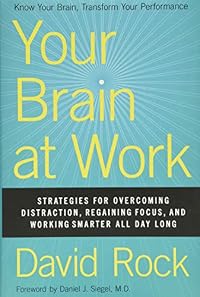
Your Brain at Work: Strategies for Overcoming Distraction, Regaining Focus, and Working Smarter All Day Long [1st Edition]
by David Rock
On This Page
Description
Meet Emily and Paul: The parents of two young children, Emily is the newly promoted VP of marketing at a large corporation while Paul works from home or from clients' offices as an independent IT consultant. Their lives, like all of ours, are filled with a bewildering blizzard of emails, phone calls, yet more emails, meetings, projects, proposals, and plans. Just staying ahead of the storm has become a seemingly insurmountable task. In this book, we travel inside Emily and Paul's brains as show more they attempt to sort the vast quantities of information they're presented with, figure out how to prioritize it, organize it and act on it. Fortunately for Emily and Paul, they're in good hands: David Rock knows how the brain works-and more specifically, how it works in a work setting. Rock shows how it's possible for Emily and Paul, and thus the reader, not only to survive in today's overwhelming work environment but succeed in it-and still feel energized and accomplished at the end of the day. YOUR BRAIN AT WORK explores issues such as: - why our brains feel so taxed, and how to maximize our mental resources - why it's so hard to focus, and how to better manage distractions - how to maximize your chance of finding insights that can solve seemingly insurmountable problems - how to keep your cool in any situation, so that you can make the best decisions possible - how to collaborate more effectively with others - why providing feedback is so difficult, and how to make it easier - how to be more effective at changing other people's behavior. show lessTags
Recommendations


















Member Reviews
Great advice but the presentation via examples made the material hard to endure. Also the examples were so extreme I found them to be a bit off-putting. They followed a pattern of saying that without the miracle techniques being presented in the book you would end up poor and unloved and it would be your own fault. But by applying the strategies from the book you would be successful in business, friendship, parenthood, and you would have more sex.
Don't get me wrong. There is undoubtable good advice in this book but results will vary. Some of the strategies will likely offend other people because they might feel that they are being manipulated. Read this book with a large pinch of salt.
Don't get me wrong. There is undoubtable good advice in this book but results will vary. Some of the strategies will likely offend other people because they might feel that they are being manipulated. Read this book with a large pinch of salt.
What good is knowledge if you can't do anything with it? Statements like we only use ten percent of our brain capacity are frustrating because they don't offer a solution for accessing the other ninety percent. Basically, what they amount to is like hearing: your brain function is roughly equivalent to that of the Geico caveman. You might as well make peace with the stultifying universe of mediocrity and ennui you're doomed to inhabit.
Then along comes a book like David Rock's Your Brain at Work and the neurons start firing all over the place. The synapses start connecting so rapidly that my shriveled cerebrum can hardly keep pace. Answers, at long last!
It's like a Christmas miracle. All over again.
In clear, concise language Rock show more explains the physiology behind our lack of focus, constant frustration and befuddlement at missed cues, lost opportunities and the sense of feeling overwhelmed. Or as an old lady shuffling down the soup aisle in my local grocery store called it, "a brain fart".
Couldn't have said it better myself.
And yet. Rock offers hope in the form of lucid metaphors that expose our "stinkin thinkin" for what it really is. His central premise is that all the brain's a stage and all the thoughts merely players. It's up to us to get the most important players on stage at any given time. And keep the least helpful players off or on for the shortest amount of time. Once the brain latches onto an unhelpful thought, it quickly spirals down into more unhelpful thoughts until we're caught in a quagmire of our own making.
Rock offers a plethora of friendly suggestions:
...become aware of your own mental energy needs and schedule accordingly. Experiment with different timings. One technique is to break work up into blocks of time based on type of brain use, rather than topic. (p. 15)
When you sense a strong emotion coming on, refocus...quickly...before the emotion takes over. (p. 118).
Playing against yourself to improve your understanding of your own brain can be a powerful way of increasing your performance (p. 200)
Chapters are structured with dual scenarios; what happens when you're on autopilot (translation: using the same old ten percent) vs what happens when you understand how the brain works and capitalize on that. Each chapter ends with (a summary) "Surprises About the Brain" and "Some Things to Try".
I've been trying them. Rock's strategies work. With continued practice the other ninety percent of my brain might kick in more frequently, increasing my chances of completing all those unfinished projects.
Hold on world, here I come. show less
Then along comes a book like David Rock's Your Brain at Work and the neurons start firing all over the place. The synapses start connecting so rapidly that my shriveled cerebrum can hardly keep pace. Answers, at long last!
It's like a Christmas miracle. All over again.
In clear, concise language Rock show more explains the physiology behind our lack of focus, constant frustration and befuddlement at missed cues, lost opportunities and the sense of feeling overwhelmed. Or as an old lady shuffling down the soup aisle in my local grocery store called it, "a brain fart".
Couldn't have said it better myself.
And yet. Rock offers hope in the form of lucid metaphors that expose our "stinkin thinkin" for what it really is. His central premise is that all the brain's a stage and all the thoughts merely players. It's up to us to get the most important players on stage at any given time. And keep the least helpful players off or on for the shortest amount of time. Once the brain latches onto an unhelpful thought, it quickly spirals down into more unhelpful thoughts until we're caught in a quagmire of our own making.
Rock offers a plethora of friendly suggestions:
...become aware of your own mental energy needs and schedule accordingly. Experiment with different timings. One technique is to break work up into blocks of time based on type of brain use, rather than topic. (p. 15)
When you sense a strong emotion coming on, refocus...quickly...before the emotion takes over. (p. 118).
Playing against yourself to improve your understanding of your own brain can be a powerful way of increasing your performance (p. 200)
Chapters are structured with dual scenarios; what happens when you're on autopilot (translation: using the same old ten percent) vs what happens when you understand how the brain works and capitalize on that. Each chapter ends with (a summary) "Surprises About the Brain" and "Some Things to Try".
I've been trying them. Rock's strategies work. With continued practice the other ninety percent of my brain might kick in more frequently, increasing my chances of completing all those unfinished projects.
Hold on world, here I come. show less
Other books go in more depth, but they lack the breadth of Your Brain at Work. I enjoyed the mix of background science with practical application. In terms of the topics covered, this book is the most comprehensive single source I have read on practical application of our understanding of how the brain work.
At first, I was skeptical of the "scenes" involving two characters, Paul and Emily, going about their day. But the scene, background, redo, recap structure worked really well for helping to cement the ideas presented in the book.
At first, I was skeptical of the "scenes" involving two characters, Paul and Emily, going about their day. But the scene, background, redo, recap structure worked really well for helping to cement the ideas presented in the book.
This is a great overview of lots of good advice in terms of focus, emotional regulation, understanding your own thought process, mindfulness etc.
What's unique about it is that it takes it from a basis of neurobiology, then brings it in to practicality, and drives it home with a little story about people struggling with everyday work problems.
Granted, this isn't the most in-depth overview of these kinds of techniques, but the format and real attempt to drive these points home to actionable techniques towards solving actual daily problems... that was something unique.
What's unique about it is that it takes it from a basis of neurobiology, then brings it in to practicality, and drives it home with a little story about people struggling with everyday work problems.
Granted, this isn't the most in-depth overview of these kinds of techniques, but the format and real attempt to drive these points home to actionable techniques towards solving actual daily problems... that was something unique.
Pleasantly surprised with this one. Saw it referenced in a webinar a few months back, looked it up and decided to put it on "the list". I wasn't keen on the actors device Rock used to bracket his point...thought them rather juvenile and distracting to the meat of the text...but I expect that he can reach a larger audience with it. Anyway, the science is good and he writes well.
Yet another take on brain science with very relatable examples - analyzing situations gone wrong from a particular family, explaining brain science rationale behind it, and then replaying the situation and showing how it could be applied to the situation to make it great. The book could have been more condensed and some of the situations seemed a bit far-fetched thus 4 stars. Great read nevertheless.
Your Brain at Work Key Idea #1: Your ability to think well is a limited resource, so conserve the resource at every opportunity.
Focus only on the most important things. Turn the recurring tasks into a habit and do them automatically without wasting brainpower.
Your Brain at Work Key Idea #2: Our attention is very easily distracted, but show more there are strategies for staying focused.
As we know from the famous marshmallow experiment, people who manage to resist distractions reap huge benefits in the long run. Distractions will pull you out of the flow state. Try to eliminate as many of them as possible.
Your Brain at Work Key Idea #3: Optimal mental performance requires just the right level of arousal of your brain.
Being alert (norepinephrine) and interested (dopamine) sharpens our focus. We need just the right amount of these chemicals in the brain. To increase the level of arousal (try imagining what will happen if you miss a deadline), write things down or take a walk to decrease it.
To increase dopamine think about the rewards of doing really great work.
Your Brain at Work Key Idea #4: Insights make it possible to overcome mental blocks that limit you to the same small set of solutions.
Sometimes we reach a mental impasse (hit a wall) when a creative solution is needed. We need the insight (which depends on the unconscious mind ) to break through it rather than conscious logical reasoning. Take a break, move, exercise, or meditate to turn off your conscious reasoning.
Your Brain at Work Key Idea #5: Mindfulness can help you focus by actually changing the structure of your brain.
To improve your brain it is important to see what's happening there and where your attention goes - mindfulness. It gets better with practice and can even alter the brain. Focusing on physical sensations, meditating, can help a lot with that.
Your Brain at Work Key Idea #6: Feelings of certainty and control are very rewarding to the brain, and you can activate these feelings yourself.
If we feel in control (have certainty) there is less stress in unexpected situations. It comes from our outlook on the situation. To have this feeling we need to interpret hard situations from another perspective - reappraise.
Your Brain at Work Key Idea #7: Regulating your expectations is key to a general feeling of happiness.
We need to manage and regulate our expectations. We can do it by having a habit to evaluate our expectations constantly. Always keep them low and you'll not be disappointed.
Your Brain at Work Key Idea #8: A feeling of relatedness to others and a sense of being treated fairly are primary rewards for the brain.
For our brain, our sense of relatedness is a crucial basic instinct, just like food. When we feel connected, our brain releases oxytocin thus decreasing stress levels. Fairness is an important part of this. In the Ultimatum game, people would reject an unfair offer even though it still would be a better outcome for them.
Your Brain at Work Key Idea #9: We are wired to feel rewarded for increases in our status, and can trick our brains into status rewards.
We're driven by how others perceive our status. If it increases, not only our happiness but also our ability to think. Increase status by finding areas where you are superior. The best way is to do it with yourself (competing from yesterday's you) and doing something better.
Your Brain at Work Key Idea #10: Feedback rarely creates positive change in others; instead, try helping them arrive at their own insights.
Feedback often is taken as a threat, the real change occurs when people see errors for themselves. A better approach is to guide/coach the person to find the issue/solution. By doing this we not only remove the threat but also increase their status (see #9). The next level is to coach them to give feedback for themselves (e.g. they should reflect on their work and iterate on their own feedback) show less
Your Brain at Work Key Idea #1: Your ability to think well is a limited resource, so conserve the resource at every opportunity.
Focus only on the most important things. Turn the recurring tasks into a habit and do them automatically without wasting brainpower.
Your Brain at Work Key Idea #2: Our attention is very easily distracted, but show more there are strategies for staying focused.
As we know from the famous marshmallow experiment, people who manage to resist distractions reap huge benefits in the long run. Distractions will pull you out of the flow state. Try to eliminate as many of them as possible.
Your Brain at Work Key Idea #3: Optimal mental performance requires just the right level of arousal of your brain.
Being alert (norepinephrine) and interested (dopamine) sharpens our focus. We need just the right amount of these chemicals in the brain. To increase the level of arousal (try imagining what will happen if you miss a deadline), write things down or take a walk to decrease it.
To increase dopamine think about the rewards of doing really great work.
Your Brain at Work Key Idea #4: Insights make it possible to overcome mental blocks that limit you to the same small set of solutions.
Sometimes we reach a mental impasse (hit a wall) when a creative solution is needed. We need the insight (which depends on the unconscious mind ) to break through it rather than conscious logical reasoning. Take a break, move, exercise, or meditate to turn off your conscious reasoning.
Your Brain at Work Key Idea #5: Mindfulness can help you focus by actually changing the structure of your brain.
To improve your brain it is important to see what's happening there and where your attention goes - mindfulness. It gets better with practice and can even alter the brain. Focusing on physical sensations, meditating, can help a lot with that.
Your Brain at Work Key Idea #6: Feelings of certainty and control are very rewarding to the brain, and you can activate these feelings yourself.
If we feel in control (have certainty) there is less stress in unexpected situations. It comes from our outlook on the situation. To have this feeling we need to interpret hard situations from another perspective - reappraise.
Your Brain at Work Key Idea #7: Regulating your expectations is key to a general feeling of happiness.
We need to manage and regulate our expectations. We can do it by having a habit to evaluate our expectations constantly. Always keep them low and you'll not be disappointed.
Your Brain at Work Key Idea #8: A feeling of relatedness to others and a sense of being treated fairly are primary rewards for the brain.
For our brain, our sense of relatedness is a crucial basic instinct, just like food. When we feel connected, our brain releases oxytocin thus decreasing stress levels. Fairness is an important part of this. In the Ultimatum game, people would reject an unfair offer even though it still would be a better outcome for them.
Your Brain at Work Key Idea #9: We are wired to feel rewarded for increases in our status, and can trick our brains into status rewards.
We're driven by how others perceive our status. If it increases, not only our happiness but also our ability to think. Increase status by finding areas where you are superior. The best way is to do it with yourself (competing from yesterday's you) and doing something better.
Your Brain at Work Key Idea #10: Feedback rarely creates positive change in others; instead, try helping them arrive at their own insights.
Feedback often is taken as a threat, the real change occurs when people see errors for themselves. A better approach is to guide/coach the person to find the issue/solution. By doing this we not only remove the threat but also increase their status (see #9). The next level is to coach them to give feedback for themselves (e.g. they should reflect on their work and iterate on their own feedback) show less
David Rock has written an entertaining book with immediately practical application for one's working and non-working relationships. He has synthesized much of the latest neuroscience, applying it, in particular and in a heretofore unique way to improving one's use of one's brain/mind, in working situations.
That the eminent neuroscientist and mightsight expert, Daniel J. Siegel, M.D., wrote the Forward for the book is further testimony to the quality of David Rock's synthesis and application of the concepts.
Mindfulness is a key concept of the book - using one's "director" to observe one's mental processes and that the neuroscience explains how this works to improve ones mental functioning while at work.
I was, at first, concerned when I show more read that David Rock had structured the book like a "play" with"acts", thinking that such a construct would only distract and/or add "filler" to the concepts. However, I found that after reading only a few pages, I immediately liked his use of the play, because he did this so well. Furthermore, as David Rock points out (and I believe Daniel Siegel would agree) the brain "likes" stories, which help integration in the mind/brain. show less
That the eminent neuroscientist and mightsight expert, Daniel J. Siegel, M.D., wrote the Forward for the book is further testimony to the quality of David Rock's synthesis and application of the concepts.
Mindfulness is a key concept of the book - using one's "director" to observe one's mental processes and that the neuroscience explains how this works to improve ones mental functioning while at work.
I was, at first, concerned when I show more read that David Rock had structured the book like a "play" with"acts", thinking that such a construct would only distract and/or add "filler" to the concepts. However, I found that after reading only a few pages, I immediately liked his use of the play, because he did this so well. Furthermore, as David Rock points out (and I believe Daniel Siegel would agree) the brain "likes" stories, which help integration in the mind/brain. show less
Members
- Recently Added By
Author Information

All Editions
Awards and Honors
Common Knowledge
- Canonical title
- Your Brain at Work: Strategies for Overcoming Distraction, Regaining Focus, and Working Smarter All Day Long [1st Edition]
- Original publication date
- 2009
Classifications
Statistics
- Members
- 633
- Popularity
- 45,657
- Reviews
- 19
- Rating
- (4.09)
- Languages
- 7 — Chinese, English, French, German, Polish, Russian, Swedish
- Media
- Paper, Audiobook, Ebook
- ISBNs
- 19
- UPCs
- 2
- ASINs
- 3