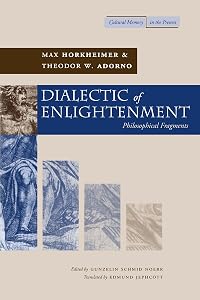
Dialectic of Enlightenment
by Max Horkheimer, Theodor W. Adorno
On This Page
Description
Dialectic of Enlightenment is undoubtedly the most influential publication of the Frankfurt School of Critical Theory. Written during the Second World War and circulated privately, it appeared in a printed edition in Amsterdam in 1947. "What we had set out to do," the authors write in the Preface, "was nothing less than to explain why humanity, instead of entering a truly human state, is sinking into a new kind of barbarism." Yet the work goes far beyond a mere critique of contemporary show more events. Historically remote developments, indeed, the birth of Western history and of subjectivity itself out of the struggle against natural forces, as represented in myths, are connected in a wide arch to the most threatening experiences of the present. The book consists in five chapters, at first glance unconnected, together with a number of shorter notes. The various analyses concern such phenomena as the detachment of science from practical life, formalized morality, the manipulative nature of entertainment culture, and a paranoid behavioral structure, expressed in aggressive anti-Semitism, that marks the limits of enlightenment. The authors perceive a common element in these phenomena, the tendency toward self-destruction of the guiding criteria inherent in enlightenment thought from the beginning. Using historical analyses to elucidate the present, they show, against the background of a prehistory of subjectivity, why the National Socialist terror was not an aberration of modern history but was rooted deeply in the fundamental characteristics of Western civilization. Adorno and Horkheimer see the self-destruction of Western reason as grounded in a historical and fateful dialectic between the domination of external nature and society. They trace enlightenment, which split these spheres apart, back to its mythical roots. Enlightenment and myth, therefore, are not irreconcilable opposites, but dialectically mediated qualities of both real and intellectual life. "Myth is already enlightenment, and enlightenment reverts to mythology." This paradox is the fundamental thesis of the book. This new translation, based on the text in the complete edition of the works of Max Horkheimer, contains textual variants, commentary upon them, and an editorial discussion of the position of this work in the development of Critical Theory. show lessTags
Recommendations


















Member Recommendations
Member Reviews
Writing in the immediate wake of Nazi rule, Horkheimer and Adorno ask how Enlightened Western civilizations turn to fascism. Their answer that the Enlightenment mindset itself has totalitarian elements and that strict rationality's uncompromising nature creates a trap that forces us to participate in our own oppression.
Horkheimer & Adorno's pessimism can easily be excused, as can their missed calls on jazz music and Hollywood film. But in the end, their overarching narrative reaches too far, sees no hope, and turns absurd as even Donald Duck is seen as an instrument of totalitarianism.
Horkheimer & Adorno's pessimism can easily be excused, as can their missed calls on jazz music and Hollywood film. But in the end, their overarching narrative reaches too far, sees no hope, and turns absurd as even Donald Duck is seen as an instrument of totalitarianism.
Three things I love here, above all else: a) the collaboration, and the refusal to disentangle themselves from it when others demanded that Horkorno coalesce into two identities: of course reminds me of Deleuze and Guattari, but, for a medievalist, also Marty Shichtman and Laurie Finke; b) the refusal to update the text to reflect the current moment: in this insistence on preserving the text as an intervention into a particular historical moment, Adorneimer refuse to pretend to speak from a position of atemporality ("We do not stand by everything we said in the book in its original form. That would be incompatible with a theory which attributes a temporal core to truth")--this helps account for the problems with their famous Culture show more Industry chapter, which, even before the 'New Media,' could have grappled with, for example, samizdat; c) the antisemitism essay, and here, I'm totally annoyed with Zizek, 'Republics of Gilead,' and so on, for not doing our thinkers the honor of acknowledging that in many ways, they got there first. But I suppose in honoring the Frankfurt school, SZ would accidentally honor Habermas...or he's just plain sloppy.
A favorite passage:
"What many individual things have in common, or what constantly recurs in one individual thing, needs not be more stable, eternal, or deep than the particular. The scale of categories is not the same as that of significance....The world is unique. The mere repetition in speech of moments which occur again and again in the same form bears more resemblance to a futile, compulsive litany than to the redeeming world. Classification is a condition of knowledge, not knowledge itself, and knowledge in turn dissolves classification" (182).
Overall, given my current interests--for readers of the blog, see my stuff on Shakespeare 'The Phoenix and Turtle'--this critique of Reason is perfect. show less
A favorite passage:
"What many individual things have in common, or what constantly recurs in one individual thing, needs not be more stable, eternal, or deep than the particular. The scale of categories is not the same as that of significance....The world is unique. The mere repetition in speech of moments which occur again and again in the same form bears more resemblance to a futile, compulsive litany than to the redeeming world. Classification is a condition of knowledge, not knowledge itself, and knowledge in turn dissolves classification" (182).
Overall, given my current interests--for readers of the blog, see my stuff on Shakespeare 'The Phoenix and Turtle'--this critique of Reason is perfect. show less
Who's one of my greatest forms of literary/critical theoretical solace? Theodor Adorno (and let's not forget Max Horkheimer). Minima Moralia is still my favorite of his, but this fine volume is chock full of fantastic discussions. Just a few talking points and/or clever observations:
* On Odysseus' reaction to Penelope's test to see whether the guy she thinks is her husband really is so: "... her husband answers her with a detailed account of his longlasting piece of woodwork. He is the prototypical bourgeois-- the with-it hobbyist." ("Odyssues or Myth and Enlightenment")
* "...compassion is always inadequate...compassion renounces the transformation of the whole." (Juliette or Enlightenment and Morality)
* On the culture industry (and show more I'll include cell phones, Facebook, etc., therein): "What is decisive today is... the necessity inherent in the system not to leave the customer alone, not for a moment to allow him any suspicion that resistance is possible... Not only does it make him believe that the deception it practices is satisfaction, but it goes further and implies that, whatever the state of affairs, he must put up with what is offered." ("The Culture Industry: Enlightenment as Mass Deception") show less
* On Odysseus' reaction to Penelope's test to see whether the guy she thinks is her husband really is so: "... her husband answers her with a detailed account of his longlasting piece of woodwork. He is the prototypical bourgeois-- the with-it hobbyist." ("Odyssues or Myth and Enlightenment")
* "...compassion is always inadequate...compassion renounces the transformation of the whole." (Juliette or Enlightenment and Morality)
* On the culture industry (and show more I'll include cell phones, Facebook, etc., therein): "What is decisive today is... the necessity inherent in the system not to leave the customer alone, not for a moment to allow him any suspicion that resistance is possible... Not only does it make him believe that the deception it practices is satisfaction, but it goes further and implies that, whatever the state of affairs, he must put up with what is offered." ("The Culture Industry: Enlightenment as Mass Deception") show less
Scritto nel 1944, va letto soprattutto come reazione alle dittature fasciste, ed è a esse che va sempre legata la critica della distorsione e decadenza degli ideali lluministici. La parte migliore e più forte del libro resta ancora oggi quella dedicata all'industria culturale (espressione che qui compare per la prima volta). Più deboli, in particolare, le parti legate al mito di Odisseo e quella sull'antisemitismo. Molto intelligente quella su Sade.
Pure and hearty intellectual soup. The density of some of the passages often insist on a double- or even triple-read, but Dialectic of Enlightenment is a goldmine of intellectual thought that's sure to enrich and reorganize some of your thinking. Would highly recommend reading, but actively, as I don't think an inactive or passive read would be very enjoyable here.
Max Horkheimer and Theodor Adorno, both prominents of the Frankfurter Schule of critical theory, wrote this work during WWII. In their own words, the purpose of the book was to explain why humanity, instead of entering a truly human state, is sinking into a new kind of barbarism. Obviously their experiences as Jewish intellectuals fleeing for the national-socialist regime to the United States was a strong impulse for this view, but the book is not limited to a critique of nazism or even totalitarianism altogether.
The main subject of the book, though that itself is already difficult to disentangle, is Enlightenment's betrayal of its own liberating capacity. Adorno & Horkheimer analyze this by means of various cultural metaphors, which show more in highly abstract, contradictory and aesthetic language (especially the parts by Adorno) trace the development of Enlightenment and its subsequent 'dark side' throughout an equally metaphorical history of culture and ideas. In a certain sense this may most remind readers not familiar with both authors of Foucault and his use of concepts like the Panopticon to express a view of power relations. The method of Adorno and Horkheimer is however not so much genealogical, as Foucault's is, as dialectical in its idealist form.
The book consists of an introduction, two "excursions" and two chapters on the Enlightenment itself, as well as a series of aphorisms provided at the end as "notes and sketches". Each part of the book consists of a very abstract, very metaphysical and almost entrancing analysis of, in turn, the development of Enlightenment as myth out of earlier myth, the form of modern Enlightenment as instrumental reason and mass deception, and the limits of Enlightenment to its own rationality, in the form of anti-semitism. The language of the book is extremely difficult, even in English, and in the best (and worst) traditions of continental philosophy it contains a very great amount of layers and meanings, not all of which are free of internal contradiction. Readers familiar to Situationist works are perhaps best prepared for the effect, which is somewhat similar in method, if not in style, to Guy Debord.
The introduction, "The Concept of Enlightenment", posits Enlightenment as thought liberating man from his natural shackles, and creating man as master of the earth. This process of liberation entails at the same time the possibility of man to protect himself from, and understand the workings of, nature, and also mankind's loss of being one with nature. In this process, the self is created as a subjectivity divorced from direct experience of the outside world. Man's memory of this is very vague and distant, but is present in everyone as a certain inchoate feeling of loss.
This is also the main subject of the first Exkurs, "Odysseus, or Myth and Enlightenment". The story of the Odysseia is here used in many ways to provide metaphorical expressions for the role of myth in and against Enlightenment. Myths are primitive descriptions of the world, and in being so are already classifications used as a form of instrumental reason, which is the seed of Enlightenment. The role of sacrifice to the Gods, for example, is presented as manipulation of those Gods, and in so doing already expression of an Enlightened mind avant la lettre. Odysseus' adventure with the Sirens is metaphor for man's loss as described above: Odysseus, the Enlightened ruler, knows his loss but is constrained by his knowledge from acting on it; and the shipmates, the great mass of modernity, is only vaguely aware of the loss, and are not affected. But Circe, the Cyclops, and many other themes are used besides.
The second Exkurs is "Juliette, or Enlightenment and Morality". The works of De Sade, in particular Juliette, here provide an expression of Enlightenments freeing and therefore contradictory character. Kant is contrasted with Juliette; where Kant is the restrained form of reason, reason as classifying and ordening power, Juliette is reason's destructive power of old orders. Because Enlightenment destroys the validity of any appeal to tradition, religion, etc., it falls pray to itself, in that Enlightenment's appeal to its own absolute values is undermined, in the same way that Juliette uses and is used by Catholicism in undermining it.
The third chapter is "Enlightenment as Mass Deception", covering the subject of the culture industry. Here Adorno rants against all the vapid and degraded culture forms he perceives in the United States, although he never states it as valid only for the US, of course. There are many interesting insights and observations about modern culture and still valid ones too in this chapter, but Adorno's general tone is that of the "hochbürgerliche" bourgeois annoyed about the offenses against good taste he sees. Yet to dismiss it based on that would be superficial, even if we cannot agree with Adorno's hatred for radio and jazz. His observations on American movies are very poignant, and in between his cultural criticism he hits on certain relations between the capitalist mode of production, its Enlightenment ideology, and the cultural superstructure that are very worthwhile for a patient radical.
The fourth chapter is called "Limits of Enlightenment", and addresses directly the subject of anti-semitism and fascism more generally. Fascism is posited as Enlightenment turned against itself (it must be noted Adorno & Horkheimer were among the first to state this, even if it is somewhat of a cliche now). Enlightenment's general instrumental reason knows only power as a measure of behavior. Therefore, it cannot tolerate the existence of groups that thrive, yet never have power, such as Jews and women. Whenever Enlightened society fails to satisfy the needs of its members, their anger is turned against such groups.
The last chapter, "Notes and Sketches", is as said a series of aphorisms, familiar to people who have read situationist works, or for example Walter Benjamin's notebooks.
Overall, this book is an extremely complex, but very worthwhile philosophical critique of modern culture, and a very pessimistic and negative analysis of Enlightenment and its possibilities. It is hard work to get to the bottom of it, but nevertheless rewarding for any student of philosophy. show less
The main subject of the book, though that itself is already difficult to disentangle, is Enlightenment's betrayal of its own liberating capacity. Adorno & Horkheimer analyze this by means of various cultural metaphors, which show more in highly abstract, contradictory and aesthetic language (especially the parts by Adorno) trace the development of Enlightenment and its subsequent 'dark side' throughout an equally metaphorical history of culture and ideas. In a certain sense this may most remind readers not familiar with both authors of Foucault and his use of concepts like the Panopticon to express a view of power relations. The method of Adorno and Horkheimer is however not so much genealogical, as Foucault's is, as dialectical in its idealist form.
The book consists of an introduction, two "excursions" and two chapters on the Enlightenment itself, as well as a series of aphorisms provided at the end as "notes and sketches". Each part of the book consists of a very abstract, very metaphysical and almost entrancing analysis of, in turn, the development of Enlightenment as myth out of earlier myth, the form of modern Enlightenment as instrumental reason and mass deception, and the limits of Enlightenment to its own rationality, in the form of anti-semitism. The language of the book is extremely difficult, even in English, and in the best (and worst) traditions of continental philosophy it contains a very great amount of layers and meanings, not all of which are free of internal contradiction. Readers familiar to Situationist works are perhaps best prepared for the effect, which is somewhat similar in method, if not in style, to Guy Debord.
The introduction, "The Concept of Enlightenment", posits Enlightenment as thought liberating man from his natural shackles, and creating man as master of the earth. This process of liberation entails at the same time the possibility of man to protect himself from, and understand the workings of, nature, and also mankind's loss of being one with nature. In this process, the self is created as a subjectivity divorced from direct experience of the outside world. Man's memory of this is very vague and distant, but is present in everyone as a certain inchoate feeling of loss.
This is also the main subject of the first Exkurs, "Odysseus, or Myth and Enlightenment". The story of the Odysseia is here used in many ways to provide metaphorical expressions for the role of myth in and against Enlightenment. Myths are primitive descriptions of the world, and in being so are already classifications used as a form of instrumental reason, which is the seed of Enlightenment. The role of sacrifice to the Gods, for example, is presented as manipulation of those Gods, and in so doing already expression of an Enlightened mind avant la lettre. Odysseus' adventure with the Sirens is metaphor for man's loss as described above: Odysseus, the Enlightened ruler, knows his loss but is constrained by his knowledge from acting on it; and the shipmates, the great mass of modernity, is only vaguely aware of the loss, and are not affected. But Circe, the Cyclops, and many other themes are used besides.
The second Exkurs is "Juliette, or Enlightenment and Morality". The works of De Sade, in particular Juliette, here provide an expression of Enlightenments freeing and therefore contradictory character. Kant is contrasted with Juliette; where Kant is the restrained form of reason, reason as classifying and ordening power, Juliette is reason's destructive power of old orders. Because Enlightenment destroys the validity of any appeal to tradition, religion, etc., it falls pray to itself, in that Enlightenment's appeal to its own absolute values is undermined, in the same way that Juliette uses and is used by Catholicism in undermining it.
The third chapter is "Enlightenment as Mass Deception", covering the subject of the culture industry. Here Adorno rants against all the vapid and degraded culture forms he perceives in the United States, although he never states it as valid only for the US, of course. There are many interesting insights and observations about modern culture and still valid ones too in this chapter, but Adorno's general tone is that of the "hochbürgerliche" bourgeois annoyed about the offenses against good taste he sees. Yet to dismiss it based on that would be superficial, even if we cannot agree with Adorno's hatred for radio and jazz. His observations on American movies are very poignant, and in between his cultural criticism he hits on certain relations between the capitalist mode of production, its Enlightenment ideology, and the cultural superstructure that are very worthwhile for a patient radical.
The fourth chapter is called "Limits of Enlightenment", and addresses directly the subject of anti-semitism and fascism more generally. Fascism is posited as Enlightenment turned against itself (it must be noted Adorno & Horkheimer were among the first to state this, even if it is somewhat of a cliche now). Enlightenment's general instrumental reason knows only power as a measure of behavior. Therefore, it cannot tolerate the existence of groups that thrive, yet never have power, such as Jews and women. Whenever Enlightened society fails to satisfy the needs of its members, their anger is turned against such groups.
The last chapter, "Notes and Sketches", is as said a series of aphorisms, familiar to people who have read situationist works, or for example Walter Benjamin's notebooks.
Overall, this book is an extremely complex, but very worthwhile philosophical critique of modern culture, and a very pessimistic and negative analysis of Enlightenment and its possibilities. It is hard work to get to the bottom of it, but nevertheless rewarding for any student of philosophy. show less
A difficult but worthwhile book, Dialectic of Enlightenment is unavoidable reading for anyone interested in modern social theory and critique, and in the heritage of the Enlightenment. Adorno and Horkheimer engage significantly with myth and epic (particularly--almost exclusively, in fact--the Odyssey), the works of the Marquis de Sade, and Nietzsche. The book finishes with some notes/drafts which are also very interesting, and helpful for working out the role A&H see for philosophy, "thought," critique, and politics; also some worthwhile reflections on the animal/human distinction.
Members
- Recently Added By
Lists

Books Referenced by Izetbegovic's Islam Between East and West
233 works; 2 members

Blindpill
20 works; 2 members

Books Cited in Wasteland by W. Scott Poole
120 works; 1 member
Author Information

127+ Works 3,971 Members
Max Horkheimer (1895-1973) was a philosopher and sociologist. He was a key member of the Frankfurt Institute for Social Research and famously collaborated with Theodor Adorno on the influential work The Dialectic of Enlightenment.

324+ Works 14,312 Members
Theodor W. Adorno is the progenitor of critical theory, a central figure in aesthetics, and the century's foremost philosopher of music. He was born and educated in Frankfurt, Germany. After completing his Ph.D. in philosophy, he went to Vienna, where he studied composition with Alban Berg. He soon was bitterly disappointed with his own lack of show more talent and turned to musicology. In 1928 Adorno returned to Frankfurt to join the Institute for Social Research, commonly known as The Frankfurt School. At first a privately endowed center for Marxist studies, the school was merged with Frankfort's university under Adorno's directorship in the 1950s. As a refugee from Nazi Germany during World War II, Adorno lived for several years in Los Angeles before returning to Frankfurt. Much of his most significant work was produced at that time. Critics find Adorno's aesthetics to be rich in insight, even when they disagree with its broad conclusions. Although Adorno was hostile to jazz and popular music, he advanced the cause of contemporary music by writing seminal studies of many key composers. To the distress of some of his admirers, he remained pessimistic about the prospects for art in mass society. Adorno was a neo-Marxist who believed that the only hope for democracy was to be found in an interpretation of Marxism opposed to both positivism and dogmatic materialism. His opposition to positivisim and advocacy of a method of dialectics grounded in critical rationalism propelled him into intellectual conflict with Georg Hegel, Martin Heidegger, and Heideggerian hermeneutics. (Bowker Author Biography) show less
Some Editions
Awards and Honors
Series
Belongs to Publisher Series
Work Relationships
Common Knowledge
- Canonical title
- Dialectic of Enlightenment
- Original title
- Dialektik der Aufklärung: Philosophische Fragmente
- Original publication date
- 1947
- Dedication*
- Voor Friedrich Pollock
- First words
- Enlightenment, understood in the widest sense as the advance of thought, has always aimed at liberating human beings from fear and installing them as masters.
- Last words
- (Click to show. Warning: May contain spoilers.)Like the genera within the series of fauna, the intellectual gradations within the human species, indeed, the blind spots within the same individual, mark the points where hope has come to a halt and in their ossification bear witness to what holds all living things in thrall.
- Original language
- German
- Canonical DDC/MDS
- 193
*Some information comes from Common Knowledge in other languages. Click "Edit" for more information.
Classifications
- Genres
- Philosophy, Nonfiction, Sociology, Literature Studies and Criticism, General Nonfiction
- DDC/MDS
- 193 — Philosophy & psychology Modern western philosophy Philosophy of Germany and Austria
- LCC
- B3279 .H8473 .P513 — Philosophy, Psychology and Religion Philosophy (General) By period Modern By region or country
- BISAC
Statistics
- Members
- 2,479
- Popularity
- 7,793
- Reviews
- 22
- Rating
- (4.10)
- Languages
- 19 — Chinese, Czech, Danish, Dutch, English, Estonian, Finnish, French, German, Hungarian, Italian, Korean, Lithuanian, Norwegian (Bokmål), Polish, Portuguese, Spanish, Swedish, Turkish
- Media
- Paper, Ebook
- ISBNs
- 75
- UPCs
- 1
- ASINs
- 20