
On This Page
Description
The man on the moon was dead. They called him Charlie. He had big eyes, abundant body hair, and fairly long nostrils. His skeletal body was found clad in a bright red spacesuit, hidden in a rocky grave. They didn't know who he was, how he got there, or what had killed him. All they knew was that his corpse was fifty thousand years old-and that meant this man had somehow lived long before he ever could have existed.Tags
Recommendations






















Member Reviews
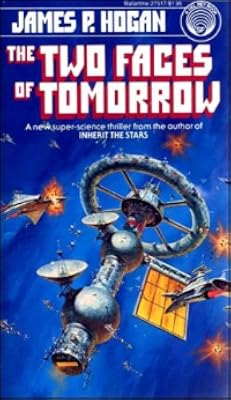
A sleeper classic, somewhat misrepresented by the pulp-ish packaging. In many ways, this reads better to me now than when I first read it decades ago. Yeah, there's the Unidentified Anomaly (the dead guy), the BDO (alien ship on Ganymede), arguing specialists of many stripes, and plenty of sense-of-wonder cues to make a good pulp, but Hogan did go a couple steps further here.
First, a couple of counter-indications. The frequent smoking, even on spaceships and in computing centers, is a really dated and awkward detail. Also, the chauvinistic lack of women in any professional role is partly anachronistic and partly just creepy. So, it seems JPH was truly a bloke of his generation all around: cigars and scotch for all the guys!
On the other show more hand, his presentation of what are effectively lap-top computers, on-line purchasing, and multinational corporations funding interdisciplinary research teams were pretty forward-thinking for 1977. Best of all, for me at least, was the focus throughout of scientists and administrators behaving right. Scientists get territorial and defensive, even punchy, about their theories and conclusions; teams reduplicate work because they weren't communicating across the hall, arguments go on and on. Like real research or conferences! And though there have been advances in all fields since the late 1970s, Hogan's presentation of evolution, physics, and linguistic reconstruction are pretty much bang on. I might not be fully at home with his attitudes, but he did his homework, and wrote science admin as he'd lived it.
There's a 50,000 year old dead guy on the moon, evidence of aliens in the Solar System, and human bases on a number of other worlds, but the real theme of this book is the researchers working the problem. That doesn't get old. show less
First, a couple of counter-indications. The frequent smoking, even on spaceships and in computing centers, is a really dated and awkward detail. Also, the chauvinistic lack of women in any professional role is partly anachronistic and partly just creepy. So, it seems JPH was truly a bloke of his generation all around: cigars and scotch for all the guys!
On the other show more hand, his presentation of what are effectively lap-top computers, on-line purchasing, and multinational corporations funding interdisciplinary research teams were pretty forward-thinking for 1977. Best of all, for me at least, was the focus throughout of scientists and administrators behaving right. Scientists get territorial and defensive, even punchy, about their theories and conclusions; teams reduplicate work because they weren't communicating across the hall, arguments go on and on. Like real research or conferences! And though there have been advances in all fields since the late 1970s, Hogan's presentation of evolution, physics, and linguistic reconstruction are pretty much bang on. I might not be fully at home with his attitudes, but he did his homework, and wrote science admin as he'd lived it.
There's a 50,000 year old dead guy on the moon, evidence of aliens in the Solar System, and human bases on a number of other worlds, but the real theme of this book is the researchers working the problem. That doesn't get old. show less
A team of scientists investigates a 50,000-year-old human corpse discovered on the Moon. Through methodical deduction, they unravel an epic mystery, rewriting the origins of humanity and a lost planetary civilization.
In 2027, a lunar mission discovers a well-preserved human astronaut in a bright red spacesuit hidden in a rocky grave. Nicknamed Charlie, testing reveals the body is exactly 50,000 years old. The mystery deepens because early humans 50,000 years ago lacked space travel technology, and anatomical tests show he did not evolve on Earth.
Led by UN scientist Victor Hunt and a multidisciplinary team, researchers work collaboratively to test, debate, and analyze clues. Every time they develop a theory about Charlie, new discoveries show more contradict it, forcing them to look for larger, systemic answers.
Through forensic analysis, archaeological findings, and the discovery of an ancient alien ship on the moon Ganymede, the scientists piece together the history of our solar system. Planet Minerva: 50,000 years ago, a human-like civilization lived on the planet that once orbited between Mars and Jupiter.
A global nuclear war over scarce resources caused Minerva to explode, creating the Asteroid Belt. Charlie was a Lunarian, an inhabitant of Minerva's moon, whose ship crash-landed on Earth's moon. The Minervans were actually the descendants of ancient humans who were transported to Minerva from Earth millions of years ago by mysterious, highly advanced aliens. show less
In 2027, a lunar mission discovers a well-preserved human astronaut in a bright red spacesuit hidden in a rocky grave. Nicknamed Charlie, testing reveals the body is exactly 50,000 years old. The mystery deepens because early humans 50,000 years ago lacked space travel technology, and anatomical tests show he did not evolve on Earth.
Led by UN scientist Victor Hunt and a multidisciplinary team, researchers work collaboratively to test, debate, and analyze clues. Every time they develop a theory about Charlie, new discoveries show more contradict it, forcing them to look for larger, systemic answers.
Through forensic analysis, archaeological findings, and the discovery of an ancient alien ship on the moon Ganymede, the scientists piece together the history of our solar system. Planet Minerva: 50,000 years ago, a human-like civilization lived on the planet that once orbited between Mars and Jupiter.
A global nuclear war over scarce resources caused Minerva to explode, creating the Asteroid Belt. Charlie was a Lunarian, an inhabitant of Minerva's moon, whose ship crash-landed on Earth's moon. The Minervans were actually the descendants of ancient humans who were transported to Minerva from Earth millions of years ago by mysterious, highly advanced aliens. show less
This book felt dated in a lot of different ways. First of all, it carries a refreshing optimism about humanity's ability to cooperate and put war behind them, which most modern sci fi has a hard time doing. Second, is the occasional reference to specific technologies or companies -- "The DEC minicomputer in the nose made contact with its IBM big brother [...]". The third is the degree to which outdated ideas of gender roles (and smoking) permeate much of the book.
At times I liked the detail with which it explored the resolution of the various mysteries, but the dedication to avoiding hand-waving frequently led to the clues or solutions feeling really improbable.
The book is wholly dedicated to this mystery-solving premise, to the show more exclusion of much plot, character development or relationships. If you happen to guess the solution ahead of time, you're in for a lot of predictable exposition before you can move on to the next thing.
It might be a coincidence but this is the (audio) book I've fallen asleep to the most so far this year. show less
At times I liked the detail with which it explored the resolution of the various mysteries, but the dedication to avoiding hand-waving frequently led to the clues or solutions feeling really improbable.
The book is wholly dedicated to this mystery-solving premise, to the show more exclusion of much plot, character development or relationships. If you happen to guess the solution ahead of time, you're in for a lot of predictable exposition before you can move on to the next thing.
It might be a coincidence but this is the (audio) book I've fallen asleep to the most so far this year. show less
Sometimes the old pulpy science fiction is really fun and good, and sometimes it just falls flat. Inherit the Stars is a case of the latter. Not so bad that I’ll never read another Hogan again, but enough to make me wary. Take a non-original idea about human origins, then have lackluster scientist-like characters dole it out in little pieces so it can all be tied together with a big let-down of a revelation on the last page. The real problem with the book though is that every single paragraph should have started with "As you know Bob…"
Full review at my blog: http://reading.kingrat.biz/reviews/inherit-the-stars-james-hogan
Full review at my blog: http://reading.kingrat.biz/reviews/inherit-the-stars-james-hogan
Inherit the Stars is a book I bought for its early paperback cover, which shows two space-suited figures digging a skeleton, also in a spacesuit, out of the Lunar regolith. I was amused by the case it makes for ancient human astronauts. The cover scene, Hogan admitted, was inspired by the obelisk in 2001: A Space Odyssey.
One is never sure how seriously we are meant to take the xenoarchaeology here. According to his Wikipedia page, Hogan never met a contrarian argument he didn’t like, but the book reads well, even if you don’t take the arguments seriously.
One is never sure how seriously we are meant to take the xenoarchaeology here. According to his Wikipedia page, Hogan never met a contrarian argument he didn’t like, but the book reads well, even if you don’t take the arguments seriously.
Published in 1977, this novel is set in a twenty-first century which now looks wildly over-optimistic: worldwide demilitarisation, no environmental crises or religious fanaticism; instead, increasing global prosperity and all the collective talent and energy formerly wasted on the military (brains and technical expertise, the enthusiasm of youth and experience of age) now being channelled into purer pursuits—including manned exploration of the entire Solar System. Ahh, if only!
The story begins at a company called Metadyne, where they’ve developed a device called the Trimagniscope which can produce magnified 3D colour images of the insides of any objects without cutting them open. They’ve been gaining an international show more reputation, but then one day are given an assignment which will test this device to its limits: a dessicated body, apparently human, has been found in a ravine on the Moon, a few miles from one of the new scientific bases. Shipped to Earth and radiocarbon-dated, it turns out to have been lying there for fifty-thousand years. There’s also its spacesuit, a range of equipment—and, in one knee-pocket, a small book far too fragile to open. Perhaps the Trimagniscope, though, can discover what’s written on its pages…
This is a lovely idea to start from, and immediately I was thinking: ancient aliens? Or time travellers? The truth, though, turned out to be much more convoluted—improbably convoluted, and some of the science a bit dodgy too, to say the least. Also, if you’re one of those people who throw their hands in the air screaming, “Info-dump! Info-dump!” you won’t like this book one bit.
I did like it. The writing itself is pretty laboured at times, and (unless it went completely over my head) I don’t think there’s anything deep here either, but it’s an entertaining read for all that. show less
The story begins at a company called Metadyne, where they’ve developed a device called the Trimagniscope which can produce magnified 3D colour images of the insides of any objects without cutting them open. They’ve been gaining an international show more reputation, but then one day are given an assignment which will test this device to its limits: a dessicated body, apparently human, has been found in a ravine on the Moon, a few miles from one of the new scientific bases. Shipped to Earth and radiocarbon-dated, it turns out to have been lying there for fifty-thousand years. There’s also its spacesuit, a range of equipment—and, in one knee-pocket, a small book far too fragile to open. Perhaps the Trimagniscope, though, can discover what’s written on its pages…
This is a lovely idea to start from, and immediately I was thinking: ancient aliens? Or time travellers? The truth, though, turned out to be much more convoluted—improbably convoluted, and some of the science a bit dodgy too, to say the least. Also, if you’re one of those people who throw their hands in the air screaming, “Info-dump! Info-dump!” you won’t like this book one bit.
I did like it. The writing itself is pretty laboured at times, and (unless it went completely over my head) I don’t think there’s anything deep here either, but it’s an entertaining read for all that. show less
This was Hogan's first book, and he started out with a bang.
The writing is somewhat clumsy, the characters are not all that interesting, but the ideas and the story are fascinating. What Hogan does well, here and in other novels, is to take some wild pseudoscientific idea and ask what would happen if it actually were true. This one is in the form of an extremely intriguing mystery. It is well thought ought, plausible given the premise, all the clues are there, but you don't see it until the end. In other words, exactly like a good mystery, though in this case nobody gets shot (at least in the story timeline), nobody is doing anything particularly wrong, but there is a huge mystery nonetheless.
The writing is somewhat clumsy, the characters are not all that interesting, but the ideas and the story are fascinating. What Hogan does well, here and in other novels, is to take some wild pseudoscientific idea and ask what would happen if it actually were true. This one is in the form of an extremely intriguing mystery. It is well thought ought, plausible given the premise, all the clues are there, but you don't see it until the end. In other words, exactly like a good mystery, though in this case nobody gets shot (at least in the story timeline), nobody is doing anything particularly wrong, but there is a huge mystery nonetheless.
Members
- Recently Added By
Lists

Books Read in 2023
5,638 works; 147 members

Tozai Mystery Best 100 | The Top 100 Mystery Novels
111 works; 3 members

Linguistics in Science Fiction
27 works; 4 members

Favorite Science Fiction
457 works; 223 members
Author Information

James P. Hogan was born in London on June 27, 1941. He left school at the age of sixteen and eventually began an intensive, broad-based five-year program at the Royal Aircraft Establishment covering the practical and theoretical sides of electrical, electronic, and mechanical engineering. He worked as a design engineer for several companies before show more moving to sales. He started writing science fiction books in the 1970s and became a full-time writer in 1979. He wrote 30 fiction and non-fiction books during his lifetime including Inherit the Stars, Voyage from Yesteryear, and Kicking the Sacred Cow. He won three Seiun-sho awards, which were voted for by Japanese science fiction fans. He died suddenly on July 12, 2010 at the age of 69. (Bowker Author Biography) show less
Some Editions
Awards and Honors
Awards
Series

Belongs to Publisher Series
Work Relationships
Common Knowledge
- Canonical title
- Inherit the Stars
- Original title
- Inherit the Stars
- Alternate titles
- Der tote Raumfahrer
- Original publication date
- 1977-05
- People/Characters
- Victor Hunt; Chris Danchekker
- Important places
- The Moon (Luna); Texas, USA; Ganymede
- Dedication
- To the memory of my Father
- First words
- He became aware of consciousness returning.
- Last words
- (Click to show. Warning: May contain spoilers.)The arm bore an inscription, which, if translated, would have read: KORIEL.
- Blurbers
- Asimov, Isaac
- Original language
- English
Classifications
Statistics
- Members
- 1,104
- Popularity
- 23,135
- Reviews
- 29
- Rating
- (3.78)
- Languages
- 8 — Czech, Dutch, English, German, Japanese, Polish, Spanish, Chinese, traditional
- Media
- Paper, Audiobook, Ebook
- ISBNs
- 25
- ASINs
- 10