
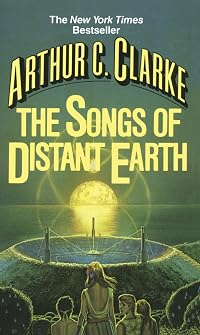
The Songs of Distant Earth
by Arthur C. Clarke
On This Page
Description
Earth refugees threaten a peaceful space settlement in this influential novel from the Golden Age science fiction author of 2001: A Space Odyssey. More than two thousand years in the future, a small human colony thrives on the ocean paradise of Thalassa-sent there centuries ago to continue the human race before Earth's destruction. Thalassa's resources are vast-and the human colony has lived a bucolic life there. But their existence is threatened when the spaceship Magellan arrives on their show more world-carrying one million refugees from Earth, fleeing the dying planet. Reputed to be Arthur C. Clarke's favorite novel, The Songs of Distant Earth addresses several fascinating scientific questions unresolved in their time-including the question of why so few neutrinos from the sun have been measured on Earth. In addition, Clarke presents an inventive depiction of the use of vacuum energy to power spacecraft-and the technical logistics of space travel near the speed of light. show lessTags
Recommendations















Member Reviews
This is a mesmerizing story about a possible future for humanity after the sun explodes, destroying Earth's solar system. In the 2500s, seed ships carrying frozen embryos were launched into space with the hope of saving humanity. By chance, one of these ships landed on a planet called Thalassa. Although it is 90% ocean, Thalassa has oxygen and a mild climate. The planet features an active volcano and intelligent underwater life forms resembling giant lobsters, which the humans called "Scorps," along with other unknown entities. The Lassans, the planet's inhabitants, are a peaceful society that controls their population and avoids conflict.
However, 800 years later, the spaceship Magellan makes an emergency landing on Thalassa while en show more route to a distant planet. The Lassans are unprepared for this unexpected arrival, which awakens curiosity about their past.
Clarke argues that religion has caused more wars, death, and sorrow than any other single factor. This is a point of endless debate, but I agree that more mayhem has been unleashed in the name of religion than by anything else. Greed for land and power comes in a close second. However, once humanity sets aside its religious beliefs and differences, peaceful conditions tend to follow. If humans ever have the chance to start anew on a distant planet, I hope we seize that opportunity to do better. show less
However, 800 years later, the spaceship Magellan makes an emergency landing on Thalassa while en show more route to a distant planet. The Lassans are unprepared for this unexpected arrival, which awakens curiosity about their past.
Clarke argues that religion has caused more wars, death, and sorrow than any other single factor. This is a point of endless debate, but I agree that more mayhem has been unleashed in the name of religion than by anything else. Greed for land and power comes in a close second. However, once humanity sets aside its religious beliefs and differences, peaceful conditions tend to follow. If humans ever have the chance to start anew on a distant planet, I hope we seize that opportunity to do better. show less
What I love so much about Arthur C. Clarke's work is his underlying sense of sorrow for the human condition. It forms a foundational layer for the emotional weight of his stories. In this one, the wistful idea looming over the characters is our own fateful end as a species. Though the characters move on, survive, carry out the directives of life, each one must deal with endings more than beginnings. Hope may be the engine driving the security of mankind but melancholy is its cockpit.
Clarke limberly uses a narrative telescopy to explore notions of cultural discovery, the dangers of influence, and the urge of human attachment... and detachment.
I recommend this story to fans of the genre, fans of Arthur C. Clarke, and to anyone who's ever show more wondered at life beyond earth and what desperate conditions may spark its beginning. show less
Clarke limberly uses a narrative telescopy to explore notions of cultural discovery, the dangers of influence, and the urge of human attachment... and detachment.
I recommend this story to fans of the genre, fans of Arthur C. Clarke, and to anyone who's ever show more wondered at life beyond earth and what desperate conditions may spark its beginning. show less
What I love so much about Arthur C. Clarke's work is his underlying sense of sorrow for the human condition. It forms a foundational layer for the emotional weight of his stories. In this one, the wistful idea looming over the characters is our own fateful end as a species. Though the characters move on, survive, carry out the directives of life, each one must deal with endings more than beginnings. Hope may be the engine driving the security of mankind but melancholy is its cockpit.
Clarke limberly uses a narrative telescopy to explore notions of cultural discovery, the dangers of influence, and the urge of human attachment... and detachment.
I recommend this story to fans of the genre, fans of Arthur C. Clarke, and to anyone who's ever show more wondered at life beyond earth and what desperate conditions may spark its beginning. show less
Clarke limberly uses a narrative telescopy to explore notions of cultural discovery, the dangers of influence, and the urge of human attachment... and detachment.
I recommend this story to fans of the genre, fans of Arthur C. Clarke, and to anyone who's ever show more wondered at life beyond earth and what desperate conditions may spark its beginning. show less
One of the best sci-fi books I've read. It's thought-provoking and full of good vibes. A ship bound from the now-destroyed earth comes to a planet where one of Earth's seedships had landed 7 centuries ago. Mostly a water-world, these people are happily settled. Ship Magellan has crossed 50 light years, stopping at planet Thalassa to pick up some water from their ocean. The exchange of technology and culture is a delight to experience through the eyes of Clarke's well-written characters. My favorite part is the explanation of god that one of Clarke's characters gives:
" 'the trouble with the word god,' he began slowly, 'is that it never meant the same thing to any two people - especially if they were philosophers. that's why it slowly show more dropped out of use during the third millennium except as an expletive--in some cultures, too obscene for polite use.
'instead, it was replaced by a whole constellation of specialized words. This at least stopped people arguing at cross-purposes, which caused 90% of the trouble in the past.
'The personal God, sometimes called God One, became Alpha. It was the hypothetical entity supposed to watch over the affairs of everyday life - every individual, every animal!--and to reward good and punish evil, usually in a vaguely described existence after death. You worshipped Alpha, prayed to it, carried out elaborate religious ceremonies, and built huge churches in its honor...
'then there was The God who created the universe and might or might not have had anything to do with it since then. That was Omega. By the time they'd finished dissecting God, the philosophers has used up all the other 20 or so letters of the ancient Greek alphabet, but Alpha and Omega will do very nicely for this morning. I'd guess that not more than 10 billion man years were ever spent discussing them.' "
He goes on with more explanation of what happened to god...pages 254-259, 1986 paperback Serendib BV edition. show less
" 'the trouble with the word god,' he began slowly, 'is that it never meant the same thing to any two people - especially if they were philosophers. that's why it slowly show more dropped out of use during the third millennium except as an expletive--in some cultures, too obscene for polite use.
'instead, it was replaced by a whole constellation of specialized words. This at least stopped people arguing at cross-purposes, which caused 90% of the trouble in the past.
'The personal God, sometimes called God One, became Alpha. It was the hypothetical entity supposed to watch over the affairs of everyday life - every individual, every animal!--and to reward good and punish evil, usually in a vaguely described existence after death. You worshipped Alpha, prayed to it, carried out elaborate religious ceremonies, and built huge churches in its honor...
'then there was The God who created the universe and might or might not have had anything to do with it since then. That was Omega. By the time they'd finished dissecting God, the philosophers has used up all the other 20 or so letters of the ancient Greek alphabet, but Alpha and Omega will do very nicely for this morning. I'd guess that not more than 10 billion man years were ever spent discussing them.' "
He goes on with more explanation of what happened to god...pages 254-259, 1986 paperback Serendib BV edition. show less
I love Arthur C. Clarke's Rendezvous with Rama and so was quite intrigued by this book's synopsis which claimed it was Clarke's favorite book of his, which just goes to show that authors have terrible taste. I found this dull and disjointed. The characterization was all telling--for example, the exposition tells us again and again that Mirissa is brilliant but yet, she *does* absolutely nothing and we never see any evidence of her superior intellect. There really is no plot, the fate of Earth is not really moving and hard to read in our current environmental moment with a straight face. Given what climate change is doing to our world, it is hard to read a prediction of humanity facing the demise of its world--for which humans bear no show more blame--with such foresight and dignity. The most interesting part of the story--the discovery of the alien race of scorps--feels really tangential even though every other (unsubtly) stated theme in the novel suggests that they should be the focus. All in all, disappointing and dull. show less
More superficial, conventional, and dated than I'd have expected from a late Arthur Clarke novel, "The Songs of Distant Earth" has a good idea, a decent colonial culture to contrast with the travelers, and potential to be a really good tale but pretty much fails to execute any of them. Everything is told in only enough depth to get to the end, side plots are introduced and completed with a handful of pages, and Thalassan society is just too utopian to be actually functioning.
Worse for me was the irritating classist/military English schoolboy in Clarke that still insists on referring to characters by their rank or hierarchical position (e.g., 'Deputy Captain X', or 'Science Officer Y') not just upon introduction but throughout the entire show more book. Geez, Clarke; we GOT it. My point is that the characters don't matter as people: it's not _who_ they are to Clarke, it's _what _ they are. This is one of many ways in which this book reads more as if it had been published in 1956 than 1986.
Wicked disappointed. show less
Worse for me was the irritating classist/military English schoolboy in Clarke that still insists on referring to characters by their rank or hierarchical position (e.g., 'Deputy Captain X', or 'Science Officer Y') not just upon introduction but throughout the entire show more book. Geez, Clarke; we GOT it. My point is that the characters don't matter as people: it's not _who_ they are to Clarke, it's _what _ they are. This is one of many ways in which this book reads more as if it had been published in 1956 than 1986.
Wicked disappointed. show less
Arthur C. Clarke is both famous for his science fiction writing (he is considered one of the Big Three of the Golden Age of SF-writing) and his scientific knowledge. That means that his science fiction novels have the potential to be a lot closer to what is actually scientifically possible than most novels. In this book he tells us in his introduction that 'inspired' by series like Star Trek and movies like Star Wars (this book is from 1986) he set out to write a 'humanity in the stars' novel that is a bit more realistic (than a warp drive for example).
In the 3800s mankind has colonized, or tried to colonize several planets far from our solar system. Back in the late 1900s, mankind discovered the Sun would be going supernova around show more 3500, so from that point on all energy was put into developing technologies to make the escape of mankind from earth possible. On the planet Thalassa, which is mostly oceanic with three islands of land, one such colonizing ship landed successfully. This ship did not carry any humans because of the length of the journey, but humans were 'grown' from DNA information stored on the ship. The planet has lost touch with Earth 400 years earlier after the local volcano destroyed their transmitting equipment. The society on Thalassa is very laid back, with a stable culture devoid of politics or religion.
One day a ship appears, Magellan, a ship from Earth, with the last million humans to have left Earth before its destruction. Just before the end humanity has developed a quantum drive making manned interstellar space travel a possibility. The crew of the Magellan is awakened near Thalassa while the other humans aboard are kept cryogenically frozen. They are on their way to Sagan 2, a planet even further from earth where they will terraform a habitable planet for themselves. They stop on Thalassa to repair their ice shield, forcing them to stay on Thalassa and mingle with the people there for at least a year.
The book deals with the consequences of the visit of the last humans to a colony of humans who never even saw Earth except in a recording. Their cultures are very different (the colonists of Thalassa received a censored version of the history and culture of Earth).
The story of the Thalassa people and the last people from Earth is very interesting. There is a clash of cultures, a sense of loss for those from Earth, a debate about the mission of Magellan. In between are many sections that go deeper into the reason for what is or has happened, for example explaining the discovery of the Sun going supernova or of the quantum drive. This is where Clarke gets more scientific than science fiction. It is very interesting to read this (although I have no idea how correct it still is, being published 27 years ago), but it slowed the story down for me. Other than that the story was very interesting, especially reading about how humanity works with the limits physics has given us. Four out of five stars. show less
In the 3800s mankind has colonized, or tried to colonize several planets far from our solar system. Back in the late 1900s, mankind discovered the Sun would be going supernova around show more 3500, so from that point on all energy was put into developing technologies to make the escape of mankind from earth possible. On the planet Thalassa, which is mostly oceanic with three islands of land, one such colonizing ship landed successfully. This ship did not carry any humans because of the length of the journey, but humans were 'grown' from DNA information stored on the ship. The planet has lost touch with Earth 400 years earlier after the local volcano destroyed their transmitting equipment. The society on Thalassa is very laid back, with a stable culture devoid of politics or religion.
One day a ship appears, Magellan, a ship from Earth, with the last million humans to have left Earth before its destruction. Just before the end humanity has developed a quantum drive making manned interstellar space travel a possibility. The crew of the Magellan is awakened near Thalassa while the other humans aboard are kept cryogenically frozen. They are on their way to Sagan 2, a planet even further from earth where they will terraform a habitable planet for themselves. They stop on Thalassa to repair their ice shield, forcing them to stay on Thalassa and mingle with the people there for at least a year.
The book deals with the consequences of the visit of the last humans to a colony of humans who never even saw Earth except in a recording. Their cultures are very different (the colonists of Thalassa received a censored version of the history and culture of Earth).
The story of the Thalassa people and the last people from Earth is very interesting. There is a clash of cultures, a sense of loss for those from Earth, a debate about the mission of Magellan. In between are many sections that go deeper into the reason for what is or has happened, for example explaining the discovery of the Sun going supernova or of the quantum drive. This is where Clarke gets more scientific than science fiction. It is very interesting to read this (although I have no idea how correct it still is, being published 27 years ago), but it slowed the story down for me. Other than that the story was very interesting, especially reading about how humanity works with the limits physics has given us. Four out of five stars. show less
Members
- Recently Added By
Lists

Best Science Fiction Novels
816 works; 430 members

Stories About Other Worlds
145 works; 13 members

The Novels of Arthur C. Clarke
21 works; 2 members

Space Colonization
100 works; 26 members

Speculative Fiction to Read
706 works; 32 members

Unread books
1,063 works; 84 members

Comfort Reads
221 works; 41 members

Genesis in literature
47 works; 7 members

1980s
356 works; 23 members

Books Read in 2007
326 works; 8 members
Author Information

860+ Works 130,139 Members
Arthur C. Clarke was born in Minehead, Somerset, England, on December 16, 1917. During World War II, he served as a radar specialist in the RAF. His first published piece of fiction was Rescue Party and appeared in Astounding Science, May 1946. He graduated from King's College in London with honors in physics and mathematics, and worked in show more scientific research before turning his attention to writing fiction. His first book, Prelude to Space, was published in 1951. He is best known for his book 2001: A Space Odyssey, which was later turned into a highly successful and controversial film under the direction of Stanley Kubrick. His other works include Childhood's End, Rendezvous with Rama, The Garden of Rama, The Snows of Olympus, 2010: A Space Odyssey II, 2062: Odyssey III, and 3001: The Final Odyssey. During his lifetime, he received at least three Hugo Awards and two Nebula Awards. He died of heart failure on March 19, 2008 at the age of 90. (Bowker Author Biography) show less
Some Editions
Awards and Honors
Distinctions
Series
Belongs to Publisher Series
Work Relationships
Is contained in
Has as a commentary on the text
Common Knowledge
- Canonical title
- The Songs of Distant Earth
- Original title
- The Songs of Distant Earth
- Original publication date
- 1986
- People/Characters
- Loren; Marissa; Brad; Kumar; Moses Kaldor
- Important places
- Thalassa (fictitious planet); Magellan (spaceship)
- Epigraph
- Nowhere in all space or on a thousand worlds will there be men to share our loneliness. There may be wisdom; there may be power; somewhere across space great instruments. . . may stare vainly at our floating cloud wrack, the... (show all)ir owners yearning as we yearn. Nevertheless, in the nature of life and in the principles of evolution we have had our answer. Of men elsewhere, and beyond, there will be none forever. . .
Loren Eiseley,
The Immense Journey(1957)
I have written a wicked book, and feel spotless as the lamb.
Melville to Hawthorne (1851) - Dedication
- For Tamara and Cherene,
Valerie and Hector
- for love and loyalty - First words
- Even before the boat came through the reef, Mirissa could tell that Brant was angry.
- Last words
- (Click to show. Warning: May contain spoilers.)One day the pain would be gone; but never the memory.
- Original language
- English
- Disambiguation notice
- THIS IS A NOVEL. Do not combine this with the short story of the same title.
Classifications
Statistics
- Members
- 3,751
- Popularity
- 4,237
- Reviews
- 62
- Rating
- (3.67)
- Languages
- 12 — Czech, Dutch, English, Estonian, Finnish, French, German, Hungarian, Italian, Portuguese, Spanish, Swedish
- Media
- Paper, Audiobook, Ebook
- ISBNs
- 40
- ASINs
- 27