Sojourner Truth's Step-Stomp Stride
by Andrea Pinkney
On This Page
Description
Sojourner Truth was born into slavery, but became a free woman. Freedom meant so much to Sojourner, she used the power of speech to help end slavery.Tags
Recommendations




Member Reviews
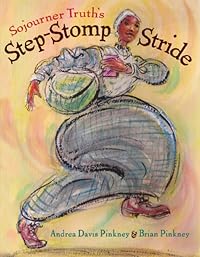
Sojourner Truth strides through life, stepping and stopping to freedom first for herself and then for others in this powerful biography of the famous nineteenth century African American. Andrea Davis Pinkney’s text blends a biographical portrait with lyrical language that tells a story instead of merely facts. Truth’s size and strength are often referred to, emphasizing and re-enforcing her as a powerful character who covered a lot of ground. The narrative leads up to Sojourner Truth’s famous “Ain’t I a Woman” speech at Akron, Ohio, 1851, which Pinkney effectively presents. After the narrative is a spread which reads more like a traditional biography with important dates and facts; also presented are sources for further show more reading. Brian Pinkney’s illustrations capture the bold, hopeful tone set by the text. He illustrates with “scratchboard” technique, coloring his work with Luma dyes and acrylic paints. His golden-mustard palette almost always depicts Sojourner Truth in active motion, complimenting the motif of her “step-stomp stride.” This work of non-fiction introduces an important woman, the concept of slavery, and the abolition movement all in a child-friendly picture book format which can be read either silently or out loud either at home or in a group setting. This biography is highly recommended for children ages seven through nine. show less
Informative children's book on Sojourner Truth, who was born a slave and was sold away from her parents when she was nine. A great book showing Sojourner's point of view and her hard life of being a runaway slave. She decided to speak up for others and work with her friend who was an abolitionist. It showed the hard but inspiring life of an enslaved woman who became an icon.
In the story, Sojourner Truth’s Step-Stomp-Stride is another great collaboration from the duo Andrea Davis Pinkney and Brian Pinkney. Together they create a beautiful piece with both words and pictures. The story is about a girl born a slave. She is described, “Big. Black. Beautiful. True. That was Sojourner.” He master called her Isabella but her parents called her Belle. When she is nine, she is sold away from her family. She finally landed with Master, John Dumont who promised her freedom if worked “extra” hard. But he knew her valuable and refused to free her. This young girl decides to run away in search of her freedom. She came to the home of a Quaker couple, Isaac and Maria Van Wagener who were abolitionists and Isaac show more frees her after paying Dumont for her. Belle made her way to New York where she found work as a maid.
This is where the story kind of takes a remarkable turn, Belle soon learns that to celebrate her freedom she needs to use her voice and speak up for what is right. This is where she changes her name to Sojourner Truth and rids herself of the name Belle, last remaining remnants of her life as a slave. She might not be able to read or write but she used her powerful words and voice. For that is who she was, “Big. Black. Beautiful. True. That was Sojourner.” Sojourner preached about the unfair treatment of women and slaves wherever she went. She discovered that freedom wasn’t really an actual place but a feeling inside.
This book is beautifully crafted illustrations by the talented Brian Pinkney. Through his beautiful watercolors and ink paintings he brings to the surface the strength and power behind Sojourner Truth’s power, strength, and determination and truth. Through Andrea Davis Pinkney’s creativity through her words you can hear and see Sojourner’s steps, her stomps and her strides. show less
This is where the story kind of takes a remarkable turn, Belle soon learns that to celebrate her freedom she needs to use her voice and speak up for what is right. This is where she changes her name to Sojourner Truth and rids herself of the name Belle, last remaining remnants of her life as a slave. She might not be able to read or write but she used her powerful words and voice. For that is who she was, “Big. Black. Beautiful. True. That was Sojourner.” Sojourner preached about the unfair treatment of women and slaves wherever she went. She discovered that freedom wasn’t really an actual place but a feeling inside.
This book is beautifully crafted illustrations by the talented Brian Pinkney. Through his beautiful watercolors and ink paintings he brings to the surface the strength and power behind Sojourner Truth’s power, strength, and determination and truth. Through Andrea Davis Pinkney’s creativity through her words you can hear and see Sojourner’s steps, her stomps and her strides. show less
I was ready to completely love this book until a colleague pointed out that Sojourner Truth's famouse "Ain't I Woman" speech, which is used heavily in the book, is now thought to be a very embellished version of the original. I'm a little disappointed that the authors didn't note that at the end of the book, especially since we keep this book in biographies, not fiction.
Otherwise, awesome book.
Otherwise, awesome book.
This book is a great way not only to discuss the life of Sojourner Truth, but also to present her famous "Ain't I a Woman" speech in an easy-to-read way. It is an excellent story about one woman's determination to rise above the norms and stereotypes of the time and stand up for what she knew was right.
My favorite part of this book is the recounting of Sojourner Truth's "Ain't I a Woman?" speech. There is a power in her words still today. I think Andrea Davis Pinkney gives enough information about the ugliness of slavery for young students (lacking prior knowledge) to have some idea why Sojourner fled, but the real focus is how she used her freedom for the benefit of African Americans and women. Good book!
"Big. Black. Beautiful. True. That was Sojourner." This quote, found on the very first page, sums up Sojourner Truth. She was born into slavery, taken from her mother and father, sold to another master, and worked very hard to be freed. She finally got her wish, changed her name, and then worked even hard to spread her story and speak of the hardships she faced. Sojourner Truth was known for "telling it like it was." Throughout her journey she was able to publish a book "The Narrative of Sojourner Truth: A Northern Slave" which from that point on, never left her side. She often spoke of diversity and believed that women should share the same rights as men. Afterall, nobody ever helped her into a carriage and ain't she a woman?
Members
- Recently Added By
Lists

Picture Books About Civil Rights
51 works; 4 members

VPL Middle Grade Books
86 works; 1 member
Author Information

59+ Works 12,650 Members
All Editions
Awards and Honors
Awards
Common Knowledge
- People/Characters
- Sojourner Truth
Classifications
- Genre
- Picture Books
- DDC/MDS
- 306.3 — Society, government, & culture Social sciences, sociology & anthropology Social Behavior - Dating, Marriage, Divorce Economic institutions
- LCC
- E185.97 .T8 .P56 — History of the United States United States Elements in the population Afro-Americans Biography. Genealogy
- BISAC
Statistics
- Members
- 336
- Popularity
- 94,808
- Reviews
- 19
- Rating
- (4.23)
- Languages
- English
- Media
- Paper
- ISBNs
- 3
- ASINs
- 3