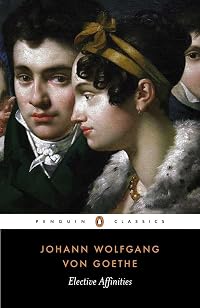
Elective Affinities
by Johann Wolfgang von Goethe
On This Page
Description
Eduard and Charlotte are an aristocratic couple who live a harmonious but idle life in their estate. But the peace of their existence is thrown into chaos when two visitors - Eduard's friend the Captain and Charlotte's passionate young ward Ottilie - provoke unexpected attraction and forbidden love. Taking its title from the principle of elective affinities - the theory that certain chemicals are naturally drawn to one another - this is a penetrating study of marriage and adultery. Inspired show more by Goethe's own conflicting loyalties as he battled to maintain his relationship with his wife and control his feelings for a younger woman, Elective Affinities is one of the greatest works of the romance era- a rich exploration of love, conflict, and the inescapable force of fate. show lessTags
Recommendations









Member Recommendations
LCBrooks Allows for interesting comparisons on the subject of double marriage.
30
Member Reviews
Elective Affinities is a bit of slog (hard to tell whether that's because of the translation from German language or the inscrutableness of turn-of-the-19th-century German aristocracy), but it's also not without certain charms. If it weren't for Ottilie's observations as scattered throughout, I wouldn't have been able to finish it; she's a highly entertaining character amidst a cast of bores.
Goethe has chosen pessimistic themes such as tragedy, death, and fatalism to illustrate an optimistic one, that of love. Well, the scientific or chemical attraction of love and how the laws of man regarding love and marriage are no match for laws of nature for the latter requires a conformity that may not be natural at all.
I can't imagine to whom show more I would ever recommend this, but I'm glad I read it. show less
Goethe has chosen pessimistic themes such as tragedy, death, and fatalism to illustrate an optimistic one, that of love. Well, the scientific or chemical attraction of love and how the laws of man regarding love and marriage are no match for laws of nature for the latter requires a conformity that may not be natural at all.
I can't imagine to whom show more I would ever recommend this, but I'm glad I read it. show less
Dopo un anno ritorno da Goethe, da quello stesso Goethe che mi ha tormentata per settimane infinite con il suo Werther, da quello stesso scrittore che mi è stato vicino e mi ha fatto compagnia con le sue parole sincere, profonde, sensibili.
Ho fatto ritorno tra le braccia di Goethe dopo un anno esatto e, dopo un anno esatto, continuo ad amarlo e ad essergli amica.
Il suo romanzo, anche questa volta, mi è stato un amico leale e, forse, persino più di un amico: esso è stato per me confidente e - per citare Kafka - esso è stato per me il coltello col quale frugare dentro me stessa. Ho forse capito meglio l’amore, l’essere affini, affinità, ma, soprattutto, l’essere affinità elettive.
- rapporti umani = rapporti chimici - così ho show more goffamente, ingenuamente, rozzamente scritto a matita a margine di una pagina di questo romanzo. Perché anche noi siamo fatti di elementi chimici, noi siamo chimica, ed è dunque la chimica che ci attrae gli uni con gli altri.
Ho amato questo libro, l’ho amato e me ne sono presa cura tanto quanto, spero, lui abbia avuto cura di me, del mio cuore giovane e colmo di sogni e di speranze, del mio cuore innamorato dell’amore e del romanticismo, e della mia anima forte e fragile a un tempo, cauta e avventata, pacata ed irruente. Goethe si è, un’altra volta, preso cura di me con la più totale delicatezza e gentilezza.
Goethe ha sempre cura di me, si pena per e con me, mi aiuta a gioire e a piangere, a morire e a rinascere. Questo scrittore è la mia medicina, così lo sono i suoi romanzi e questo, questo breve e immenso romanzo, è una autentica professione d’amore incondizionato e puro. show less
Ho fatto ritorno tra le braccia di Goethe dopo un anno esatto e, dopo un anno esatto, continuo ad amarlo e ad essergli amica.
Il suo romanzo, anche questa volta, mi è stato un amico leale e, forse, persino più di un amico: esso è stato per me confidente e - per citare Kafka - esso è stato per me il coltello col quale frugare dentro me stessa. Ho forse capito meglio l’amore, l’essere affini, affinità, ma, soprattutto, l’essere affinità elettive.
- rapporti umani = rapporti chimici - così ho show more goffamente, ingenuamente, rozzamente scritto a matita a margine di una pagina di questo romanzo. Perché anche noi siamo fatti di elementi chimici, noi siamo chimica, ed è dunque la chimica che ci attrae gli uni con gli altri.
Ho amato questo libro, l’ho amato e me ne sono presa cura tanto quanto, spero, lui abbia avuto cura di me, del mio cuore giovane e colmo di sogni e di speranze, del mio cuore innamorato dell’amore e del romanticismo, e della mia anima forte e fragile a un tempo, cauta e avventata, pacata ed irruente. Goethe si è, un’altra volta, preso cura di me con la più totale delicatezza e gentilezza.
Goethe ha sempre cura di me, si pena per e con me, mi aiuta a gioire e a piangere, a morire e a rinascere. Questo scrittore è la mia medicina, così lo sono i suoi romanzi e questo, questo breve e immenso romanzo, è una autentica professione d’amore incondizionato e puro. show less
Goethe doesn't just write in German, he is the very definition of the German language. This book, as well as das Leiden des Jungen Werters, have clearly shown to me the beauty of die Deutsche Sprache.
Because of this reason I would recommend everybody with only the slightest knowledge of German, to read this in the original language. A translation could never grasp the majestic feeling in which Goethe seems to soak all his words.
Die Wahlverwandschaften is in the first place a book about interpersonal relationships. The titles refers to the chemistry that occurs when certain people are placed together. In this book, a wealthy couple, Eduard and Charlotte, invites two friends: one, a frail, polite girl, the other a solemn guy, who show more temporarily is out of work. It does not take long until things start to change in this once stable family: in no time Eduard falls in love with Otillie, the girlfriend of Charlotte. And Charlotte starts having feelings for Hauptmann, the friend of Eduard.
The passion, the forbidden love, is a theme that Goethe handles well. The desperate feelings that the protagonists experience are translated into descriptions of intense craving for something that cannot be. Especially interesting is how each person deals differently with the emotions he or she experiences and this supports the main point of the work: people are slaves to their personalities.
One should not live his life without having read at least one work by Goethe. It makes you think about the way we experience emotions, and how we are all part of a mysterious game, driven by even more mysterious forces. Emotions can be as destructive as they are beautiful. show less
Because of this reason I would recommend everybody with only the slightest knowledge of German, to read this in the original language. A translation could never grasp the majestic feeling in which Goethe seems to soak all his words.
Die Wahlverwandschaften is in the first place a book about interpersonal relationships. The titles refers to the chemistry that occurs when certain people are placed together. In this book, a wealthy couple, Eduard and Charlotte, invites two friends: one, a frail, polite girl, the other a solemn guy, who show more temporarily is out of work. It does not take long until things start to change in this once stable family: in no time Eduard falls in love with Otillie, the girlfriend of Charlotte. And Charlotte starts having feelings for Hauptmann, the friend of Eduard.
The passion, the forbidden love, is a theme that Goethe handles well. The desperate feelings that the protagonists experience are translated into descriptions of intense craving for something that cannot be. Especially interesting is how each person deals differently with the emotions he or she experiences and this supports the main point of the work: people are slaves to their personalities.
One should not live his life without having read at least one work by Goethe. It makes you think about the way we experience emotions, and how we are all part of a mysterious game, driven by even more mysterious forces. Emotions can be as destructive as they are beautiful. show less
It is very important you read a good edition of this book- as it affects the translation. I read one edition almost to the end and restarted from another, and it was an entirely different experience. The one I preferred, invariably, was the one you can find for free on the "Online Library of Liberty" website.
As per the novel, it was amazing. There are ups, downs, tribulations, foils, the switching of motivations and emotions, love, obsession, and overall unity of form. It is a surprising journey from inception to denouement and there is something to be garnered from each and every character. The language, indeed, at times approaches the sublime as well (as well as Odette's diary entries--aphorism in themselves) that unite the entirety show more of the experience together in a closely knit flashion.
4.5 stars--well deserved too! show less
As per the novel, it was amazing. There are ups, downs, tribulations, foils, the switching of motivations and emotions, love, obsession, and overall unity of form. It is a surprising journey from inception to denouement and there is something to be garnered from each and every character. The language, indeed, at times approaches the sublime as well (as well as Odette's diary entries--aphorism in themselves) that unite the entirety show more of the experience together in a closely knit flashion.
4.5 stars--well deserved too! show less
My first experience at reading Goethe was a major disappointment. Perhaps his novella is kept alive because- being produced in 1809- it was one of the first publications in Germany about social life. Or maybe because it was toted as an early example of the “Strum und Drang” romanticism movement. “Strum und Drang” means “storm and stress”, but for all the stormy drama and stressful tragedy of Elective Affinities, the story left me cold. Goethe’s prose is stiff, unemotional, and boring.
"Elective Affinities" is the story of a German upper-class married couple- Eduard and Charlotte- who appear to be happily married until they invite Charlotte’s niece and an old friend of Eduard’s to be house guests. Charlotte immediately show more falls in love with Eduard’s friend and Eduard falls in love with the niece. Charlotte’s infidelity results in a pregnancy. Surely a shocking story for the early 1800s, but Goethe does not elaborate on physical details. He is more concerned with the psychology of human behavior.
Elaborating on the term “elective affinities” which- as quoted on the back cover of the Penguin Classics edition means- “the theory that certain chemicals are naturally drawn to one another”, Goethe proceeds to build his story on the premise that the infidelity of Charlotte was inevitable. And ideally, matching up Eduard with the niece will present a perfect balance. Only it doesn’t. Chaos ensues.
The problems with "Elective Affinities":
The plot lacks credibility. The only person that has consistent behavior is Eduard. All the other primary players seem to fall in and out of character as Goethe requires to move the story line along to his desired finish.
And the final outcome is much too conveniently tragic. It’s a case of literary overkill. Literally!
In addition, the writing style is unpolished and awkward, moving in and out of past and present tense inappropriately. I don’t know if it is just a poor translation from German or not, but it was very distracting which diminished both interest and patience on the part of this reader. show less
"Elective Affinities" is the story of a German upper-class married couple- Eduard and Charlotte- who appear to be happily married until they invite Charlotte’s niece and an old friend of Eduard’s to be house guests. Charlotte immediately show more falls in love with Eduard’s friend and Eduard falls in love with the niece. Charlotte’s infidelity results in a pregnancy. Surely a shocking story for the early 1800s, but Goethe does not elaborate on physical details. He is more concerned with the psychology of human behavior.
Elaborating on the term “elective affinities” which- as quoted on the back cover of the Penguin Classics edition means- “the theory that certain chemicals are naturally drawn to one another”, Goethe proceeds to build his story on the premise that the infidelity of Charlotte was inevitable. And ideally, matching up Eduard with the niece will present a perfect balance. Only it doesn’t. Chaos ensues.
The problems with "Elective Affinities":
The plot lacks credibility. The only person that has consistent behavior is Eduard. All the other primary players seem to fall in and out of character as Goethe requires to move the story line along to his desired finish.
And the final outcome is much too conveniently tragic. It’s a case of literary overkill. Literally!
In addition, the writing style is unpolished and awkward, moving in and out of past and present tense inappropriately. I don’t know if it is just a poor translation from German or not, but it was very distracting which diminished both interest and patience on the part of this reader. show less
Analysis of the meaning and difficulties of marriage, especially the effect of other people. The first third is more thoughtful and analytical; the remainder slightly more plot-driven. The mannered, detached and somewhat unnatural style (though apparently typical of a common German novel form of the time) is slightly reminiscent of Ivy Compton-Burnett, and makes the whole experience rather unengaging.
“Elective Affinities” is the story of the inevitable attraction of some people to others, along the same lines as certain chemicals are said to have an affinity towards one another. A married couple invite an old friend and a beautiful young girl to live with them, and the result, put as a chemical reaction, is AB + CD AD + BC. Apparently the story was spurred in part from Goethe’s own love affairs, late in life, with women far younger than him. It sounds more interesting than it is though.
Quotes, just a few:
On ups and downs in life:
“Even on dry land it was possible to be shipwrecked; to recover from it quickly as possible was a fine and praiseworthy thing. Life was, after all, only a matter of profit and loss. How many show more plans went awry! How often one was diverted from one’s chosen course! How often we were turned aside from a clearly envisaged goal so as to achieve a higher! The traveller on his way breaks a wheel and is greatly annoyed by it, yet through this unpleasant accident he makes the most agreeable connections and acquaintances, which then go on to influence his entire life. Fate grants us our desires but it does so in its own fashion, so that it can give us something over and above what we desire.”
On marriage, not sure if I agree with it but…
“And why speak of unhappiness at all? Impatience is what it really is, ever and again people are overcome by impatience, and then they like to think themselves unhappy. Let the moment pass, and you will count yourself happy that what has so long stood firm still stands. As for separation, there can be no adequate grounds for it. The human condition is compounded of so much joy and so much sorrow that it is impossible to reckon how much a husband owes a wife or a wife a husband. It is an infinite debt, it can be paid only in eternity. Marriage may sometimes be an uncomfortable state, I can well believe that, and that is as it should be. Are we not also married to our conscience, and would we not often like to be rid of it because it is more uncomfortable than a husband or wife could ever be?”
On transience:
“The young workman, who had been busier than anyone during all this, now took up his oratorical posture again and continued: ‘We found this stone for eternity, to ensure the enjoyment of this house to its present and future possessors for the longest possible time. But while we here as it were bury a treasure and are occupied with the most fundamental of all tasks, we think at the same time of the transitoriness of human things: we think of the possibility that this firm-sealed lid may one day be opened again, which could not happen unless that which has not yet even been built were all to be destroyed again.’” show less
Quotes, just a few:
On ups and downs in life:
“Even on dry land it was possible to be shipwrecked; to recover from it quickly as possible was a fine and praiseworthy thing. Life was, after all, only a matter of profit and loss. How many show more plans went awry! How often one was diverted from one’s chosen course! How often we were turned aside from a clearly envisaged goal so as to achieve a higher! The traveller on his way breaks a wheel and is greatly annoyed by it, yet through this unpleasant accident he makes the most agreeable connections and acquaintances, which then go on to influence his entire life. Fate grants us our desires but it does so in its own fashion, so that it can give us something over and above what we desire.”
On marriage, not sure if I agree with it but…
“And why speak of unhappiness at all? Impatience is what it really is, ever and again people are overcome by impatience, and then they like to think themselves unhappy. Let the moment pass, and you will count yourself happy that what has so long stood firm still stands. As for separation, there can be no adequate grounds for it. The human condition is compounded of so much joy and so much sorrow that it is impossible to reckon how much a husband owes a wife or a wife a husband. It is an infinite debt, it can be paid only in eternity. Marriage may sometimes be an uncomfortable state, I can well believe that, and that is as it should be. Are we not also married to our conscience, and would we not often like to be rid of it because it is more uncomfortable than a husband or wife could ever be?”
On transience:
“The young workman, who had been busier than anyone during all this, now took up his oratorical posture again and continued: ‘We found this stone for eternity, to ensure the enjoyment of this house to its present and future possessors for the longest possible time. But while we here as it were bury a treasure and are occupied with the most fundamental of all tasks, we think at the same time of the transitoriness of human things: we think of the possibility that this firm-sealed lid may one day be opened again, which could not happen unless that which has not yet even been built were all to be destroyed again.’” show less
Members
- Recently Added By
Lists

1001 Books You Must Read Before You Die
1,448 works; 1,133 members

Favourite 19th century fiction
257 works; 62 members

German Literature
518 works; 55 members

Western World's Greatest Books - Project Gutenberg
295 works; 15 members
Favorite Literary Love Stories
182 works; 100 members

Books Set in Germany
74 works; 12 members

Harold Bloom - The Western Canon: B. The Aristocratic Age
231 works; 13 members

Love Triangles in Literature
108 works; 15 members

1,001 BYMRBYD Concensus
723 works; 27 members

Books Read in 2020
4,379 works; 124 members
150 Best Novels Selected by Brander Matthews (1883)
150 works; 7 members
Author Information

3,043+ Works 51,467 Members
Johann Wolfgang von Goethe, 1749-1832 Johann Wolfgang von Goethe was born in Frankfurt am Main. He was greatly influenced by his mother, who encouraged his literary aspirations. After troubles at school, he was taught at home and gained an exceptionally wide education. At the age of 16, Goethe began to study law at Leipzig University from 1765 to show more 1768, and he also studied drawing with Adam Oeser. After a period of illness, he resumed his studies in Strasbourg from 1770 to 1771. Goethe practiced law in Frankfurt for two years and in Wetzlar for a year. He contributed to the Frankfurter Gelehrte Anzeigen from 1772 to 1773, and in 1774 he published his first novel, self-revelatory Die Leiden des Jungen Werthers. In 1775 he was welcomed by Duke Karl August into the small court of Weimar, where he worked in several governmental offices. He was a council member and member of the war commission, director of roads and services, and managed the financial affairs of the court. Goethe was released from day-to-day governmental duties to concentrate on writing, although he was still general supervisor for arts and sciences, and director of the court theatres. In the 1790s Goethe contributed to Friedrich von Schiller´s journal Die Horen, published Wilhelm Meister's Apprenticeship, and continued his writings on the ideals of arts and literature in his own journal, Propyläen. The first part of his masterwork, Faust, appeared in 1808, and the second part in 1832. Goethe had worked for most of his life on this drama, and was based on Christopher Marlowe's Faust. From 1791 to 1817, Goethe was the director of the court theatres. He advised Duke Carl August on mining and Jena University, which for a short time attracted the most prominent figures in German philosophy. He edited Kunst and Altertum and Zur Naturwissenschaft. Goethe died in Weimar on March 22, 1832. He and Duke Schiller are buried together, in a mausoleum in the ducal cemetery. (Bowker Author Biography) show less
Some Editions
Awards and Honors
Notable Lists
Series
Belongs to Publisher Series
insel taschenbuch (0001)
Die hundert Bücher (46)
dtv Klassik (2067)
Prisma Klassieken (11)
Wereldbibliotheek (301)
A tot vent (291)
Reclams Universal-Bibliothek (7835)
Work Relationships
Is contained in
Sorrows of Young Werther: WITH Elective Affinities, Faust and Italian Journey (Everyman's Library classics) by Johann Wolfgang von Goethe
Goethes Werke [7] : [Die Wahlverwandtschaften, Wilhelm Meisters Wanderjahre erstes Buch] by Johann Wolfgang von Goethe
Has the adaptation
Common Knowledge
- Canonical title
- Elective Affinities
- Original title
- Die Wahlverwandtschaften
- Alternate titles*
- Zielsverwanten; Affiniteiten
- Original publication date
- 1809
- People/Characters
- Eduard; Charlotte; Ottilie; Herr Mittler; Luciane
- Important places
- Weimar, Thuringia, Germany
- Related movies*
- Le affinità elettive (1996 | IMDb)
- First words
- Eduard was the name of a wealthy baron in the prime of life and he had been spending the best hour of an April afternoon in his orchard nursery grafting new shoots he had just obtained on to the young trees.
Goethe's Elective Affinities began life as a Novelle, and was to have been inserted into Wilhelm Meister's Years of Travel. - Quotations
- Human beings reveal their character most clearly by what they find ridiculous.
There are certain things which fate is obstinately determined upon. Reason and virtue, duty and all that is sacred, oppose it in vain; something is to happen that seems right to fate, even if it does not seem right to us; an... (show all)d so, do what we will, fate at last prevails. - Last words
- (Click to show. Warning: May contain spoilers.)And thus the lovers lie side by side. Peace hovers about their abode, smiling angelic figures (with whom too they have affinity) look down upon them from the vault above, and what a happy moment it will be when one day they awaken again together.
(Click to show. Warning: May contain spoilers.)It is a chilling, in some ways a repellent book, and would be nihilistic (the characters drifting helplessly to ruin) did it not, through the passion of Eduard and Ottilie and through their braver equivalents in the Novelle, call for its own wholehearted contradiction. (Introduction) - Original language
- German
*Some information comes from Common Knowledge in other languages. Click "Edit" for more information.
Classifications
- Genres
- General Fiction, Fiction and Literature
- DDC/MDS
- 833.6 — Literature & rhetoric German & related literatures German fiction 1750-1832 : 18th century, classical period, romantic period
- LCC
- PZ3 .G552 .E — Language and Literature Fiction and juvenile belles lettres Fiction and juvenile belles lettres Fiction in English
- BISAC
Statistics
- Members
- 2,301
- Popularity
- 8,642
- Reviews
- 28
- Rating
- (3.76)
- Languages
- 20 — Catalan, Chinese, Czech, Danish, Dutch, English, Finnish, French, German, Greek, Hebrew, Hungarian, Italian, Lithuanian, Norwegian (Bokmål), Russian, Slovenian, Spanish, Swedish, Portuguese (Portugal)
- Media
- Paper, Audiobook, Ebook
- ISBNs
- 193
- UPCs
- 1
- ASINs
- 64