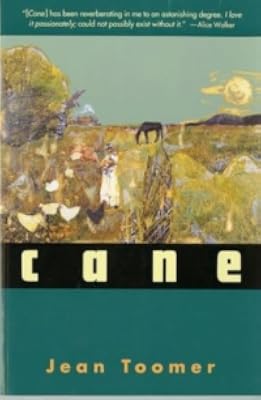
Cane
by Jean Toomer
On This Page
Description
First published in 1923, Jean Toomer's Cane is an innovative literary work powerfully evoking black life in the South. Rich in imagery, Toomer's impressionistic, sometimes surrealistic sketches of Southern rural and urban life are permeated by visions of smoke, sugarcane, dusk, and fire; the northern world is pictured as a harsher reality of asphalt streets. This iconic work of American literature is a classic of both American modernism and the Harlem Renaissance, and challenges the idea of show more race as a scientific or biological concept. show lessTags
Recommendations






Member Reviews
Well, this was different. The Library of America calls this a novel and maybe under some definition of a modernist novel, it may qualify. I don't read the modernists (or I do very rarely anyway) and I need my novels to have a structure or at least a plot. Although after having read that, I realize that if a structure is enough, then this indeed may be a novel. But that will also be true for linked stories collections. Or maybe I should stop trying to find a box to fit it under and just talk about the book.
The book is a mix of poems, stories, vignettes and even a mix of a play and a story at the very end. All the pieces have the same main topic - the life of African Americans in a world designed and ran by the whites. And Toomer takes a show more circular route into the topic - he starts with the South (Georgia), moves north (Washington) and then sends a northern man south to close the circle back in rural Georgia. And while this cycle ties the different texts together, it also highlighted the difference between the different parts.
The first one, the one set in the South reads like one of those stories that evolve around a fireplace - a mix of poetry and small stories and portraits of people and places, with repetitions inside of the same story and between stories. It sounds like a sing-song, even the parts that are obviously prose. Not all of those stories are nice, most of them are not but they all work as a whole and paints an image of a land steeped in legends and superstitions.
And as lyrical as that first part is, the second one pulls you out and throws you into the emerging jazz era of the big city. The same mix of prose and poetry reads very very differently and it loses the magic of the legends. It was intentional I think - it was supposed to show the new world but for some reason it sounded more crude and disjointed than a real counterpart of the first part.
And then comes the (almost) play, "Kabnis". A Northern black teacher moves to Georgia to teach and finds a community in the middle of a change. The lyrical language of the first part is back but now mixed with something else. The start is rough in the same way the very beginning of the novel is but once you get used to the dialect and the rhythm of the play/story, it slowly turns into the best part of the whole book. It is not just a play, there are parts of it which cannot be set on stage but using the play format allows the author not to look for scene transitions and connections and to set the acts he wants to.
Tradition meets jazz (and the new world), racism meets love and women meеt men -- most of the pieces deal with at least one of these pairs; the ones that do not deal with just one side of a pair. And somewhere under all these diverse stories and poems emerges a portrait of a time, told by a voice of someone who belongs to the Jazz era but lives outside of it.
At the end I liked this more than I expected to. I came into it with very low expectations - modernist fiction rarely works for me. And it took awhile for me to warm up to it. I still do not find the style appealing but I am happy I read this one. show less
The book is a mix of poems, stories, vignettes and even a mix of a play and a story at the very end. All the pieces have the same main topic - the life of African Americans in a world designed and ran by the whites. And Toomer takes a show more circular route into the topic - he starts with the South (Georgia), moves north (Washington) and then sends a northern man south to close the circle back in rural Georgia. And while this cycle ties the different texts together, it also highlighted the difference between the different parts.
The first one, the one set in the South reads like one of those stories that evolve around a fireplace - a mix of poetry and small stories and portraits of people and places, with repetitions inside of the same story and between stories. It sounds like a sing-song, even the parts that are obviously prose. Not all of those stories are nice, most of them are not but they all work as a whole and paints an image of a land steeped in legends and superstitions.
And as lyrical as that first part is, the second one pulls you out and throws you into the emerging jazz era of the big city. The same mix of prose and poetry reads very very differently and it loses the magic of the legends. It was intentional I think - it was supposed to show the new world but for some reason it sounded more crude and disjointed than a real counterpart of the first part.
And then comes the (almost) play, "Kabnis". A Northern black teacher moves to Georgia to teach and finds a community in the middle of a change. The lyrical language of the first part is back but now mixed with something else. The start is rough in the same way the very beginning of the novel is but once you get used to the dialect and the rhythm of the play/story, it slowly turns into the best part of the whole book. It is not just a play, there are parts of it which cannot be set on stage but using the play format allows the author not to look for scene transitions and connections and to set the acts he wants to.
Tradition meets jazz (and the new world), racism meets love and women meеt men -- most of the pieces deal with at least one of these pairs; the ones that do not deal with just one side of a pair. And somewhere under all these diverse stories and poems emerges a portrait of a time, told by a voice of someone who belongs to the Jazz era but lives outside of it.
At the end I liked this more than I expected to. I came into it with very low expectations - modernist fiction rarely works for me. And it took awhile for me to warm up to it. I still do not find the style appealing but I am happy I read this one. show less
Beautifully written short stories with lyrical poems in-between! I felt transported to that time, and that place, with the sweet taste of cane sugar teasing the tip of my tongue. So many words resonated with me with me, and the quotes below were my favorites!
“Wind is in the cane. Come along.”
“Time and space have no meaning in a canefield.”
“Houses are shy girls whose eyes shine reticently upon the dusk body of the street.”
“…O pines, whisper to Jesus…
“Wind is in the cane. Come along.”
“Time and space have no meaning in a canefield.”
“Houses are shy girls whose eyes shine reticently upon the dusk body of the street.”
“…O pines, whisper to Jesus…
A wonderful, magisterial voice - at its best, up there with Whitman - but young and unfinished. It has that explosive, tightrope feel of some early works by brilliant writers. It's known as the first important Black novel of the Harlem Renaissance, which is funny because it's not a novel and Toomer liked to insist he wasn't Black. It's hard to see which he hated and feared the most - women or himself.
Cane is a slim work of fiction that defies category, interspersing poetry with prose in a willfully modernist style that fascinates for its seeming innocence, as if Jean Toomer had no idea just how strange his writing was. Darwin T. Turner, in his introduction to the Norton "Liveright" edition, focuses on the racial implications and quotes Toomer on the same. This view is reasonable but somewhat myopic. Toomer's prose is invaded by poems, lyrics, and drama; most of the prose ignores the traditional beginning, middle and end of a "story" and functions closer to prose poems or spontaneous tales. Cane is meant to be listened to; you are meant to concentrate as if in the presence of an oral storyteller.
The book is divided into three parts, show more bound together by focusing on the lives of black men and women; their scorched emotions juxtaposed with depictions of the landscapes around them, the latter described in a sensuous style reminiscent of D. H. Lawrence.
Part 1 is in the agrarian setting of rural Georgia. It's grim stuff, verging on southern gothic; a world of religious obsession, fear, sudden violence and extensive bigotry. The stories focus on the lives of women; men are seen only in relation to women who've gone into a hibernation of feeling or sold themselves for an easier time of it. Names and phrases thread between the sketches, tying together into a cohesive look at a poor, closed off sawmill town. There are moments later when the author's voice becomes slightly shrill in its depiction of race relations, but this first segment is universal in its portrayal of the numbness induced by suffering and deprivation. The poems are left to become the only refuge (and that rarely) of tenderness in Cane.
Part 2, written primarily to lengthen the book, takes to the north and the city. For the clearest example of the change in the writing, just compare the first lines of each segment. Part 1: "Men had always wanted her, this Karintha, even as a child, Karintha carrying beauty, perfect as dusk when the sun goes down." Part 2: "Seventh Street is a bastard of Prohibition and the War." Part 2 takes up the props and scenery of the Jazz Age, focusing attention on the lives of men, moving at a swift pace and leaning on dialogue and stream-of-consciousness. At times, Toomer experiments with the drama format to depict what the characters are thinking underneath their interactions (later on, Eugene O'Neill would incorporate that technique into his play Strange Interlude). Though the northern characters are materially better off, they still struggle to understand one another, locked so deeply in their minds that they cannot act...
Part 3 is built rather loosely in the form of a play, centering around the character of Ralph Kabnis, a northerner come to teach in Georgia, bringing Cane back to where it started. Gothic elements return with a silent old man living in a basement, the outsider Lewis who is viewed with suspicion, the memories of brutal racial murders and Kabnis' own violence. Kabnis is a coward, too frightened to act except in the spontaneous slaughter of chickens. He hides from his demons, raving, wearing a mask of superiority and despising the quiet, watchful Lewis. This segment draws heavily on dialogue and a negro dialect which is rather taxing to read but not half so incomprehensible as the Roxy-narrated chapters of Twain's Pudd'nhead Wilson. And while the character of Kabnis is impossible to like, his story, and thus the "novel" that Cane isn't, end on a deeply haunting note.
A quick word about the poetry, which ranges in style from the structure of gospel lyric to the unrhymed techniques typical of modernists. The poems form bridges around and between each sketch, sometimes standing alone and sometimes used to create emphasis. There are moments when one phrase will overlap with an ambivalent cut-in:
Words form in the eyes of the dwarf:
Do not shrink. Do not be afraid of me.
Jesus
See how my eyes look at you.
the Son of God
I too was made in His image.
was once-
I give you the rose.
Muriel, tight in her revulsion, sees black, and daintily reaches for the offering. As her hand touches it, Dan springs up from his seat and shouts:
"JESUS WAS ONCE A LEPER!"
Yes, Cane is historically important as one of the earliest works of the Harlem Renaissance and as a modernist experiment, but that's window-dressing. It is a grim and challenging work, but if you're prepared, it's also rewarding. It's a brief series of visions: sharp, unsettling and fascinating, possessing a somber sense of beauty. A book to savor. show less
The book is divided into three parts, show more bound together by focusing on the lives of black men and women; their scorched emotions juxtaposed with depictions of the landscapes around them, the latter described in a sensuous style reminiscent of D. H. Lawrence.
Part 1 is in the agrarian setting of rural Georgia. It's grim stuff, verging on southern gothic; a world of religious obsession, fear, sudden violence and extensive bigotry. The stories focus on the lives of women; men are seen only in relation to women who've gone into a hibernation of feeling or sold themselves for an easier time of it. Names and phrases thread between the sketches, tying together into a cohesive look at a poor, closed off sawmill town. There are moments later when the author's voice becomes slightly shrill in its depiction of race relations, but this first segment is universal in its portrayal of the numbness induced by suffering and deprivation. The poems are left to become the only refuge (and that rarely) of tenderness in Cane.
Part 2, written primarily to lengthen the book, takes to the north and the city. For the clearest example of the change in the writing, just compare the first lines of each segment. Part 1: "Men had always wanted her, this Karintha, even as a child, Karintha carrying beauty, perfect as dusk when the sun goes down." Part 2: "Seventh Street is a bastard of Prohibition and the War." Part 2 takes up the props and scenery of the Jazz Age, focusing attention on the lives of men, moving at a swift pace and leaning on dialogue and stream-of-consciousness. At times, Toomer experiments with the drama format to depict what the characters are thinking underneath their interactions (later on, Eugene O'Neill would incorporate that technique into his play Strange Interlude). Though the northern characters are materially better off, they still struggle to understand one another, locked so deeply in their minds that they cannot act...
Part 3 is built rather loosely in the form of a play, centering around the character of Ralph Kabnis, a northerner come to teach in Georgia, bringing Cane back to where it started. Gothic elements return with a silent old man living in a basement, the outsider Lewis who is viewed with suspicion, the memories of brutal racial murders and Kabnis' own violence. Kabnis is a coward, too frightened to act except in the spontaneous slaughter of chickens. He hides from his demons, raving, wearing a mask of superiority and despising the quiet, watchful Lewis. This segment draws heavily on dialogue and a negro dialect which is rather taxing to read but not half so incomprehensible as the Roxy-narrated chapters of Twain's Pudd'nhead Wilson. And while the character of Kabnis is impossible to like, his story, and thus the "novel" that Cane isn't, end on a deeply haunting note.
A quick word about the poetry, which ranges in style from the structure of gospel lyric to the unrhymed techniques typical of modernists. The poems form bridges around and between each sketch, sometimes standing alone and sometimes used to create emphasis. There are moments when one phrase will overlap with an ambivalent cut-in:
Words form in the eyes of the dwarf:
Do not shrink. Do not be afraid of me.
Jesus
See how my eyes look at you.
the Son of God
I too was made in His image.
was once-
I give you the rose.
Muriel, tight in her revulsion, sees black, and daintily reaches for the offering. As her hand touches it, Dan springs up from his seat and shouts:
"JESUS WAS ONCE A LEPER!"
Yes, Cane is historically important as one of the earliest works of the Harlem Renaissance and as a modernist experiment, but that's window-dressing. It is a grim and challenging work, but if you're prepared, it's also rewarding. It's a brief series of visions: sharp, unsettling and fascinating, possessing a somber sense of beauty. A book to savor. show less
If you have heard a Jewish cantor sing, if he has touched you and made your own sorrow seem trivial when compared with his, you will know my feeling when I follow the curves of her profile, like mobile rivers, to their common delta.
I find it impossible this morning to attempt comment on a lynching or a literary reflection thereof. Despite my tone deaf groaning as of late about dialect, the final parable in this tome touched me. Earnest. Cane is a modernist mélange of prose and verse. A Biblical air is present but the motivations are Freudian.
This book was recommended to me about 10 years ago by a childhood friend. That friend was entitled to his own weary blues.
I find it impossible this morning to attempt comment on a lynching or a literary reflection thereof. Despite my tone deaf groaning as of late about dialect, the final parable in this tome touched me. Earnest. Cane is a modernist mélange of prose and verse. A Biblical air is present but the motivations are Freudian.
This book was recommended to me about 10 years ago by a childhood friend. That friend was entitled to his own weary blues.
Kaleidoscopic, thrilling, and in its own way, touching. This is a very unique and distinct text that will grab and force you to think. Whether or not the conclusions you come to are pleasant, immediately pertinent, or overall relevant, kind of depends on the reading. Also, for such a short work, it houses a power rarely seen in (or that i've seen) in much of english language (even translated) literature. Give it a shot.
Highlights were "pines whispering" and
"Shadows of pines are dreams the sun shakes from its eyes."
Yes, The South delivered realistic slices of life with no race spared from depressing details.
With Northern stories, I wish that Old Mr. Dan Moore had stayed quieter -
his inner Box Seat revelations remain an intriguing mystery.
Other connections were with Avey and the reaper of The Harvest Song.
Kabnis was so totally gruesome from the start that readers can wonder why it needed to be written.
"Shadows of pines are dreams the sun shakes from its eyes."
Yes, The South delivered realistic slices of life with no race spared from depressing details.
With Northern stories, I wish that Old Mr. Dan Moore had stayed quieter -
his inner Box Seat revelations remain an intriguing mystery.
Other connections were with Avey and the reaper of The Harvest Song.
Kabnis was so totally gruesome from the start that readers can wonder why it needed to be written.
Members
- Recently Added By
Lists

1001 Books You Must Read Before You Die
1,448 works; 1,133 members

Read These Too
458 works; 9 members

Best African American Literature
53 works; 9 members

Harold Bloom - The Western Canon: D. The Chaotic Age
833 works; 24 members
Literary Travelogue of the United States Challenge
133 works; 6 members
Larry McCaffery's 20th Century Greatest Hits: 100 English-Language Books
103 works; 12 members
Black Authors
384 works; 32 members

Lithub: 50 Great Classic Novels Under 200 pages
50 works; 10 members

Classics you know you should have read but probably haven't
421 works; 408 members
Reading LIst
648 works; 1 member
Author Information

20+ Works 2,316 Members
Jean Toomer is known today for the one successful book of his career, the novel Cane, published in 1923. Based in part upon his brief experience in the South as a school teacher, Cane was perhaps the first genuinely experimental novel by an African American writer responding to the liberating form of modernist narrative techniques as well as to show more the deepest and most primal roots of black folk culture in both the South and the North. As such, it reflects in its form the identity conflict that the novel's interwoven stories and poems address. Cane is unique for its blend of poetic language and psychological and moral realism; it established Toomer as one of the leading figures of the Harlem Renaissance. However, Toomer soon was absorbed in his own spiritual education. He eventually became a Quaker and spent most of the last part of his life in seclusion. (Bowker Author Biography) show less
Some Editions
Awards and Honors
Series
Belongs to Publisher Series
Work Relationships
Is contained in
Is abridged in
Has as a reference guide/companion
Has as a student's study guide
Has as a teacher's guide
Common Knowledge
- Canonical title
- Cane
- Original publication date
- 1923
- Last words
- (Click to show. Warning: May contain spoilers.)Gold-glowing child, it steps into the sky and sends a birth-song slanting down gray dust streets and sleepy windows of the southern town.
- Original language
- English
- Disambiguation notice
- Please do not combine this LT work for Jean Toomer's original 1923 work, Cane, with the Norton Critical Edition of the same title. Norton Critical Editions are significantly different from the corresponding original wo... (show all)rks, with thorough explanatory annotations; they also need to be kept separate in order to be part of the "Norton Critical Editions" series. Thank you.
Classifications
Statistics
- Members
- 1,617
- Popularity
- 14,007
- Reviews
- 15
- Rating
- (3.78)
- Languages
- English, French, German, Italian
- Media
- Paper, Audiobook, Ebook
- ISBNs
- 59
- UPCs
- 4
- ASINs
- 29