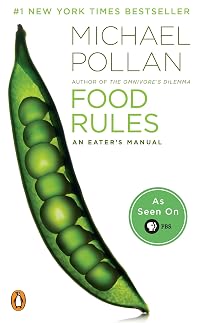
Food Rules: An Eater's Manual
by Michael Pollan
On This Page
Description
From the bestselling author of "The Omnivore's Dilemma" and "In Defense of Food" comes this collection of simple, sensible, and easy to use rules--the perfect guide for anyone who would like to become more mindful of the food he or she eats. (Consumer Health).Tags
Recommendations
Member Reviews
I really enjoyed Food Rules and how it was short, simple, and to the point. A lot of “healthy living” books contain important information and genuine wisdom, but it might be hidden between hundreds of pages of what is suddenly a memoir and lots of philosophical speculation, making you think, “what am I even doing here?!”
Meanwhile, this book is so precise that all advice is listed by number. While some of the “rules” may seem obvious if you’re trying to eat healthy (i.e. rule 36 - don’t eat breakfast cereals that change the color of the milk), they are smart, and I still felt compelled to take notes. Some favorites are:
13. Eat only foods that will eventually rot.
19. If it comes from a plant, eat it; if it was made in a show more plant, don’t.
24. The Chinese proverb “Eating what stands on one leg [mushrooms and plant foods] is better than eating what stands on two legs [fowl], which is better than eating what stands on four legs [cows, pigs, and other mammals].”
37. “The whiter the bread, the sooner you’ll be dead.” show less
Meanwhile, this book is so precise that all advice is listed by number. While some of the “rules” may seem obvious if you’re trying to eat healthy (i.e. rule 36 - don’t eat breakfast cereals that change the color of the milk), they are smart, and I still felt compelled to take notes. Some favorites are:
13. Eat only foods that will eventually rot.
19. If it comes from a plant, eat it; if it was made in a show more plant, don’t.
24. The Chinese proverb “Eating what stands on one leg [mushrooms and plant foods] is better than eating what stands on two legs [fowl], which is better than eating what stands on four legs [cows, pigs, and other mammals].”
37. “The whiter the bread, the sooner you’ll be dead.” show less
A quick hymnal of pithy dietary guidelines, expanding on the basic pronouncement to "eat real food, not too much, mostly plants" as detailed in his previous books. Most of the advice is good, but at times he treads into the dangerous margins of anti-scientific "chemicals are bad" thinking.
Specifically, he prohibits eating anything that the average third grader would have difficulty pronouncing, as if phytomenadione and xanthophyll beta-cryptoxanthin roll off the tongue (vitamin K and A, respectively). There's a reason why we refer to them by a single letter, most scientific terminology can sound scary if abused ("don't drink that, it's full of dihydrogen monoxide!") Similarly, he urges us to restrict our diets to things that our show more great-grandparents ate. As if there has been no possibility of technological or scientific progress in the past 90 years.
It's also important to keep in mind his target audience, the average overweight American slob who drives everywhere, and is plopped on the couch the rest of time, slurping down Big Macs and Cheetos and diet Coke as they watch sportsball on the TeeVee. Or the upper middle class yuppie who pays 6x as much for their groceries at Whole Food Market and only eats organic free-range grass fed cheeseburgers at the local gastropub, but whose diet is not appreciatively more healthy.
The advice isn't nearly as relevant for the minimum wage immigrant living in a food desert, or for the millions of people who struggle just to put enough food on the table to avoid going to bed hungry by necessity and not by choice. show less
Specifically, he prohibits eating anything that the average third grader would have difficulty pronouncing, as if phytomenadione and xanthophyll beta-cryptoxanthin roll off the tongue (vitamin K and A, respectively). There's a reason why we refer to them by a single letter, most scientific terminology can sound scary if abused ("don't drink that, it's full of dihydrogen monoxide!") Similarly, he urges us to restrict our diets to things that our show more great-grandparents ate. As if there has been no possibility of technological or scientific progress in the past 90 years.
It's also important to keep in mind his target audience, the average overweight American slob who drives everywhere, and is plopped on the couch the rest of time, slurping down Big Macs and Cheetos and diet Coke as they watch sportsball on the TeeVee. Or the upper middle class yuppie who pays 6x as much for their groceries at Whole Food Market and only eats organic free-range grass fed cheeseburgers at the local gastropub, but whose diet is not appreciatively more healthy.
The advice isn't nearly as relevant for the minimum wage immigrant living in a food desert, or for the millions of people who struggle just to put enough food on the table to avoid going to bed hungry by necessity and not by choice. show less
I was recommended Pollan's books as I am very interested in botany, and picked this one at random. It seemed like a good first choice, as it was a short and quick-looking read that covered a lot of different areas.
What I read was a logical fallacy ridden, anti-science self-help book. It presents some good advice---don't overdo high sugar foods---but also a ton of nonsense. Don't eat anything with preservatives! Vitamin C is a preservative, and last I checked, it was good for us. Don't eat anything with ingredients a 3rd grader can't pronounce! A 3rd grader would have difficulty pronouncing ascorbic acid, but its good for us (its vitamin C). Don't eat high-frustose corn syrup! And yet we are encouraged to eat fruits that naturally show more contain fructose, glucose, and sucrose (and some of which have more fructose than HFCS). Stay away from chemicals! Well...
This book is nothing but naturalistic fallacies and fad advice, with a healthy dollop of fear mongering. This book is no better than any other fad diet book. You might as well write a diet based on your astrological sign. show less
What I read was a logical fallacy ridden, anti-science self-help book. It presents some good advice---don't overdo high sugar foods---but also a ton of nonsense. Don't eat anything with preservatives! Vitamin C is a preservative, and last I checked, it was good for us. Don't eat anything with ingredients a 3rd grader can't pronounce! A 3rd grader would have difficulty pronouncing ascorbic acid, but its good for us (its vitamin C). Don't eat high-frustose corn syrup! And yet we are encouraged to eat fruits that naturally show more contain fructose, glucose, and sucrose (and some of which have more fructose than HFCS). Stay away from chemicals! Well...
This book is nothing but naturalistic fallacies and fad advice, with a healthy dollop of fear mongering. This book is no better than any other fad diet book. You might as well write a diet based on your astrological sign. show less
I'd heard Michael Pollan's "eat food, not too much, mostly plants" quote many times, and have meant to read his books. So, when I saw this 64-point, 90-something page condensed version of his work available as an e-book download from my library last night, I snagged it and read it within a couple of hours. Simple, sensible, mostly familiar stuff. Easy to put into practice? No, not for me. Following his rules is something to aspire to though, and I appreciate that he broke it down to the essentials.
Michael Pollan and Maira Kalman together: a perfect pairing, delicious. These rules about eating might just as easily have come out of the mouth of Alice Waters as from my grandmother who though she made everything from scratch, fed me way too much apple pie and egg noodles. My mother on the other hand, made the colorful plate a daily model. So I didn't need the rules to tell me how to eat, but I love the humor in the obvious and I love to be reaffirmed in my own prejudices. Take this one for instance: "It's Not Food if It Arrived Through the Window of Your Car." Aw, come on now, don't your neighbors still deliver free-range hand-plucked chickens straight out their Chevy truck window? Here's one I particularly like: "Do All Your Eating show more at a Table." I think I would add, if your car smells like old take out instead of fresh apples, maybe you need to rethink your eating habits. And two of my very favorites: "No Labels on the Table" and "Place a Bouquet of Flowers on the Table and Everything Will Taste Twice as Good." These are rules for people who love food, that is people who truly enjoy real food. They are mostly common sense rules with a dash of humor. Kalman, whose illustrations are as colorful as your plate plate ought to be, is one of my all time favorite illustrators; they are quirky, well down right funny, and as always right on target. show less
I thoroughly enjoyed Michael Pollan's latest book. He has condensed his research and given it to us in an easy-to-swallow and remember listing of guidelines broken out under his main three headings: Eat Food, Mostly Plants, Not Too Much.
He left out the scientific factoids that can be found in his other books and just gave the headlines here. You can read it in an hour and carry the knowledge forever.
Simple!
He left out the scientific factoids that can be found in his other books and just gave the headlines here. You can read it in an hour and carry the knowledge forever.
Simple!
This is not a book that adds much to the knowledge imparted by Pollan's other books, In Defense of Food and The Omnivore's Dilemma. Those who expected it to be a new treatise may be disappointed. Arguably, it's not really a book at all, but more a collection of aphorisms and mini-essays.
But there is another way to look at this small paperback. There is a wealth of practical wisdom from many cultures and generations here that, if we make use of them, could replace shelves of diet and fitness books. Pollan reminds us that much of what Americans eat today really isn't food and that the "edible foodlike substances" that have replaced the real stuff play a huge part in our diet-related epidemics. Most books on food and nutrition won't tell show more us to avoid eating things that our grandmothers wouldn't have recognized as food, or to avoid eating things advertised on television. But these are key points: the countless choices we make in response to relentless promotional messages, or in resistance to them, will determine how fit and healthy we will be.
The most important section is the last, with simple guidelines on *how* to eat--not too much, not too fast, cook it at home--provide keys to improved health and wellness. Pollan could have devoted hundreds of pages explaining these principles at length. Instead, he provides a portable and accessible set of tips and reminders that can be returned to in a moment and applied for a lifetime. show less
But there is another way to look at this small paperback. There is a wealth of practical wisdom from many cultures and generations here that, if we make use of them, could replace shelves of diet and fitness books. Pollan reminds us that much of what Americans eat today really isn't food and that the "edible foodlike substances" that have replaced the real stuff play a huge part in our diet-related epidemics. Most books on food and nutrition won't tell show more us to avoid eating things that our grandmothers wouldn't have recognized as food, or to avoid eating things advertised on television. But these are key points: the countless choices we make in response to relentless promotional messages, or in resistance to them, will determine how fit and healthy we will be.
The most important section is the last, with simple guidelines on *how* to eat--not too much, not too fast, cook it at home--provide keys to improved health and wellness. Pollan could have devoted hundreds of pages explaining these principles at length. Instead, he provides a portable and accessible set of tips and reminders that can be returned to in a moment and applied for a lifetime. show less
Members
- Recently Added By
Lists

Non-Fiction Worth Reading
1,016 works; 255 members

Books Read in 2010
631 works; 11 members

Reading LIst
648 works; 1 member
Author Information

Michael Pollan is a contributing writer for "The New York Times Magazine" as well as a contributing editor at "Harper's" magazine. He is the author of two prize-winning books: "Second Nature: A Gardener's Education" and "A Place of My Own: The Education of an Amateur Builder." Pollan lives in Connecticut with his wife and son. (Publisher Provided) show more Michael Pollan was born in 1955 and raised on Long Island, NY. He received his B.A. in English from Bennington College in 1977 and his Masters, also in English, from Columbia University, in 1981. He is the author of Cooked: A Natural History of Transformation, as well as 5 New York Times bestselling books: Food Rules: An Eater's Manual, In Defense of Food: An Eater's Manifesto, The Omnivore's Dilemma: A Natural History of Four Meals. The Botany of Desire: A Plant's-Eye View of the World and Ho wto Change Your Mind: What the New Science of Psychedelics Teaches Us about Consciousness, Dying, Addiction, Depression, and Transcendence. (Bowker Author Biography) show less
Some Editions
Awards and Honors
Notable Lists
Series
Belongs to Publisher Series
Work Relationships
Common Knowledge
- Canonical title*
- Oikean ruoan ohjeet : Syöjän käsikirja
- Original title
- Food Rules: An Eater's Manual
- Alternate titles
- Oikean ruoan ohjeet : Syöjän käsikirja; Les Regles d'une Saine Alimentation
- Original publication date
- 2009-12-29
- Related movies
- Food, Inc. (2008 | IMDb); Michael Pollan on Food Rules: An Eater's Manual
- Dedication
- For my mother,
who always knew butter was better for you
than margarine - First words
- Eating in our time has gotten complicated---needlessly so, in my opinion.
- Quotations
- "It's not food if it came from the window of your car."
"The banquet is in the first bite."
"If it came from a plant, eat it; if it was made in a plant, don't."
"Eat only foods that will eventually rot."
"Better to pay the grocer than the doctor."
"Better to go to waste than to (the) waist." (show all 9)
"Don't eat breakfast cereals that change to color of your milk."
"The whiter the bread, the sooner you'll be dead."
It is entirely possible to eat healthily without knowing what an antioxidant is. - Last words
- (Click to show. Warning: May contain spoilers.)"All things in moderation," it is often said, but we should never forge the wise addendum, sometimes attributed to Oscar Wilde: "Including moderation."
- Blurbers
- Bruni, Frank; Maslin, Janet
*Some information comes from Common Knowledge in other languages. Click "Edit" for more information.
Classifications
- Genres
- Health & Wellness, General Nonfiction, Nonfiction, Food & Cooking, Science & Nature
- DDC/MDS
- 613.2 — Applied science & technology Medicine & health Personal health and Fitness Dietetics
- LCC
- RA784 .P6429 — Medicine Public aspects of medicine Public aspects of medicine Public health. Hygiene. Preventive medicine Personal health and hygiene
- BISAC
Statistics
- Members
- 3,340
- Popularity
- 5,091
- Reviews
- 118
- Rating
- (3.86)
- Languages
- 12 — Chinese, Dutch, English, Estonian, Finnish, French, German, Italian, Korean, Portuguese, Spanish, Vietnamese
- Media
- Paper, Audiobook, Ebook
- ISBNs
- 44
- ASINs
- 16