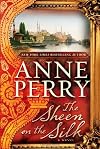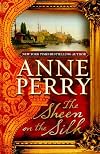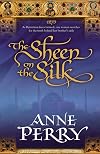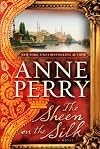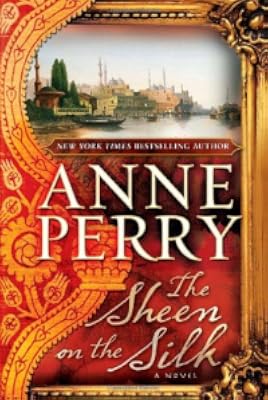
The Sheen on the Silk
by Anne Perry
On This Page
Description
Arriving in the ancient Byzantine city in the year 1273, Anna Zarides has only one mission: to prove the innocence of her twin brother, Justinian, who has been exiled to the desert for conspiring to kill Bessarion, a nobleman. Disguising herself as a eunuch named Anastasius, Anna moves freely about in society, using her skills as a physician to manoeuver close to the key players involved in her brother's fate.Tags
Recommendations








Member Recommendations
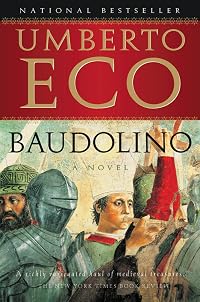
Limelite Similarly set in Constantinople in the Middle Ages, Eco's book, also a saga, is literary, far richer, and more dynamic.
Member Reviews
I wanted to love this book -- I'm a fan of Anne Perry's Victorian-era mysteries featuring Pitt and Monk, and even enjoyed her segue into the World War I era with a quartet of novels which I felt were generally less successful. And I'm a big fan of mainstream historical fiction, including the epics of authors like Sharon Kay Penman, whose company Perry is clearly trying to join with this, her first 'mainstream' historical novel.
But although I plodded my way diligently through all 500-plus pages, doing so sometimes started feeling like a chore; this was a book that, despite a fascinating setting -- the Byzantine empire in the late 13th century, threatened by a repeat of the devastating attack by Roman Catholic crusaders that had occurred show more in 1204 -- and a few vivid characters, was too easy to put down and forget about, even midway through.
The plot -- loosely, at least -- revolves around Anna, who disguises herself as a eunuch and travels to the empire's capital in order to try to unravel the mystery surrounding her brother's banishment to a distant monastery for having murdered a young Byzantine nobleman. But while most of Perry's conventional mysteries are resolved within the few weeks required for one of her detectives to ferret out the truth, this novel drags on for nearly a decade. Anna, disguised as Anastasius the eunuch, establishes herself as a physician to the nobility and even treats the emperor. His/her path crosses with members of the nobility, including some who are extraordinarily devout, extraordinarily manipulative and even extraordinarily murderous. The main plot becomes caught up in far too many sub-plots, many of which aren't well-developed or convincing. That in turn distracts the reader from the main plot, which in turn is related to Byzantine issues of state: will Byzantium accept changes to its Greek Orthodox faith in order to save itself from invasion from another bunch of crusaders? What will those who oppose these compromises -- who include some of the novels heroes and its villains -- resort to in order to preserve their way of life? The city is at war with itself, diplomats on one side -- including the city's emperor, Michael -- and religious purists like bishop Constantine on the other.
Unfortunately, instead of allowing the action to drive the plot, Perry far too often allows her narrative to fall into ruminations about theological issues, the nature of good and evil, heaven and hell, the role of religion in life, etcetera. Some of these discussions last for pages, and by the end had become so repetitious that I literally rolled my eyes, closed the book and thumped it down on a table on reading the following comment by one key character to another: "You missed the grace and the passion, the courage beyond anything we can imagine, the hope even in absolute darkness, the gentleness, the laughter and the love that has no shadow. The journey is longer and steeper than any of us can understand, but then heaven is higher, so it has to be steep, and far."
There is far too much florid, introspective language of that kind (always a feature of Perry's books) in this novel. It works when set in a shorter book, and when a character is in the midst of an epiphany, but is sententious, awkward and cumbersome when it happens every 20 pages or so. Anna notes of one character, "He described the funny and the absurd with pleasure and, she noticed, without cruelty. The more she listened to him, the more irrevocably she felt bound to the good in him." This could have been conveyed far more vividly in half as many words...
Perry has done a superb job of researching and recreating 13th century Byzantium, but I felt let down by the novel itself, the vehicle she used to try and convince her readers that it was a fascinating and dynamic place, a society so compelling that it becomes seductive to even those that start out as its enemies. It just doesn't work, and that's why I can't give this more than three stars or recommend it very heartily even to dedicated historical fiction readers. Byzantium isn't well-trodden territory in historical fiction, and this was Perry's chance to make it as fascinating and immediate to readers as Sharon Penman has done with medieval Wales and Colleen McCullough with ancient Rome. She doesn't pull it off, and it's because the novel meanders too much, pulled down by its multiple subplots, theological meandering and repetitive musing.
This will appeal to Perry's hardcore fans; those who sometimes struggle with her tendency to have her characters talk incessantly about their feelings and existential thoughts will find this book a far tougher read than her detective novels, because it's moving at a much slower pace. Personally, after finishing this, I really felt the need to go off and read something tightly and vividly written. show less
But although I plodded my way diligently through all 500-plus pages, doing so sometimes started feeling like a chore; this was a book that, despite a fascinating setting -- the Byzantine empire in the late 13th century, threatened by a repeat of the devastating attack by Roman Catholic crusaders that had occurred show more in 1204 -- and a few vivid characters, was too easy to put down and forget about, even midway through.
The plot -- loosely, at least -- revolves around Anna, who disguises herself as a eunuch and travels to the empire's capital in order to try to unravel the mystery surrounding her brother's banishment to a distant monastery for having murdered a young Byzantine nobleman. But while most of Perry's conventional mysteries are resolved within the few weeks required for one of her detectives to ferret out the truth, this novel drags on for nearly a decade. Anna, disguised as Anastasius the eunuch, establishes herself as a physician to the nobility and even treats the emperor. His/her path crosses with members of the nobility, including some who are extraordinarily devout, extraordinarily manipulative and even extraordinarily murderous. The main plot becomes caught up in far too many sub-plots, many of which aren't well-developed or convincing. That in turn distracts the reader from the main plot, which in turn is related to Byzantine issues of state: will Byzantium accept changes to its Greek Orthodox faith in order to save itself from invasion from another bunch of crusaders? What will those who oppose these compromises -- who include some of the novels heroes and its villains -- resort to in order to preserve their way of life? The city is at war with itself, diplomats on one side -- including the city's emperor, Michael -- and religious purists like bishop Constantine on the other.
Unfortunately, instead of allowing the action to drive the plot, Perry far too often allows her narrative to fall into ruminations about theological issues, the nature of good and evil, heaven and hell, the role of religion in life, etcetera. Some of these discussions last for pages, and by the end had become so repetitious that I literally rolled my eyes, closed the book and thumped it down on a table on reading the following comment by one key character to another: "You missed the grace and the passion, the courage beyond anything we can imagine, the hope even in absolute darkness, the gentleness, the laughter and the love that has no shadow. The journey is longer and steeper than any of us can understand, but then heaven is higher, so it has to be steep, and far."
There is far too much florid, introspective language of that kind (always a feature of Perry's books) in this novel. It works when set in a shorter book, and when a character is in the midst of an epiphany, but is sententious, awkward and cumbersome when it happens every 20 pages or so. Anna notes of one character, "He described the funny and the absurd with pleasure and, she noticed, without cruelty. The more she listened to him, the more irrevocably she felt bound to the good in him." This could have been conveyed far more vividly in half as many words...
Perry has done a superb job of researching and recreating 13th century Byzantium, but I felt let down by the novel itself, the vehicle she used to try and convince her readers that it was a fascinating and dynamic place, a society so compelling that it becomes seductive to even those that start out as its enemies. It just doesn't work, and that's why I can't give this more than three stars or recommend it very heartily even to dedicated historical fiction readers. Byzantium isn't well-trodden territory in historical fiction, and this was Perry's chance to make it as fascinating and immediate to readers as Sharon Penman has done with medieval Wales and Colleen McCullough with ancient Rome. She doesn't pull it off, and it's because the novel meanders too much, pulled down by its multiple subplots, theological meandering and repetitive musing.
This will appeal to Perry's hardcore fans; those who sometimes struggle with her tendency to have her characters talk incessantly about their feelings and existential thoughts will find this book a far tougher read than her detective novels, because it's moving at a much slower pace. Personally, after finishing this, I really felt the need to go off and read something tightly and vividly written. show less
I've read most of Anne Perry's books and liked them, but this one far surpasses the others. Perhaps it is just that it is easier to break free of constraints in a stand alone novel, one that is set in an entirely different time and place from her series.
The story is set in Constantinople in the 1270s. Anna Lascaris Zarides has come to Constantinople from her home in Nicea. Her twin brother Justinian has been exiled for his role in the death of the popular Bessarion, who was leading the fight against a union of the Orthodox Church and the Roman. The emperor, Michael Peleogus, has agreed to the union with Rome in order to save Constantinople from being attacked by Crusaders as it was 70 years previously, an attack from which it has not show more recovered.
Anna is a physician, but in order to operate openly in the city she pretends to be a eunuch. She gathers what information she can over a few years, treating everyone from the emperor to the poor while doing so.
The strength of this epic work is in its characters. Anna is an outstanding character, but there are others, from all sides of the various conflicts going on. The most amazing character is Zoe, who saw her mother raped and murdered in the sack of the city in 1204, and who will do anything to avoid a repeat of that disaster. Zoe is Constantinople, beautiful, old, cunning, a master of plots and counterplots. Other important characters include a papal legate, a Venetian soldier, the Orthodox clergyman who is determined that the city will not abandon its faith, and others. They are rich and complex characters, driven by the needs of their positions and beliefs, some convinced they know God's will, others seeking God's grace.
It is a long book, but tightly written... not a wasted page in it. I think that when 2020 comes around, this book will be considered one of the best of the decade.
Disclaimer: I received my copy of the book free from the Amazon Vine program in exchange for a review. I would have reviewed this book the same, however, if I had not gotten it free. show less
The story is set in Constantinople in the 1270s. Anna Lascaris Zarides has come to Constantinople from her home in Nicea. Her twin brother Justinian has been exiled for his role in the death of the popular Bessarion, who was leading the fight against a union of the Orthodox Church and the Roman. The emperor, Michael Peleogus, has agreed to the union with Rome in order to save Constantinople from being attacked by Crusaders as it was 70 years previously, an attack from which it has not show more recovered.
Anna is a physician, but in order to operate openly in the city she pretends to be a eunuch. She gathers what information she can over a few years, treating everyone from the emperor to the poor while doing so.
The strength of this epic work is in its characters. Anna is an outstanding character, but there are others, from all sides of the various conflicts going on. The most amazing character is Zoe, who saw her mother raped and murdered in the sack of the city in 1204, and who will do anything to avoid a repeat of that disaster. Zoe is Constantinople, beautiful, old, cunning, a master of plots and counterplots. Other important characters include a papal legate, a Venetian soldier, the Orthodox clergyman who is determined that the city will not abandon its faith, and others. They are rich and complex characters, driven by the needs of their positions and beliefs, some convinced they know God's will, others seeking God's grace.
It is a long book, but tightly written... not a wasted page in it. I think that when 2020 comes around, this book will be considered one of the best of the decade.
Disclaimer: I received my copy of the book free from the Amazon Vine program in exchange for a review. I would have reviewed this book the same, however, if I had not gotten it free. show less
This is a long book and it did take me awhile to get into it, but once my interest was piqued, then I really enjoyed it. It is quite a bit different than Perry's earlier works and the time frame and location are certainly different. The book is set in Byzantium (which later on in history became the city of Constantinople) in the 13 century. The premise behind the book is the differences in points of view and in religious dogma between the Roman Catholic Church and the Greek Orthodox Church. It is also set around the time of the Crusades, so that too is also thrown into the mix. People are fighting for their homeland and their religion and it is a very unsettling and unstable time. I love the way Anne Perry sets the stage in her books, show more and even though this one was slower than her other works, the stage was set magnificently. I found that I really got into the time and place and really cared about what happened to Anna and her friends. Anna is a wonderful heroine - a strong female who is also a doctor and one who cares deeply for the human race. And no one can weave a plot like Anne Perry! It is her own particular secret and that is what keeps me turning the pages in every book she writes. I think that this book puts Anne Perry near the top of the historical novel writers list because she has diverged so much from her regular series, and still has managed to write a book that fascinates and enthralls. show less
In The Sheen in the Silk, Anne Perry enters different territory than with her Victorian-era mysteries. Set in Constantinople in the 1270s and ‘80s, it features the adventures of Anna Zarides, a young woman who goes to the city to investigate a murder supposedly committed by her brother. Anna dresses as a eunuch and poses as a physician, so that she may better conduct her inquiries. All of this is set against a larger struggle between the Eastern Orthodox church and western Christianity.
Oh, dear. I really wanted to like this book. A beautiful setting, an intriguing plot—I thought, how could you go wrong with that? Well, a lot of things. It’s not that Anne Perry is a bad writer; it’s just that this particular novel wasn’t show more interesting or intriguing enough to make me want to read on. From the get-go, the premise of the book isn’t entirely clear; for the first two hundred pages or so, I had a hard time sorting out the characters and what had happened to whom. There also wasn’t enough back story to any of the characters from the start, so I was confused for a long time before things began to make some sense.
Another one of the book’s problem is that it’s a mix of genres, both mystery and epic historical fiction, if you want to call it that. This confused and confusing mix of genres ultimately works against the novel; because it frequently becomes a convoluted mess.
Another thing I didn’t like about this book were the characters, especially the main one; it seems as though the author pulled out all the clichés to describe here. How many times before have we seen the enlightened female physician in historical fiction? Also, I thought that Anna was extremely difficult to like as a character, simply because we never got to see her as anything other than cold and clinical. In fact, Anna spends so much time with her patients and not enough time investigating the murder that I began to get bored after a while. Her search is conducted over a number of years, too, which lessened the sense of urgency that make you as the reader want to read on. Anne Perry’s descriptions of 13th century Constantinople are gorgeous, and her writing style is very straightforward; but I simply did not connect to any of the characters or the implausible plot for me to continue reading after page 200. It’s a shame, because, having read some of her Thomas Pitt novels, I was expecting something much better. show less
Oh, dear. I really wanted to like this book. A beautiful setting, an intriguing plot—I thought, how could you go wrong with that? Well, a lot of things. It’s not that Anne Perry is a bad writer; it’s just that this particular novel wasn’t show more interesting or intriguing enough to make me want to read on. From the get-go, the premise of the book isn’t entirely clear; for the first two hundred pages or so, I had a hard time sorting out the characters and what had happened to whom. There also wasn’t enough back story to any of the characters from the start, so I was confused for a long time before things began to make some sense.
Another one of the book’s problem is that it’s a mix of genres, both mystery and epic historical fiction, if you want to call it that. This confused and confusing mix of genres ultimately works against the novel; because it frequently becomes a convoluted mess.
Another thing I didn’t like about this book were the characters, especially the main one; it seems as though the author pulled out all the clichés to describe here. How many times before have we seen the enlightened female physician in historical fiction? Also, I thought that Anna was extremely difficult to like as a character, simply because we never got to see her as anything other than cold and clinical. In fact, Anna spends so much time with her patients and not enough time investigating the murder that I began to get bored after a while. Her search is conducted over a number of years, too, which lessened the sense of urgency that make you as the reader want to read on. Anne Perry’s descriptions of 13th century Constantinople are gorgeous, and her writing style is very straightforward; but I simply did not connect to any of the characters or the implausible plot for me to continue reading after page 200. It’s a shame, because, having read some of her Thomas Pitt novels, I was expecting something much better. show less
The perfect book for me to read while I was in Istanbul and exploring the mosques and churches, this novel gave me a historical framework for all the sights I was seeing. Plus, the suspense of solving the murders, the division between the Roman church and Greek Orthodoxy, and the budding romance of the main character, all made this rather long work a page-turner.
It's always nice to see a good author show versatility, and Anne Perry has done that with this book. It has even more depth and substance than her popular detective series and greater results to be gained if the puzzles are worked out. While all the principles are trying to work out an idea of what is really happening, what has happened, and what is going to happen, kismet comes along and gives it all a new twist. In trying to save Constantinople from another sacking by the "Christian crusaders" on their way to Jerusalem, the Byzantines consider signing a truce and agreement with the Vatican and the Roman Catholic Pope, a move which would likely lead to the eastern church losing much of its self determination to the less openminded show more Roman Catholics. Rome uses many tactics to gain the upper hand, but many of the Byzantine residents are just as clever and resourceful in combating the supposed threat. This is a delicious look at the politics of the area in 1276, including lots of interesting detail and much religious philosophy of the era and much historical fact. The western world probably owes a great deal to the brave citizens of Constantinople, in culture, heritage, and freedom as well as the resulting history. show less
I am very familiar with Anne Perry from her two mystery series set in London and surrounds, back in the early part of the last century. Her ability to evoke a sense of place is laudable, and I thought that this book might be a good companion for a car trip I was taking, especially since this book is set in a time and place that fascinate me: Constantinople in the 1270's. I was in Istanbul 700 years after this story takes place, and the remnants of history, culture, religions, and war are still firmly planted in my memories.
The story follows Anna Lascaris who, disguised as Anastasius, a eunuch and physician comes to Constantinople in search of information that can help rescue her twin brother Justinian from shadow of crime (he's been show more accused of colluding in murder) and the banishment that resulted. Over the next decade, Anna establishes herself as a physician of skill, and works her way into the confidences and households of some of the most important homes in the city, including the emperor himself, and high figures in the Eastern Orthodox church. All the while, the division of faith between the church in Byzantium and the Roman Catholic Church in Rome. War, in the form of another crusade, hovers in the background. Anna struggles with her own feelings as a woman, as a physician, as a believer in the eastern church. And struggle it is, because there is a lot of secrecy and duplicity surrounding her. She is not the only one hiding something.
To be honest, the beauty of the story for me was in the city, the passions and powers that swept through it. Less interesting were the people (and there were a lot of characters in this tale). Anna was well-drawn, if not rather dull for a woman disguised as a eunuch, but some of the others, including a couple of main characters, were more of a caricature, particularly the mother/daughter duo of Zoe and Helena. I also found what little information that slipped through about herbal remedies interesting. Because of that and the setting captured me, I give this a 3 star. show less
The story follows Anna Lascaris who, disguised as Anastasius, a eunuch and physician comes to Constantinople in search of information that can help rescue her twin brother Justinian from shadow of crime (he's been show more accused of colluding in murder) and the banishment that resulted. Over the next decade, Anna establishes herself as a physician of skill, and works her way into the confidences and households of some of the most important homes in the city, including the emperor himself, and high figures in the Eastern Orthodox church. All the while, the division of faith between the church in Byzantium and the Roman Catholic Church in Rome. War, in the form of another crusade, hovers in the background. Anna struggles with her own feelings as a woman, as a physician, as a believer in the eastern church. And struggle it is, because there is a lot of secrecy and duplicity surrounding her. She is not the only one hiding something.
To be honest, the beauty of the story for me was in the city, the passions and powers that swept through it. Less interesting were the people (and there were a lot of characters in this tale). Anna was well-drawn, if not rather dull for a woman disguised as a eunuch, but some of the others, including a couple of main characters, were more of a caricature, particularly the mother/daughter duo of Zoe and Helena. I also found what little information that slipped through about herbal remedies interesting. Because of that and the setting captured me, I give this a 3 star. show less
Members
- Recently Added By
Author Information

199+ Works 55,124 Members
Anne Perry was born Juliet Hume on October 28, 1938 in Blackheath, London. Sent to Christchurch, New Zealand to recover from a childhood case of severe pneumonia, she became very close friends with another girl, Pauline Parker. When Perry's family abandoned her, she had only Parker to turn to, and when the Parkers planned to move from New Zealand, show more Parker asked that Perry be allowed to join them. When Parker's mother disagreed, Perry and Parker bludgeoned her to death. Perry eventually served five and a half years in an adult prison for the crime. Once she was freed, she changed her name and moved to America, where she eventually became a writer. Her first Victorian novel, The Cater Street Hangman, was published in 1979. Although the truth of her past came out when the case of Mrs. Parker's murder was made into a movie (Heavenly Creatures), Perry is still a popular author and continues to write. She has written over 50 books and short story collections including the Thomas Pitt series, the William Monk series, and the Daniel Pitt series. Her story, Heroes, won the 2001 Edgar Award for Best Short Story. Her title's Blind Justice and The Angel Court Affair made The New York Times Best Seller List. (Bowker Author Biography) show less
Awards and Honors
Awards
Common Knowledge
- Canonical title
- The Sheen on the Silk
- Original title
- The Sheen on the Silk
- People/Characters
- Anna Zarides
- Important places*
- Constantinople
*Some information comes from Common Knowledge in other languages. Click "Edit" for more information.
Classifications
Statistics
- Members
- 443
- Popularity
- 69,122
- Reviews
- 15
- Rating
- (3.24)
- Languages
- English, French, German, Spanish
- Media
- Paper, Audiobook, Ebook
- ISBNs
- 35
- ASINs
- 6