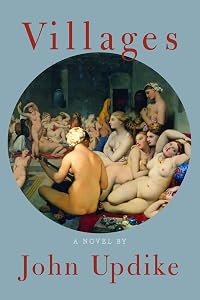
Villages
by John Updike
On This Page
Description
John Updike’s twenty-first novel, a bildungsroman, follows its hero, Owen Mackenzie, from his birth in the semi-rural Pennsylvania town of Willow to his retirement in the rather geriatric community of Haskells Crossing, Massachusetts. In between these two settlements comes Middle Falls, Connecticut, where Owen, an early computer programmer, founds with a partner, Ed Mervine, the successful firm of E-O Data, which is housed in an old gun factory on the Chunkaunkabaug River. Owen’s show more education (Bildung) is not merely technical but liberal, as the humanity of his three villages, especially that of their female citizens, works to disengage him from his youthful innocence. As a child he early felt an abyss of calamity beneath the sunny surface quotidian, yet also had a dreamlike sense of leading a charmed existence. The women of his life, including his wives, Phyllis and Julia, shed what light they can. At one juncture he reflects, “How lovely she is, naked in the dark! How little men deserve the beauty and mercy of women!” His life as a sexual being merges with the communal shelter of villages: “A village is woven of secrets, of truths better left unstated, of houses with less window than opaque wall.” This delightful, witty, passionate novel runs from the Depression era to the early twenty-first century. From the Hardcover edition. show lessTags
Recommendations











Member Reviews
Villages was one of Updike's later novels, released in 2005. Like many of his earlier novels, it's based around a story of middle class adultery in average-town America, with the main character looking back in his old age at the sex and love which has been indelibly weaved throughout his life's story.
With the historical narrative set mainly in the 1950s - 1970s, the protagonist, Owen Mackenzie - an MIT graduate and early pioneer of computer technology - lives comfortably in various 'villages' around the east coast of the States. He is the kind of man who has always been enthralled by the smallest details of the women who have crossed his path, seeing beauty in all the differences of their physique and character. Not surprisingly, this show more appreciation leads to him being easily persuaded to loosen the moral tethers that bind his marriage, from which point there is no going back.
Selfish, self-centred, amoral, most of the characters echo the stereotypes from the Rabbit Angstrom novels, with the familiar theme of middle-age boredom setting in amongst the weekend cocktail party set. That being said, this novel is much more focused on Mackenzie's emotional connections (or lack of) to his sexual affairs, and as such is probably most similar to his earlier Couples novel.
The sexual reminiscing is fairly unerotic, but as usual Updike manages to make the lives of weak, morally bankrupt characters totally engaging.
I'm a big Updike fan, and as always was blown away by the utter skill of his narrative. Not my favourite of his books so far, but enjoyable nonetheless. show less
With the historical narrative set mainly in the 1950s - 1970s, the protagonist, Owen Mackenzie - an MIT graduate and early pioneer of computer technology - lives comfortably in various 'villages' around the east coast of the States. He is the kind of man who has always been enthralled by the smallest details of the women who have crossed his path, seeing beauty in all the differences of their physique and character. Not surprisingly, this show more appreciation leads to him being easily persuaded to loosen the moral tethers that bind his marriage, from which point there is no going back.
Selfish, self-centred, amoral, most of the characters echo the stereotypes from the Rabbit Angstrom novels, with the familiar theme of middle-age boredom setting in amongst the weekend cocktail party set. That being said, this novel is much more focused on Mackenzie's emotional connections (or lack of) to his sexual affairs, and as such is probably most similar to his earlier Couples novel.
The sexual reminiscing is fairly unerotic, but as usual Updike manages to make the lives of weak, morally bankrupt characters totally engaging.
I'm a big Updike fan, and as always was blown away by the utter skill of his narrative. Not my favourite of his books so far, but enjoyable nonetheless. show less
It's odd that while I have been a voracious reader all my life I had never read anything by Updike. I remember seeing the Rabbit books in bookstores and just not being interested. Yet I read books by others who were almost contemporaries: John Cheever, Norman Mailer, others.
In some ways this book reminded me of Cheever, although it does not have the distrust of women in it that Cheever seems to broadcast. The themes seem similar: middle-class marriages, sexual relations.
The villages in this book are the stages of life of the main character, Owen Mackenzie. Owen seems obsessed with satisfying his sexual urges through most of the middle period, while he's more relaxed in the other two times. I was not sure what he was really striving for show more with all those adulterous ventures. In fact, the fault may be in me, as I soon tired of them and didn't want to see more.
The language at times is beautiful. It often made me smile. show less
In some ways this book reminded me of Cheever, although it does not have the distrust of women in it that Cheever seems to broadcast. The themes seem similar: middle-class marriages, sexual relations.
The villages in this book are the stages of life of the main character, Owen Mackenzie. Owen seems obsessed with satisfying his sexual urges through most of the middle period, while he's more relaxed in the other two times. I was not sure what he was really striving for show more with all those adulterous ventures. In fact, the fault may be in me, as I soon tired of them and didn't want to see more.
The language at times is beautiful. It often made me smile. show less
John Updike has won every imaginable award for this stellar writing ability- including the Pulitzer Prize. His numerous novels written over the course of 50 years of time all share the common elements of candid descriptions of all phases of life, told from a white male’s point of view. Surely annoying and distasteful to the woke generation of readers.
Updike’s characters may not always be likable. In fact, Owen MacKenzie of "Villages", is downright offensive. One element that clearly offends is Updike’s eager willingness to blame women for Owen’s infidelities, and his graphic sexual descriptions of sexual encounters with various wanton, clingy, women from the village. However, maybe woke readers should consider it a compliment show more that the women in Owen’s life were the aggressors- in total control of their decisions, intentionally leading him down the path of immoral behavior and marital sin.
As the story begins, we learn Owen and his wife Phyllis were clearly sexually incompatible. It didn’t appear to be a deal breaker, or of much importance in the early years of marriage. And then the sexual revolution of the late 1960s began, and Owen got bored and strayed- over and over. As Owen becomes a successful entrepreneur in the budding computer software industry (with lots of vivid descriptions of the evolution of computers) his family grows to four children.
This is Owen’s story. He loves his work, and he loves his life. And his wife either loves him too much to complain about his extra-marital affairs, or does not love him enough to think it matters. We will never know. It would have been interesting to hear her side of the story- perhaps inspiring a 5 Star review. But Updike does not provide all the answers. All we know is that Owen is a man of intense physical passions. His one philosophical observation in the entire story is simply stated, “sex is a holiday”. It is just too bad his holidays had to occur outside the home with other women.
Adultery happens. It’s not for me to judge. But I fail to understand why anyone would indiscriminately go through a series of bawdy one night stands and casual affairs just for the sexual entertainment. So, please note that my rating is not based on condoning the actions of the characters, but is based on the captive quality of Updike’s storytelling, his ability to transition his narrative smoothly jumping back and forth in time, and his realistic descriptions of people. His characters come to life. Their pain, confusion, doubt, and insecurities are palpable. Likable or not, Owen MacKenzie conveys the image a real person. show less
Updike’s characters may not always be likable. In fact, Owen MacKenzie of "Villages", is downright offensive. One element that clearly offends is Updike’s eager willingness to blame women for Owen’s infidelities, and his graphic sexual descriptions of sexual encounters with various wanton, clingy, women from the village. However, maybe woke readers should consider it a compliment show more that the women in Owen’s life were the aggressors- in total control of their decisions, intentionally leading him down the path of immoral behavior and marital sin.
As the story begins, we learn Owen and his wife Phyllis were clearly sexually incompatible. It didn’t appear to be a deal breaker, or of much importance in the early years of marriage. And then the sexual revolution of the late 1960s began, and Owen got bored and strayed- over and over. As Owen becomes a successful entrepreneur in the budding computer software industry (with lots of vivid descriptions of the evolution of computers) his family grows to four children.
This is Owen’s story. He loves his work, and he loves his life. And his wife either loves him too much to complain about his extra-marital affairs, or does not love him enough to think it matters. We will never know. It would have been interesting to hear her side of the story- perhaps inspiring a 5 Star review. But Updike does not provide all the answers. All we know is that Owen is a man of intense physical passions. His one philosophical observation in the entire story is simply stated, “sex is a holiday”. It is just too bad his holidays had to occur outside the home with other women.
Adultery happens. It’s not for me to judge. But I fail to understand why anyone would indiscriminately go through a series of bawdy one night stands and casual affairs just for the sexual entertainment. So, please note that my rating is not based on condoning the actions of the characters, but is based on the captive quality of Updike’s storytelling, his ability to transition his narrative smoothly jumping back and forth in time, and his realistic descriptions of people. His characters come to life. Their pain, confusion, doubt, and insecurities are palpable. Likable or not, Owen MacKenzie conveys the image a real person. show less
John Updike's novels read just like his short stories, only longer. It's the same "slice of life" approach, he just gives you a broader slice. In Villages, we are presented with Updike's version of small town life, through the life of his main character, Owen Mackenzie. We're also presented with a brief history of the early decades of computer science, which is Owen's field. (This is integrated into the story somewhat more successfully than the history of postwar American art was in Updike's previous novel, Seek My Face.)
But what Villages is really about is sex. It follows Owen's sexual development from childhood to old age. Most of the book is about his many affairs with practically every woman in town. Updike has some interesting show more things to say about sex, some insightful things, some obvious things, some inconsistent things, and some just plain wrong things. On the whole, the attitude toward sex in this artistic portrayal of it isn't exactly healthy, but neither is it as sick as, say, Joyce's in Ulysses.
Not a bad read overall, but not fantastic either. show less
But what Villages is really about is sex. It follows Owen's sexual development from childhood to old age. Most of the book is about his many affairs with practically every woman in town. Updike has some interesting show more things to say about sex, some insightful things, some obvious things, some inconsistent things, and some just plain wrong things. On the whole, the attitude toward sex in this artistic portrayal of it isn't exactly healthy, but neither is it as sick as, say, Joyce's in Ulysses.
Not a bad read overall, but not fantastic either. show less
This novel, read magnificently in its audio version by Edward Herrmann, is vintage Updike. A man in his 70s remembers & celebrates the women in his life--mother, grandmother, girlfriends, 2 wives, lovers--their beauty, their sexuality, their contributions to his developing selfhood. Typically, there's lots of vividly described sex. The central question seems to be: Why do women fuck, when it comes with such tremendous costs for them, costs that men such as the book's subject mostly ignore? He sets the question (less successfully) in the context of the villages with which this fucking (& its consequences) occur. As he concludes, he writes (in a statement probably not adequately set up by the preceding narrative): "Life is show more madness.Villages exist to moderate that madness." Beautifully, perceptively wrtten, as always, with Updike's usual keen insights into the vicissitudes of the cultural experiences of middle-class American males since WWII, it could have explored more thoroughly & perceptively this moderating role of villages. show less
Basically, this is one man's life story, from birth to death. The book was a little too dry and rambling for me. I have enjoyed other Updike books, but this was not one of my favorites.
this is just a waterered down, condensed version of Rabbit. It is a shame that Updike is not interested in much else besides philandering cowardly selfish suburban husbands -- he's wasting his talent.
Members
- Recently Added By
Published Reviews
ThingScore 63
This book gives great pleasure. Some writers get more boring with age, but John Updike just gets more perspicacious. The wealth of connections and imagery increases with the years; the practice of literary expression makes the prose yet more perfect.
added by MikeBriggs
Unfortunately for the reader, his latest novel, "Villages,'' is very much in the "Licks of Love'' mode: it reconnoiters old territory surveyed by Mr. Updike many, many times before. Once again, we are treated to rambling, sometimes lascivious accounts of small-town adultery. Once again, we are given disquisitions on how sexual mores changed from the staid 1950's through the cultural revolution show more of the 60's and 70's, and into the roaring 90's. And once again, we are provided with a retrospective narrative in which the hero gazes into the rearview mirror of his life, reliving long-ago affairs and missed opportunities from the vertiginous vantage point of late middle age. show less
added by MikeBriggs
Author Information

342+ Works 53,758 Members
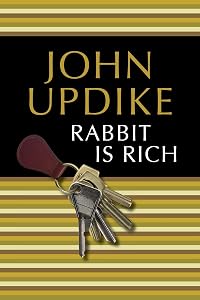
American novelist, poet, and critic John Updike was born in Reading, Pennsylvania on March 18, 1932. He received an A.B. degree from Harvard University, which he attended on a scholarship, in 1954. After graduation, he accepted a one-year fellowship to study painting at the Ruskin School of Drawing and Fine Art in Oxford, England. After returning show more from England in 1955, he worked for two years on the staff of The New Yorker. This marked the beginning of a long relationship with the magazine, during which he has contributed numerous short stories, poems, and book reviews. Although Updike's first published book was a collection of verse, The Carpentered Hen and Other Tame Creatures (1958), his renown as a writer is based on his fiction, beginning with The Poorhouse Fair (1959). During his lifetime, he wrote more than 50 books and primarily focused on middle-class America and their major concerns---marriage, divorce, religion, materialism, and sex. Among his best-known works are the Rabbit tetrology---Rabbit, Run (1960), Rabbit Redux (1971), Rabbit Is Rich (1981), and Rabbit at Rest (1988). Rabbit, Run introduces Harry "Rabbit" Angstrom as a 26-year-old salesman of dime-store gadgets trapped in an unhappy marriage in a dismal Pennsylvania town, looking back wistfully on his days as a high school basketball star. Rabbit Redux takes up the story 10 years later, and Rabbit's relationship with representative figures of the 1960s enables Updike to provide social commentary in a story marked by mellow wisdom and compassion in spite of some shocking jolts. In Rabbit Is Rich, Harry is comfortably middle-aged and complacent, and much of the book seems to satirize the country-club set and the swinging sexual/social life of Rabbit and his friends. Finally, in Rabbit at Rest, Harry arrives at the age where he must confront his mortality. Updike won the Pulitzer Prize for both Rabbit Is Rich and Rabbit at Rest. Updike's other novels range widely in subject and locale, from The Poorhouse Fair, about a home for the aged that seems to be a microcosm for society as a whole, through The Court (1978), about a revolution in Africa, to The Witches of Eastwick (1984), in which Updike tries to write from inside the sensibilities of three witches in contemporary New England. The Centaur (1963) is a subtle, complicated allegorical novel that won Updike the National Book Award in 1964. In addition to his novels, Updike also has written short stories, poems, critical essays, and reviews. Self-Consciousness (1989) is a memoir of his early life, his thoughts on issues such as the Vietnam War, and his attitude toward religion. He was elected to the American Academy of Arts and Letters in 1977. He died of lung cancer on January 27, 2009 at the age of 76. (Bowker Author Biography) John Updike was born in 1932, in Shillington, Pennsylvania. Since 1957 he has lived in Massachusetts. His novels have won the Pulitzer Prize, the National Book Award, the National Book Critics Circle Award, & the Howells Medal. (Publisher Provided) John Updike was born in 1932 and attended Harvard College and the Ruskin School of Drawing and Fine Art in Oxford, England. Form 1955 to 1957 he was a staff member of The New Yorker, which he contributed numerous writings. Updike's art criticism has appeared in publications including Arts and Antiques, The New Republic, The New York Times Book Review, and Realites, among many others. He is the author of such best-selling novels as Rabbit Run and Rabbit is Rich. His many works of fiction, poetry and criticism have been awarded the Pulitzer Prize, the National Book Award, the American Book Award, and the National Book Critics Circle Award. For the past 40 years he has lived in Massachusetts. (Publisher Provided) John Updike is the author of some 50 books, including collections of short stories, poems, & criticism. His novels have won the Pulitzer Prize, the National Book Award, the National Book Critics Circle Award, & the Howells Medal. Born in Shillington, Pennsylvania, in 1932, he has lived in Massachusetts since 1957. (Publisher Provided) show less
Awards and Honors
Awards
Series
Belongs to Publisher Series
rororo (24016)
Common Knowledge
- Original title
- Villages
- Original publication date
- 2004 (first edition usa) (first edition usa); 2004 (first edition uk) (first edition uk); 2006 (first edition Penguin Books) (first edition Penguin Books)
- Epigraph
- Ah, love, let us be true
To one another! for the world, which seems
To lie before us like a land of dreams,
So various, so beautiful, so new,
Hath really neither joy, nor love, nor light,
No... (show all)r certitude, nor peace, nor help for pain....
--Matthew Arnold, "Dover Beach" - First words
- For a long time, his wife has awoken early, at five or five-thirty. By the rhythms of her chemistry, sometimes discordant with Owen's, Julia wakes full of affection for him, her companion on the bed's motionless voyage throug... (show all)h that night of imperfect sleep. She hugs him and, above his protests that he is still sleeping, declares in a soft but relentless voice how much she loves him, how pleased she is by their marriage. "I'm just so happy with you."
- Last words
- (Click to show. Warning: May contain spoilers.)It is a mad thing, to be alive. Villages exist to moderate this madness--to hide it from children, to bottle it for private use, to smooth its imperatives into habits, to protect us from the darkness without and the darkness within.
- Publisher's editor
- Jones, Judith
Classifications
Statistics
- Members
- 609
- Popularity
- 48,148
- Reviews
- 10
- Rating
- (3.25)
- Languages
- 9 — Dutch, English, French, German, Hungarian, Italian, Russian, Spanish, Swedish
- Media
- Paper, Audiobook, Ebook
- ISBNs
- 27
- ASINs
- 5