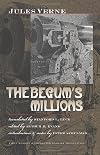
On This Page
Description
Verne's first cautionary tale about the dangers of science -- first modern and corrected English translation.Tags
Recommendations



























Member Reviews
The eighteenth Extraordinary Voyage is considered by some Verne scholars as the start of the second part of his career, marked by a more cautionary, pessimistic outlook about progress and occasionally featuring evil scientists and politics. It's not a clean change of style, in any case. The next books will be traditional adventures, and there are a good number of Verne novels to come that fit well with the optimistic, exploratory adventures of his early works.
First read or reread?: This is a first read for me.
What is it about?: Two men inherited a vast fortune as descendants of a French soldier who settled in India and married the immensely rich widow of a native prince – the begum of the title. One of the inheritors is a French show more physician, Dr. Sarrasin, who has long been concerned with the unsanitary conditions of European cities. He uses the money to establish a utopian model city constructed and maintained with public health as its government's primary concern. The other is a German scientist Prof. Schultze, a militarist and racist. Though having a French grandmother, he is convinced of the superiority of the "Saxon" (i.e., German) over the "Latin" (primarily, the French), which he believes will lead to the eventual destruction of the latter by the former. Schultze had published many articles "proving" the superiority of the German race. Schultze decides to make his own utopia—a city devoted to the production of ever more powerful and destructive weapons—and vows to destroy Sarrasin's city.
This is both an utopic and dystopic novel, contrasting the two cities, the well-ordered, health-focused France-Ville, and the industrial, totalitarian nightmare of Stahlstadt ("Steel City"). I read it as a political fable, since one cannot take seriously the idea that the US would have allowed the two millionaires the temporary right to establish sovereign cities within their territory, no matter how much they were willing to pay. Also, France-Ville is very idealized (there's no crime in it). But these details are not the focus of the novel, and we accept the unlikely premise in order to set the conflict and the contrast between the two mindsets.
Verne was clearly bitter about the Franco-Prussian War of 1870, which had resulted in the defeat of France, the unification of Germany and the establishment of the Second Reich. Germany's industrialization was more advanced than France's, which is reflected in the industrial nature of Stahlstadt. It can't be a coincidence that the novel's hero, Marcel Bruckmann, a protégé of Dr. Sarrasin who infiltrates Stahlstadt as a spy, is from Alsace, a region of France with a blend of French and German culture which had been taken by Germany after the war.
This bitterness, which had not been present in Verne's earlier work (see for example the German heroes in Journey to the Center of the Earth) results in the depiction of Prof. Schultze as an unflattering caricature of German people, complete with his racist belief in the supremacy of the German race and his exaggerated fondness for Frankfurter sausages and sauerkraut. (The anti-racist message of the novel is perhaps undermined by how the Chinese migrant workers who help build France-Ville are sent away when the city is completed but, as I have mentioned in other reviews, Verne, while enlightened and forward-thinking in some ways, was not free from the European prejudices of his time). One could say that the caricature of the German is heavy-handed, but I have to admit that in hindsight the novel can be a bit uncanny as an anticipation of World War II, with the supremacist ideology, the chemical weapons of mass destruction, the totalitarian state where people are identified with numbers...
Other elements of anticipation are the use of teleconferences for meetings, the creation of an artificial satellite that is (accidentally) put into orbit, or the long range siege gun that brings to mind the Paris Gun that Germany would use to bombard Paris during World War I.
In the first chapters Verne displays some of his sense of humor in his depiction of the rapacious lawyers who handle the inheritance or the way the attendants to a scientific meeting change their attitude towards Dr. Sarrasin when they learn about his newfound wealth.
I enjoyed that instead of boring the reader by insisting too much on the depiction of the political contrast between the two cities, Verne keeps things moving with the story of the spy who infiltrates Stahlstadt. However, the resolution of the story, while satisfactory, was kind of anticlimactic, in the sense that it is achieved without the heroes actually having to do anything. This is a very short novel, and maybe Verne could have extended it to set up a better ending.
It is worth mentioning that the original English translation of this novel (the one you can find for free or cheap in different places) is reputed to be particularly awful. The official translator, W. H. G. Kingston, was dying and his wife, who understandably had other things on her mind, did the translation. If you want to read the novel in English, the advice is to seek the 2005 translation by Stanford Luce.
Enjoyment factor: I have to confess that my love for Verne comes from his more optimistic adventure and exploration stories. I prefer to travel with my imagination in a balloon with Dr. Fergusson, Kennedy and Joe, discovering the source of the Nile, instead of getting into the awful, polluted Stahlstadt. Nevertheless this was an enjoyable read, with more elements to analyse than the average exploration adventure and with a reasonable pace, the fortunate result of Verne not forgetting to have a plot. The ending was lackluster, though.
See all my Verne reviews here: https://www.sffworld.com/forum/threads/reading-vernes-voyages-extraordinaires.58... show less
First read or reread?: This is a first read for me.
What is it about?: Two men inherited a vast fortune as descendants of a French soldier who settled in India and married the immensely rich widow of a native prince – the begum of the title. One of the inheritors is a French show more physician, Dr. Sarrasin, who has long been concerned with the unsanitary conditions of European cities. He uses the money to establish a utopian model city constructed and maintained with public health as its government's primary concern. The other is a German scientist Prof. Schultze, a militarist and racist. Though having a French grandmother, he is convinced of the superiority of the "Saxon" (i.e., German) over the "Latin" (primarily, the French), which he believes will lead to the eventual destruction of the latter by the former. Schultze had published many articles "proving" the superiority of the German race. Schultze decides to make his own utopia—a city devoted to the production of ever more powerful and destructive weapons—and vows to destroy Sarrasin's city.
This is both an utopic and dystopic novel, contrasting the two cities, the well-ordered, health-focused France-Ville, and the industrial, totalitarian nightmare of Stahlstadt ("Steel City"). I read it as a political fable, since one cannot take seriously the idea that the US would have allowed the two millionaires the temporary right to establish sovereign cities within their territory, no matter how much they were willing to pay. Also, France-Ville is very idealized (there's no crime in it). But these details are not the focus of the novel, and we accept the unlikely premise in order to set the conflict and the contrast between the two mindsets.
Verne was clearly bitter about the Franco-Prussian War of 1870, which had resulted in the defeat of France, the unification of Germany and the establishment of the Second Reich. Germany's industrialization was more advanced than France's, which is reflected in the industrial nature of Stahlstadt. It can't be a coincidence that the novel's hero, Marcel Bruckmann, a protégé of Dr. Sarrasin who infiltrates Stahlstadt as a spy, is from Alsace, a region of France with a blend of French and German culture which had been taken by Germany after the war.
This bitterness, which had not been present in Verne's earlier work (see for example the German heroes in Journey to the Center of the Earth) results in the depiction of Prof. Schultze as an unflattering caricature of German people, complete with his racist belief in the supremacy of the German race and his exaggerated fondness for Frankfurter sausages and sauerkraut. (The anti-racist message of the novel is perhaps undermined by how the Chinese migrant workers who help build France-Ville are sent away when the city is completed but, as I have mentioned in other reviews, Verne, while enlightened and forward-thinking in some ways, was not free from the European prejudices of his time). One could say that the caricature of the German is heavy-handed, but I have to admit that in hindsight the novel can be a bit uncanny as an anticipation of World War II, with the supremacist ideology, the chemical weapons of mass destruction, the totalitarian state where people are identified with numbers...
Other elements of anticipation are the use of teleconferences for meetings, the creation of an artificial satellite that is (accidentally) put into orbit, or the long range siege gun that brings to mind the Paris Gun that Germany would use to bombard Paris during World War I.
In the first chapters Verne displays some of his sense of humor in his depiction of the rapacious lawyers who handle the inheritance or the way the attendants to a scientific meeting change their attitude towards Dr. Sarrasin when they learn about his newfound wealth.
I enjoyed that instead of boring the reader by insisting too much on the depiction of the political contrast between the two cities, Verne keeps things moving with the story of the spy who infiltrates Stahlstadt. However, the resolution of the story, while satisfactory, was kind of anticlimactic, in the sense that it is achieved without the heroes actually having to do anything. This is a very short novel, and maybe Verne could have extended it to set up a better ending.
It is worth mentioning that the original English translation of this novel (the one you can find for free or cheap in different places) is reputed to be particularly awful. The official translator, W. H. G. Kingston, was dying and his wife, who understandably had other things on her mind, did the translation. If you want to read the novel in English, the advice is to seek the 2005 translation by Stanford Luce.
Enjoyment factor: I have to confess that my love for Verne comes from his more optimistic adventure and exploration stories. I prefer to travel with my imagination in a balloon with Dr. Fergusson, Kennedy and Joe, discovering the source of the Nile, instead of getting into the awful, polluted Stahlstadt. Nevertheless this was an enjoyable read, with more elements to analyse than the average exploration adventure and with a reasonable pace, the fortunate result of Verne not forgetting to have a plot. The ending was lackluster, though.
See all my Verne reviews here: https://www.sffworld.com/forum/threads/reading-vernes-voyages-extraordinaires.58... show less
Relatively short story, this is an odd one. It starts as if setting up a family drama about the dangers of a sudden influx of money, switches to utopian fiction before morphing into a James Bond style espionage thriller.
The basic premise is that a frenchman and a german both inherit an obscene amount of money, naturally (because Verne is french) the former uses his to help all mankind while the latter attempts to exterminate the former as a prelude to taking over the world.
It seems pretty insulting to the germans until you remember that whole Hitler thing, then it just seems prophetic. However despite one side being composed of nazi's its still hard to entirely sympathize with our supposed heroes who show their own brand racism and show more sexism. Its a bit short and anti-climactic but interesting. show less
The basic premise is that a frenchman and a german both inherit an obscene amount of money, naturally (because Verne is french) the former uses his to help all mankind while the latter attempts to exterminate the former as a prelude to taking over the world.
It seems pretty insulting to the germans until you remember that whole Hitler thing, then it just seems prophetic. However despite one side being composed of nazi's its still hard to entirely sympathize with our supposed heroes who show their own brand racism and show more sexism. Its a bit short and anti-climactic but interesting. show less
This was a surprisingly entertaining book! The only problem I found with it was that right when I was really starting to get into it, the novel sped up and then the conclusion inevitably arrived. The characters seem real, even in their dimensions of archetypes, and the action is sharp and focused. I quite liked the tale and feel that, for those who like Verne, they will not be disappointed.
3.35 stars!
3.35 stars!
review of
Jules Verne's The Begum's Fortune
by tENTATIVELY, a cONVENIENCE - March 13, 2013
Earlier this yr, I was reading The Science Fiction Stories of Rudyard Kipling (see my review here: http://www.goodreads.com/book/show/443932.The_Science_Fiction_Stories_of_Rudyard... ) & there was a capsule review from the Washington Post Book World on the back cover that praised it thusly: "The equal of Wells and the superior of Verne"." Well, I didn't agree so I decided to read some more Verne again - not having done so for a long time.
When I was young, probably pre-teen, I'd read the famous ones: A Journey to the Center of the Earth, 20,000 Leagues under the Sea, Around the World in Eighty Days, & the less famous Master of the World. Later I show more discovered the more obscure Lighthouse at the End of the World & the 'lost novel' Paris in the Twentieth Century. Maybe I even read the short bio by Franz Born: The Man Who Invented the Future.
But recently I was pleasantly surprised to find 8 more novels by him that I'd never heard of, all part of the "Fitzroy" Edition edited by I. O. Evans, so I plucked them up & decided to read them in chronological order starting w/ this one. "The intention of this new edition [new in 1958, ie] of one of the greatest writers is to make it as comprehensive as possible, and to include his lesser-known, as well as his most popular works." (p 192) Perfect! I'm interested in the "lesser-known" works.
The intro by Evans states that: ""Jules Verne" said H. G. Wells, "made some remarkable forecasts" and some of the most remarkable are contained in this book. Yet, as Wells explained, they had a factual basis; and here it was the Franco-Prussian War. This not only brought home to Verne the menace of German militarism but made him realize what war might become when throughly mechanized." [..] "So, perhaps, he derived the idea of the two rival cities, and Dickens' Bleak House suggested a plausible device for bringing them into being.* *From Dickens, too, he gained another idea which he used in a tale of adventure published a little before The Begum's Fortune: a savage chieftain in Dick Sands the Boy Captain dies, though more plausibly than a character in Bleak House, of spontaneous combustion!" Bleak House being my favorite Dickens novel that perked up my interest.
The intro continues w/: "He was probably the first to envisage the launching of an artificial satellite; and this may conceivably end, as he showed it as beginning, as a war-weapon." I'm, of course, reminded of the satellite-based aspects of the Strategic Defense Initiative announced on March 23, 1983, by then-President Reagan.
"He foresaw, too, the dangers of long-range bombardment with gas shells and showers of incendiary bombs, and the attempts which would be made to counteract them by mass evacuation schemes and the formation of a Civil Defence Service provided with fire-fighting equipment.
"He regarded other developments as even more disquieting than such weapons: the attempt of German militarism to dominate the world and the rise of a totalitarian state, rigidly directing its people's lives and infested by political police. Here it is significant that the illustrations of Herr Schultz, in the original French edition of this book, resemble a portrait of Bismarck deprived of his moustache!" - p 6
& all those foresights are nothing to write off as trivial! Let's say this bk predicts nazism. It was written in 1879. Cd you write something NOW, in 2013, that wd foresee a particular political event in, say 2075? This was written 35 yrs before Heinrich Mann's Little Superman, the other main novel that I can think of that predicts nazism (see my review here: http://www.goodreads.com/book/show/442159.Man_of_Straw ).
All in all, I thought this was great. Verne makes fun of pompous ranking titles & otherwise shows an appreciation for more democratized ways of doing things. Nonetheless, I've only given this bk a 3 star rating b/c he also still has plenty of racist & classist dregs in his approach that undermine his egalitarianism. Early on, he describes the way a person's having an abundance of money wrongly influences people's perception of that person. Fair enuf. But then he writes: "Had he been a humpbacked dwarf, an ignorant Hottentot, the lowest specimen of humanity, instead of one of its most intelligent representatives, his value would have been the same as Lord Glandover had expressed it, he "was worth" henceforth just twenty-one million pounds, no more and no less." (pp 35-36) A "humpbacked dwarf" is not necessarily a so-called inferior being. Nor is a "Hottentot" - wch was an offensive name at the time for a member of the Khoikhoin, a pastoral people of Namibia and South Africa. Verne is highly offended by the German devaluing of the French but has no problem devaluing Africans in pretty much the same way.
Alas, many aspects of this bk run along similar lines. A main character of the bk, A Frenchman, thru no effort of his own, inherits a HUGE fortune from a distant relative who was imperialistically lording it over the natives in India. Verne doesn't question the justice of this at all. Instead, he has the lucky man enhanced to heroic proportions b/c he makes a seemingly humanitarian proposal:
""Why should we not, by uniting the powers of our minds, produce the plan of a model city, based upon strictly scientific principles?" (Cries of "Her, Hear.") "Why should we not afterwards devote our capitol to the erection of such a city, and then present it to the world as a practical illustration of what all cities ought to be?" (Hear, Hear! and thunders of applause.)" - p 38
The villain, Professor Schultz, then comes into the picture, attempting to wrest the Frenchman's inheritance from him by consulting w/ the English lawyer who's arranged it: "His aim was to demonstrate to this Englishman, this Mr. Sharp, that by rights the German race should, in all things, predominate over all others. His object in putting forth a claim to this inheritance was chiefly that it might be snatched from french hands, which could not fail to make absurd use of it. What he hated in his rival was his nationality. Had he been a German he certainly should not have interfered, etc., etc." If there weren't so much 20th century history of Germany attacking France this wd seem like another unfortunate stereotype. Alas, tho, even that is probably a bit historically inaccurate given that it was France that declared war on Germany in the Franco-Prussian War in Verne's lifetime that was partial inspiration for this bk.
Verne even takes a dig at law-suits (w/ the relevance of Bleak House thusly appearing) by parodying the solicitor Sharp's profit motive when considering Schultz's claim to the money:
"But this relationship, being in a secondary degree to that of Doctor Sarrasin, would give only secondary rights to the inheritance. The solicitor perceived, however, the possibility of lawfully sustaining them, and in this possibility he foresaw another which would be much to the advantage of Billows, Green, and Sharp, something which would change the Langévol affair, already productive, into a very good thing, indeed, a second case of the "Jarndyce versus Jarndyce" of Dickens. An extensive horizon of stamped paper, deeds, documents of all sorts, rose before the yes of the man of law; and, what was even more enticing, he saw a compromise conducted by himself, Sharp, to the interest of both his clients, which would equally bring to himself honour and profit." - p 47
Sarrasin's plan of a model city is mocked by Schultz, whose negative perception of it is based on his notion of the superiority of the German people. Again, given that this novel's from 1879, what Verne has Schultz thinking, saying, & doing is eerily prescient of nazism. So eerily prescient, in fact, that it's bizarre to think that there was this much advance warning: "He thought this enterprise absurd and to his mind it was sure to fail, as it opposed the law of progress, which decreed the uprooting of the Latin race, its subjection to the Saxon, and at last its disappearance from the surface of the globe. However, these results might be held in check if the doctor started to carry out his programme and even more so, if there were any prospect of its success. It was, therefore, the duty of every true Saxon, in the interest of general order, to obey this appointed law, and bring this insane enterprise to nothing - if he could. In the circumstances it was quite clear that he, Schultz, M.D.., privat docent of chemistry in Jena University, known by his numerous works on the different human races - works in which it was proved that the German race was to absorb all others - it was quite clear that he was especially designed by the great creative and destructive forces of nature to annihilate the pigmies who were struggling against it." (p 54) Substitute Aryan for Saxon & Jewish for Latin & you've got a pretty typical taste of nazi propaganda.
Verne seems to further his peaceful notions in his grim depictions of the arms manufacturing city that Schultz then goes on to have built:
"In five years there sprang up on this bare and rocky plain eighteen villages, composed of small wooden houses, all alike, brought ready-built from Chicago, and containing a large population of rough workmen.
"In the midst of these villages, at the very foot of the Coal Butts, as the inexhaustible mountains of coal are called, rises a dark mass, huge, and strange, an agglomeration of regular-shaped buildings, pierced with symmetrical windows, covered with red roofs, and surrounded by a forest of cylindrical chimneys, which continually vomit forth clouds of dense smoke. Through the black curtain which veils the sky dart red lightning-like flames, while a distant roaring resembles that of thunder or the beating of the surf on a rocky shore." (pp 57-58)
I write that "Verne seems to further his peaceful notions" in the above b/c that doesn't necessarily turn out to be true later on. However, while this review has some spoilers I don't wan to give it all away. After all, this is a fairly entertaining novel, worth reading even despite my criticisms.
Interestingly, in Schultz's city there's something reminiscent of Centralia, Pennsylvania (& many, MANY other places): "not far from the spot was a coal mine permanently on fire". (p 89) Schultz's megalomania is depicted: "The truth was that Max had. at first glance seen through the character of his formidable patron, and perceiving that blind and insatiable vanity was its leading feature, he regulated his conduct by humouring the egotism which he despised. / In a dew days the young man had acquired such skill in the fingering necessary for this human keyboard, that he could play upon Schultz as easily as one plays on a piano." (pp 91-92) Of course, the "In a dew days" is a typo in the bk & shd read "In a few days". I rather like it so I think I'll treat it as a 'happy accident' & exploit it a little in this review.
In the dew course of the narrative, we're treated to a Verne the Frenchman's disdain for German cooking: ""Those sausages were delicious, weren't they?" remarked Herr Schultz, whose love of his favorite dish was unaffected by the Begum's millions. / "Delicious!" returned Max, who had heroically partaken of this mess every evening, till at last he hated the very sight of it." (p 94) In dew time at all, we even get to gassing, that nightmare of diabolical human invention so heavily associated w/ WWI & II: "An enormous volume of carbonic acid gas rushes into the air, and a cold of a hundred degrees below zero seizes upon the surrounding atmosphere. Every living thing within a radius of thirty yards from the centre of the explosion is at once frozen and suffocated." (p 100)
Various implausibilities mar the story slightly. As in so many stories of this kind w/ heavy 'good'-guy-vs-'bad'-guy action, the 'bad' guy often prolongs the execution of his enemy in a completely unbelievable way so that the 'good' guy can ultimately, of course, make his escape.
The coordinates of Sarrasin's model city are given:
""The place where the new city now stands was five years ago a complete desert. The exact spot lies 43º 11' 3" north latitude, and 124º 41' 17" west longitude.
"""It will be seen that this is on the shores of the Pacific Ocean, and at the foot of the secondary chain of the Rocky Mountains, called the Cascade Mountains, sixty miles to the north of White Cape, Oregon State, North America.["]" - p 119
In 1879, that are of North America must've seemed like extreme wilderness. That got me wondering what's there now. The result I got from http://itouchmap.com/latlong.html is actually IN the Pacific Ocean off Coos Bay in Oregon.
Alas, this model city, this exemplar of how the world shd live, is built by "an army of twenty thousand Chinese coolies, under the direction of five hundred overseers and European engineers". (p 120) & in the German newspaper that's reporting on this model city there's a curiously conflicted reporting on these "coolies": "Several states had, in the interest of their own population, actually expelled these unfortunate people en masse." [..] "The wages were deposited every week, in the presence of delegates in the great bank of San Francisco, and every coolie was warned that when he drew it out he was not to return. This precaution was absolutely necessary to get rid of a yellow population, which would have infallibly lowered the tone and standard of the new city." (p 121) So is this description of a 'Yellow Peril' an invention of the racist German newspaper or an unquestioned part of the 'model city'? It's hard to tell from the story but at least the 'coolies' are still thre after the building of the city judging from this description from 5 yrs later after the city's established: "Gangs of coolies banked up the earth, dug trenches" etc. Never, however, are these Chinamen ever mentioned in any context other than as laborers. A 5,000 yr old civilization & all the Chinese are good for is labor? What's wrong w/ this picture?
Much of this bk is just Verne's excuse for providing a description of what he imagines to be an ideal city. It doesn't really seem that appealing to me. Take, eg, "The plan of the town is essentially simple and regular, the roads crossing at right angles, at equal distances, of a uniform width, planted with trees, and numbered" & "They are also accustomed to such strict cleanliness that they consider a spot on their simple clothes quite a disgrace." (p 125) But back in the arms manufacturing town, things are even worse: "Invested with almost absolute power over their subordinates, they were each, in regard to Herr Schultz - as they were in regard to his memory - like so many human tools, without authority, without ability to show initiative or any voice in anything. Each ensconced himself within the narrow limits of his duty, waited, temporized, and watched the course of events." (p 160)
Nonetheless, one of the remarkable charms of this novel is that it seems to've been written in the 20th century until one gets to passages like this: "The wisest and most prudent among the workmen, those who has foreseen hard times and had laid by for a rainy day, hastened to escape with bag and baggage; and happy rosy-cheeked children, wild with delight at the new world revealed to them, peeped through the curtains of the departing waggons". (p 162) Yes, "waggons", we're back in the 19th century.
Verne does dabble w/ class references, but in the usual bourgeois way. In response to impending war, the "common danger had united the citizens more closely. All classes had been brought nearer to each other and knew themselves to be brothers, animated with the same feelings, and affected by the same interests." (p 165) So why are their classes at all? Presumably, even in this 'model city' it's like the English Civil War: the bourgeoisie unites w/ the laborers to knock the aristocracy down a notch &.. then.. it's back to business-as-usual.
But Verne isn't completely w/o political sense: "For indeed, isn't the best government the one where the chief, when he dies can be most easily replaced, and which will go on working smoothly, just because all the machinery is open and visible?"" (p 184) Of course, from my anarchist perspective, the 'need' for a government or a chief are both delusional. show less
Jules Verne's The Begum's Fortune
by tENTATIVELY, a cONVENIENCE - March 13, 2013
Earlier this yr, I was reading The Science Fiction Stories of Rudyard Kipling (see my review here: http://www.goodreads.com/book/show/443932.The_Science_Fiction_Stories_of_Rudyard... ) & there was a capsule review from the Washington Post Book World on the back cover that praised it thusly: "The equal of Wells and the superior of Verne"." Well, I didn't agree so I decided to read some more Verne again - not having done so for a long time.
When I was young, probably pre-teen, I'd read the famous ones: A Journey to the Center of the Earth, 20,000 Leagues under the Sea, Around the World in Eighty Days, & the less famous Master of the World. Later I show more discovered the more obscure Lighthouse at the End of the World & the 'lost novel' Paris in the Twentieth Century. Maybe I even read the short bio by Franz Born: The Man Who Invented the Future.
But recently I was pleasantly surprised to find 8 more novels by him that I'd never heard of, all part of the "Fitzroy" Edition edited by I. O. Evans, so I plucked them up & decided to read them in chronological order starting w/ this one. "The intention of this new edition [new in 1958, ie] of one of the greatest writers is to make it as comprehensive as possible, and to include his lesser-known, as well as his most popular works." (p 192) Perfect! I'm interested in the "lesser-known" works.
The intro by Evans states that: ""Jules Verne" said H. G. Wells, "made some remarkable forecasts" and some of the most remarkable are contained in this book. Yet, as Wells explained, they had a factual basis; and here it was the Franco-Prussian War. This not only brought home to Verne the menace of German militarism but made him realize what war might become when throughly mechanized." [..] "So, perhaps, he derived the idea of the two rival cities, and Dickens' Bleak House suggested a plausible device for bringing them into being.* *From Dickens, too, he gained another idea which he used in a tale of adventure published a little before The Begum's Fortune: a savage chieftain in Dick Sands the Boy Captain dies, though more plausibly than a character in Bleak House, of spontaneous combustion!" Bleak House being my favorite Dickens novel that perked up my interest.
The intro continues w/: "He was probably the first to envisage the launching of an artificial satellite; and this may conceivably end, as he showed it as beginning, as a war-weapon." I'm, of course, reminded of the satellite-based aspects of the Strategic Defense Initiative announced on March 23, 1983, by then-President Reagan.
"He foresaw, too, the dangers of long-range bombardment with gas shells and showers of incendiary bombs, and the attempts which would be made to counteract them by mass evacuation schemes and the formation of a Civil Defence Service provided with fire-fighting equipment.
"He regarded other developments as even more disquieting than such weapons: the attempt of German militarism to dominate the world and the rise of a totalitarian state, rigidly directing its people's lives and infested by political police. Here it is significant that the illustrations of Herr Schultz, in the original French edition of this book, resemble a portrait of Bismarck deprived of his moustache!" - p 6
& all those foresights are nothing to write off as trivial! Let's say this bk predicts nazism. It was written in 1879. Cd you write something NOW, in 2013, that wd foresee a particular political event in, say 2075? This was written 35 yrs before Heinrich Mann's Little Superman, the other main novel that I can think of that predicts nazism (see my review here: http://www.goodreads.com/book/show/442159.Man_of_Straw ).
All in all, I thought this was great. Verne makes fun of pompous ranking titles & otherwise shows an appreciation for more democratized ways of doing things. Nonetheless, I've only given this bk a 3 star rating b/c he also still has plenty of racist & classist dregs in his approach that undermine his egalitarianism. Early on, he describes the way a person's having an abundance of money wrongly influences people's perception of that person. Fair enuf. But then he writes: "Had he been a humpbacked dwarf, an ignorant Hottentot, the lowest specimen of humanity, instead of one of its most intelligent representatives, his value would have been the same as Lord Glandover had expressed it, he "was worth" henceforth just twenty-one million pounds, no more and no less." (pp 35-36) A "humpbacked dwarf" is not necessarily a so-called inferior being. Nor is a "Hottentot" - wch was an offensive name at the time for a member of the Khoikhoin, a pastoral people of Namibia and South Africa. Verne is highly offended by the German devaluing of the French but has no problem devaluing Africans in pretty much the same way.
Alas, many aspects of this bk run along similar lines. A main character of the bk, A Frenchman, thru no effort of his own, inherits a HUGE fortune from a distant relative who was imperialistically lording it over the natives in India. Verne doesn't question the justice of this at all. Instead, he has the lucky man enhanced to heroic proportions b/c he makes a seemingly humanitarian proposal:
""Why should we not, by uniting the powers of our minds, produce the plan of a model city, based upon strictly scientific principles?" (Cries of "Her, Hear.") "Why should we not afterwards devote our capitol to the erection of such a city, and then present it to the world as a practical illustration of what all cities ought to be?" (Hear, Hear! and thunders of applause.)" - p 38
The villain, Professor Schultz, then comes into the picture, attempting to wrest the Frenchman's inheritance from him by consulting w/ the English lawyer who's arranged it: "His aim was to demonstrate to this Englishman, this Mr. Sharp, that by rights the German race should, in all things, predominate over all others. His object in putting forth a claim to this inheritance was chiefly that it might be snatched from french hands, which could not fail to make absurd use of it. What he hated in his rival was his nationality. Had he been a German he certainly should not have interfered, etc., etc." If there weren't so much 20th century history of Germany attacking France this wd seem like another unfortunate stereotype. Alas, tho, even that is probably a bit historically inaccurate given that it was France that declared war on Germany in the Franco-Prussian War in Verne's lifetime that was partial inspiration for this bk.
Verne even takes a dig at law-suits (w/ the relevance of Bleak House thusly appearing) by parodying the solicitor Sharp's profit motive when considering Schultz's claim to the money:
"But this relationship, being in a secondary degree to that of Doctor Sarrasin, would give only secondary rights to the inheritance. The solicitor perceived, however, the possibility of lawfully sustaining them, and in this possibility he foresaw another which would be much to the advantage of Billows, Green, and Sharp, something which would change the Langévol affair, already productive, into a very good thing, indeed, a second case of the "Jarndyce versus Jarndyce" of Dickens. An extensive horizon of stamped paper, deeds, documents of all sorts, rose before the yes of the man of law; and, what was even more enticing, he saw a compromise conducted by himself, Sharp, to the interest of both his clients, which would equally bring to himself honour and profit." - p 47
Sarrasin's plan of a model city is mocked by Schultz, whose negative perception of it is based on his notion of the superiority of the German people. Again, given that this novel's from 1879, what Verne has Schultz thinking, saying, & doing is eerily prescient of nazism. So eerily prescient, in fact, that it's bizarre to think that there was this much advance warning: "He thought this enterprise absurd and to his mind it was sure to fail, as it opposed the law of progress, which decreed the uprooting of the Latin race, its subjection to the Saxon, and at last its disappearance from the surface of the globe. However, these results might be held in check if the doctor started to carry out his programme and even more so, if there were any prospect of its success. It was, therefore, the duty of every true Saxon, in the interest of general order, to obey this appointed law, and bring this insane enterprise to nothing - if he could. In the circumstances it was quite clear that he, Schultz, M.D.., privat docent of chemistry in Jena University, known by his numerous works on the different human races - works in which it was proved that the German race was to absorb all others - it was quite clear that he was especially designed by the great creative and destructive forces of nature to annihilate the pigmies who were struggling against it." (p 54) Substitute Aryan for Saxon & Jewish for Latin & you've got a pretty typical taste of nazi propaganda.
Verne seems to further his peaceful notions in his grim depictions of the arms manufacturing city that Schultz then goes on to have built:
"In five years there sprang up on this bare and rocky plain eighteen villages, composed of small wooden houses, all alike, brought ready-built from Chicago, and containing a large population of rough workmen.
"In the midst of these villages, at the very foot of the Coal Butts, as the inexhaustible mountains of coal are called, rises a dark mass, huge, and strange, an agglomeration of regular-shaped buildings, pierced with symmetrical windows, covered with red roofs, and surrounded by a forest of cylindrical chimneys, which continually vomit forth clouds of dense smoke. Through the black curtain which veils the sky dart red lightning-like flames, while a distant roaring resembles that of thunder or the beating of the surf on a rocky shore." (pp 57-58)
I write that "Verne seems to further his peaceful notions" in the above b/c that doesn't necessarily turn out to be true later on. However, while this review has some spoilers I don't wan to give it all away. After all, this is a fairly entertaining novel, worth reading even despite my criticisms.
Interestingly, in Schultz's city there's something reminiscent of Centralia, Pennsylvania (& many, MANY other places): "not far from the spot was a coal mine permanently on fire". (p 89) Schultz's megalomania is depicted: "The truth was that Max had. at first glance seen through the character of his formidable patron, and perceiving that blind and insatiable vanity was its leading feature, he regulated his conduct by humouring the egotism which he despised. / In a dew days the young man had acquired such skill in the fingering necessary for this human keyboard, that he could play upon Schultz as easily as one plays on a piano." (pp 91-92) Of course, the "In a dew days" is a typo in the bk & shd read "In a few days". I rather like it so I think I'll treat it as a 'happy accident' & exploit it a little in this review.
In the dew course of the narrative, we're treated to a Verne the Frenchman's disdain for German cooking: ""Those sausages were delicious, weren't they?" remarked Herr Schultz, whose love of his favorite dish was unaffected by the Begum's millions. / "Delicious!" returned Max, who had heroically partaken of this mess every evening, till at last he hated the very sight of it." (p 94) In dew time at all, we even get to gassing, that nightmare of diabolical human invention so heavily associated w/ WWI & II: "An enormous volume of carbonic acid gas rushes into the air, and a cold of a hundred degrees below zero seizes upon the surrounding atmosphere. Every living thing within a radius of thirty yards from the centre of the explosion is at once frozen and suffocated." (p 100)
Various implausibilities mar the story slightly. As in so many stories of this kind w/ heavy 'good'-guy-vs-'bad'-guy action, the 'bad' guy often prolongs the execution of his enemy in a completely unbelievable way so that the 'good' guy can ultimately, of course, make his escape.
The coordinates of Sarrasin's model city are given:
""The place where the new city now stands was five years ago a complete desert. The exact spot lies 43º 11' 3" north latitude, and 124º 41' 17" west longitude.
"""It will be seen that this is on the shores of the Pacific Ocean, and at the foot of the secondary chain of the Rocky Mountains, called the Cascade Mountains, sixty miles to the north of White Cape, Oregon State, North America.["]" - p 119
In 1879, that are of North America must've seemed like extreme wilderness. That got me wondering what's there now. The result I got from http://itouchmap.com/latlong.html is actually IN the Pacific Ocean off Coos Bay in Oregon.
Alas, this model city, this exemplar of how the world shd live, is built by "an army of twenty thousand Chinese coolies, under the direction of five hundred overseers and European engineers". (p 120) & in the German newspaper that's reporting on this model city there's a curiously conflicted reporting on these "coolies": "Several states had, in the interest of their own population, actually expelled these unfortunate people en masse." [..] "The wages were deposited every week, in the presence of delegates in the great bank of San Francisco, and every coolie was warned that when he drew it out he was not to return. This precaution was absolutely necessary to get rid of a yellow population, which would have infallibly lowered the tone and standard of the new city." (p 121) So is this description of a 'Yellow Peril' an invention of the racist German newspaper or an unquestioned part of the 'model city'? It's hard to tell from the story but at least the 'coolies' are still thre after the building of the city judging from this description from 5 yrs later after the city's established: "Gangs of coolies banked up the earth, dug trenches" etc. Never, however, are these Chinamen ever mentioned in any context other than as laborers. A 5,000 yr old civilization & all the Chinese are good for is labor? What's wrong w/ this picture?
Much of this bk is just Verne's excuse for providing a description of what he imagines to be an ideal city. It doesn't really seem that appealing to me. Take, eg, "The plan of the town is essentially simple and regular, the roads crossing at right angles, at equal distances, of a uniform width, planted with trees, and numbered" & "They are also accustomed to such strict cleanliness that they consider a spot on their simple clothes quite a disgrace." (p 125) But back in the arms manufacturing town, things are even worse: "Invested with almost absolute power over their subordinates, they were each, in regard to Herr Schultz - as they were in regard to his memory - like so many human tools, without authority, without ability to show initiative or any voice in anything. Each ensconced himself within the narrow limits of his duty, waited, temporized, and watched the course of events." (p 160)
Nonetheless, one of the remarkable charms of this novel is that it seems to've been written in the 20th century until one gets to passages like this: "The wisest and most prudent among the workmen, those who has foreseen hard times and had laid by for a rainy day, hastened to escape with bag and baggage; and happy rosy-cheeked children, wild with delight at the new world revealed to them, peeped through the curtains of the departing waggons". (p 162) Yes, "waggons", we're back in the 19th century.
Verne does dabble w/ class references, but in the usual bourgeois way. In response to impending war, the "common danger had united the citizens more closely. All classes had been brought nearer to each other and knew themselves to be brothers, animated with the same feelings, and affected by the same interests." (p 165) So why are their classes at all? Presumably, even in this 'model city' it's like the English Civil War: the bourgeoisie unites w/ the laborers to knock the aristocracy down a notch &.. then.. it's back to business-as-usual.
But Verne isn't completely w/o political sense: "For indeed, isn't the best government the one where the chief, when he dies can be most easily replaced, and which will go on working smoothly, just because all the machinery is open and visible?"" (p 184) Of course, from my anarchist perspective, the 'need' for a government or a chief are both delusional. show less
Two wealthy guys start two competing utopian cities; war ensues. The one run by a maniacal supervillain intent on building weapons of mass destruction ends up wiping itself out. I appreciate that Verne is trying to do something more interesting here than his usual travelogues, but it's not actually very interesting. No characterization, mediocre plot.
I struggled to finish this boring book. Not Verne's best.
In the beginning of the story, Dr sarrasin, a Frenchman, is attending the Hygienic Conference in London, and that's when he receives news that he is the inheritor of a fortune. Whereas the day before, he had been treated as a mere speck on the floor, the second day, when they had all learned that he was suddenly rich, their hypocritical natures showed themselves:
"but on the present occasion Lord GLandover smiled most graciously upon Dr sarassin as he entered, and even carried his courtesy so far as to invite him by a sign to be seated at his right hand. The other members of the conference all Rose when he appeared on the platform.
Considerably astonished by so flattering a show more reception, Dr sarrasin took the chair he was offered, concluding that, in further consideration, his invention had been found of much greater importance than his scientific brethren had at first supposed."
Max is a friend of Dr sarassin's family, treated as a son from the time his parents died when he was a boy. He infiltrates stahlstadt, the home of Dr sarassin's enemy, as a spy. He stays with a widow and her boy, little Carl Bauer, who works in the minr day and night. When he doesn't return home one Sunday morning, Max sets off to find out what happened to him. He finds an overseer, and the two of them, with a few other men, searched the mine for the boy.
"Max took his little box from his pocket, struck a match, and stooping, held it towards the ground, upon which it instantly went out.
'I was sure of it,' he remarked.
'The gas, being heavier than the air, lies close to the ground. You must not stay here - I mean those without the galibert apparatus. If you like, sir, we can continue the search alone.'
This being agreed to, Max and the overseer each took between his teeth the mouthpiece of his airbox, placed the clamp on his nostrils, and boldly penetrated into a succession of old galleries.
In a quarter of an hour they came out to renew the air in their reservoir; this done, they started again.
On the third trial their efforts were crowned with success. The faint blueish light of an electric lamp was seen far off in the darkness. They hastened to it.
At the foot of the damp wall, motionless and already cold, lay poor little carl. His blue lips and sunken eyes told what had happened. Evidently he had wished to pick up something from the ground: he had stooped, and been literally drowned in the choke damp.
Every effort to recall him to life was in vain. He must have been already dead four or 5 hours. By the next evening there was another little grave in the cemetery of stahlstadt, and poor Dame Bauer was bereaved of her child as well as of her husband."
Max infiltrates, by his hard work, into the interior of the king of spouse thought himself, Herr Schultz.
'are you the draftsman?'
'yes, sir.'
'I have seen your diagrams. They are very good. But do you understand nothing but Steam engines?'
'I have never been examined in anything else.'
'do you know anything of the science of projectiles?'
'I have studied it in my spare time, and for my own pleasure.'
This reply interested Herr schultz.
He deigned to turn and look at his employee.
'Well, will you undertake to design a cannon with me? We shall see what you can make of it! Ah! You will be scarcely able to take the place of that idiot of a sohne, who got killed this morning whilst handling some dynamite! The fool might have blown us all up!'
It must be acknowledged that this revolting want of feeling was only What might Have been expected from the mouth of Herr schultz."
Herr Schultz reveals to Max what he wants to do with the cannon that Max will design:
"... With one of these shells, which, thrown by my gun from the platform, will cross the Cascade mountains. Where? There exists a city, separated from us by 30 miles at the most, upon whose inhabitants it will come like a thunderclap, for even if they expected it they could not Ward it off or escape its horrific effects. This is now the 5th of september. Well, on the 13th, at a quarter before midnight, frankville will disappear from off American soil! The burning of Sodom will be rivaled. Professor Schultz in his turn, will let loose the fires of heaven! "
Here's the racist part, talking about how frankville was constructed by Chinese people:
"... Placards posted up all over the state of california, an advertisement van permanently attached to the express train, which starts every morning from San Francisco to Traverse the American continent, and a daily article in the 23 newspapers of that town, were sufficient to ensure the recruiting of the laborers. It was not even found necessary to resort to the expedient of publishing on a grand scale by means of gigantic letters sculptured on the peaks of the rocky mountains, that men were wanted. It must be said that the influx of Chinese coolies into Western America had just at this time caused much perturbation in the labor market. Several states had, in the interest of their own population, actually expelled these unfortunate people en masse. The building of frankville came just in time to save them from perishing. Their wages, fixed at a dollar a day, were not to be paid them until the works were finished, and their rations were distributed by the municipal administration. thus all the disorder and shameful speculations, which so often attend any great displacement of population, were avoided. The wages were deposited every week, in the presence of delegates in the great Bank of San francisco, and every Coolie was warned that when he drew it out he was not to return. This precaution was absolutely necessary to get rid of a yellow population, which would otherwise have infallibly lowered the tone and standard of the new city. The founders having, besides, reserve the right of granting or refusing permission to live there, the application of this measure was comparatively easy."
So I guess at the time that this book was published, not only did Germans hate French people and vice versa, but French people hated Chinese people, and so did americans. What a mess. show less
In the beginning of the story, Dr sarrasin, a Frenchman, is attending the Hygienic Conference in London, and that's when he receives news that he is the inheritor of a fortune. Whereas the day before, he had been treated as a mere speck on the floor, the second day, when they had all learned that he was suddenly rich, their hypocritical natures showed themselves:
"but on the present occasion Lord GLandover smiled most graciously upon Dr sarassin as he entered, and even carried his courtesy so far as to invite him by a sign to be seated at his right hand. The other members of the conference all Rose when he appeared on the platform.
Considerably astonished by so flattering a show more reception, Dr sarrasin took the chair he was offered, concluding that, in further consideration, his invention had been found of much greater importance than his scientific brethren had at first supposed."
Max is a friend of Dr sarassin's family, treated as a son from the time his parents died when he was a boy. He infiltrates stahlstadt, the home of Dr sarassin's enemy, as a spy. He stays with a widow and her boy, little Carl Bauer, who works in the minr day and night. When he doesn't return home one Sunday morning, Max sets off to find out what happened to him. He finds an overseer, and the two of them, with a few other men, searched the mine for the boy.
"Max took his little box from his pocket, struck a match, and stooping, held it towards the ground, upon which it instantly went out.
'I was sure of it,' he remarked.
'The gas, being heavier than the air, lies close to the ground. You must not stay here - I mean those without the galibert apparatus. If you like, sir, we can continue the search alone.'
This being agreed to, Max and the overseer each took between his teeth the mouthpiece of his airbox, placed the clamp on his nostrils, and boldly penetrated into a succession of old galleries.
In a quarter of an hour they came out to renew the air in their reservoir; this done, they started again.
On the third trial their efforts were crowned with success. The faint blueish light of an electric lamp was seen far off in the darkness. They hastened to it.
At the foot of the damp wall, motionless and already cold, lay poor little carl. His blue lips and sunken eyes told what had happened. Evidently he had wished to pick up something from the ground: he had stooped, and been literally drowned in the choke damp.
Every effort to recall him to life was in vain. He must have been already dead four or 5 hours. By the next evening there was another little grave in the cemetery of stahlstadt, and poor Dame Bauer was bereaved of her child as well as of her husband."
Max infiltrates, by his hard work, into the interior of the king of spouse thought himself, Herr Schultz.
'are you the draftsman?'
'yes, sir.'
'I have seen your diagrams. They are very good. But do you understand nothing but Steam engines?'
'I have never been examined in anything else.'
'do you know anything of the science of projectiles?'
'I have studied it in my spare time, and for my own pleasure.'
This reply interested Herr schultz.
He deigned to turn and look at his employee.
'Well, will you undertake to design a cannon with me? We shall see what you can make of it! Ah! You will be scarcely able to take the place of that idiot of a sohne, who got killed this morning whilst handling some dynamite! The fool might have blown us all up!'
It must be acknowledged that this revolting want of feeling was only What might Have been expected from the mouth of Herr schultz."
Herr Schultz reveals to Max what he wants to do with the cannon that Max will design:
"... With one of these shells, which, thrown by my gun from the platform, will cross the Cascade mountains. Where? There exists a city, separated from us by 30 miles at the most, upon whose inhabitants it will come like a thunderclap, for even if they expected it they could not Ward it off or escape its horrific effects. This is now the 5th of september. Well, on the 13th, at a quarter before midnight, frankville will disappear from off American soil! The burning of Sodom will be rivaled. Professor Schultz in his turn, will let loose the fires of heaven! "
Here's the racist part, talking about how frankville was constructed by Chinese people:
"... Placards posted up all over the state of california, an advertisement van permanently attached to the express train, which starts every morning from San Francisco to Traverse the American continent, and a daily article in the 23 newspapers of that town, were sufficient to ensure the recruiting of the laborers. It was not even found necessary to resort to the expedient of publishing on a grand scale by means of gigantic letters sculptured on the peaks of the rocky mountains, that men were wanted. It must be said that the influx of Chinese coolies into Western America had just at this time caused much perturbation in the labor market. Several states had, in the interest of their own population, actually expelled these unfortunate people en masse. The building of frankville came just in time to save them from perishing. Their wages, fixed at a dollar a day, were not to be paid them until the works were finished, and their rations were distributed by the municipal administration. thus all the disorder and shameful speculations, which so often attend any great displacement of population, were avoided. The wages were deposited every week, in the presence of delegates in the great Bank of San francisco, and every Coolie was warned that when he drew it out he was not to return. This precaution was absolutely necessary to get rid of a yellow population, which would otherwise have infallibly lowered the tone and standard of the new city. The founders having, besides, reserve the right of granting or refusing permission to live there, the application of this measure was comparatively easy."
So I guess at the time that this book was published, not only did Germans hate French people and vice versa, but French people hated Chinese people, and so did americans. What a mess. show less
I don't have many 'least favorite Verne books', but this is one of them. It seemed a bit slow, and the ending is kind of like, "Yeah, well...okay, I guess." But it's still a Verne book and even the slower one or two are worth a read once!
Members
- Recently Added By
Lists

Best Science Fiction Originally Published in a Language Other Than English
449 works; 31 members

Liste Otto
107 works; 1 member
Author Information

Jules Verne was born on February 8, 1828 in Nantes, France. He wrote for the theater and worked briefly as a stockbroker. He is considered by many to be the father of science fiction. His most popular novels included Journey to the Center of the Earth, Twenty Thousand Leagues Under the Sea, and Around the World in Eighty Days. Several of his works show more have been adapted into movies and TV mini-series. In 1892, he was made a Chevalier of the Legion of Honor in France. He died on March 24, 1905 at the age of 77. (Bowker Author Biography) Jules Verne (1828-1905) is the author of numerous adventure stories grounded in popularizations of science. (Publisher Provided) show less
Some Editions
Series

Belongs to Publisher Series
Work Relationships
Is contained in
Has the adaptation
Common Knowledge
- Canonical title*
- Die 500 Millionen der Begum
- Original title
- Les Cinq cents millions de la Bégum
- Alternate titles
- The Begum's Millions
- Original publication date
- 1879
- Original language
- French
*Some information comes from Common Knowledge in other languages. Click "Edit" for more information.
Classifications
Statistics
- Members
- 558
- Popularity
- 52,794
- Reviews
- 16
- Rating
- (3.48)
- Languages
- 16 — Catalan, Chinese, Czech, Dutch, English, Finnish, French, German, Hungarian, Italian, Polish, Portuguese, Romanian, Spanish, Swedish, Turkish
- Media
- Paper, Audiobook, Ebook
- ISBNs
- 64
- ASINs
- 30