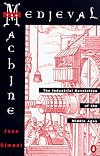
The Medieval Machine: The Industrial Revolution of the Middle Ages
by Jean Gimpel
On This Page
Description
Through his own choice of source material, the author of this book reconstructs the commercial life of the Middle Ages, giving the reader an appreciation of how energy resources, manpower and sheer ingenuity were applied to agriculture, light industry, the construction trades and mining. He also brings to life some of the great men of the period - the architect-engineers and other technicians whose genius anticipated many of the innovations credited to Leonardo and other luminaries of the show more Renaissance. show lessTags
Recommendations






















Member Recommendations
Member Reviews
OK, so you have to be warned that Gimpel starts off by making a huge error that really, any trained historian should know better: he tries to predict the future. & declares that (speaking in 1976), the West has invented pretty much everything that it will, it's all decline from here on out, no more technical innovation for us.
Really: how many of our forebears had any idea what was coming next? The Black Death came seemingly out of nowhere; ditto for many of us (including Gimpel), the Information Age.
Now, if you can get past that, the rest of the book is brilliant. It's a technical/technological history, but that's a tale that can't be told without talking about the technicians, so it's also a social history. The innovation was funded by show more capital, so there's some banking history. Innovation is frequently adapted for combat, so there's some military history. It's a small book with a very broad scope.
Does that mean there's a little lacking in depth? Possibly: Gimpel himself regrets that there is not more attention paid to the history of engineering, & seems to be deliberately attempting to kickstart such a discipline.
Overall, a very worthwhile book for anyone interested in the Middle Ages, or any fan of the Renaissance willing to have a few of their bubbles burst. show less
Really: how many of our forebears had any idea what was coming next? The Black Death came seemingly out of nowhere; ditto for many of us (including Gimpel), the Information Age.
Now, if you can get past that, the rest of the book is brilliant. It's a technical/technological history, but that's a tale that can't be told without talking about the technicians, so it's also a social history. The innovation was funded by show more capital, so there's some banking history. Innovation is frequently adapted for combat, so there's some military history. It's a small book with a very broad scope.
Does that mean there's a little lacking in depth? Possibly: Gimpel himself regrets that there is not more attention paid to the history of engineering, & seems to be deliberately attempting to kickstart such a discipline.
Overall, a very worthwhile book for anyone interested in the Middle Ages, or any fan of the Renaissance willing to have a few of their bubbles burst. show less
A book that has a great deal to say about the advances in technology in Western Europe until 1400 CE. Quite insightful about that. However, in the last chapter he descends to make some forecasts about the future of technological advance, and the totality of the book suffers. One must remember that the copyright date was 1976, and things have not made many of his predictions brilliant. But for facts, some arresting charts and the strictly medieval portion of the book, still a valuable read.
Changed how I thought about a lot of things. The overview of how agriculture and animal husbandry changed in the Middle Ages was a complete eye opener. In particular, the example of how the ancient world didn't know how to efficiently harness a horse was fascinating. Definitely want to go read his other books.
This is a fantastic book, detailing how agriculture architecture, and building were revolutionized during the Middle Ages, and dispelling the myths of "The Dark Ages" and loss of technology for the 500 years after the fall of the Roman Empire. Anyone interested in the Middle Ages, SCA, or Renaissance Festivals should read this book.
The medieval ages were far more like our modern age than we often think. The only thing that came to my mind prior to reading this book was knights and castles. Hardly a dark age as often portrayed, the period was full of industrial innovation, and Jean Gimpel makes an interesting survey of some of the inventions that came out of the period, discussing the engineering and architectural feats of the age.
The book was written in the 1970s, so it's a little dated, but it was a fast and insightful read, shedding light to a beginning learner on a period of history that generally escapes notice but for as backdrop period films and sword and sorcery fantasies. I read it for a history class during my undergrad degree, but I have kept it and show more occasionally reviewed it since. show less
The book was written in the 1970s, so it's a little dated, but it was a fast and insightful read, shedding light to a beginning learner on a period of history that generally escapes notice but for as backdrop period films and sword and sorcery fantasies. I read it for a history class during my undergrad degree, but I have kept it and show more occasionally reviewed it since. show less
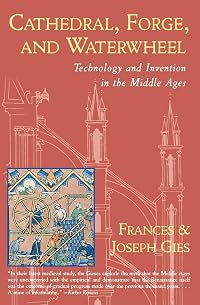
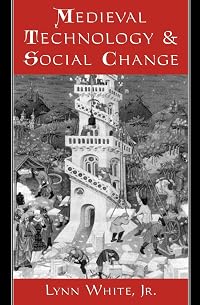
This is an 1976 book recently reissued in paperback; when first published it was one of the few sources for information about medieval technology (the only other one I can think of is Lynn White’s Medieval Technology and Social Change). However, it’s now sadly dated and a little socially peculiar. Author Jean Gimpel covers medieval energy sources (wind and water mills), mining, farming (the horse collar, the wheeled plow, and horseshoes), and clocks – this is adequate but mostly already discussed by White. The discussion of cathedral building is disappointing, because Gimpel is more interested in cathedral design and the handling of skilled labor than the actual construction of cathedrals – these are interesting topics but not show more what I was looking for. Finally, the last chapter is a very strange discursus comparing medieval France with 1970s America – predicting the collapse of America due to the limitation of free enterprise, the collapse of the entrepreneurial spirit, overextension of higher education, and resistance to technological innovation. Now what place does that have in a book on medieval technology – despite being prescient and apparently true? show less
A fascinating discussion of the technological revolution in the Middle Ages. Gimpel writes not only about inventions and inventors, but about how those inventions changed society and, finally, what caused the innovations to stop. In the last chapter he discusses what might cause the end of the West's second industrial revolution. While some of this chapter is a bit dated, it provides a lot of food for thought. I highly recommend this book to anyone interested in the history of technology or the effects of technology on society.
Members
- Recently Added By
Lists

Five star books
1,767 works; 110 members
Author Information

11 Works 1,014 Members
Some Editions
Series
Belongs to Publisher Series
Seuil, Points histoire (H19)
Common Knowledge
- Canonical title
- The Medieval Machine: The Industrial Revolution of the Middle Ages
- Original title
- La Révolution industrielle du Moyen-Âge
- Original publication date
- 1975
- First words
- The Middle Ages introduced machinery into Europe on a scale no civilization had previously known.
- Quotations
- It is an astonishing concept to the modern mind that medieval man was surrounded by machines. The fact is, machines were not something foreign or remote to the townsman or to the peasant in his fields. The most common was the... (show all) mill, converting the power of water or wind into work: grinding corn, crushing olives, fulling cloth, tanning leather, making paper, and so on. These were the factories of the Middle Ages. In the towns and villages the citizen could stand on a bridge over a river or canal and observe the different types of water mill: mills built along the banks, others floating midstream or moored to the banks, and, if he cared to look under the bridge, he might find the same machines built between the arches. If he walked upstream he would find the river dammed to provide a sufficient fall of water to drive the mills' machinery.
- Last words
- (Click to show. Warning: May contain spoilers.)Nevertheless, it was from a twofold medieval legacy - the inovations relating to navigational techniques and printing, both recognized landmarks in the history of mankind - that the Renaissance blossomed forth.
- Original language*
- Français
*Some information comes from Common Knowledge in other languages. Click "Edit" for more information.
Classifications
Statistics
- Members
- 700
- Popularity
- 40,850
- Reviews
- 10
- Rating
- (3.78)
- Languages
- 7 — Danish, English, French, German, Portuguese, Spanish, Turkish
- Media
- Paper
- ISBNs
- 18
- ASINs
- 7