On This Page
Description
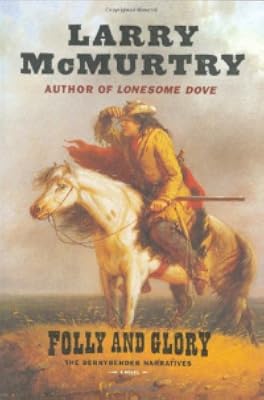
Tasmin and her family find themselves under arrest in Mexican Santa Fe, from which they are led on the terrifying "Dead Man's Walk" to Vera Cruz, while Jim Snow, accompanied by Kit Carson, journeys to New Orleans.Tags
Recommendations





Member Reviews
So, at the end of the last volume, we found ourselves filled with deep and terrible misgivings for the future of our vulnerable band. Turns out I had nothing to worry about! Absolutely nothing bad happens to anyone in this book. All journeys are brief and easy. All sojourns safe and comfortable. All dilemmas resolved with wisdom, all heart's desire fulfilled, all children grow strong and beautiful and above average, all disputes settled with civilised words over cups of hot tea. The buffalo roam, the Mexicans prosper, the Indians thrive, the Europeans bring peace and plenty wherever they settle.
All amazingly unexpected developments in a Larry McMurtry novel! One would, perhaps, have anticipated further hardship and cruelties to plague show more our adventurers, to have the heart torn out of the novel and out of the reader in one flat, brief page of devastating mortality right at the dead centre of the book, from which there can only be long, lingering, spiraling fall towards an ending. Even that's not enough, and random horror begets an explosion of bloody, vengeful, sin-killing violence that lays grief on grief. Or it would if McMurtry had written more or less true to form and not produced the passages of bucolic bliss and happiness, instead of delivering the surviving frail and ravaged community of people, united in sharing a brimful of human suffering, to a more or less safe end, forever altered by their experiences of America in her birth-pangs and a landscape in its death-throes.
Lalalala. show less
All amazingly unexpected developments in a Larry McMurtry novel! One would, perhaps, have anticipated further hardship and cruelties to plague show more our adventurers, to have the heart torn out of the novel and out of the reader in one flat, brief page of devastating mortality right at the dead centre of the book, from which there can only be long, lingering, spiraling fall towards an ending. Even that's not enough, and random horror begets an explosion of bloody, vengeful, sin-killing violence that lays grief on grief. Or it would if McMurtry had written more or less true to form and not produced the passages of bucolic bliss and happiness, instead of delivering the surviving frail and ravaged community of people, united in sharing a brimful of human suffering, to a more or less safe end, forever altered by their experiences of America in her birth-pangs and a landscape in its death-throes.
Lalalala. show less
"… folly doesn't last forever." (pg. 18)
It is a telling comment on how I have viewed the four volumes of the Berrybender Narratives that I enjoyed Folly and Glory, the fourth and final book of the series, in large part because it abandoned much of what made this series so idiosyncratic. The books' awkward balance between comic vaudeville, sadistic frontier brutality and author Larry McMurtry's enduringly fine ability to spin a Western yarn has always been alternately frustrating and entertaining. The imbalance has ensured they remain ultimately unsatisfying.
Aside from a few moments, Folly and Glory abandons much of that light-comic romping. With the series now in its end-game, McMurtry leans more heavily towards the stark brutality show more and his patented Western storytelling. Gone is the frivolous verbal sparring and the bed-hopping; the characters now speak seriously to one another and the effects of their decisions over the four books begin to weary them, like a hangover after the indulgent bout of drinking. To someone who has not read the books, this might sound like a criticism, a charge that Folly and Glory is less fun. But it does mean that the frustrating imbalance of previous volumes is gone and we can engage with the book as story. And story has always been the one thing McMurtry is good at.
This means that, throughout Folly and Glory, we are invested in the characters and their losses – moreso than we have felt inclined to do in previous books, when it felt like the author wasn't always taking it seriously. It means that, as the book ends, we are reluctant to part from characters who, in previous books, we'd have been happy to see the back of. It means that well-written scenes are no longer isolated events to re-energise the reader as they go about their trials, but tense, fitting moments that engage us further in the story and remind us, even if only a small amount, of McMurtry's better work in this genre.
The series has always felt to me a bit pointless, an interesting but idle doodle from an expert hand, and certainly I wondered, in the finer dramatic and character moments of Folly and Glory and its predecessors, how I would have felt in such moments if they were not spent so casually on such a head-scratching concept. Even now, I struggle to see what McMurtry hoped to accomplish by placing comic English aristocrats on the American frontier and have them mooch around. They had no story to tell, and their position did not shine a light on the West either. "Had it been glory, or had it been folly, the unrelenting American push?" McMurtry writes on page 28, recalling the title of this final volume. "Were town and farm better than red men and buffalo?" The bewildering thing is that the four Berrybender Narratives have never seemed inclined to address any of the questions they might have posed. Only McMurtry's excellent storytelling ability – his pacing, his characterisation, his lively dialogue – has saved his concept from itself. And even that could only take it so far. show less
It is a telling comment on how I have viewed the four volumes of the Berrybender Narratives that I enjoyed Folly and Glory, the fourth and final book of the series, in large part because it abandoned much of what made this series so idiosyncratic. The books' awkward balance between comic vaudeville, sadistic frontier brutality and author Larry McMurtry's enduringly fine ability to spin a Western yarn has always been alternately frustrating and entertaining. The imbalance has ensured they remain ultimately unsatisfying.
Aside from a few moments, Folly and Glory abandons much of that light-comic romping. With the series now in its end-game, McMurtry leans more heavily towards the stark brutality show more and his patented Western storytelling. Gone is the frivolous verbal sparring and the bed-hopping; the characters now speak seriously to one another and the effects of their decisions over the four books begin to weary them, like a hangover after the indulgent bout of drinking. To someone who has not read the books, this might sound like a criticism, a charge that Folly and Glory is less fun. But it does mean that the frustrating imbalance of previous volumes is gone and we can engage with the book as story. And story has always been the one thing McMurtry is good at.
This means that, throughout Folly and Glory, we are invested in the characters and their losses – moreso than we have felt inclined to do in previous books, when it felt like the author wasn't always taking it seriously. It means that, as the book ends, we are reluctant to part from characters who, in previous books, we'd have been happy to see the back of. It means that well-written scenes are no longer isolated events to re-energise the reader as they go about their trials, but tense, fitting moments that engage us further in the story and remind us, even if only a small amount, of McMurtry's better work in this genre.
The series has always felt to me a bit pointless, an interesting but idle doodle from an expert hand, and certainly I wondered, in the finer dramatic and character moments of Folly and Glory and its predecessors, how I would have felt in such moments if they were not spent so casually on such a head-scratching concept. Even now, I struggle to see what McMurtry hoped to accomplish by placing comic English aristocrats on the American frontier and have them mooch around. They had no story to tell, and their position did not shine a light on the West either. "Had it been glory, or had it been folly, the unrelenting American push?" McMurtry writes on page 28, recalling the title of this final volume. "Were town and farm better than red men and buffalo?" The bewildering thing is that the four Berrybender Narratives have never seemed inclined to address any of the questions they might have posed. Only McMurtry's excellent storytelling ability – his pacing, his characterisation, his lively dialogue – has saved his concept from itself. And even that could only take it so far. show less
Folly and Glory is part-four of a four-part series chronically the adventures of the aristocratic, English Berrybender family exploring the American West in the 1830's on a steamship on the Missouri River. Lord Berrybender is accompanied by his gluttonous wife and six of his 14 legitimate children. The series is historical fiction in that it incorporates actual people such as Kit Carson and Jim Bridges, yet the tales are so fanciful that history is left in the dust.
Outrageous is the best general characterization of these stories. The adventures and their characters seem larger than life and more colorful than neon. Not for the faint of heart, unexpected, random, senseless and disturbing atrocities, injuries, and deaths litter these show more tales, with a side of lots of “rutting.” The majority of the initial primary characters do not survive to see book four4 of the series.
Yet, the stories grabbed me. I went through the series like popcorn, wanting to see what amazing events would occur to the crazy Berrybenders and their growing entourage. The series is intense, rollercoastering through every facet of human emotion and many aspects of abnormal psychology. Nothing dull in these books. The frequent connections to actual historical persons and events keep the tales interesting and grounded, despite the continuum of bizarre incidents. Not for everyone, but I liked it. show less
Outrageous is the best general characterization of these stories. The adventures and their characters seem larger than life and more colorful than neon. Not for the faint of heart, unexpected, random, senseless and disturbing atrocities, injuries, and deaths litter these show more tales, with a side of lots of “rutting.” The majority of the initial primary characters do not survive to see book four4 of the series.
Yet, the stories grabbed me. I went through the series like popcorn, wanting to see what amazing events would occur to the crazy Berrybenders and their growing entourage. The series is intense, rollercoastering through every facet of human emotion and many aspects of abnormal psychology. Nothing dull in these books. The frequent connections to actual historical persons and events keep the tales interesting and grounded, despite the continuum of bizarre incidents. Not for everyone, but I liked it. show less
The story of the Berrybender family, a traditional British family who is transported to the frontier West by the patriarch for a hunting and sightseeing expedition. Along the way, they run into Sin Killer, an Indial fighter and frontiersman, who immediately falls in love with one of the Berrybender girls. The story follows the Berrybender's arduous trek through the rugged landscape. The story is filled with rich and strong-minded characters, all crashing into one another.
I enjoyed the opening novel the most, while the others seemed to fall back onto a redundant story line a few times. Also, the characters do not connect easily with the reader in some cases. And the ending novel in the series left me a little disappointed in the show more resolution. But, I am a McMurtry fan and his wit and ability to create raucous and unusual situations was ever present. There were quite a few laugh out loud moments. show less
I enjoyed the opening novel the most, while the others seemed to fall back onto a redundant story line a few times. Also, the characters do not connect easily with the reader in some cases. And the ending novel in the series left me a little disappointed in the show more resolution. But, I am a McMurtry fan and his wit and ability to create raucous and unusual situations was ever present. There were quite a few laugh out loud moments. show less
Seems fitting to end this year with a McMurtry (who died this past March), the final novel in the Berrybender series, and a book that is awash in sadness, struggle, brutality, and the tragically clumsy manner in which humans try to connect with one another. What will the new year (a mere few hours away) bring? I can only offer the words of Tasmin (and Petal): "You mustn't ask me that, my dear. It's rather too soon to know."
Same review as for Volume 3 "Sorrows River": A bit like a TV series. Too much plot and adventure, so it loses its realism, and not enough depth. But entertaining and finishes on a cliff hanger so one feels compelled to read the next one. Fun but not satisfying.,
Final installment of the Berrybinder narratives, a moderately interesting western which has become something of a cash grab by the author, akin to King's Gunslinger novellas.
Members
- Recently Added By
Author Information

97+ Works 43,645 Members
Larry McMurtry, winner of the Pulitzer Prize for Fiction, among other awards, is the author of twenty-four novels, two collections of essays, two memoirs, more than thirty screenplays, & an anthology of modern Western fiction. He lives in Archer City, Texas. (Publisher Provided) Novelist Larry McMurtry was born June 3, 1936 in Wichita Falls, show more Texas. He received a B.A. from North Texas State University in 1958, an M.A. from Rice University in 1960, and attended Stanford University. He married Josephine Ballard in 1959, divorced in 1966, and had one son, folksinger James McMurtry. Until the age of 22, McMurtry worked on his father's cattle ranch. When he was 25, he published his first novel, "Horseman, Pass By" (1961), which was turned into the Academy Award-winning movie Hud in 1962. "The Last Picture Show" (1966) was made into a screenplay with Peter Bogdanovich, and the 1971 movie was nominated for eight Oscars, including one for best screenplay adaptation. "Terms of Endearment" (1975) received little attention until the movie version won five Oscars, including Best Picture, in 1983. McMurtry's novel "Lonesome Dove" (1985) won the Pulitzer Prize in 1986 and the Spur Award and was followed by two popular TV miniseries. The other titles in the Lonesome Dove Series are "Streets of Laredo" (1993), "Dead Man's Walk" (1995), and "Comanche Moon" (1997). The other books in his Last Picture Show Trilogy are "Texasville" (1987) and "Duane's Depressed" (1999). McMurtry suffered a heart attack in 1991 and had quadruple-bypass surgery. Following that, he suffered from severe depression and it was during this time he wrote "Streets of Laredo," a dark sequel to "Lonesome Dove." His companion Diana Ossana, helping to pull him out of his depression, collaborated with him on "Pretty Boy Floyd" (1994) and "Zeke and Ned" (1997). He co-won the Best Screenplay Golden Globe and the Academy Award for Best Adapted Screenplay for Brokeback Mountain in 2006. He made The New York Times Best Seller List with his title's Custer and The Last Kind Words Saloon. McMurtry is considered one of the country's leading antiquarian book dealers. (Bowker Author Biography) show less
Series

Common Knowledge
- Canonical title
- Folly and Glory
Classifications
Statistics
- Members
- 591
- Popularity
- 49,861
- Reviews
- 8
- Rating
- (3.75)
- Languages
- English
- Media
- Paper, Audiobook, Ebook
- ISBNs
- 16
- UPCs
- 2
- ASINs
- 4