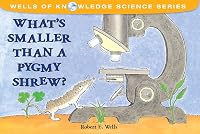
What's smaller than a pygmy shrew?
by Robert E. Wells
On This Page
Description
A pygmy shrew is small - it's among the littlest mammals! A ladybug is even smaller, but it hardly seems tiny when you compare it to a protozoa! And there are many things smaller still-so small that we can see them only with a microscope. Would you believe there are particles that are so tiny that we can't measure their exact size? Explore the huge world of the very small!.Tags
Recommendations







Member Reviews
I absolutely loved this particular science book because it was very funny and light spirited.. However it also depicted many animals that were very small. I felt like this book was the most successful science book I've read because it's style, tone, and content were perfect. The book started off talking about how small a shrew might feel when next to an elephant, the biggest mammal, to talking about atoms, electrons,neutrons. This is the first children's book that I've seen that talked about animals and they're sizes to chemistry and made it flow very well. I would definitely read this book to my future science class.
This was a great book to introduce kids to the idea of microscopic organisms and particles. the book begins by comparing a pygmy shrew to things like mushrooms and elephants to give kids an idea of it's size. Then, it gradually compares things that are smaller and smaller until they are describing atoms and the protons, neutrons and electrons inside of an atom. I loved how this book gave students a sense of just how small these particles are. It makes it more approachable and understandable to children.
This book explores the tiny things that make up the universe by starting with a pygmy shrew, the smallest mammal, and going down to tiny bacteria, and eventually down to the quarks that make up the protons and neutrons of atoms! Not only does this help to foster realistic perspectives of how small things like molecules can be, it also opens up opportunity to talk about systems and parts. It can help students to think about how, like ecosystems, all living things have smaller parts with different functions.
This book has a cute little way of explaining how small the small things in the world really are, down to the tiniest atom. It starts out with a pygmy shrew who feels small and moves on to explain how a pygmy shrew is big compared to a ladybug, how ladybugs are bigger than protozoa, and so on, all the way down to the atom. It does drag on for a while and gets more and more in depth the longer it goes so it may be a good read aloud for 3rd or 4th graders.
This was such a cute book! The author used a progressive layout to clearly teach comparisons of large animals all the way down to the smallest atom. I would use this book in the classroom to teach key vocabulary "greater and smaller" to my first grade students. The illustrations in this book were very well done as well.
This book talks about the earth and the different things in it that are smaller than a pigmy shrew. It goes into detail about each thing such as a ladybug, a water droplet, and even an atom. It not only talks about each object but gives little facts and interesting text bubbles around the illustrations. This informative text is perfect to use as a read aloud to engage students. It can also be used as the beginning of a unit and help give context to an exploration that may be used for a science lesson.
This book has a great comparison concept. At first it compares a pigmy shrew (which is really small) to an animal that is bigger than it. It then compares a pigmy shrew to an animal which is smaller than it, then it compares that animal to something smaller than it and continues to reduce to electrons, explaining along the way. This is a great lesson in reduction and comparison. I would ask them what they would compare a pigmy shrew to or other various animals.
Members
- Recently Added By
Lists

Sonlight Books
1,487 works; 25 members

Children's Books About Science and Math
461 works; 12 members

al.vick-wishlist-Children's
462 works; 3 members
Author Information

17 Works 3,289 Members
Awards and Honors
Series
Belongs to Publisher Series
Common Knowledge
- Canonical title
- What's smaller than a pygmy shrew?
Classifications
Statistics
- Members
- 664
- Popularity
- 43,303
- Reviews
- 13
- Rating
- (4.11)
- Languages
- English
- Media
- Paper, Ebook
- ISBNs
- 8
- ASINs
- 1